
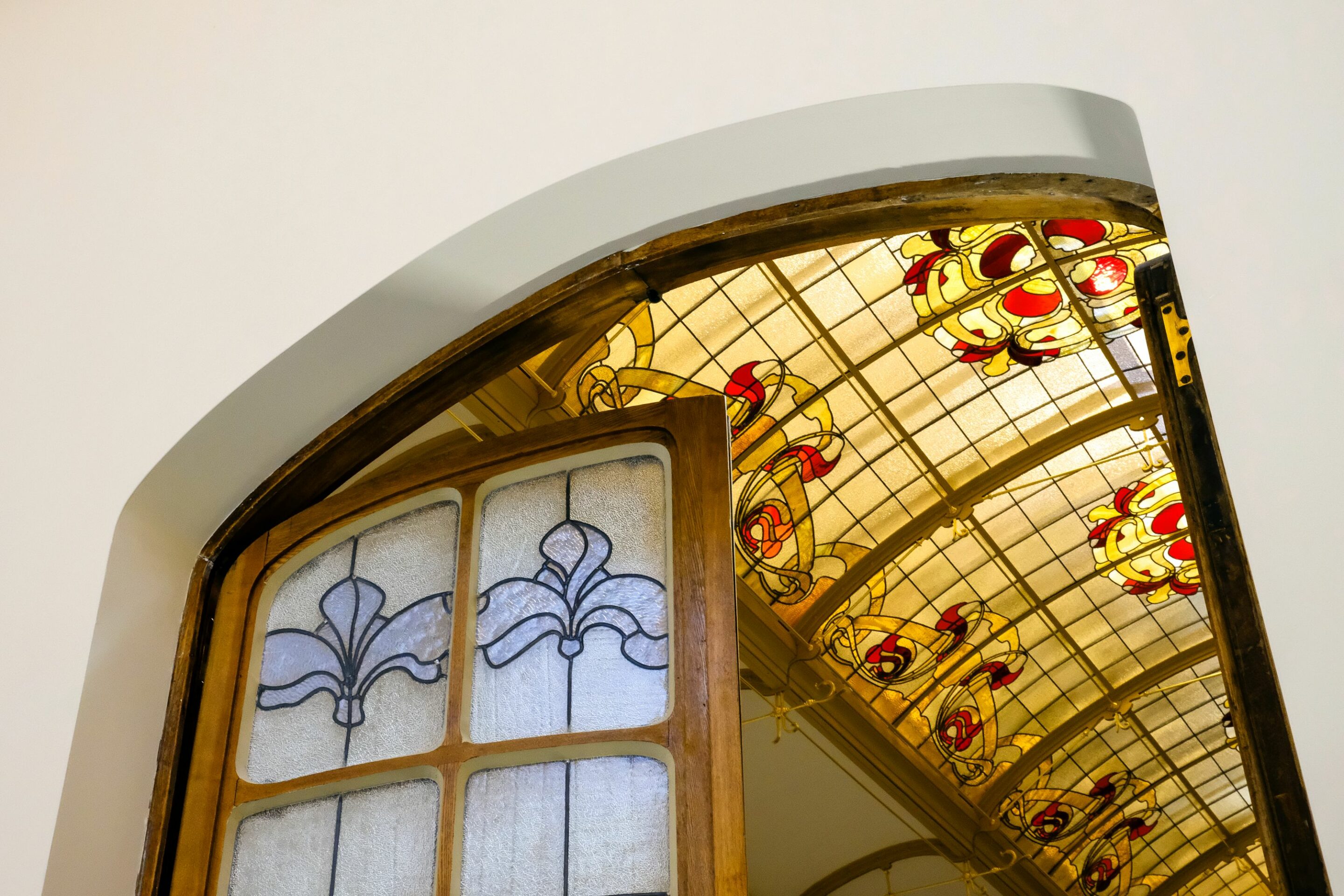
Two lavish new galleries in the Cinquantenaire Park unveil Belgium’s design story like never before — from the birth of Art Nouveau to the glamour of Art Deco and the gilded oddities of the 19th century. With 700 rarely seen objects and a showstopping Horta reconstruction, the Art & History Museum reclaims its decorative legacy.
In Cinquantenaire Park, in a corner of the hulking Art & History Museum, activity and anticipation buzz. Two new rooms are set to represent the biggest revamp in the museum in over two decades. What began as a new collection of Art Nouveau has, over years of preparation, been expanded to include Art Deco, plus a room featuring Belgian decorative arts and lifestyle pieces from Belgian independence through the 19th century.
Curator Werner Adriaenssens, in charge of Art Nouveau and Art Deco, and Sophie Balace, one of the team responsible for the 19th century room, are readying the galleries to show us around.
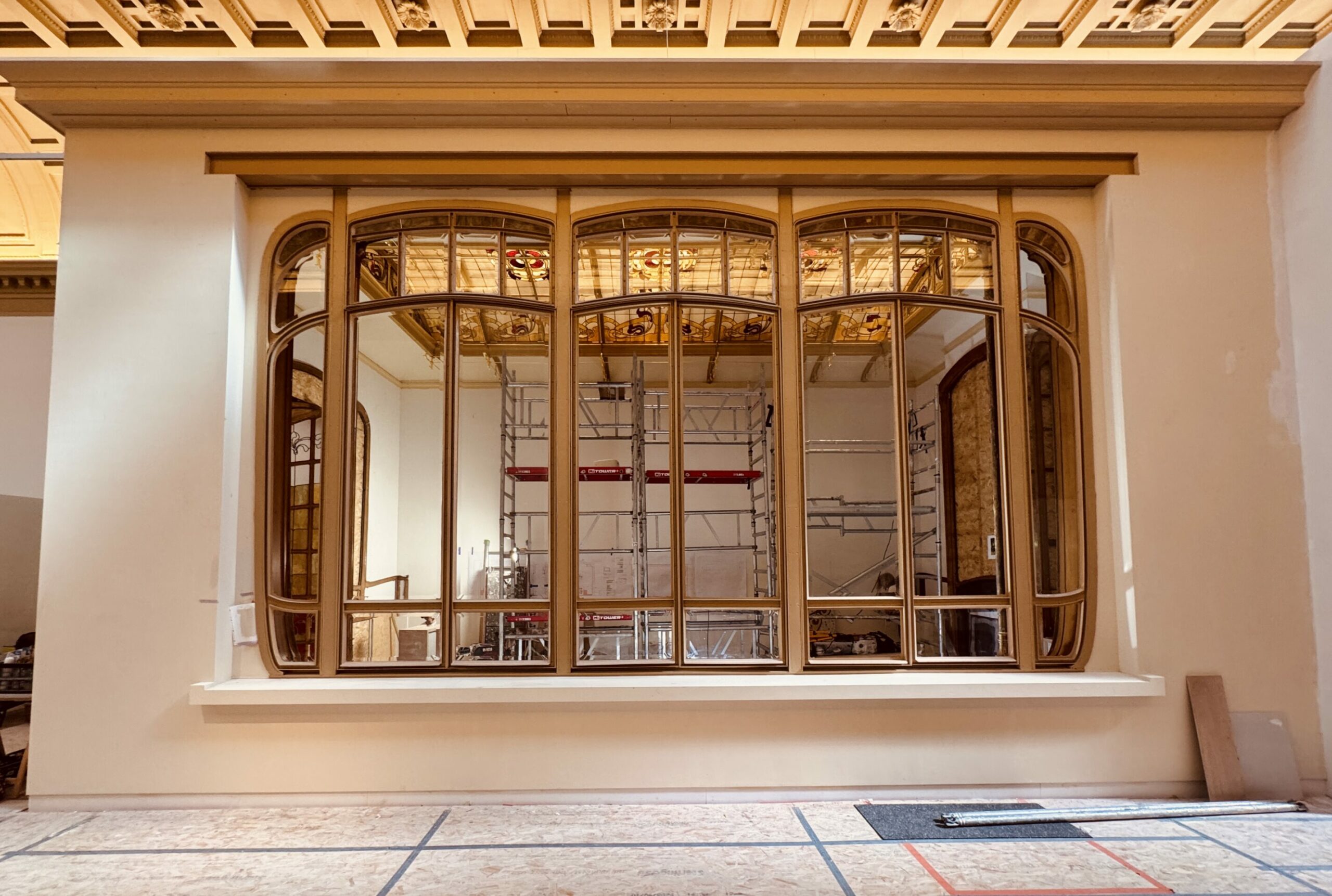
As we walk, people put up panels, staff cross over to ask questions about construction invoices, and drills sounding from inside the painstaking reconstruction of Victor Horta’s formerly lost Winter Garden.
The team are full steam ahead to prepare the rooms for a visit of the King and Queen on June 10, and the opening to the general public on June 13. “We’ll get there,” says Adriaenssens as we stride through.
The two newly renovated galleries have their sights set on bringing fresh life to the story of Belgium’s decorative arts. The galleries present some 700 pieces – many previously kept in storage – housed across around 1,200 square metres of redesigned space. They reflect a growing recognition of Belgium’s central role in European design, especially in the evolution of Art Nouveau. But they go further, tracing the social, political, and technological developments that shaped the everyday life and aesthetic ideals of Belgian society from 1830 to 1958.
Nouveau celebration
The first gallery is dedicated to Belgium’s most celebrated design export: Art Nouveau, along with its successor, Art Deco. Curator Werner Adriaenssens takes us through an eclectic collection comprising giant posters from international fairs, stunning candelabra, room furnishings, folding screens, tables, a mass of chairs, paintings, tapestries, and more.
The space captures a vibrant era of creative renewal that sowed the seeds for modern design. The Art Nouveau movement took off in Brussels in the 1890s, with Victor Horta's 1893 Hôtel Tassel on Rue Paul-Emile Janson often cited as its architectural starting point.
Adriaenssens stresses that Belgian Art Nouveau wasn’t merely derivative: “It really is something that is born in Belgium and was internationally influential.”
He’s also emphatic that Art Nouveau is not all about Horta – a variety of styles and approaches abounded within the movement. To that, end the gallery showcases early proponents such as Paul Hankar. A contemporary of Horta, he opened his own studio house on Rue Defacqz in 1893, just a stone’s throw from Horta’s Hôtel Tassel at almost exactly the same time.
Trained in sculpture and architectural design, Hankar was known for blending structural clarity with artistic flair. He worked closely with craftsmen like goldsmith and sculptor Philippe Wolfers and painters such as Emile Van Nooten, while also pioneering the use of materials like sgraffito – a decorative wall technique where a coloured surface is coated with white mortar, then scraped to reveal the underlying colour in vibrant and intricate patterns. Hankar also designed interiors and trained assistants who would go on to become the second generation of Art Nouveau artists.
Henry Van de Velde, who would go on to work in Germany and found institutions like Brussels’ La Cambre art school, is represented through striking pieces of furniture and graphics. In 1895 van de Velde designed his iconic residence Bloemenwerf, in Uccle. For him, lines needed to be abstract, devoid of any reference to nature, and decoration had to be functional, deliberately placed, and never merely for ornamentation. His work reveals a commitment to the idea that beauty and utility could – and should – coexist. That belief would underpin much of 20th century design theory.
Victor Horta, meanwhile, is represented through a sensational reconstruction of the Winter Garden from one of his private houses. The Ghent-born architect trained in Paris and in the studio of Leopold II’s architect before setting up on his own and becoming synonymous with Art Nouveau.
Horta’s interiors combine architecture, furniture, and decoration into unified aesthetic statements that emphasise fluid lines, light, and organic form. Salvaged from demolition, the Winter Garden is an immersive environment allowing visitors to experience the idea of the Gesamtkunstwerk, or total work of art, a central ideal in Art Nouveau.
Garden regrown
The Winter Garden was built in 1900 for engineer Jean Cousin. It stood behind a townhouse on Chaussée de Charleroi in Saint-Gilles but was torn down in 1969 through the so-called Brusselisation (Bruxellization in some spellings), the modernist reconstruction of the city, which also put paid to Horta’s Maison du Peuple and Hôtel Aubecq.
Horta’s apprentice managed to save much of the Winter Garden. “It was 2000 that it came to this museum,” says Adriaenssens. “Before that, it was stocked all over the place, things were broken and stolen. We really wanted to rebuild it.”
The reconstruction took six years, with plasterers refashioning original elements, and myriad other details installed or replicated. Hundreds of thousands of pieces had to be fit together like a 3D jigsaw puzzle, with guidance from Horta-specialist architect Barbara Van Der Wee. The resultant nine-by-four metre space has a seven-metre-high glass ceiling and a bay window framed by columns of gilded bronze. With plenty of gold leaf, the costs required sponsorship from the King Baudouin Foundation, Baillet-Latour Fund, and TotalEnergies Foundation.
Other objects on display include glass by Val Saint-Lambert, jewellery by Philippe Wolfers, and textiles by Constant Montald. Not merely decorative luxuries, these are expressions of a broader cultural ethos – a desire to break from historical imitation and embrace a modern aesthetic rooted in nature, geometry, and symbolism.
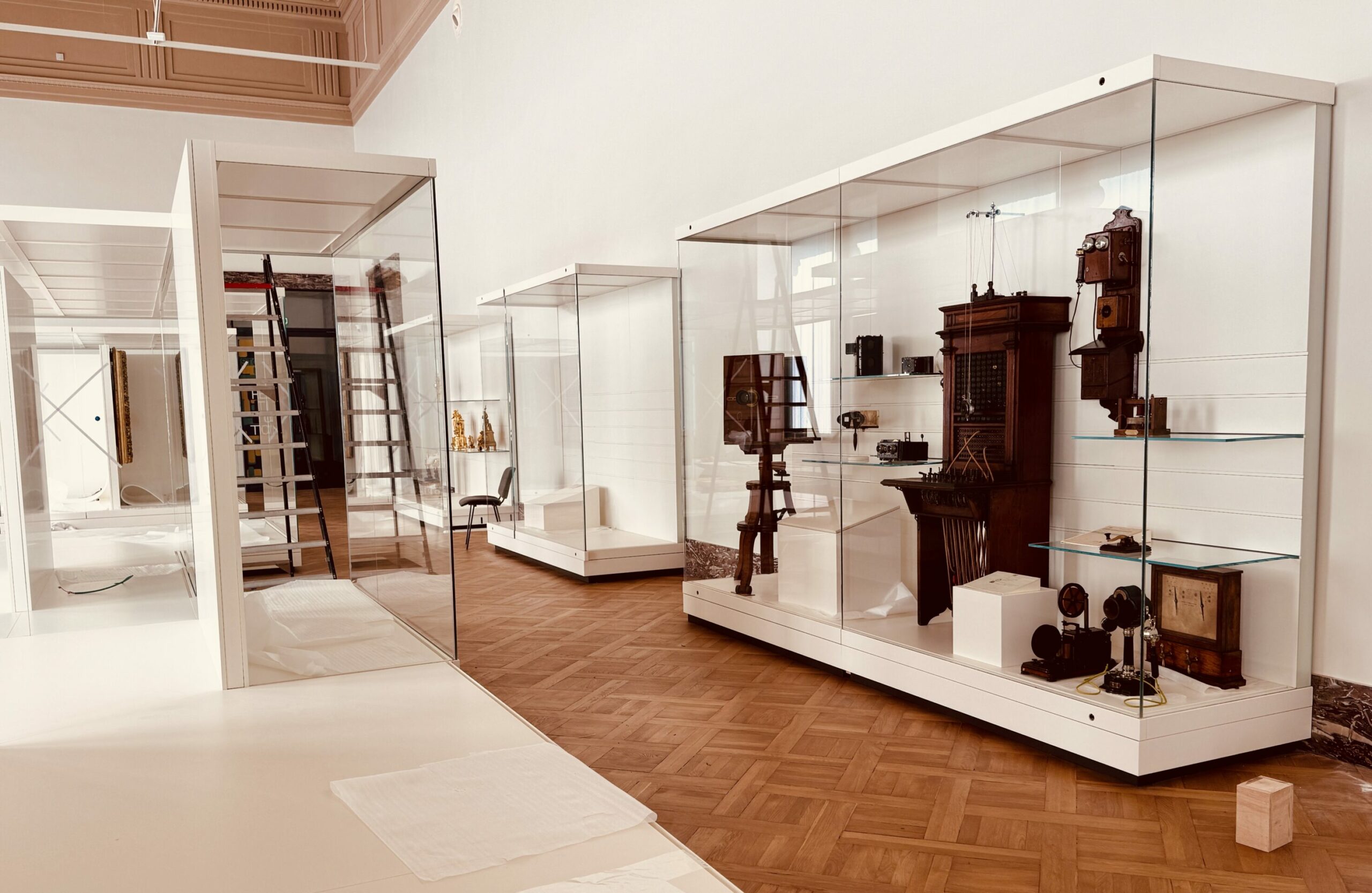
The new displays.
A collection of chairs sits beyond the Winter Garden, a mass of seating devices that together represent the hands of the best designers of the time. “Why do we present it like that?” asks Adriaenssens. “It’s like knives and forks and spoons: you eat with them. Chairs: you sit on them. They have to be stable, so you see the styles of the architects.” Among chairs from a hotel in Paris, from the exhibition of 1902, and more, the similarity of the function permits a pure appreciation of each piece’s individuality.
The gallery documents the movement’s evolution. By the 1910s and 20s, the expressive curves of Art Nouveau gave way to the streamlined elegance of Art Deco. Belgian designers like Antoine Courtens (see article on previous pages) took part in the landmark 1925 Exposition des Arts Décoratifs in Paris (which eventually gave its name to Art Deco), signalling a shift toward more geometric, globally influenced design. African, Islamic, and East Asian motifs entered the Belgian decorative vocabulary, while firms like Val Saint Lambert began to see the commercial importance of getting involved.
Adriaenssens points to the interwar period as one of extraordinary variety: “What you see is a society negotiating modernity – the desire for beauty, functionality, and identity in a changing world.”
One stunning object in this section is a monumental black diamond-shaped plinth, originally designed as a prize in a luxury tombola around 1925. Its rediscovery in a garden, and subsequent acquisition by the museum in 2015, highlights the institution’s ongoing commitment to recovering forgotten treasures.
19th century reframed
Encompassing the period from Belgian independence in 1830 to the early years of the 20thcentury, the other gallery, on Decorative Arts of the 19th Century, explores a time of upheaval and experimentation. Years in the making, thanks to the pandemic interrupting building work, and the long deliberation over which articles to include, the displays in this spell tell a story.
Curator Sophie Balace describes the 500 square-metre gallery as a response to the question: “How do you create a coherent narrative in a century so full of different styles, objects, and influences?” The answer lies in the careful curation of themes, rather than chronology alone. The gallery is divided into sections that explore style, innovation, craftsmanship, and daily life.
Early in the century, neoclassicism remained dominant, reflecting Enlightenment ideals and a fascination with antiquity. As Balace points out, in the 1830s many craftsmen working hailed still from the previous century. But the old corporations were dying out and new influences were arriving on the scene. For example, she shows the work of a goldsmith who was the son of a farmer – previously unheard of as goldsmiths would have been born into the trade.
“Styles were exploding,” says Balace. Gilded elements proliferate making for a sea of gold, and ornaments adorn every table leg – not to mention the boiler in one of the first bathrooms with heated running water. Gradually, Romanticism, Historicism, and eclectic styles emerged, often blending elements from Gothic, Renaissance, and other historical vocabularies.
Balace is particularly proud of a large clock, imitating the Boulle style of Louis XVII, but much exaggerated. The Louis XVII equivalent would have been smaller, made with exquisite and expensive materials, but the 19th century artisans allowed themselves to go bigger and bolder. She recounts that the family who donated the clock were even convinced it was an 18th century clock and were shocked to discover it was from a hundred years later.
Stylistic diversity was paralleled by transformations in how objects were made: traditional artisanal techniques existed alongside new industrial processes. Balace points out how much of our industry today has its roots in this time and geography. As well as intricately woven Brussels lace, machine-made lace appears at the end of the collection, showing the emergence of fast fashion. From exquisite examples of Brussels porcelain, we progress to printed ceramics. As Balace explains, “Tableware alone tells a story about how we lived, how we gathered, and what we considered beautiful.”
Meanwhile, mass production’s beginnings are revealed through certain pieces. Two papier mâché chairs from England were pressed from moulds, making their fabrication less time and cost-intensive. Along with items like printed ceramics, these point to the Industrial Revolution’s impact on everyday life. This was also a time when electricity, photography and gas lighting were reshaping the domestic sphere.
Belgium’s rapid industrialisation made it one of Europe’s manufacturing powerhouses, and its access to colonial raw materials shaped both what was produced and how. New tensions arose between handcraft and industry, which would become central to later design debates. The long furniture catwalk of the room concludes with the first glimmerings of art nouveau, as a reaction to the gilded gaudiness of previous styles.
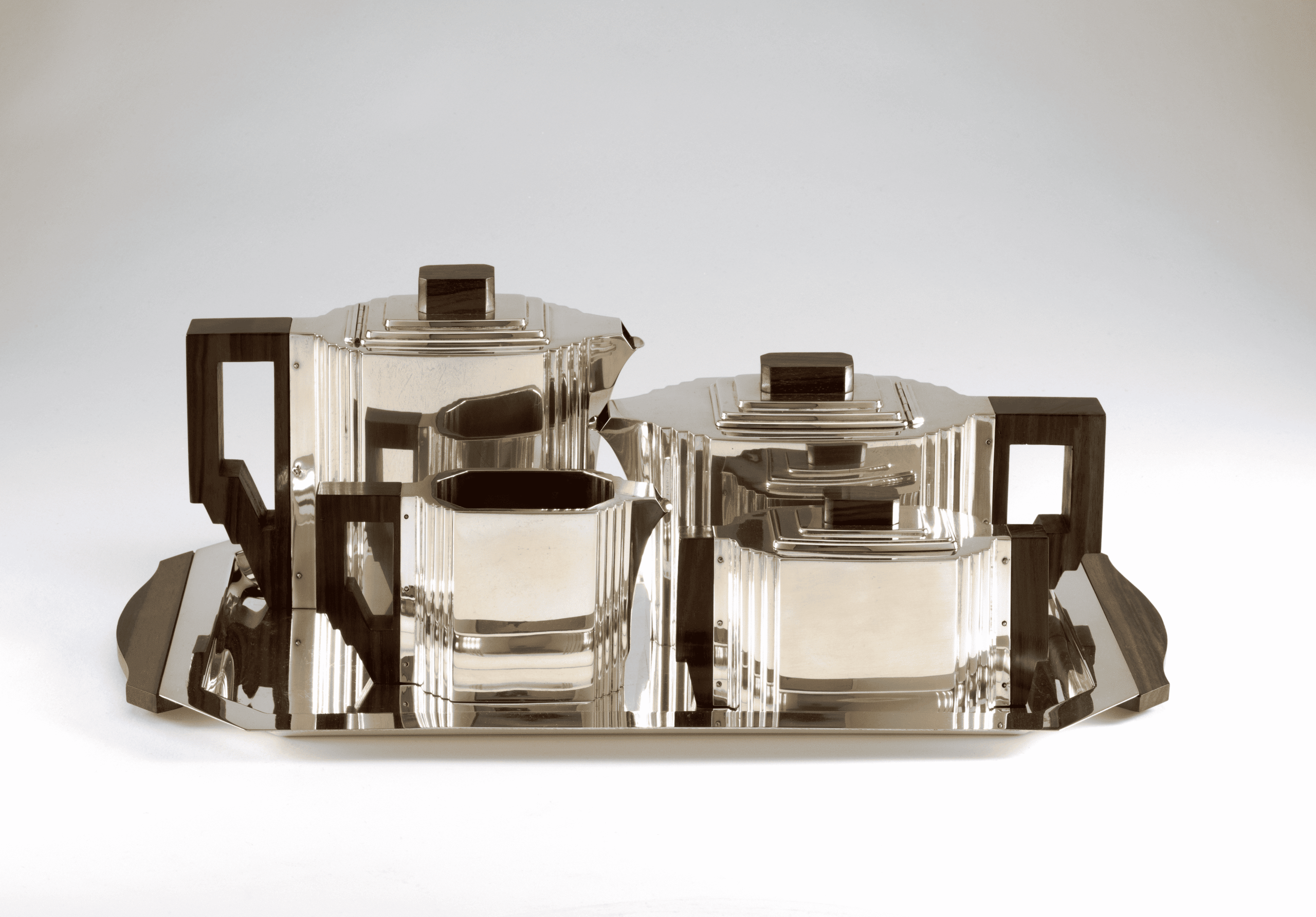
Silver coffee and tea
set by Delheid brothers, 1930-1935
The museum
In a way, the museum is itself a product of the period that the new galleries explore. Housed in Cinquantenaire Park, it occupies one of Brussels’ most iconic 19th century cultural buildings. The structure was conceived as part of Leopold II’s bombastic vision to commemorate Belgium’s 50thanniversary of independence in 1880. The grand exhibition halls were meant not only to celebrate national achievement but also to project Belgium’s modern identity on an international stage.
The museum building as we know it today was largely developed between 1880 and the 1920s, part of a wider movement to establish encyclopaedic museums that would catalogue the material cultures of the world. Its purpose was both educational and ideological: to present human civilisation through objects, with a special focus on Belgium’s place within that narrative. This reflected the 19th-century belief in progress, categorisation, and the museum as a tool of public enlightenment. The renewed focus on Belgian decorative arts signals a deliberate shift inward – toward examining the nation’s own legacy of design and everyday life. The institution’s original mission has come full circle.
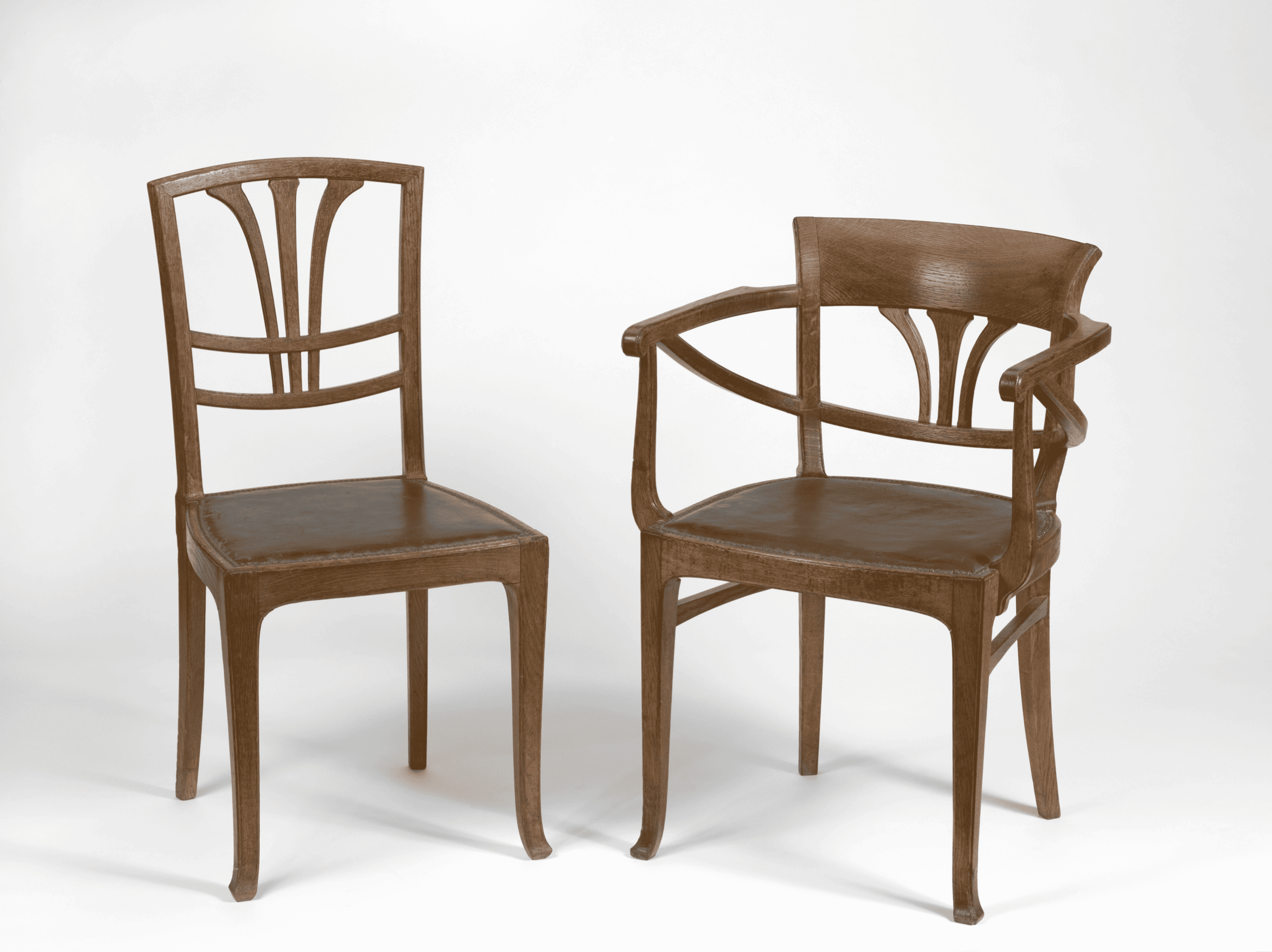
Oak chairs by Georges Hobé, 1902.
Five of the Best
Some standout pieces in the Art Nouveau & Art Deco Gallery:
1. The Cousin Winter Garden (Victor Horta, 1900)
A showstopper, this reconstructed architectural gem once graced the home of engineer Jean Cousin in Saint-Gilles (now an anonymous apartment block and a Brico City). With gilded steel columns, stained glass windows, mosaic floors, and a marble fireplace, it embodies Horta’s vision of a Gesamtkunstwerk – a total work of art. The only surviving reconstruction of a Horta building.
2. L’Art Décoratif (Pieter Braecke, 1925)
Created for the Belgian pavilion at the 1925 Paris Exposition by Pierre Braecke, this monumental sculpture of a semi-naked woman once crowned the entrance. With its bold sunflowers symbolising the post-war rebirth of decorative arts, it was awarded the expo’s Grand Prix, its highest distinction – and now makes its public return after its rediscovery in the museum workshop.
3. Pair of Candelabras (Henry van de Velde, 1898–99)
Designed in silvered bronze, these elegant and functional objects reflect Van de Velde’s commitment to uniting utility and aesthetic purity. They exemplify the streamlined yet expressive ethos of Belgian Art Nouveau.
4. Sphinx Mystérieux (Charles Van der Stappen, 1897)
This enigmatic sculpture in ivory, silver, and onyx captures the Symbolist undercurrents of late 19th century design. Purchased by the museum the same year it was made, it’s a striking fusion of mystery and luxury.
5. Daphné (Isidore de Rudder, ca. 1895)
A collaboration with the Vermeren-Coché ceramic workshop, this part-glazed ceramic figure references classical mythology through a distinctly modern lens. With flowing lines and a subtle finish
