
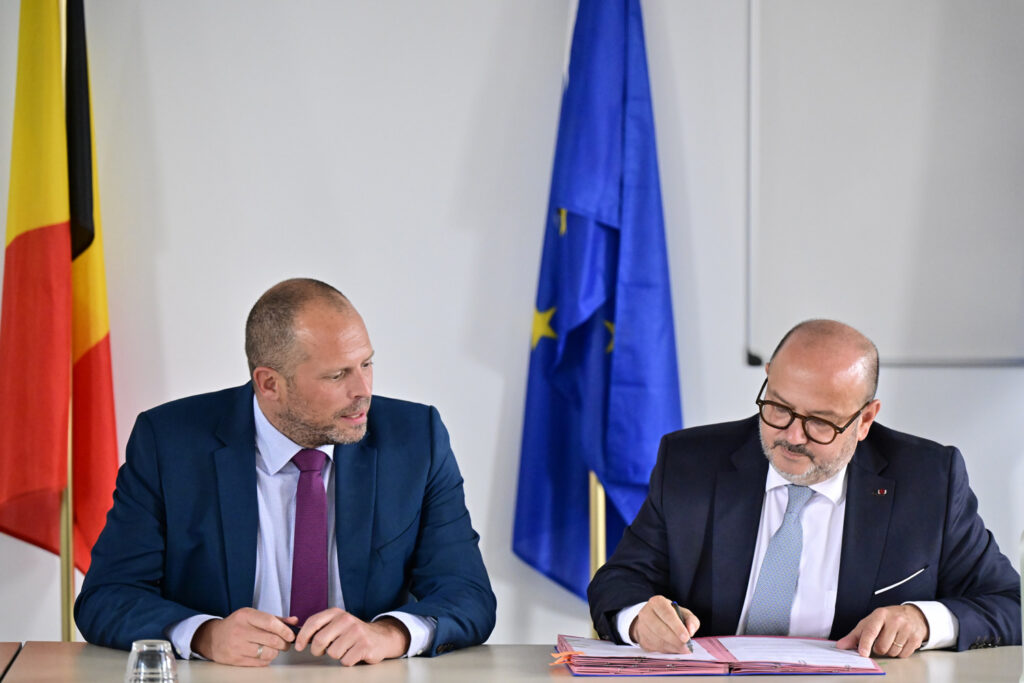
Military personnel will secure Belgium’s nuclear plants in the coming months, under a cooperation protocol regarding the monitoring of the sites, signed on Tuesday by Interior and Defence Ministers, Bernard Quintin and Theo Francken.
From 1 July, military personnel will secure the nuclear power plants at Doel and Tihange, followed by the facilities at Mol, Geel, and Dessel on 1 December, and the Fleurus site on 1 April 2026.
This agreement will relieve police capacities, thereby enhancing security measures in Brussels.
The surveillance of these sites is currently handled by the Federal Police’s Security Directorate, DAB, which also manages tasks like transporting prisoners to courts. However, there is a staff shortage, causing inspectors to assume roles that should be assigned elsewhere.
In the Easter agreement, the government decided that Defence, set to receive significant investments this year, will support the police by protecting nuclear sites, as it did in 2016 when military personnel patrolled streets and monitored sensitive areas.
Within two years, Mr Francken plans to establish a territorial reserve that will oversee the security of nuclear sites and potentially other locations, such as embassies.
The government aims to finalise a “Defence Codex” by the year’s end, outlining legal provisions for independent military intervention. This legislation will be presented to parliament next year.
Between 200 and 300 military personnel will be deployed for this mission.
