
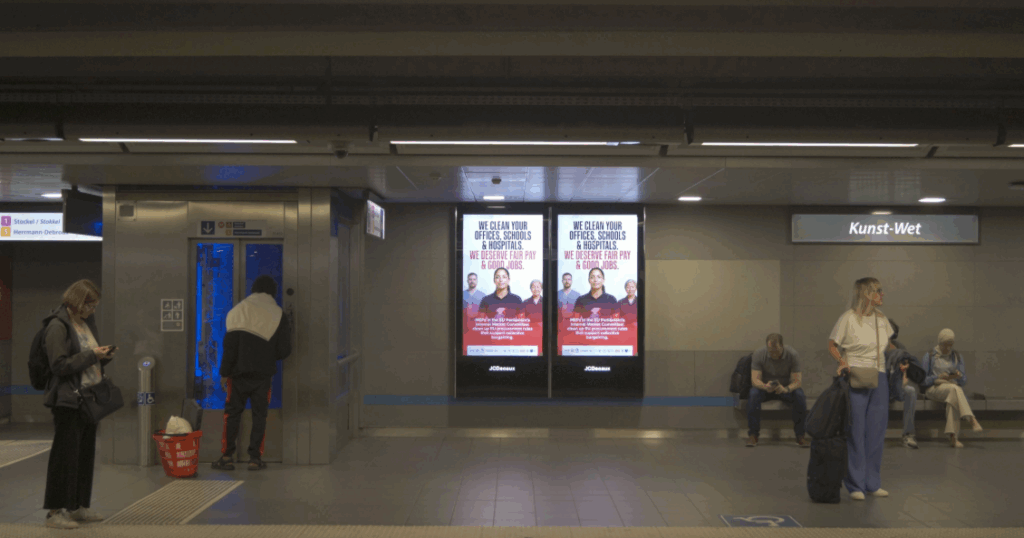
A digital billboard campaign showing key workers calling for “fair pay and good jobs” has been launched this week in Brussels.
The campaign, organised by a group of European trade union federations, calls on MEPs in the EU Parliament’s Internal Market Committee to boost the importance of collective bargaining in public procurement processes.
The posters show key public service employees, including cleaners, security guards and care workers, directly appealing to MEPs. One poster says: "We keep you safe from harm. We deserve fair pay and good jobs." Below is a direct plea to politicians: "MEPs in the EU Parliament's Internal Market committee: secure EU procurement rules that support collective bargaining."
Collective bargaining and public procurement
Collective bargaining, as the name suggests, is where working people enter into negotiations with an employer as a group, usually through a trade union.
They collectively negotiate their salaries, working conditions, benefits and other terms of employment. Unions argue this process benefits workers through higher pay and job protections.
According to trade union UNI Europa, the EU’s current procurement rules incentivise authorities to award public contracts based on price.
At the same time, they say, legal barriers prevent public procurement decisions based on social needs – by, for example, awarding public contracts to companies which use collective agreements.
UNI Europa argue the result is a “publicly funded race to the bottom for wages and working conditions that undermines competition across economic sectors”.
'Fixing the EU’s broken procurement system'
Oliver Roethig, UNI Europa Regional Secretary, said: “Our campaign shows that fixing the EU’s broken procurement system has the power to improve the lives of millions of workers on public contracts across the EU.
“The kind of essential workers that clean your office, care for your loved ones, keep you safe. We are watching closely the ongoing negotiations in the Parliament’s IMCO Committee. Their report should support workers’ livelihoods and decent companies that engage in collective bargaining with trade unions.”
Esther Lynch, ETUC General Secretary, said: “This crucial campaign highlights how Europe’s broken public procurement rules, which put the lowest cost above all other considerations, are driving poverty pay and dangerous conditions.
“It is time to ensure that companies which receive huge sums of public money act in the public interest, by paying fair wages, funding training and creating jobs rather than simply siphoning off more and more money into the offshore accounts of shareholders.
“That means that the EU’s public procurement rules must be revised to ensure that public money goes to organisations that respect workers’ and trade union rights, that negotiate with trade unions and whose workers are covered by collective agreements.”
'Legal and political challenges'
Earlier this year, the European Commission published a roadmap for reforming the EU's procurement framework. The parliament's Internal Market Committee is currently negotiating a report that will inform the European Parliament’s position on the Commission’s reform proposal.
Piotr Muller, the MEP responsible for drafting the report in the European Parliament, told the Brussels Times that the current system does “tend to favour the lowest price”.
He said: “The concerns raised by European trade unions regarding the impact of EU public procurement rules on wages and working conditions are both legitimate and important.
“The current framework does indeed tend to favour the lowest price, and this can lead to undesired outcomes when it comes to job quality and respect for workers’ rights. I fully share the view that public procurement must not become a tool that drives down social standards.”
However, Muller believes that linking the award of public contracts to the existence of collective agreements “poses legal and political challenges”.
“Member States have diverse labour market models and traditions, and their legal frameworks for collective bargaining vary significantly,” he said. “This makes it difficult to propose a one-size-fits-all obligation that would gain broad political support and be workable in practice.
“Finally, we must not overlook the overarching structural issue affecting the entire procurement system: its complexity. Excessive administrative burden and legal uncertainty discourage both contracting authorities and potential bidders, particularly small and medium enterprises, from participating in public tenders.
“Addressing this complexity should be a central priority, as it undermines competition, quality, and the social and economic objectives we are trying to achieve.”
The digital billboard campaign is supported by all ten European trade union federations, including UNI Europa, EFFAT and IndustriAll Europe, as well as by the European Trade Union Confederation (ETUC).
This article was amended on 18 June to include views expressed by MEP Piotr Muller.
