
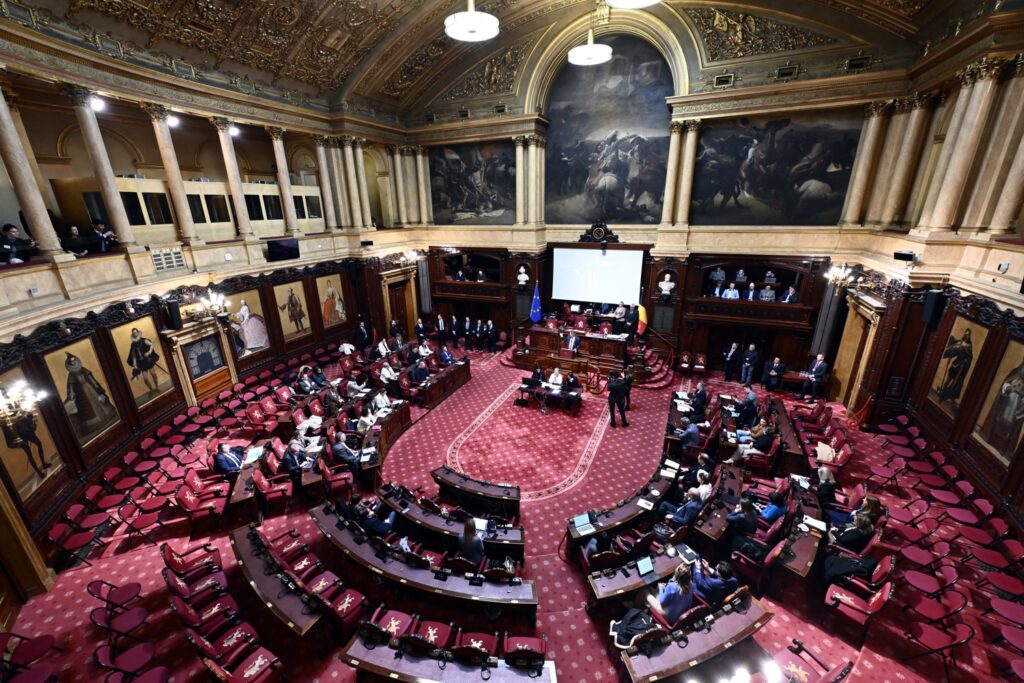
The Arizona coalition is aiming to establish legislation to abolish the Senate before the summer break.
“Discussions are ongoing, and it’s not yet clear whether there will be a bill or proposal; we’ll see,” stated Prime Minister Bart De Wever during a House committee meeting on Tuesday. He expressed optimism about securing the necessary majority in the near term. Emphasising the importance of preventing the Senate from persisting, like a “phoenix rising from its ashes,” he reiterated this during the presentation of his general policy note on the Constitution and Institutional Renewal.
De Wever acknowledged concerns that opposition parties might attempt to resurrect the Senate. The coalition will need support from opposition members, whose votes are currently uncertain, he noted.
Opposition members have raised questions about how federal entities and their role in upcoming state reforms will be represented if the Senate is abolished. “Personally, I’m not particularly worried,” De Wever responded, arguing that Chamber representatives naturally embody the communities they were elected from.
He did, however, recognise the validity of these concerns, which also resonate within the German-speaking community, as highlighted by Engagés member Luc Frank. “The Engagés support abolishing the Senate and neutralising the effect of the head-of-list,” Frank said. “But as a German-speaker, I can’t hide my concerns.”
The Senate, with its designated German-speaking seat, has been an important entry point into the federal parliament for this minority, as well as the head-of-list ranking system, which aids the election of German-speaking candidates. This system has ensured a German-speaking deputy’s presence in the Chamber since 1925, with only a brief gap between 1999 and 2007, Frank added.
Addressing this, De Wever confirmed ongoing discussions with the German-speaking community’s Minister-President, Oliver Paasch. There has been a correspondence exchange, and a meeting is planned to discuss potential solutions, highlighting his openness to proposals.
Interfederal cooperation is a key focus for the Prime Minister in facilitating institutional and socio-economic reforms. In this context, an initial “informal consultation” took place on 11 March with the Flemish and Walloon ministers-presidents. Another meeting is scheduled for Wednesday, De Wever explained.
Socialist Khalil Aouasti noted that Belgium consists of three regions. “Has Brussels been excluded from this exercise?” he asked. “No, but currently there is no government or political direction,” the N-VA Prime Minister responded.
