
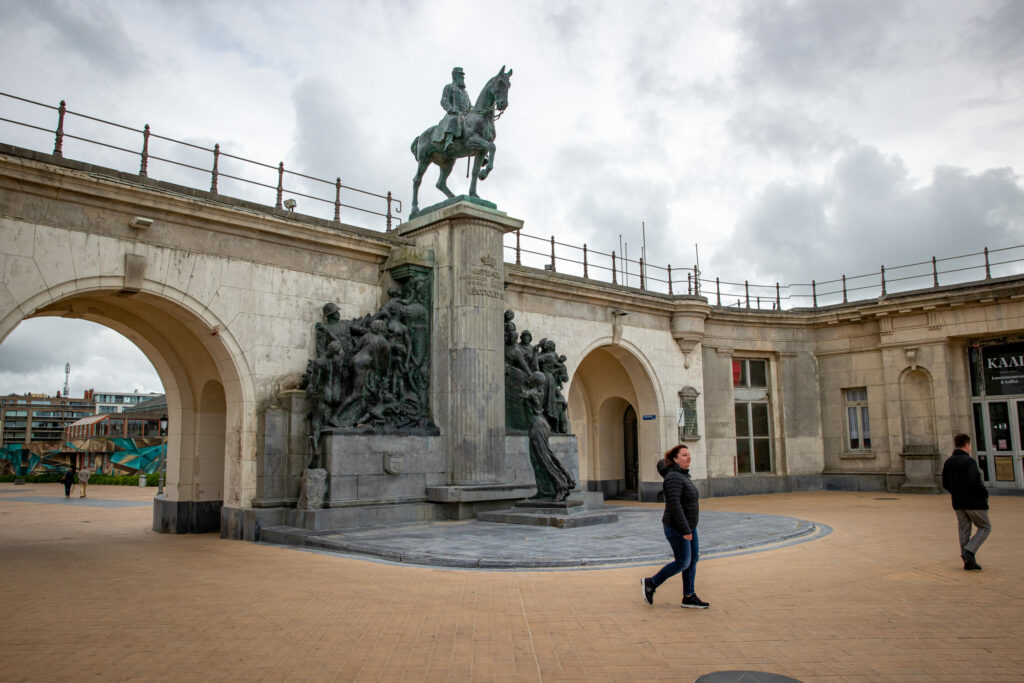
A British-Guyanese artist says he is “disappointed” after Ostend city council decided to block his plan to “recontextualise” a controversial statue of King Leopold II.
Last year, the city council commissioned artist Hew Locke to create an installation in front of the statue of King Leopold II on the seafront at Ostend.
The statue, which was erected in 1931, shows the former king sitting on horseback in military uniform, looking over the North Sea. Below the statue of Leopold is a bronze sculpture of his Congolese subjects supposedly thanking him for “freeing them from slavery among the Arabs”.
In 2019, Ostend decided to keep the monument in place but provide extra context though an artistic installation. Having been selected to work on the project, Locke planned to “interrupt the view” of the statue by placing five masts in front of it. On each mast, he intended to add a symbol of colonial history or resistance to colonial rule.
On the artist’s Instagram page, he published a mock-up of the latest design, showing a golden elephant shorn of its tusks, alongside a depiction of Leopold’s decapitated head on a spike and a fist as an "international symbol of resistance".
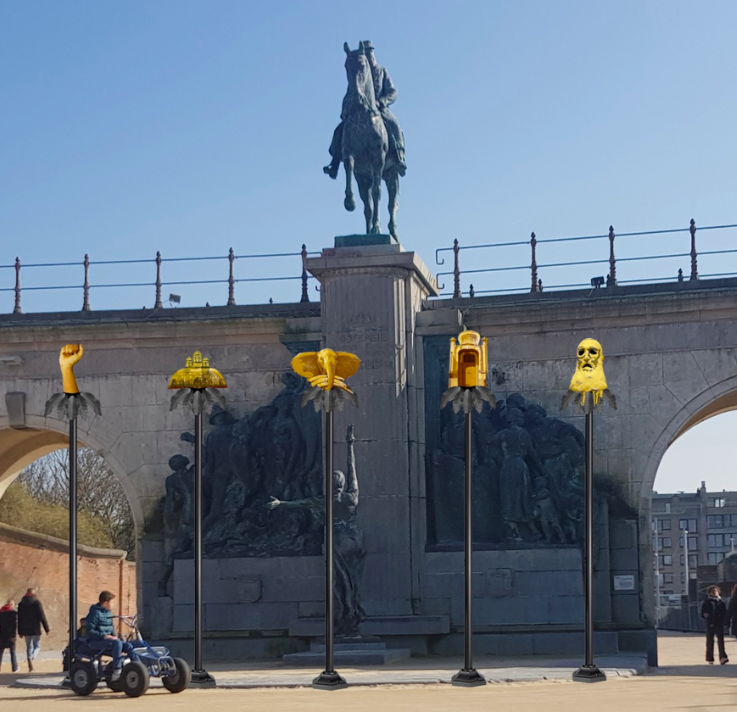
How Hew Locke's art installation might have looked had the project gone ahead. Credit: Hew Locke/Instagram
Ostend cancels the project
The work was supposed to be installed at the end of this year. Earlier this month, however, Locke was told by the council that the project had been cancelled.
He wrote on his Instagram page: “Really disappointed that the newly elected council of Ostend have cancelled the project to re-contextualise their statue of King Leopold II. The commission had been selected and offered to me by Ostend City Council in an email in November 2024. They announced my project on their own website, and to the press.”
The council reportedly suggested an alternative location for the installation. However, according to British newspaper the Daily Telegraph, Locke rejected this proposal.
Locke told the Telegraph: “The city’s suggestions of moving the poles further away from the statue would mean that they no longer would be disrupting the view…so this would make my artwork meaningless.
“I was literally interrupting the view and story presented by the statue. Viewers would not have been able to ignore the intervention, and would have to question the meaning and history and symbolism of the monument.”
In a statement on its website, Ostend city council cited a lack of public consultation as the reason why the project had been abandoned: “In the previous legislature, the City of Ostend decided to appoint an artistic committee and to provide an artistic realisation as a counter-image to the equestrian statue of Leopold II. This was to transform the entire site of the Drie Gapers. The City would collaborate with artist Hew Locke for this.
“The vision of the current board does not fully correspond with this trajectory, in which the transformation of the 3 Gapers site was central, without consultation with the people of Ostend. That is why the City decided to stop this project and not to place a new work of art around the Horse Statue.”
Leopold's dark legacy
Leopold II ruled Belgium from 1865 to 1909 and was the founder and sole owner of the Congo Free State – now known as the Democratic Republic of Congo.
Under his rule, tens of thousands of Congolese were killed and abused. The regime relied on forced labour to exploit the country’s resources. The so-called Free State became a byword for violence and inhumanity.
There are at least a dozen statues to Leopold II in Belgium, and numerous parks, squares and streets are named after him.
The equestrian statue in Ostend has been defaced, daubed with red paint and vandalised several times in the past.
In 2020, attacks on colonial-era statues made headlines throughout Belgium, with numerous statues being defaced or damaged.
