
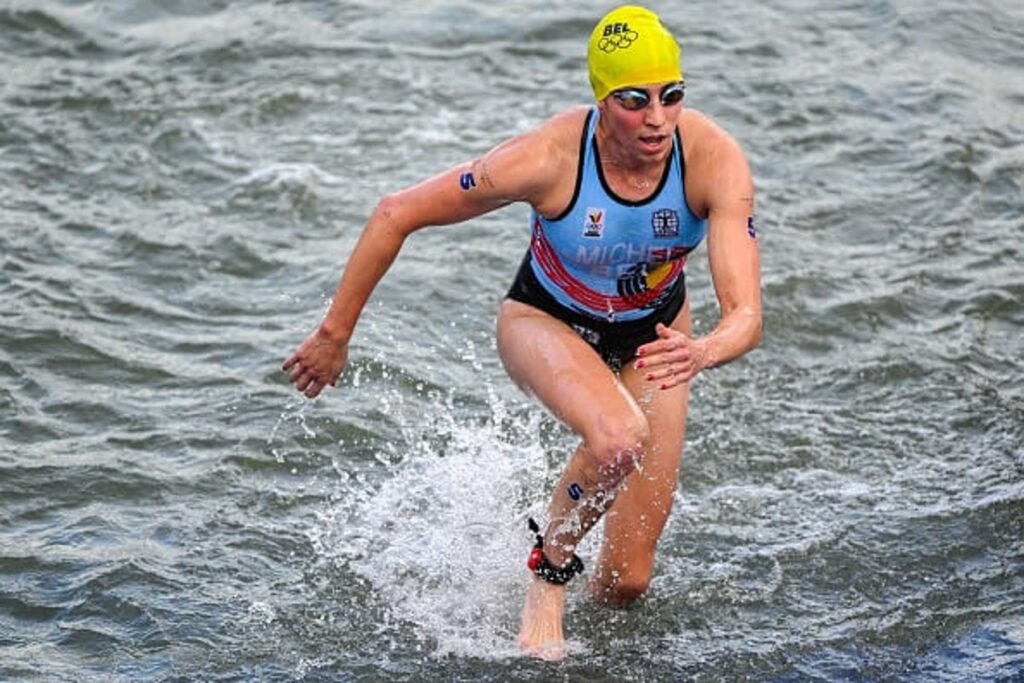
Triathlons are rapidly gaining popularity among Belgians. Highly educated middle-class people in particular are taking up the sport, fueled by apps such as Strava and social media. Some are questioning this growing interest. "For some, it has become a status symbol."
3.8 kilometres of swimming, 180 kilometres of cycling and 42 kilometres of running? The challenge doesn’t deter Thomas De Jonghe (44). He has completed three full triathlons, the last one three years ago in Copenhagen.
"It gives me a lot of satisfaction to train and work towards something. It keeps you busy for several months and you want to see it through to the end. You want to be the best version of yourself," he tells The Brussels Times.
"At the same time, when I'm struggling, I ask myself sometimes: why don't I find another hobby? One of the big challenges is combining it with your family and work. For a triathlon, I trained 10 to 15 hours a week, and as the competition approached, that increased to 20 hours a week. That's not always easy. Yet you keep doing it. You push your limits. I always wanted a longer, faster or more difficult race."
De Jonghe is not alone. According to Ironman, the best-known organiser of triathlon events, a record number of 1,687 Belgian athletes have registered for a long-distance competition this year. That is 68% more than two years ago and more than double the number ten years ago.
Simon Plasschaert, general manager of Triatlon Vlaanderen, sees a likewise evolution in the number of members of his organisation, with a peak of 18% last year. He refers, among others, to Average Rob and his brother Arno The Kid, two well-known Belgian YouTubers who recently completed the renowned Klagenfurt triathlon.
"They attract a lot of media attention and inspire people. Triathlons appeal to the imagination of many. There is an ambitious generation of Belgian amateur athletes who are motivated to raise the bar higher and higher," he explains to The Brussels Times.
The Ironman website fuels the hype with a quote from former American triathlete John Collins: ‘Swim 3.8 kilometres, cycle 180 kilometres, run 42 kilometres and brag for the rest of your life.’
It's a sports trend that has been around for a while, says professor in sports sociology Jeroen Scheerder in an interview.
"Excess is becoming normalised. We are increasingly seeking out extremes. It's as if running a marathon has become normal and we have to go even further. Mind you, in absolute terms, triathlon is still a small sport, but its growth is phenomenal," Scheerder says.
Scheerder and his colleague Jef Huyghe conducted research into the social profile of triathletes. According to him, it is mainly a younger group that is increasingly seeking out the extreme.
"Millennials and Gen Z, mostly highly educated middle-class people, see sport as an extension of their performance-oriented daily lives. An Ironman is something they want to tick off their bucket list. We saw the same thing happen with marathons. I find that remarkable, at a time when people say they have little time. I also question it, especially when I see how quickly people want to do it."
Thomas De Jonghe: "I have seen triathlon become more popular. People want to show they are preparing for a competition. A few years ago, for example, I saw an interview with a CEO in the business newspaper De Tijd. The photo was taken in his office, with a triathlon bike next to him. I found that so typical."
Push to the limit
Sport is becoming increasingly extreme, says sports doctor Roel Parys. "That's the influence of social media and sports apps like Strava, where athletes can share their performances. In itself, it's good that people are exercising. The more, the better. But you need accurate training guidance with a good structure. Many people get injured because they start too enthusiastically, he tells The Brussels Times.
With good guidance, triathlon is suitable for many people, he says. "Not everyone, but many."
In practice, however, it is mainly middle-class people who take part. That makes sense, according to Parys. "A good time trial bike can easily cost £10,000 new. You also need good running shoes. And it takes time. Especially if you've just had children and you're not getting much sleep, it's not easy to combine everything."
The sport has not only become more popular but also more commercial, says Scheerder. There are more competitions than ever, even though there is none in Belgium (so far).
"There are two big names in the triathlon world: Ironman and Challenge. The former has a tough, macho image, while the latter exudes family values and conviviality. These are real companies. A lot of money is involved. Imagine you want to qualify for Ironman Hawaii or the world championships and you've just qualified. Before you even have time to get changed, you're asked to pay already in order to register. There's a huge industry behind it."
Apart from this commercialisation, there is another debate going on in Belgium about triathlon. Until last year, triathletes had to undergo a mandatory medical screening by their general practitioner every four years to avoid the risk of injury or worse. That has been abolished. Some fear that this could cause problems for inexperienced athletes.
"In consultation with general practitioners and specialists, it was decided to abolish the screening because it does not guarantee how healthy someone is when they start a triathlon," says Simon Plasschaert. "We are fully committed to raising awareness and ask every athlete who registers for a competition to consider how healthy they are. Triathlon does not involve any greater risk than other sports."
Roel Parys agrees: "Stricter testing may prevent people from participating unnecessarily. Sport also has many health benefits that you lose that way."
