
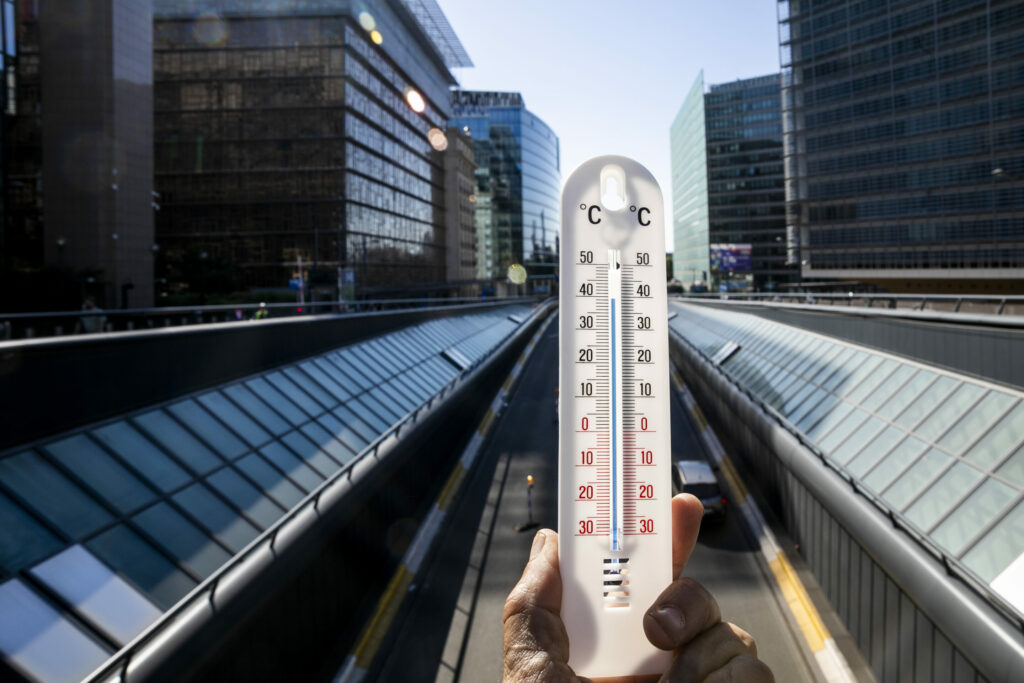
With temperatures due to reach well into the 30's this week, Belgium is facing a potentially sweltering summer. Climate models point towards hotter and drier-than-usual conditions across much of the country.
A mass of very hot southern air is expected to reach Belgium at the start of this week, prompting the Royal Meteorological Institute (RMI) to issue an orange warning for Tuesday and Wednesday. On Monday, temperatures will hover around 32°C in many areas. By Tuesday, they are expected to reach or exceed 35°C in several central and western regions of the country. Wednesday could see maximum temperatures of about 36°C or 37°C in the central and eastern areas.
The prediction of abnormal summer conditions follows a particularly arid spring. Between 1 March and 25 May, only 38.91 mm of rain fell at the Royal Meteorological Institute of Belgium’s (KMI/IRM) measuring station in Uccle, making it the second driest such period since records began in 1892. Only 1893 was drier.
“The forecasts for the next four weeks suggest that July will be dominated by heat and less rain than usual,” Pascal Mailier, meteorologist at the KMI/IRM, told The Brussels Times. “On average, climate models continue to favour a scenario that is hotter and drier than usual across much of Europe… Record temperatures in July and/or August are entirely plausible, but this is not a promise. It’s far too early to predict where or when that might happen ”
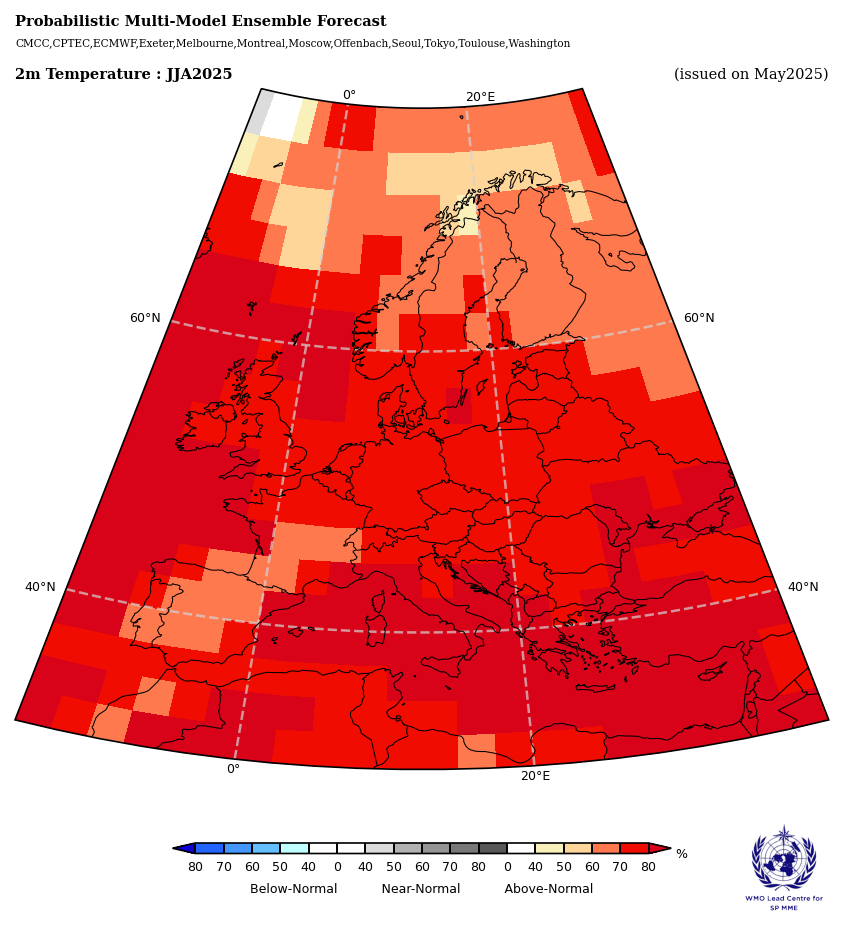
Long-term seasonal forecasts remain experimental, and their accuracy is not as high as that of two-week forecasts; however, they are increasingly used to guide planning. Unlike daily forecasts, these models offer probabilities rather than certainties. By simulating thousands of scenarios, meteorologists can assess the likelihood of specific weather trends. For instance, whether the coming months will be cooler, warmer, wetter or drier than average.
Credit: OMM
Currently, predictions from the European Centre for Medium-Range Weather Forecasts (ECMWF) models are unanimous: high-pressure systems over Western Europe are expected to block the flow of cooler, wetter air from the Atlantic. This ‘blocking’ effect is known to increase the risk of heatwaves and droughts.
Dry summer
For Belgium, this could have some serious consequences this summer. Belgium has long suffered from prolonged periods of drought, resulting in depleted water tables and increased water scarcity in many parts of the country.
This warm weather means soils heat up faster than wet ones, and with less evaporation from plants and soil, the air retains more heat. This not only fuels the cycle of extreme temperatures but also raises the likelihood of forest fires, crop failures, and heat-related health emergencies.
Related News
- Temperatures expected to keep rising after a few weekend showers
- 300,000 spend weekend on Belgian coast
While a dry spring doesn’t guarantee a hot summer, it does tip the balance. “We now have a greater-than-usual chance of heading into a summer marked by more heat and less rain,” Mailier said in an earlier KMI/IRM bulletin. “That doesn’t rule out thunderstorms or temporary cooler spells, but the dominant signal is clear.”
For June through August, the ECMWF overwhelmingly favours above-average temperatures for Belgium and much of Europe, with a strong likelihood of below-average rainfall. July, in particular, is shaping up to be hot.
But with climate change adding volatility to weather systems, Mailier urges caution: “These seasonal forecasts are still experimental and should be interpreted with caution, as they involve large-scale projections and carry significant uncertainty.”
According to the KMI/IRM’s forecasts, the end of this month and the start of July are already set to be hot. Rising across the weekend, on 1 July, temperatures are expected to peak at 35 degrees Celcius. At the start of July, the KMI/IRM expects that temperatures will hover in the mid-20s in the capital.
