
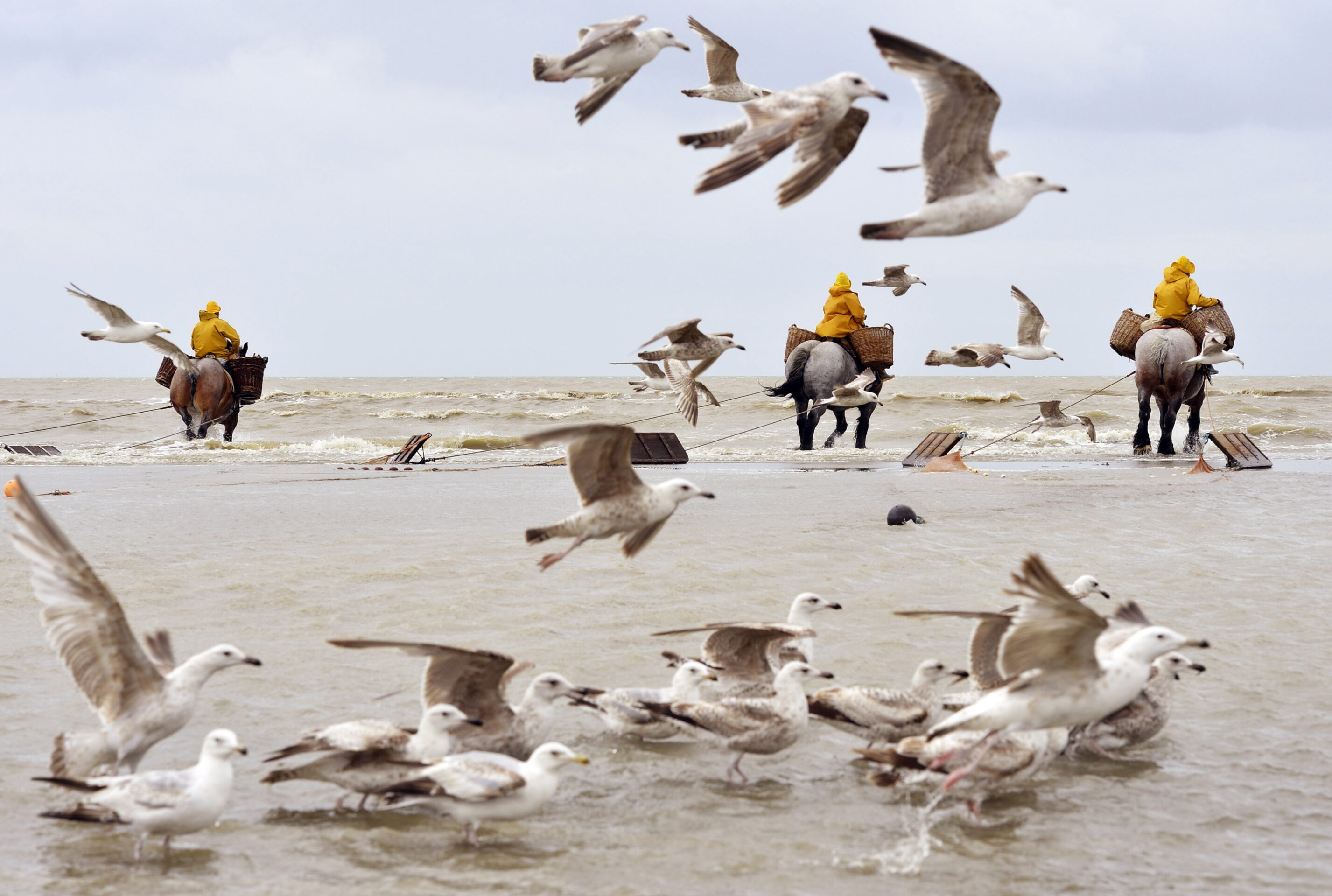
In a rural meadow a few kilometres from the West Flanders coast, Nele Bekaert fetches one of several Brabant draft horses that her family owns.
Weighing about a ton, the mature and powerful horse is ideal for pulling a drag net to catch tiny, grey shrimp in the North Sea. Bekaert outfits it with blankets and an old-fashioned wooden saddle, to which a cart carrying her fishing gear is hitched. She rides the horse from dirt to paved roads amidst cars and onlookers to the seaside of Oostduinkerke.
At low tide, the horse trudges through wet sand for hundreds of metres to reach the sea’s edge. Bekaert walks alongside it donning thigh-high, waterproof boots.
Upon arrival, she puts on bright yellow waterproof overalls, a slicker and fishing hat. She replaces the cart behind the horse with ropes and a large dragnet. Two baskets are placed at the animal’s sides and a bag of straw is thrown on top of the saddle. Bekaert skillfully mounts the massive horse, wedging herself between the baskets.
She leads the bold horse into the sea until the water reaches its thighs and they slowly move parallel to the coastline. A pair of metal-wooden plates flanks the net, dragging on the sea floor to keep it open. A metal chain attached to the front of the net trawls over the sand, creating “shockwaves” that cause shrimp to jump into the net, while water pressure pushes the catch to the back.
After about 30 minutes, Bekaert and her equine “co-worker” return to shore. As onlookers gather round, she empties the net, rinses and sorts the catch, keeping shrimp and edible fish like sole, while leaving small fish and crabs for the seagulls. Using metal sieves, she filters out undersized shrimp, retaining only those fully grown and large enough to eat.
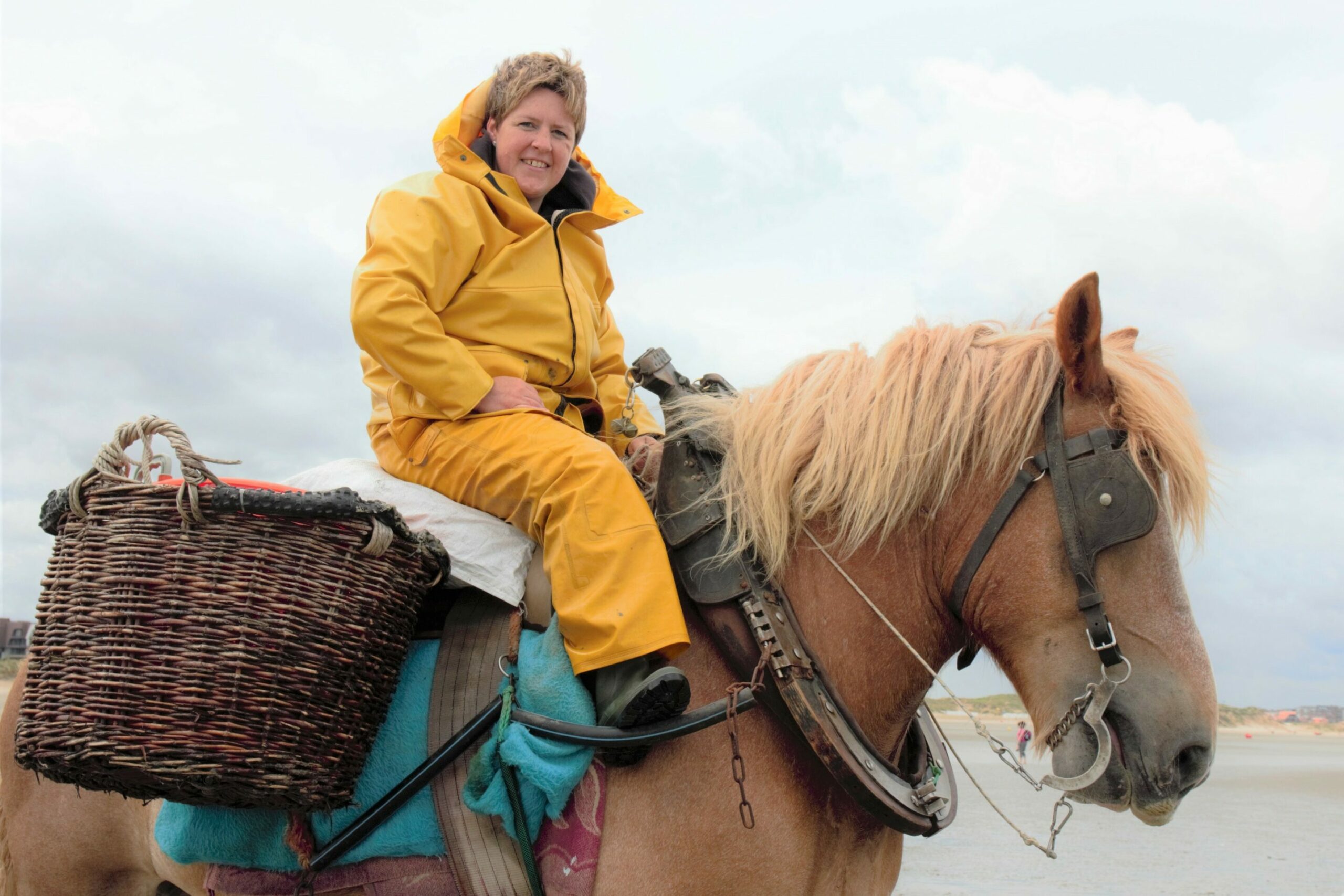
Nele Bekaert shrimp fishing on horseback. Credit: Angela Dansbury / The Brussels Times
For this tourist demonstration, Bekaert would normally boil the shrimp on the beach, but on this day, she takes the catch home. It is only about one kilo – just enough for her family. She returns the horse and cart to the meadow and hurries home by car to cook as the shrimp are best boiled alive for maximum freshness.
The 42-year-old mother of three greets her family and brings water to a boil with a proprietary amount of salt in a stove-like cauldron outside of their garage. She and her shrimp fisher husband, Chris Vermote, remove any remaining unwanted creatures from the catch before throwing the shrimp into the hot water.
About 10 minutes later, the grey shrimp turn pink and white. Bekaert removes them with a large slotted spoon and begins the arduous task of peeling to get seafood less than a centimetre long. A taste test reveals the big flavour of these little shrimp and their unparalleled freshness.
Safeguarding a nearly extinct craft
Bekaert and Vermote are part of an elite team of 14 active horseback shrimp fishers, formerly known as d’Oostduinkerkse Paardenvissers (East Dunkirk Horse Fishers). Each year in Oostduinkerke, they give 36 public demonstrations and participate in a Shrimp Festival, events subsidised by the village’s municipality of Koksijde to keep the craft alive.
From the 16th century until just after World War II, shrimp fishing on horseback was done in several North Sea territories (Flanders, France, England and the Netherlands) but eventually, it practically died out as economies improved and coastal farmer-fishers disappeared. In Belgium, for example, coastal dunes had small farms where horses were used to trawl for shrimp as an extra source of food and income. But as the coastline developed, farms were driven out and horses moved inland.
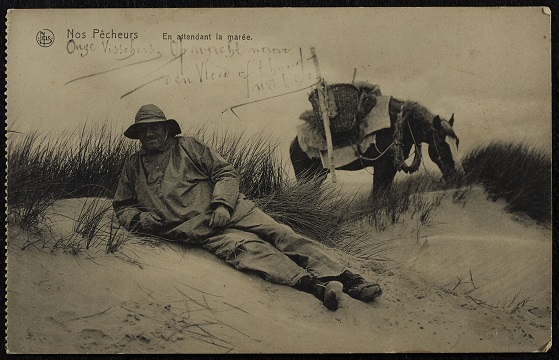
Old postcard of shrimp fisherman of Flanders
Nowadays, the old-fashioned method has been entirely replaced by commercial beam trawling except in Oostduinkerke. That is thanks to former Koksijde Mayor Honoré Loones, who saved horseback shrimp fishing from extinction in 1950 by making it a tourist attraction with the first Shrimp Festival. The craft has been supported by the municipality ever since, including the provision of land for horses.
In 1967, the Koninklijke Orde van de Paardenvisser (Royal Order of the Horse Fishers) was founded and took over festival organisation. Its mission is to promote and sustain shrimp fishing on horseback, support local tourism and gastronomy, represent the community at public events and carry out international promotions. It was granted the royal title in 2017.
As part of the Order, the East Dunkirk Horse Fishers play a vital role in promoting their craft. Members travel for demonstrations at events across Europe and each September, they present the season’s first catch to the Belgian King Philippe at the Palace of Laeken as a symbolic gesture of the nation’s reverence for the activity. “The tradition is very important,” Bekaert notes. “I’m happy to help preserve and share it.”
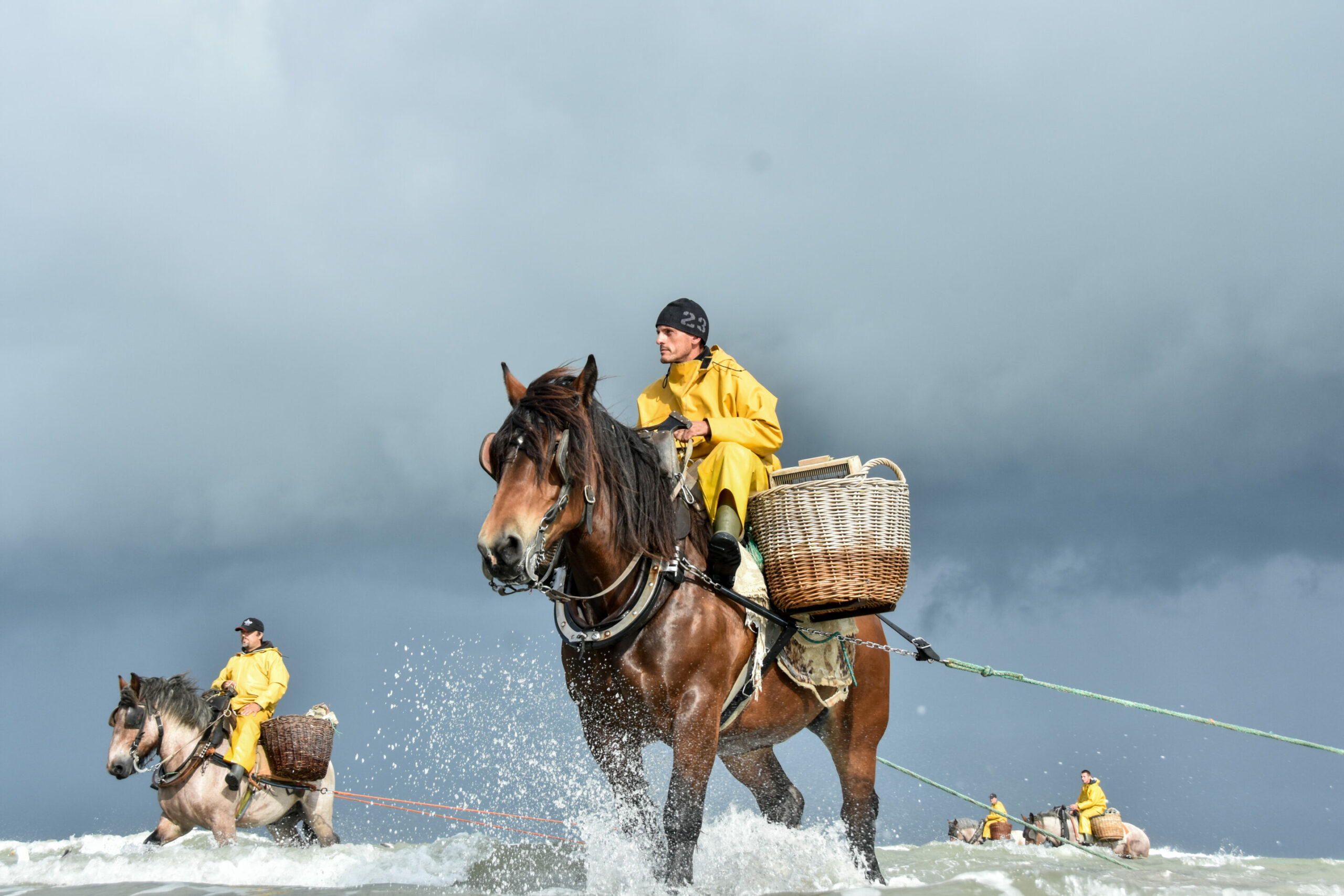
Shrimp fishing on horseback.
Pivotal to her doing so was horseback shrimp fishing being added to UNESCO’s Representative List of Intangible Cultural Heritage of Humanity in 2013. It called for a safeguarding plan and opened the door for women to participate.
NAVIGO Visserij (Fisheries) Museum in Oostduinkerke, funded by the municipality, has also been an anchor in preserving shrimp fishing on horseback. Founded in 1974, it provides related exhibits, educational programs and for the last dozen years, the theoretical test for new candidates.
It was closed for renovation for three years, reopening on 7 Sept. 2024 with a new building, exhibition room, entrance and sperm whale skeleton. The museum currently has a temporary photo exhibition with portraits of “Pèèrdevisschers” (West Flemish dialect for “horseback fishers”) by renown photographer Stephan Vanfleteren until 4 January 2026.
Breaking barriers and passing on skills
While local women once commonly caught shrimp by hand-pushing mini trawlers, they were discouraged from doing so on horseback, as this was considered a task for men only. That notion persisted until 2015, when Bekaert became accredited to join the East Dunkirk Horse Fishers by completing a two-year training course with one of its members (her husband) and passing theoretical and practical exams. The hands-on test is assessed by a jury of horseback fishers, including the mayor of Koksijde.
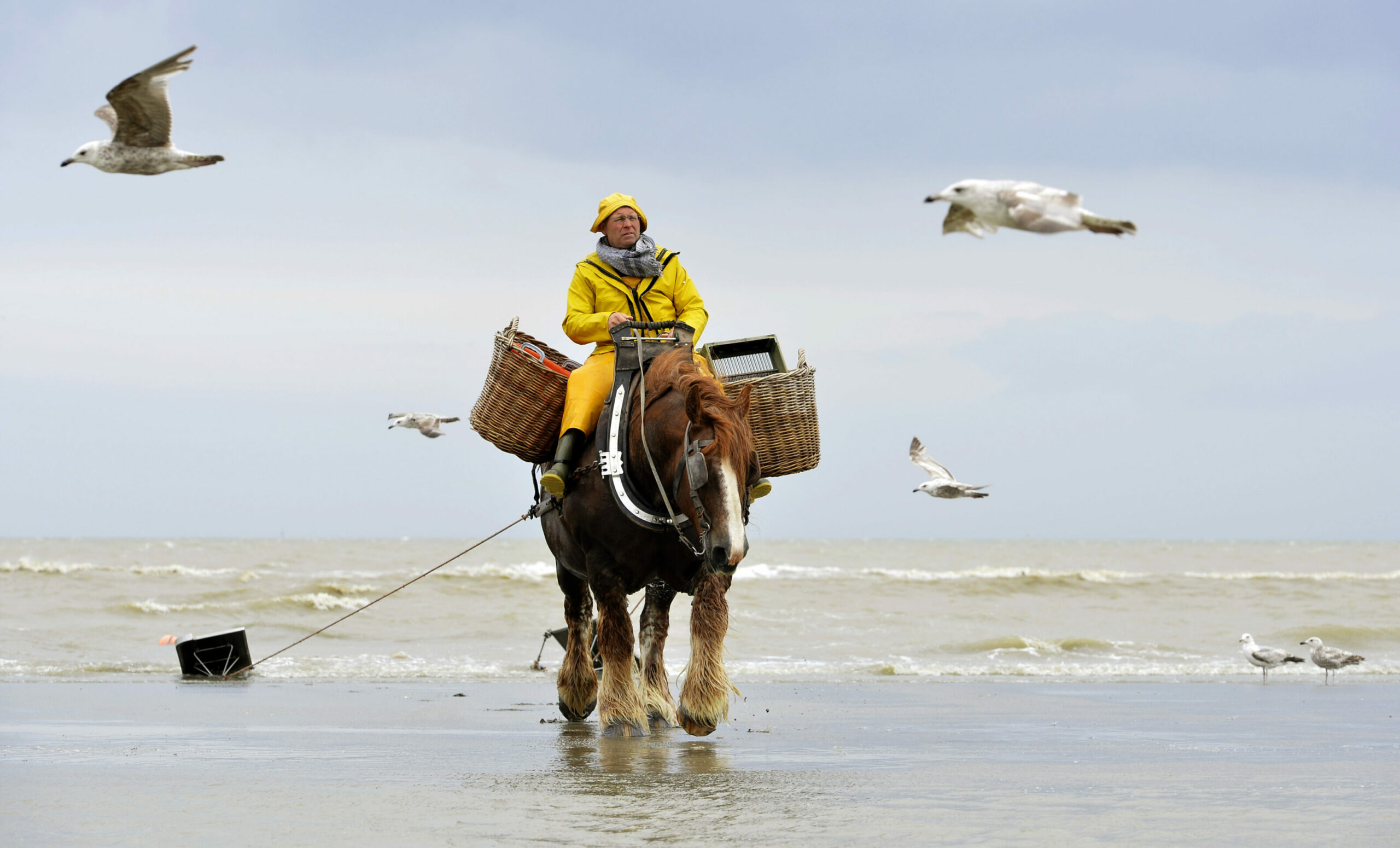
Illustration picture shows a shrimp-fisherman works during a royal visit to the 'Orde van de Paardevisser', shrimp-fishermen on horses, Thursday 13 June 2013 in Oostduinkerke, Koksijde. Credit: Belga / Benoit Doppagne
This training program was inspired by UNESCO as part of a master plan to preserve shrimp fishing on horseback. Because activities on its Intangible Cultural Heritage list must be equal opportunity, UNESCO also paved the way for women to break into the historical “men’s club”. Bekaert was the first. “What a man can do, a woman can do also,” she explains. “And with UNESCO recognition, they could not say no to me.”
Bekaert and her husband and trainer, Vermote, initially faced resistance, but they persevered and proved her skill on horseback. “He supported me the whole way,” she notes. “He said you know ‘you can do it, just do it.’”
Not only did she become a member of the East Dunkirk Horse Fishers, she was honoured by the Royal Order of the Horse Fishers in 2020 with her photo on an annual champagne label promoting their craft.
Now, she and Vermote are teaching one of their 14-year-old twin daughters to become the first shrimp fishing family on horseback. (To start official training, she must be 18.) Bekaert is hopeful that her daughter, plus two men currently getting accredited, can replace three elderly shrimp fishers who passed away in the past recent years.
The generational passing of this tradition is crucial to its survival. Each household involved specialises in a necessary skill such as net weaving, assessing tides and currents, or caring for horses. A dozen households representing 12 fishermen and two fisherwomen are interdependent.
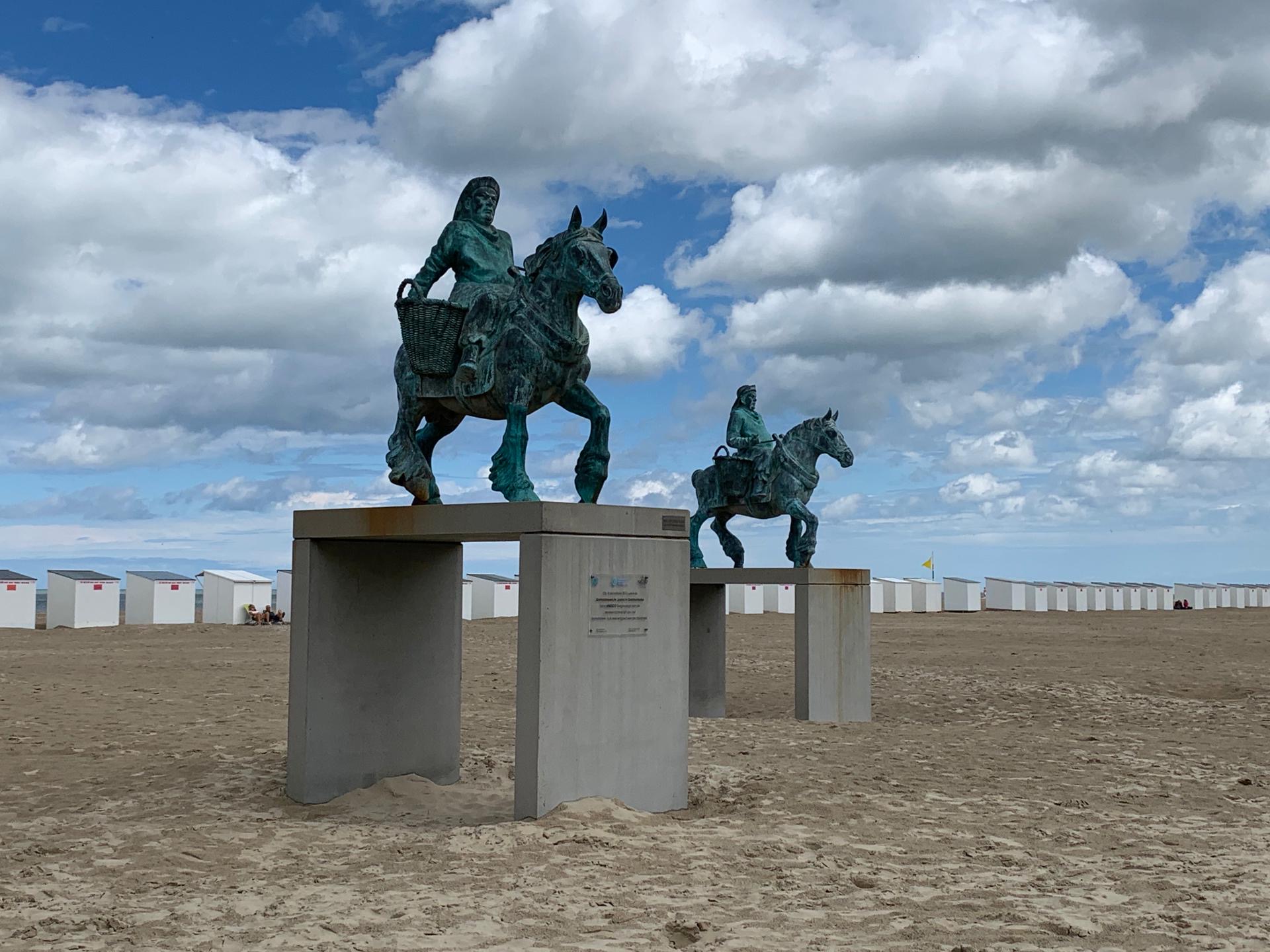
Statues of horse fishermen Oostduinkerke. Credit: Angela Dansby / The Brussels Times
Shrimp fishing on horseback not only requires excellent equestrianism and significant trust with a horse, but also knowledge of the coastline, tides, sandbanks, currents, wave patterns and even cooking shrimp, notes Ruth Pirlet, NAVIGO scientific coordinator. “It does take a lot of skill [and] there are a lot of different skills involved.”
Bekaert’s achievement has drawn more publicity to the practice. She also inspired fellow shrimp fisherwoman Katrien Terryn, who joined the team in 2020. The women’s presence has brought new energy to the community, broadening interest in the practice, notes Pirlet.
“It's important to keep educating people about this tradition,” adds Terryn. “It's a big part of the cultural history of this town.”
Fostering environmental sustainability
While less efficient than beam trawling, horseback shrimp fishing is more sustainable with the use of lightweight equipment in shallow water. Its small-scale approach minimises bycatch and coastal impact. In contrast, beam trawlers use heavier equipment that can damage the seabed and disrupt marine ecosystems.
Economically, however, shrimp fishing on horseback is not sustainable unto itself. “It's a hobby that costs a lot of money and takes a lot of time,” says Pirlet. “Most of these horseback fishers have a regular job and do this on top.” The municipality only subsidises their public events and horse land, not ordinary shrimp fishing days, equipment, horses or animal care.
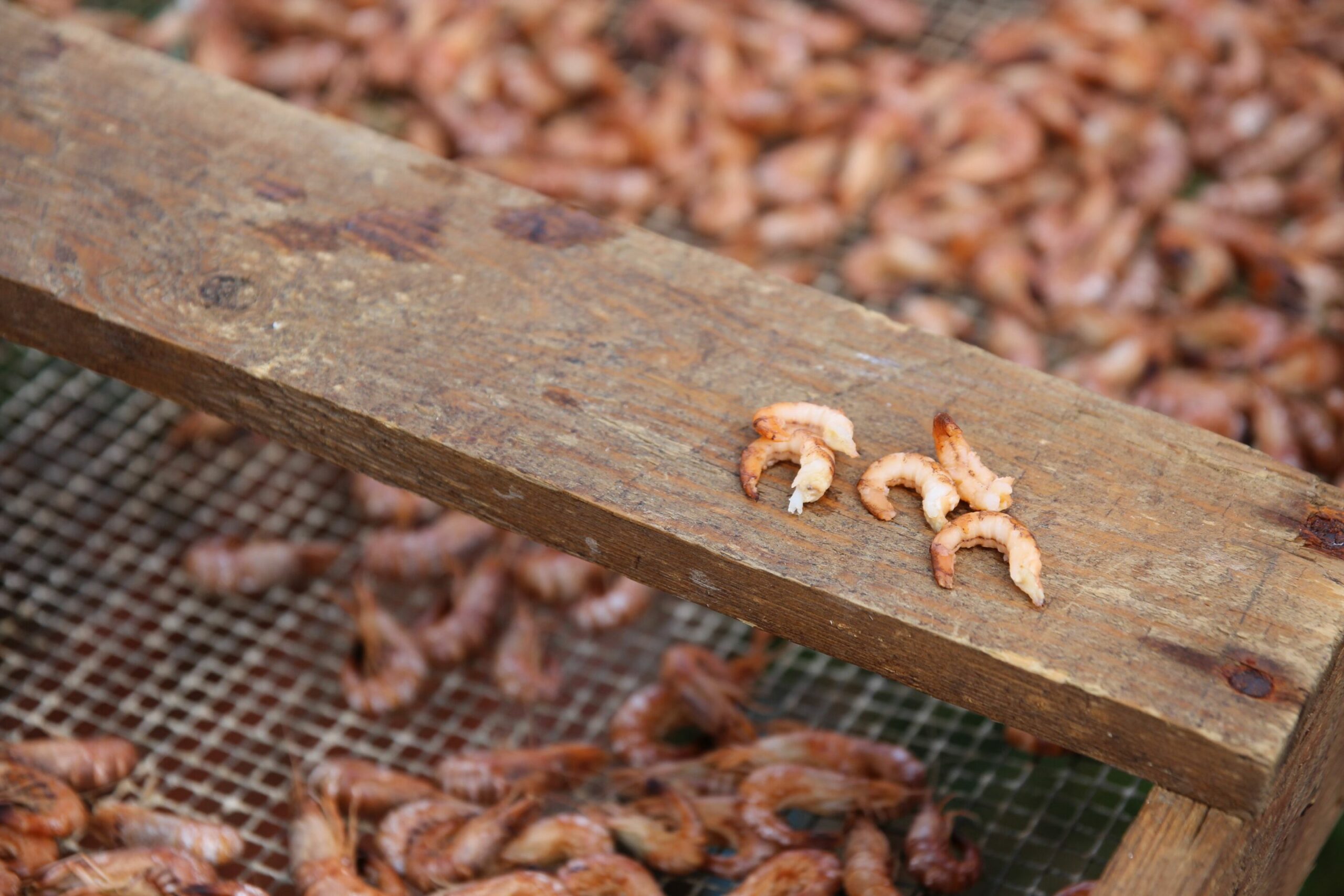
Shrimp Fishing on Horseback. Credit: Angela Dansbury / The Brussels Times
When shrimp are most prevalent – September to November and March to May – the average catch is 7 kilos and they sell for about €10 per kilo. (In the summer, it’s too hot for most shrimp to come to shore.)
This is based on about three hours of fishing – 1.5 hours before low tide and 1.5 hours afterwards – with shore stops every 30 minutes to empty the net and put sorted catch into baskets for a total of nine hours per outing. The shrimp fishers typically eat, freeze or sell their catch to locals on call lists.
The tiny, grey shrimp are big in Belgian cuisine; about half of all caught in the North Sea are consumed in this country. They are used in classic dishes such as Croquette Crevette (deep-fried, battered rolls with molten shrimp filling, often including ground peels for extra flavor) and Tomate-Crevette (a large tomato filled mayonnaise-coated shrimp).
The shrimp are also simply served atop buttered brown bread with coffee, beer or white wine. Restaurants proudly feature Oostduinkerke shrimp on their menus and the local catch is highly sought after for its freshness and quality.
Besides contributing to Belgian cuisine, shrimp fishing on horseback feeds the soul. ”It’s fantastic to see, do and feel,” Bekaert says. “It’s all nature and oneness – just a horse, human and the sea.”
Promoting culture and local pride
Oostduinkerke’s identity and pride is largely tied to its horseback shrimp fishers. “The people who live here are very proud of them,” notes NAVIGO’s Pirlet. “It's a tradition that's very much the life here.” Statues of the fishers stand in the village square and their images adorn local art, street names, venues and even the label of Peerdevissher, a locally brewed beer. Their tradition is celebrated in stories, songs and family lore passed down through generations.
The shrimp fishers go out to sea throughout the year, except winter. Their public demonstrations are on Oostduinkerke Beach from April to October, most frequently from the last weekend in June, when the Shrimp Festival occurs, through August. (Navigomuseum.be has exact dates and times as well as contacts to book a private session with a shrimp fisher.)
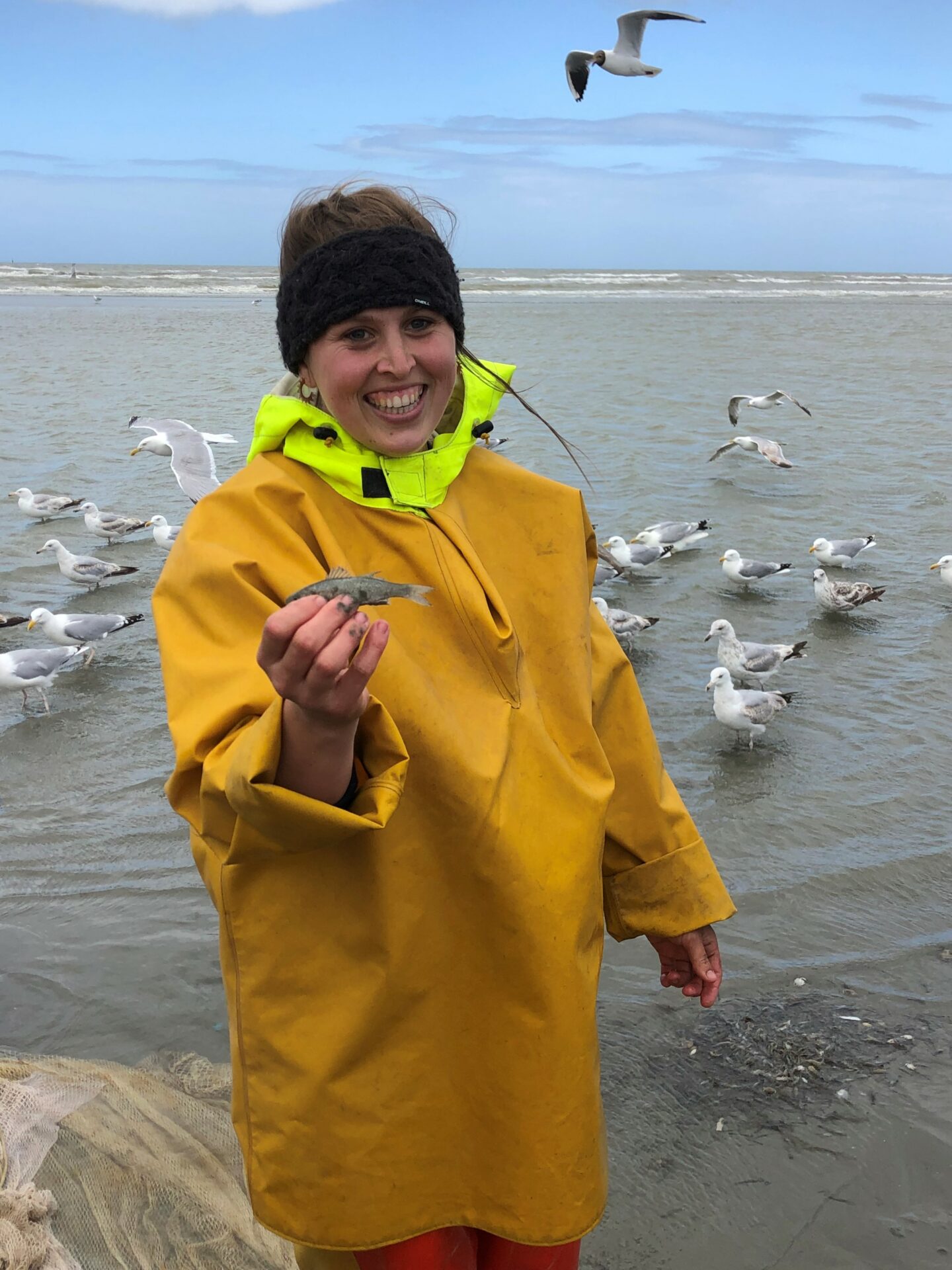
Shrimp fisherwoman Katrien Terryn from Oostduinkerke. Credit: Angela Dansby / The Brussels Times
The two-day Shrimp Festival is the highlight of the local calendar, drawing around 10,000 international visitors each year. It features a lively parade with decorated floats, shrimp fishing demos and competition (whomever wins rides first in the parade), Belgian Shrimp Peeling Championship, blessing of the sea, folklore market, shrimp tastings and a musical tribute by Mariette Crevette, the “mother” of shrimp fishers.
On Fridays in July and August, NAVIGO has Fisheries Folklore Evenings, staying open late with free admission as from 6 pm. Music and seafood are in its courtyard until 10 pm, including fishing craft demos like basket weaving and shrimp peeling.
Such events help promote and preserve the art of shrimp fishing on horseback, one of Belgium’s most unique and impressive historical practices. As fisherwoman Terryn puts it, “It’s a very beautiful tradition that cannot be forgotten.”
