
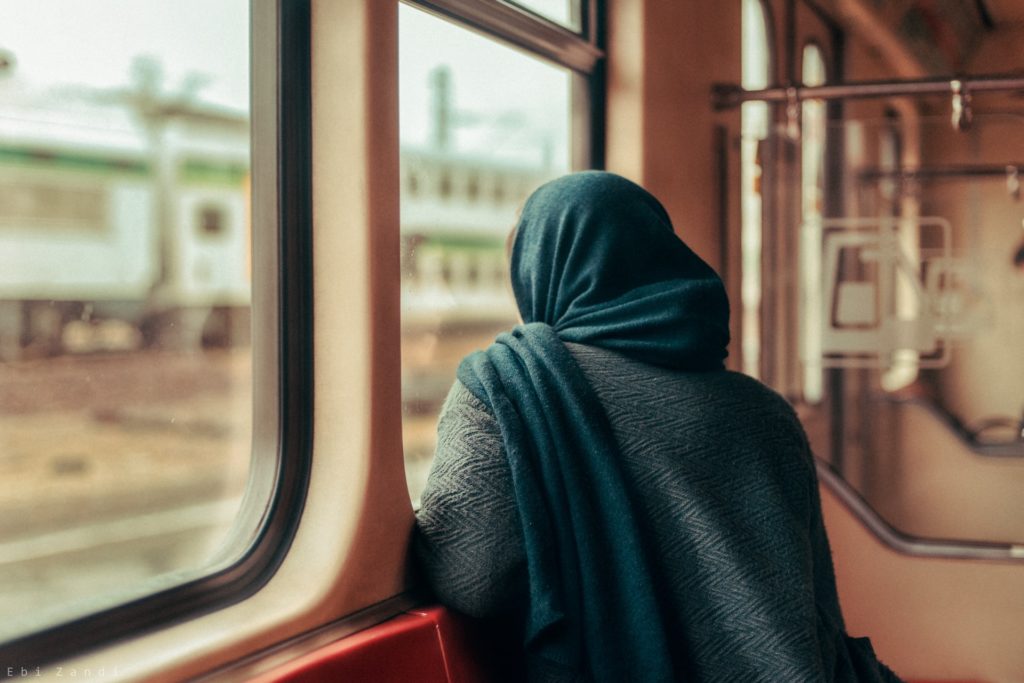
Two young girls were excluded from a high school graduation ceremony in the Brussels municipality of Schaerbeek for wearing headscarves last week. Philosophical or religious symbols – and specifically the headscarf – are a regular topic of debate, but what are the rules in Belgium?
Despite the constant debates about the topic in Belgium, there is rarely a clear outcome. In the case of the two girls in Schaerbeek, the school refused to award them their diplomas during the ceremony – citing its internal regulations prohibiting religious symbols during school hours.
What are the rules about religious symbols in schools in Belgium?
At school
Education in Belgium is regulated at the community level, meaning that the broad outlines are set for Flanders and Dutch-language schools in Brussels by the Flemish Community. The same is true for Wallonia and the Francophone schools in Brussels (the Wallonia-Brussels Federation).
However, the same rules do not apply to every school.
- Community education: These are government schools, subsidised by the Flemish and French-speaking Communities. Here, there is a general ban on religious and philosophical symbols such as headscarves, crosses or skullcaps, as is also the case in other "visible" government functions such as counter staff. The idea behind this measure is that the government should be neutral.
- Freely subsidised education (which includes Catholic education, the largest umbrella organisation): In addition to the government, private individuals may also set up subsidised school groups where they determine their own rules. There, each school determines its own policy on religious symbols.
- Officially subsidised education: These are the schools of the municipal, local and provincial education systems. Whether wearing religious symbols is allowed or not is decided by the municipal and provincial councils, in consultation with the management and the team.
- Private schools: A few dozen private schools in Belgium are not recognised by the government. Here, too, the school boards themselves determine the rules.
Generally speaking, the principle of "neutrality" prevails more in French-speaking than in Dutch-speaking education. Now, French-speaking Education Minister Valérie Glatigny (MR) even said she wants to ban teachers in the community and the officially subsidised education systems from wearing religious symbols. She wants to go as far as possible with this ban, meaning: first teachers, then pupils.
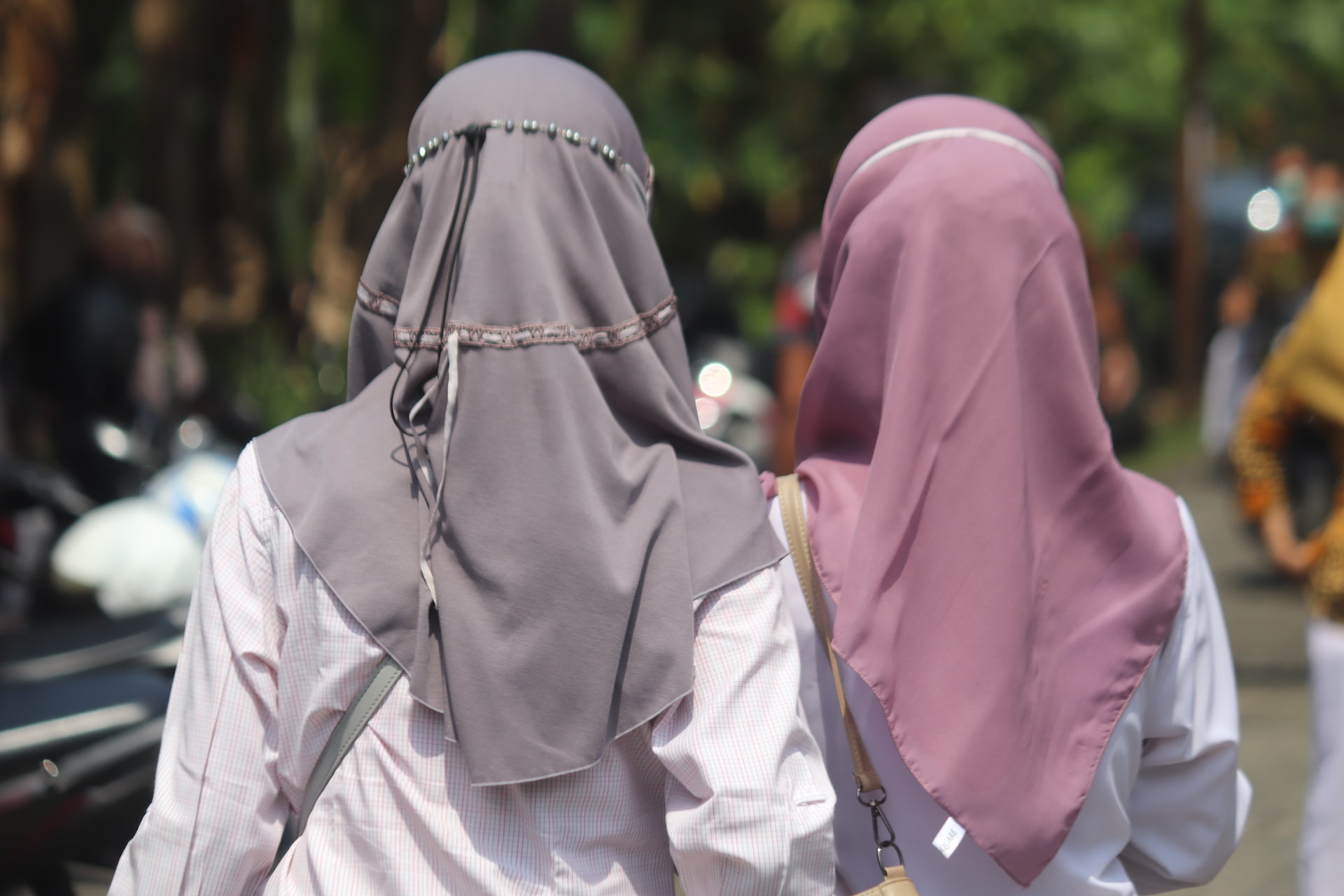
Two women wearing headscarves. Credit: Unsplash
At work
Public sector
The principle of neutrality means that the Belgian State is neutral, meaning that civil servants in public services must act and appear neutrally.
This means that the personal preferences of civil servants are not allowed to (appear to) play a role in their treatment of citizens, because all citizens must be treated equally. As a result, wearing religious or philosophical symbols is forbidden for civil servants.
The Court of Justice of the European Union ruled that the Federal Government itself decides on the form of neutrality it wants to apply with regard to its staff. The interpretation of the principle of neutrality is therefore a political and social choice, not a legal one. There is no obligation to ban all religious symbols in the name of neutrality.
Private sector
Private employers are not obliged to offer a neutral service. A ban on a headscarf or other religious symbol is only possible if there is a legitimate purpose. Justified reasons for a ban include:
- In the cultural sphere, this may involve artistic freedom, or authenticity, among other things. For example, for a theatre performance about a historical figure, a company only wants to use actors with certain physical characteristics.
- In the commercial sphere, this is advertising aimed at certain target groups. When advertising hair products, a company may prefer models without a headscarf or head covering.
- In terms of safety, a ban may be justified in order to guarantee safety in the company, the safety of third parties, public safety, among others. For example, loose clothing may be prohibited when working with machines to avoid occupational accidents.
- For reasons of hygiene, a ban may also apply. For example, no loose hair or other hygiene regulations for kitchen staff.
There must always be an appropriate and necessary justification for the ban. This is only the case if there is no alternative measure possible that would also achieve the objective and that would also affect a fundamental right in a less far-reaching and less serious way.
Another legitimate objective for a ban on a religious or philosophical symbol (for example, the headscarf) could be a neutral image.
Credit: Belga
Such a ban is only possible if it meets one of three conditions. Firstly, the ban must have a legitimate purpose, meaning that employers must be able to demonstrate that a neutral attitude towards customers is a real need or that it is necessary to avoid social conflicts.
Secondly, the ban must be an appropriate means to guarantee that neutrality. To not violate the non-discrimination principle, employers have to apply the rules to all employees: such a ban should apply to a Christian cross and a Sikh turban as well as an Islamic headscarf, for example.
Lastly, the ban must not go further than strictly necessary. In some companies, a ban may apply to employees for whom "visual contact" with customers is an essential part of their job description. However, in these cases, the employer must also check whether employees who want to (continue to) wear religious symbols can be given another job without visual contact with customers.
Importantly, this should not be too much of a burden for the employer, and restrictions specific to the company must also be taken into account. Offering an employee another job is easier in large companies, while this will be more difficult in a smaller SME, for example.
