

Crippled by a year without a government and soaring debt, Brussels is gasping for cash. A Brussels Times investigation reveals a public sector where systemic blurring of norms has led to potential budgetary fraud, including the apparent misuse of €250m worth of EU loans to cover debts.
The Brussels Region – home to the “capital of Europe” – is drifting deeper into a financial and political crisis.
With no functioning government, debt piling up and cash running out, political oversight is unraveling just when bureaucratic control is needed most. In the absence of clear leadership, a kind of lawlessness has gripped the machinery of public finances - where officials resort to increasingly acrobatic manoeuvres to stay solvent.
Now, it appears they may have crossed a line: using freshly borrowed EU funds meant for metro expansion to pay off old debts - a move experts warn amounts to misuse of public money and budgetary fraud.
Earlier this year, the Brussels Region drew €175 million from the European Investment Bank and €75 million from the Council of Europe Development Bank specifically earmarked for expanding the Brussels metro and upgrading public transport infrastructure.
But instead of immediately distributing the funds to the public transport operator STIB/MIVB, the money appears to have been pooled together with other cash at the Brussels Debt Agency, which manages the public debt, and used for general treasury operations — such as daily expenses, rolling over old debt, and paying interest on existing debt.
Approached by The Brussels Times prior to publication of this article, Outgoing Finance Minister Sven Gatz said “I’m not a technocrat” and referred “all technical questions” to the Brussels Debt Agency, led by Director Serge Dupont. A spokesperson for Gatz reiterated on Wednesday that “the minister does not wish to comment further on this matter”.
“The funds were integrated into the overall financial management for reasons of operational optimisation,” the Brussels Debt Agency acknowledged in a written reply to specific questions about the EU loans by email from The Brussels Times.
This co-mingling of earmarked funds with general cash may appear to be a technical manoeuvre, buried deep inside the Debt Agency’s 100-page annual report, but it amounts to little more than ‘robbing Peter to pay Paul’. Even if the metro works are eventually funded from the Region’s treasury, the initial diversion is clear and carries real risk.
“They can not do that, no, they’re not allowed to do that. It’s not right. That’s sjoemel,” said Guy Vanhengel, a veteran Brussels politician, who served twice as Brussels Finance Minister (2004-2009 and 2011-2019) and once as Belgium’s federal Finance Minister (2009-2011), using the Brussels dialect word for tampering or fiddling.
“This is the story of how one-off investment projects, which come with earmarked revenues and expenditures – in this case marked for the metro – are twisted into structural general spending. It happens when people convince themselves that they can use one-time income to fund recurring expenses - even though that’s not what those funds are meant for,” Vanhengel told The Brussels Times.
The Brussels Times previously reported that the Region faced mounting uncertainty earlier this year over its dwindling cash reserves, as banks hesitated to extend credit lines and financial markets proved slow to lend. Outgoing Finance Minister Sven Gatz openly acknowledged the risk of a liquidity crunch during the summer months of June, July, and August - just as rising interest payments are set to kick in following last month’s S&P credit downgrade, and while the Region awaits its main tax revenues, expected in September. It was precisely during this precarious period that the metro loans were drawn - and diverted into general cash operations, including the servicing of existing debt.
This kind of activity goes beyond creative accounting, raising serious questions about whether the Region violated the terms of its EU loan agreements, breached parliamentary spending rules, and misled credit rating agencies and ultimately its own investors.
If this alleged misuse of funds is acknowledged by all parties involved, the entire house of cards risks coming down.
EU Loan Agreements Violated
The Brussels Debt Agency’s 2024 annual report reveals that Belfius Bank conditioned its €500 million credit line - available through 2025 - on the Region having access to loans from the European Investment Bank and the Council of Europe Development Bank.
In doing so, the EU loans were effectively treated as eligible for general cash management. ING Belgium, in turn, made its own €500 million credit line conditional on the participation of Belfius.
There is no suggestion that either ING or Belfius were aware of any misappropriation of loan funds but, as a result, the Debt Agency now counts on €1 billion in bank credit and €250 million in drawn EU loans as well as €825 million in yet-undrawn EU loans to support its day-to-day cash needs through 2025. That’s over €2 billion in readily available cash, all unlocked on the premise that the EU loans could legally be used for day-to-day treasury operations.
However, the European Investment Bank – the largest provider of the loans underpinning this financial pyramid – firmly rejects that interpretation and takes a different view.
“The loan agreements clearly state that the loan facilities are exclusively earmarked for use on the metro expansion and other transport infrastructure projects, and on those projects only,” said a spokesperson at the European Investment Bank, conveying the position of the loan officers overseeing two facilities of €475 million granted in 2022 and 2023, of which €175 million was drawn earlier this year. (The loan of the Council of Europe Development Bank amounts to €250 million, of which €75 million was drawn this year.)
Governments, like the Brussels Region, typically borrow most of their money on international markets by issuing debt certificates, the spokesperson explained, which can be used to finance any part of their budget. But the EU loans in question are different. “They can not, under no circumstances, be diverted and used, for other purposes, not temporarily and not partly.”
“Their use in general cash management is not allowed,” the spokesperson told The Brussels Times.
Parliamentary Oversight Sidestepped
Ultimately, it is the Brussels Parliament that holds the power of the purse. Each year, it adopts a budget that sets out how much the Region may spend, tax, and borrow - and for what purposes.
The Brussels Region spent €7.8 billion in 2024 against just €6.3 billion in revenue and is running one of the largest deficits of any region in Europe, approaching 20%. To cover the gap, the Region has embarked on a borrowing spree that more than doubled its debt in just five years: from €6.4 billion in 2019 to €15 billion today. At the current pace, debt is rising by €1.5 billion annually and is expected to reach €16 billion by the end of 2025, pushing Brussels’ debt-to-revenue ratio to a staggering 250%.
“Parliament adopts annual budgets that constrain how the executive may use funds, and approves annual accounts that show how funds were actually spent — per department, per project,” said Gilles Verstraeten, a member of the Brussels Parliament with the Flemish nationalist party N-VA.
“If money earmarked for a specific project like the metro was diverted to cover unrelated expenses without a formal parliamentary reallocation, it violates the budgetary law itself.”
“We’re not really involved in daily operations, and we don’t have visibility on all day-to-day financial manoeuvres carried out to manage daily expenses and cash reserves, which is really the domain of the executive. Unless of course we suspect that something is wrong, in which case we exert our powers of parliamentary control to check what is going on,” Verstraeten explained.
He reacted with disbelief - though not surprise - upon learning of the Region’s dubious cash manoeuvres, particularly given that they occurred just ahead of last month’s anticipated credit downgrade by S&P.
“It’s normal for any institution to put their most embellished case to a rating agency, even lobby a bit. After the mild credit downgrade by Standard & Poor’s, I thought perhaps I overestimated how dire the situation was — but here, as it turns out, they’ve just deceived everyone — the rating agency, their creditors, and ultimately parliament. This goes far beyond the ordinary.”
Standard & Poor’s Ratings And Investors Misled
In June, the Brussels Region’s soaring debt, ongoing deficits, weak governance, and lack of a clear repayment strategy prompted S&P Global Ratings to slash its credit rating by four notches, from ‘A+ with a stable outlook’ to ‘A with a negative outlook’. The sharp downgrade means that Brussels will now likely face higher borrowing costs.
S&P warned that, unless corrective measures are swiftly adopted, Brussels risks further downgrades later this year on 10th October, a scenario that would push up borrowing costs even further and undermine access to capital markets at a moment of increased political vulnerability.
Amid consecutive years of credit downgrades, investors and lenders alike are starting to pay closer attention, not only to the credit ratings, but also to Brussels’ political credibility and the quality of its financial disclosures and accounting practices.
Mariamena Ruggiero, the lead analyst at S&P Global Ratings for the Brussels Region, told The Brussels Times that the two loans from EU institutions were indeed included in the Region’s potential cash reserves - and factored into the metrics (such as the liquidity coverage ratio) used to assess whether Brussels had enough money on hand to meet its short-term obligations.
Metro 3 expansion
These loans were explicitly earmarked for metro and transport infrastructure only, and not allowed to be used for general cash management. By presenting them as fungible, the Region made its cash position look stronger than it actually was.
The inflated cash figures reportedly played an important part in S&P’s decision to uphold Brussels’ investment-grade rating.
“I don’t think it's our job to audit,” Ruggiero said, when asked whether she had verified how the Region represented the EU loans. “We look at the facts and the numbers as they are presented to us.”
Byzantine Government Architecture Shrouds Uncertified Accounts
Behind the headline numbers of debts and deficits lies a large, complex government architecture, which is hard to control either politically or financially, according Vanhengel, who, as a former finance minister, knows the complexities of the system all too well.
“The fundamental handicap of the Brussels Region is that it’s a sub-state made up of a city, but without the suburbs or countryside to support it,” Vanhengel explained.
“With just 1.1 million inhabitants, it’s relatively small in scale, yet because of Belgium’s federal state structure it received an equal amount of government institutions and bureaucracy as the larger regions, but without the means to carry them.”
The Brussels Region consists of a central government with five core departments - Urban Development, Mobility, Environment, Finance, and Employment - together with a network of 22 semi-autonomous agencies. These agencies operate as separate legal entities: about a third are fully owned and controlled by the Region, while the remaining two-thirds have outside shareholders, independent boards, and their own budgets, accounts, and borrowing powers.
Some of their finances, including debt, are consolidated into the Region’s official accounts, but many are not. To complicate matters further, many of these agencies also operate through sub-entities in each of the 19 communes of Brussels, multiplying the number of opaque financial boxes.
The last time the Belgian Court of Auditors, the official body in charge of auditing all levels of government according to EU rules, certified the annual accounts of the Brussels Region was in 2017 – eight years ago. Since then, things have gone from bad to worse, with auditors going from “refusing to certify” to outright “abstaining” from formulating an official opinion in the past four years.
“An abstention is considered even worse than a refusal to certify,” said Karl Hendrickx, deputy chief of staff to the president of the Court of Auditors. “It means that rather than pointing out instances of clear rule-breaking or misrepresentation, auditors are unable to draw conclusions about insufficient or unreliable data,” he told The Brussels Times in a telephone interview.
One level down, at the level of the semi-autonomous agencies, the Court approved the 2023 accounts of only 16 out of the 22 agencies - and half of those came with significant reservations. This pattern of irregularities, too, has been going on for many years.
Vivaqua’s €1.2 billion debt and silent bailout
In its audit of the Region’s 2023 accounts, the Court of Auditors noted that many fully independent entities - including public utilities and non-profit organisations performing essential public functions - are still excluded from the Region’s consolidated accounts, even though they should be included.
Their debts, which according to experts are increasing in line with the government’s own debts, are not formally guaranteed by the Region, but are widely seen as implicitly backed by it. Several lending banks confirmed this assessment on condition of anonymity, citing the sensitivity of discussing public-sector clients.
Brussels’ public water utility, Vivaqua, is facing severe financial distress, with over €1.2 billion in bank debt and mounting concerns over its long-term solvency, according to a former board director of the company, speaking on condition of anonymity to The Brussels Times.
The roots of Vivaqua’s financial troubles lie in underfunded investment decisions, chronic billing failures — including a three-year IT malfunction that left tens of thousands of water bills unsent — and escalating operational costs, the ex-director explained. About €150 million of its bank debt is held by the European Investment Bank, which required an explicit guarantee from the Brussels Region.
Last year, when Vivaqua warned it could no longer meet interest and principal payments on its €1.2 billion debt - which is not explicitly guaranteed by the Brussels Region - the Region nonetheless stepped in with an emergency €18 million cash injection. The quiet bailout was designed to prevent a default and, crucially, to avoid triggering the Region’s explicit guarantee on the €150 million EIB loan, which would have come due if Vivaqua failed to pay.
The silent bailout of Vivaqua showed how the €1.2 billion debt of an independent public utility - formally not guaranteed by the Region- is nevertheless widely assumed to be implicitly backed by it. And rightly so, apparently.
“The moment you're dealing with an essential public service like water, as a government, there’s no escaping responsibility. You’ll have to intervene, if not fully, then at least partially, by negotiating with creditors,” the former board director concluded.
Fire Brigade and Street Cleaning Agencies hide €1 billion pension gap
Two Brussels agencies, the Fire Brigade (SIAMU) and the Regional Cleaning Agency (Net Brussel), are sitting on an underfunded pension “time bomb” that saddles the Region with more than €1 billion in liabilities by 2046, according to a senior official on the Brussels Commission for Financial Strategy, who spoke to The Brussels Times on condition of anonymity.
Pensions across the Belgian government for statutory officials are normally covered by the federal pension service, except for these two regional agencies (due to a historical anomaly). They are supposed to withhold employer contributions and invest them into a privately managed investment fund, but historically, they have failed to make sufficient contributions. Their pension fund, administered by Ethias, is now nearly depleted, with less than €40 million in reserves, not even enough to cover a single year of pension benefits.
Each year, the Region quietly transfers about €20 million at the end of the fiscal cycle to cover the shortfall, as more than €60 million in pension obligations are due annually. Experts warn that if the Region doesn’t begin contributing at least €100 million per year (the estimated structural cost of this liability) the situation will spiral further out of control. The fund’s structural hole estimated for the following twenty years, the typical 20-year horizon used for calculating long-term pension liabilities, is about €1 billion, the senior official estimated.
Brussels Hospitals hold €500 million in debt, mostly paid by the Region
Brussels’ five public hospitals (St. Pierre, Brugmann, Iris Sud, Queen Fabiola Children’s Hospital, and Jules Bordet) and its three main private hospitals (St. Jean, Clinique de l’Europe and Chirec) receive funding for their infrastructure works from the Brussels Region (the university hospitals are funded at the federal level for infrastructure investments).
This encompasses building new facilities, renovating existing structures, and equipping specialised spaces such as operating theaters, intensive care units, and sterilisation rooms.
The financing system relies on reimbursement over thirty years. By law, new infrastructure projects are not repaid in a single payment but through installments spread across thirty years. Consequently, these hospitals, all non-profit organisations, secure bank loans to fund their projects initially, then depend on the Region to cover approximately 80% of the principal and interest payments annually.
“It’s hard to say how much bank debt these hospitals are carrying across their balance sheets, but a conservative estimate would be a little over €500 million,” said Dirk Thielens, the executive director of the Regional Interhospital Association for Healthcare Infrastructure, or IRIS-koepel, a public oversight and advisory body for Brussels hospitals.
“The problem is not so much the level of indebtedness, which remains relatively stable, but the continued capacity of the hospitals to keep repaying the remaining 20% out of their own operating results.”
“In 2023 about 65% of hospitals in Belgium had a negative operating result, compared to about 20% in 2019,” Thielens explained. “The costs for hospitals keep rising, driven mostly by inflation and rising pension burdens, while public financing doesn’t follow.”
The lending banks assume that the repayment capacity for this infrastructure debt lies with the Region, while most public accounting experts argue that the debt should be consolidated, at least in part, into the Region’s accounts, as it is ultimately mostly the Region’s responsibility to repay.
Brussels Regional Housing Company loses market access, cut off by banks
The Brussels Regional Housing Company (BGHM) oversees the capital’s heavily subsidised public housing programme, coordinating 16 communal public housing developers.
Under the Region’s current plan to build 6,000 new social housing units, half of the cost is covered by direct subsidies, while the other half is supposed to be borrowed by BGHM or its affiliated entities. These loans are then meant to be repaid over time using revenues from low social rents, topped up by additional regional support.
But in recent years, rental income passed up from the 16 communal housing entities has fallen far short. In fact, this year, the communal entities are not expected to send up any money at all, as their rental revenues barely cover the salaries of their own employees, according to several Brussels officials and parliamentarians familiar with the situation.
In 2023, BGHM budgeted €300 million to execute on the housing plan. The Region provided €150 million in subsidies — but when BGHM turned to the market to raise the remaining €150 million, local banks refused to lend. Bankers reportedly cited the agency’s weak internal controls and growing unease over the Region’s deteriorating financial health.
In response, the Brussels Region quietly stepped in with an extraordinary €150 million loan of its own, plugging the gap with public funds. Experts say this marks an unprecedented shift, where an agency meant to be co-financed through market borrowing now relies entirely on its public parent to stay afloat.
The Brussels Parliament is currently debating the future of the social housing plan.
Brussels Housing Fund fails to raise €150 million
The Brussels Housing Fund (BHF), a regional financial body that provides low-interest home loans to low-income residents, is partially backed by the Region. As a semi-public financial intermediary, its role is to borrow money en masse from a series of banks, and because of the large volumes and the partial backing by a government entity, can negotiate cheaper interest rates, which it then passes on to low income families.
Except that last year, to fund its activities, the BHF sought to raise €150 million on the market and approached 20 banks, according to a senior official with insights into the BHF’s accounts. Only two responded: ING and Belfius, together offering just €80 million — well below the amount requested. Several other banks explicitly declined, citing concerns over the Region’s deteriorating finances and pending credit downgrade, the official said.
As market access tightens, even longstanding lenders are becoming more reluctant to extend financing to the Brussels Region and even its explicitly backed entities.
First Humiliating Default: Schuman Square
Amid the headquarters of the European Commission, the European Council, and the European External Action Service – arguably the EU’s most powerful institutions – lies a small square known as Schuman Square.
If there is any geographical heart to the European Union’s institutional presence, then this square is it.
The square has been undergoing renovation works since autumn 2023 with an originally planned budget of €30.2 million to provide for new pedestrian paths, more green space, and an impressive canopy.

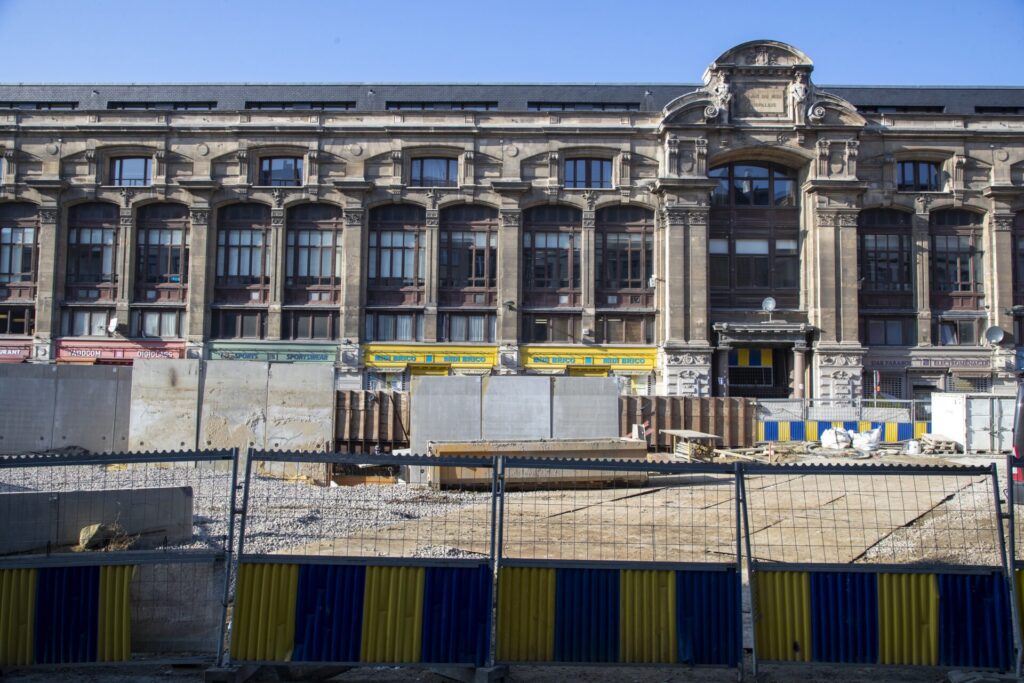
Schuman Square
Rising material costs and unanticipated security upgrades demanded by EU institutions have inflated expenses by at least €12.4 million, an additional burden the Brussels Region stated earlier this year it cannot absorb.
With an annual budget of €7.8 billion and monthly expenditures of roughly €700 million, the Brussels Region claims it lacks the funds to cover the extra €12 million. The renovation was funded through Beliris, a fund co-administered by the Brussels Region and the Federal Government to pay for Brussels projects of national or international significance.
It is replenished annually with approximately €200 million by the Federal Government. Beliris officials have said the project’s allocated budget is exhausted, and additional costs fall to the Brussels Region’s Department of Mobility.
The responsible Minister for Mobility, Elke Van den Brandt, has so far refused to pay contractors working on the square’s renovation using general treasury funds or reallocating money from other budget lines — a stark contrast to the earlier approach, under which EU metro loans were co-mingled into general treasury use, including for servicing debt.
Instead, Ms. Van den Brandt wrote a letter to five European institutions based in Brussels (the European Commission, the European Parliament, the Council of the EU, the European External Action Service and the Committee of the Regions), asking whether they would consider making a joint financial contribution to cover the €12.4 million.
"It is truly a disgrace, a total humiliation: the Brussels Region begging for money to build a square. I had to apologise," Belgian Prime Minister Bart De Wever said about the default, stressing the diplomatic importance of Brussels.
395 Days Without A Government
Meanwhile, summer recess is approaching for the Brussels Parliament without any government formation in sight. Vanhengel, the former Brussels Finance Minister, doubts that one will even be formed before the end of the year.
“The Brussels state apparatus, with all its tentacles and dependencies, is creaking and cracking under the strain of cash shortages and soaring debt,” he said, puffing on a cigar during a long, unfiltered conversation in the homemade bar of his garage on a hot afternoon.
“Anyone with a bit of jugeote can see why the system is rudderless without a fully responsible government. Politicians are playing hide-and-seek, because whoever becomes the next government will receive the bill,” he said, using the Brussels slang term for sound judgement.
“To save costs – an inevitability under any future scenario – the outgoing government or the next one will have to cut major one-off investment projects.”
“Who still believes the metro expansion works will continue? They may have to repay those loans early – if they still have them!”
