
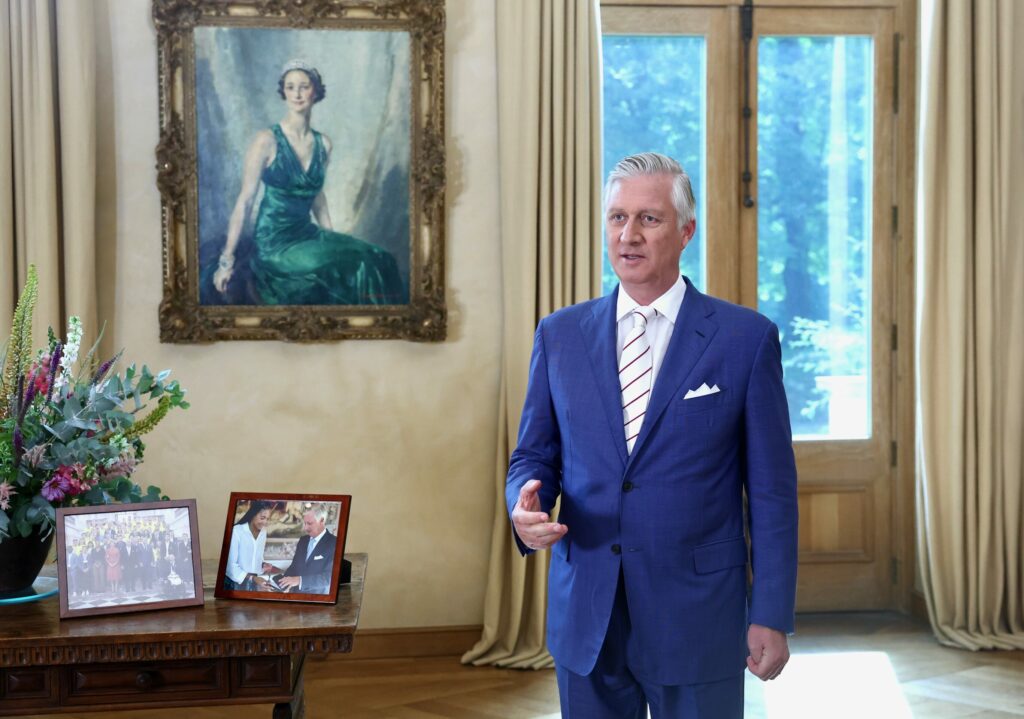
On the eve of each national day celebration, King Philippe addresses the nation to champion Belgian unity. The monarch and his family carefully weigh every word of the speech to appeal to Belgians, but even then, things can go wrong.
King Philippe learned an important lesson during last year's national holiday. In a country like Belgium, a seemingly innocuous speech can stir commotion.
Shortly after last year’s federal and regional elections, the monarch delivered a positive message on the national holiday - or so he thought. With major political divisions marking the country and parties on both the far right and the far left of the aisle gaining popularity, the King spoke of opportunities for a “new political project”. It was an optimistic message, emphasising that cooperation was possible - but his words did not sit well with everyone.
According to French-speaking socialists, the King demonstrated a political preference in his speech - or at least gave the impression that he felt that the current federal majority, including the Parti Socialiste (PS), had not performed adequately. That is at odds with his role as head of state.
“I’m deeply hurt”, PS party chairman Paul Magnette said at the time. The reaction surprised many, including the palace and Jo De Poorter, an author, communications expert and professional royal-watcher.
“These are sensitivities that are difficult to predict," De Poorter tells The Brussels Times. "It is logical that King Philippe conveyed that message. As head of state, he is involved in the formation of the government: it is one of the most valuable and meaningful responsibilities he has. He cherishes it."
This example underlines how difficult it is for the King to deliver a speech that is totally inoffensive. Behind every word he utters, countless hours of work and research are done to achieve just that.
Weeding out controversial content
Behind the scenes, the text is tweaked and polished for weeks. It passes through various stages, with the aim of combing through the text for any potentially controversial content.
“His chief of staff and an entire communications department work hard on the text," said De Poorter. "The message in the speech is also checked and submitted to the prime minister. Of course, they have years of experience in the palace, so adjustments are rarely made. He has been head of state for more than ten years now. He knows how to do it and what is and is not acceptable."
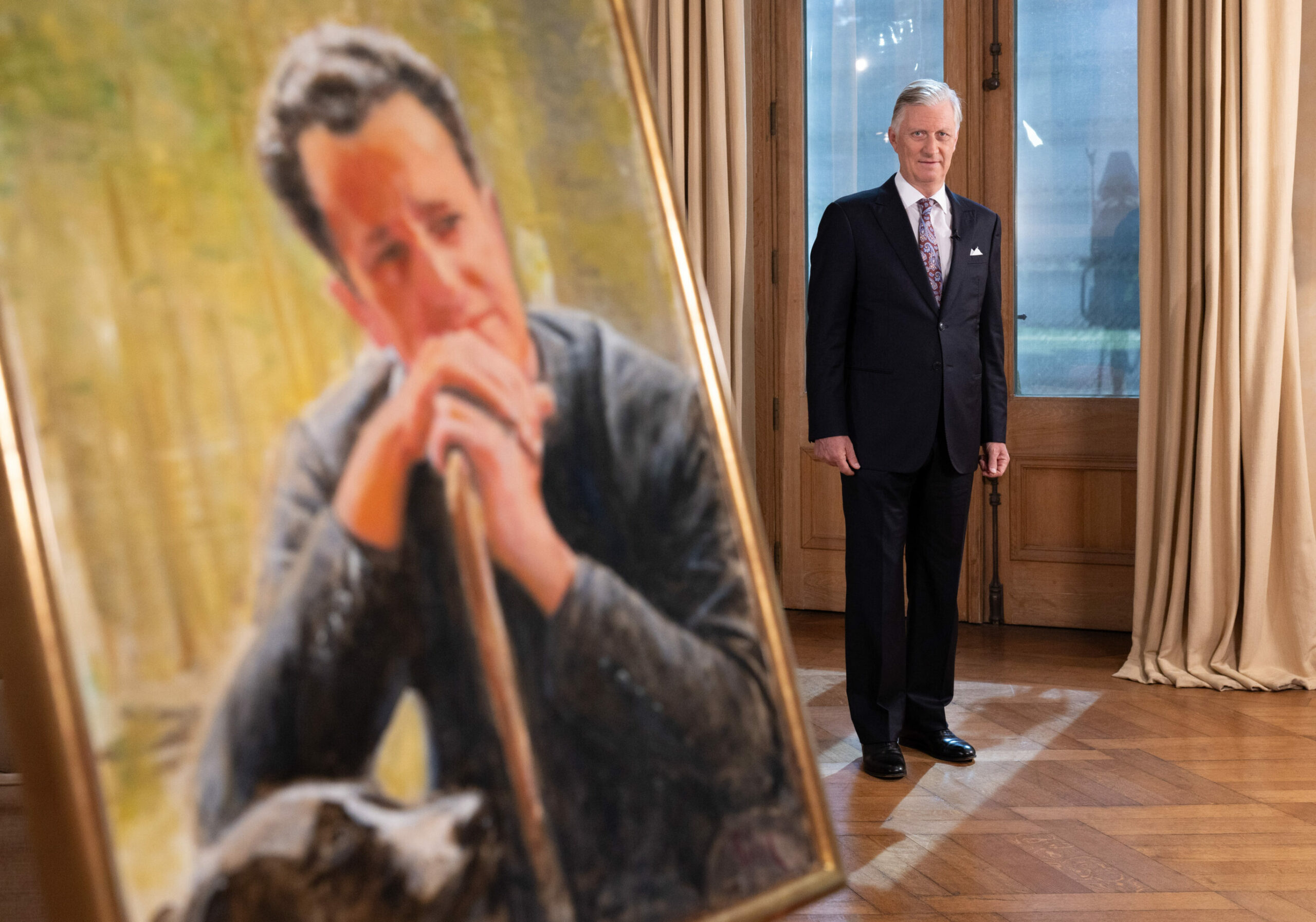
King Philippe with a portrait of former King Baudouin during the recording of his annual television and radio speech on the occasion of the Belgian National Day in 2023. Credit: Belga/ Benoit Doppagne.
According to De Poorter, the Queen occasionally reviews the speech before it is delivered. Images in the press once showed the Queen personally reviewing the text, which caused irritation at the Palace. “They were not amused - it was not meant for people to see,” said De Poorter.
Despite all the careful scrutiny and research that goes into the speech, the royal expert says spectators at this year’s national day celebrations should not expect a particularly animated speech.
“Philippe has to stick to his role as head of state," he said. "He is cautious and neutral. He has to be a master of balance. I always find it interesting to see how he manages to do that. It's also nice to see how the Dutch and French speeches differ.
"There are differences between them, mainly because you notice that the King feels more at ease in French. When he speaks Dutch, you can hear that he comes from Brussels and has a French-speaking background.”
'The Belgian idea is something he proclaims with great passion'
Nevertheless, the King does sometimes take a stand when he speaks on 21 July.
“If there is one theme that runs through his speeches on the national holiday, it is the struggle for Belgium's existence,” said De Poorter. “Many of his speeches are about how we have more similarities than differences. How Belgium unites us. How we must work together, how there is a unity that is invisible but tangible. The Belgian idea is something he proclaims with great passion.”
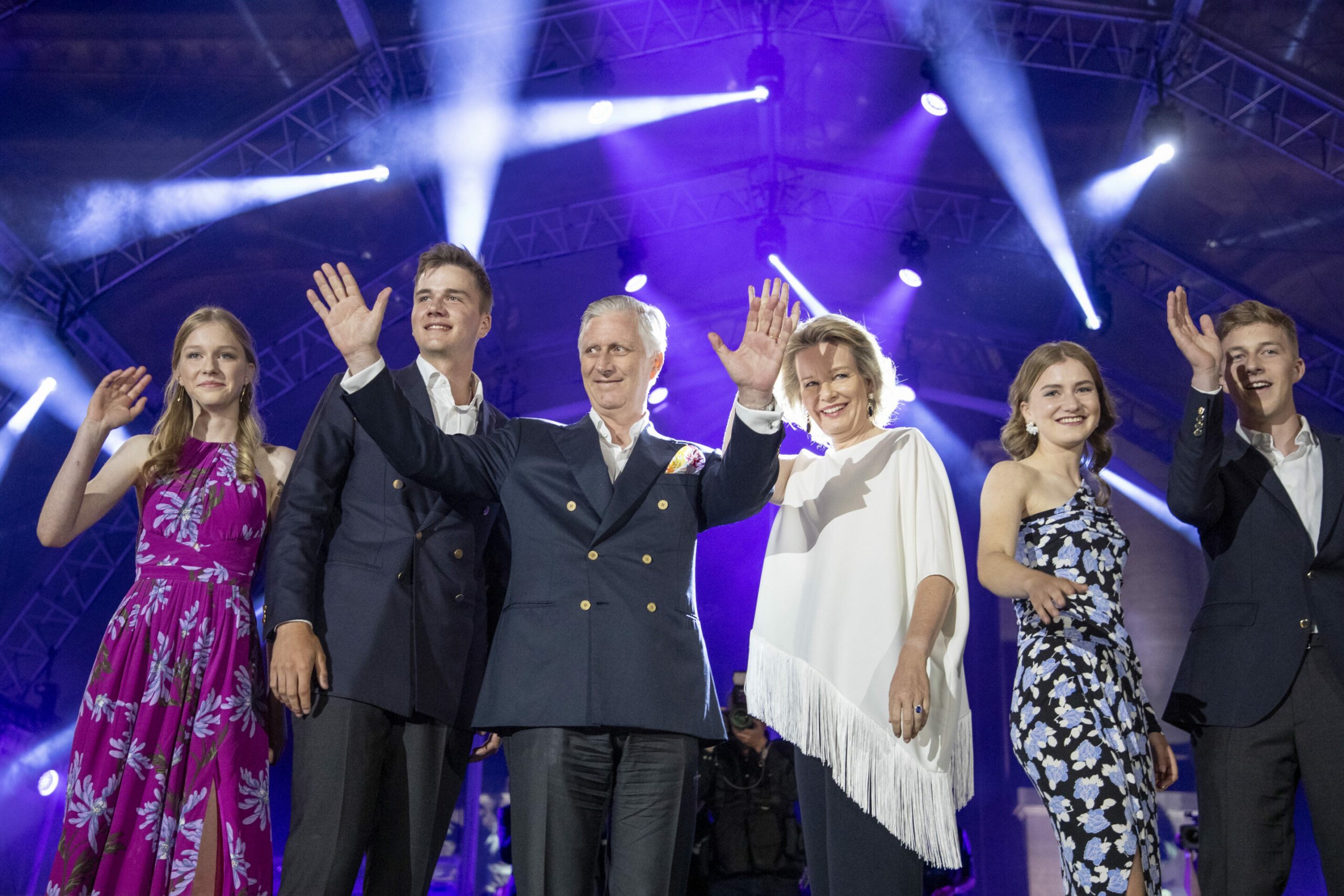
Princess Eleonore, Prince Gabriel, King Philippe, Queen Mathilde, Crown Princess Elisabeth and Prince Emmanuel pictured on the podium at the end of the 'Belgium Celebrates' event, at the Parc du Cinquantenaire in 2023. Credit: Belga/Nicolas Maeterlinck.
In light of the growing separatist movement in Flanders and the first tenure of an openly independentist prime minister, this is a sensible message to convey.
The message of unity extends to other subjects, such as racism, which the king addressed a few years ago.
The King has also used his platform to speak out against racism. Xavier Baert, director of communication at the Royal Palace, told us that in 2020, “the monarch spoke out against racism at a time when Vincent Kompany was still coach of Anderlecht and was subjected to racist chants at the Club Brugge stadium, among other places.”
The topic of racism is said to be of particular importance to the King, and he used his national day speech to take a firm stance on this topic, in stark contrast to the typically balanced and neutral tone used in other speeches.
“The King really does not think that [the racist abuse] is okay, and he has said so," said Baert. "You know that not everyone supports such a statement, but that is also the role of the king: he tries to build bridges between all parts of society as much as possible."
King Philippe’s address broke the mould. De Poorter believes this showed that the King, while a constitutional monarch, was willing to stand up and address perceived injustices within Belgian society.
“Within his role as head of state, Philippe is certainly not colourless," he argued. "His father Albert remained more on the surface. He made only one exception to this in 2012, when the formation of the government was taking a little too long. He vehemently opposed this, mainly through his body language, but also by saying that they should get on with it. King Baudouin always referred to God – 'God protect Belgium' – but Philippe is careful not to do so. He fears that this would conflict with the neutrality expected of him.”
Credit: Belga/Nicolas Maeterlinck
De Poorter, who is himself a speechwriter, believes that King Philippe has been largely successful with his speeches, delivering calm and collected appeals to the nation and treading the line between neutrality and calls for social justice.
“He cannot deliver speeches like those of Martin Luther King or Obama, who left their mark," said De Poorter. "They did so at historic moments, with brilliant speechwriters at their side who kept working on their speeches until they were masterpieces. Philippe doesn't have people of that calibre. He's not an exceptional orator himself, and he knows it.
“He does his job well, but whether he really enjoys it is another matter. I suspect he still prefers kitesurfing or cycling.”
