
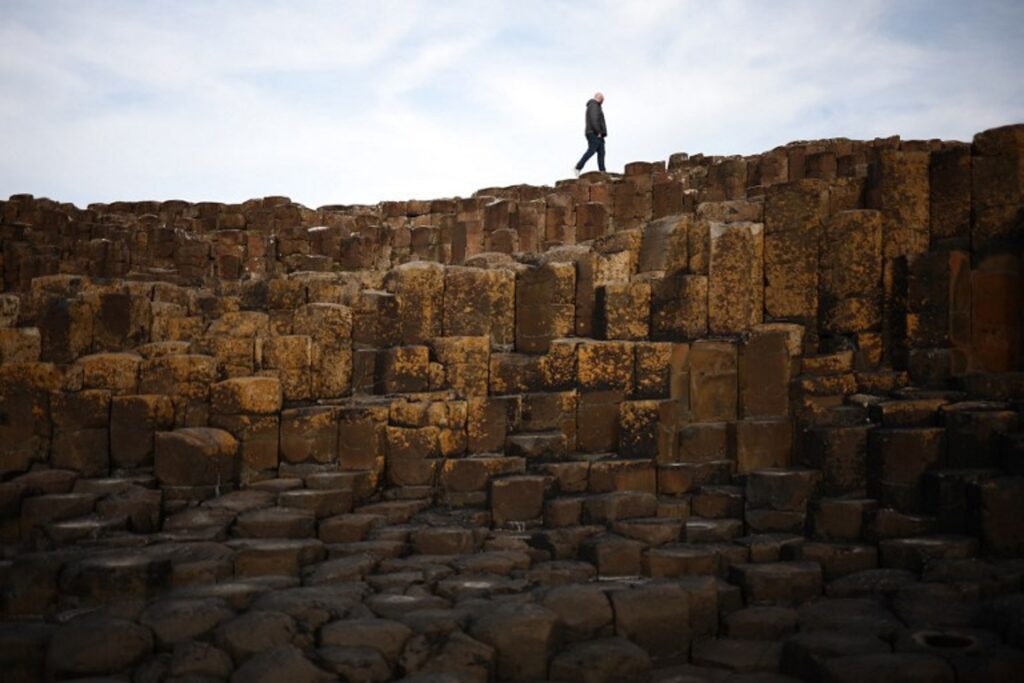
Visitors to the Giant’s Causeway, a renowned natural tourist attraction on the Northern Irish coast, are being urged to stop wedging coins between the stones, as this superstition is causing significant damage.
Tourists have, for decades, inserted thousands of coins into the rocks and crevices at the site, hoping to attract “love or luck,” according to Cliff Henry, who oversees the site for the National Trust, an organisation managing numerous British heritage sites.
The Giant’s Causeway is a spectacular volcanic formation attracting nearly a million tourists each year, comprising approximately 40,000 vertical basalt columns interlocking along the coastline, resembling a paved road disappearing into the sea.
Geologists state this natural phenomenon was formed by a basaltic lava flow around 60 million years ago, shaped further by wave erosion over time.
Legend has it that the causeway was created by the Irish giant Finn McCool, and it is reputed to have magical powers. The site was designated as a UNESCO World Heritage Site in 1986.
However, coins left by visitors rapidly rust, leaving unsightly brown stains and expanding to sometimes triple their original size, which chips away at the rock, highlights Cliff Henry while inspecting the columns.
A 2021 report by the British Geological Survey confirmed the severe damage caused by these coins, stressing the need for action, according to Henry.
Signs have been installed around the Giant’s Causeway urging tourists to “leave no trace” of their visit.
Tour guides, like Joan Kennedy, are now tasked with politely yet firmly instructing tourists to keep their coins in their wallets.
The National Trust and the Causeway Coast & Glens Heritage Trust have conducted tests to determine whether stonemasons could remove the coins without causing further damage, with successful results, Henry reports.
The cost of removing all the coins is estimated at £30,000 (approximately €34,800).
