

Despite its almost universal availability, the 5G network is still barely used in Belgium.
A new report by the Belgian Institute for Postal Services and Telecommunications (BIPT) has shown that mobile data usage has more than tripled in five years.
The number of SIM cards bought by individuals with active data usage has increased by 15% over the same period. The average monthly mobile data consumption rose from 3 GB per month in 2019 to 10.1 GB in 2024.
Yet, out of this astronomical rise in mobile data use, only 17.9% of mobile network operators' data traffic passes through 5G, the fifth generation of wireless cellular technology. It is designed to offer higher upload and download speeds, more consistent connections, and improved capacity than previous networks.
These low 5G usage figures do not reflect the high coverage of Belgium, which has been further strengthened this year. In February, 99.78% of Belgian households had access to 5G – up from 87.5% of the year before.
Remarkable progress
Overall, the coverage in Flanders has been much more advanced than in Wallonia, which is not unsurprising as the roll-out permits were signed by the regional Flemish Government two years before its Walloon counterpart. Brussels, however, was the last region to sign off on its 5G roll-out just over a year ago.
The original rollout was delayed in 2019 due to disagreements between regional governments on how to divide up the income from handing the 5G rollout rights to an internet provider. Two years ago, Wallonia lagged behind Europe in its roll-out, but this year's map by nPerf showed the remarkable progress the region has made.
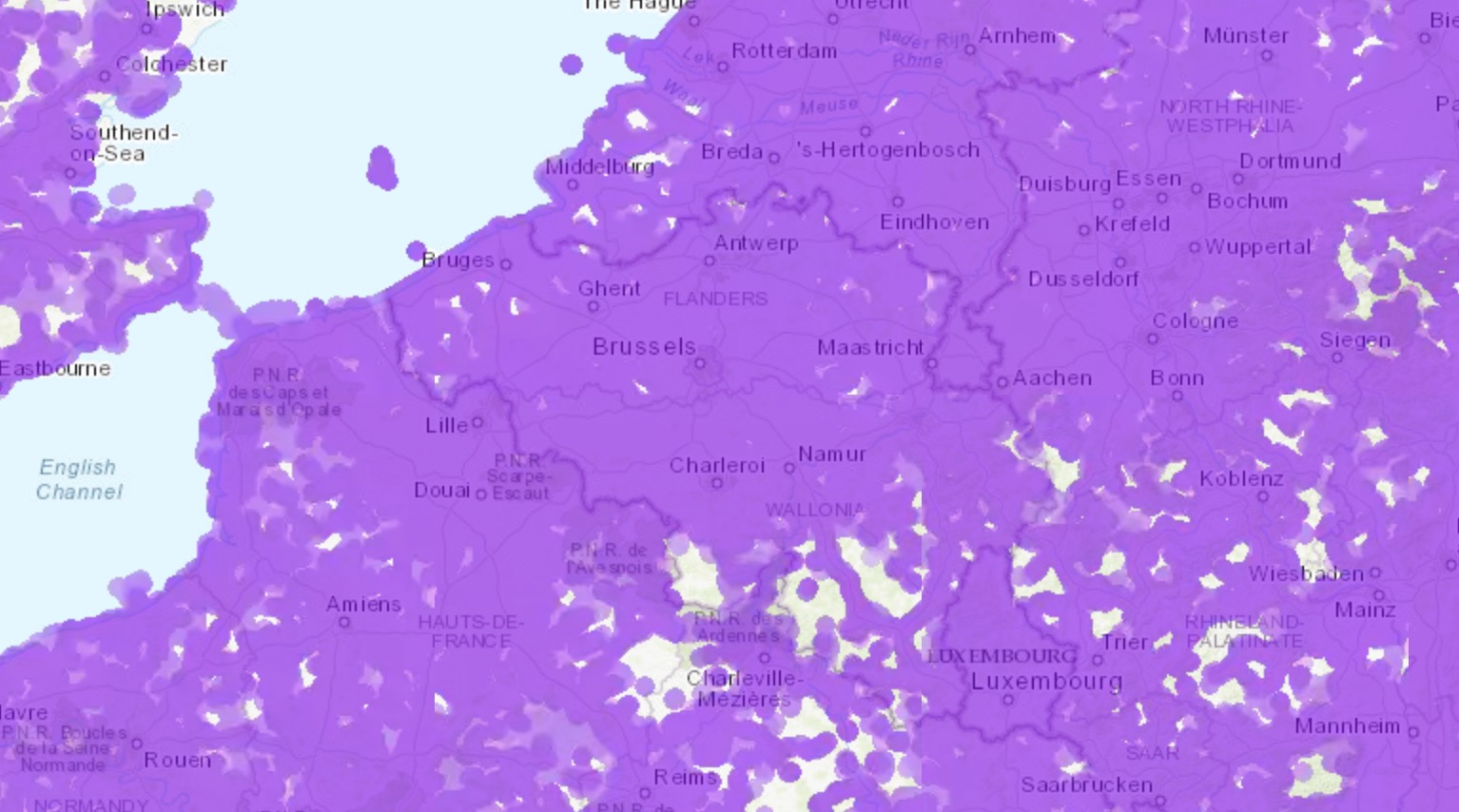
5G coverage in Belgium in 2025. Credit: nPerf
The next phase will consist of densifying 5G networks by exploiting what is known as ‘5G Full’ in densely populated areas, such as cities. This phase coincides with the gradual phasing out of 3G networks by all operators, according to an analysis by BeMobile in January.
According to BIPT's report, only 1% of mobile network operators' data traffic still passed through the old 3G network in 2024, the same as last the year before.
Proximus' 5G coverage is dense in most cities and urban areas, with just south of the province of Namur and the Province of Luxembourg still lagging behind. Between Brussels and Namur, the 5G signal is now almost constant.
Orange was late to roll out 5G, but is now accelerating its deployment, particularly in Wallonia. It is also the operator that seems to be developing the most ‘full 5G’ sites, with a focus expanding it on urban areas.
4G still dominates
Last December, the sluggish rollout of 5G was identified as one of the "weak points" of Belgium's digital economy in a report by the Ministry of Economy. It highlighted that the country was lagging behind the rest of Europe.
However, a spokesperson for technology federation Agoria clarified at the time that figures in the report were "mostly outdated" – underlining Belgium's record internet infrastructure to meet EU targets.
Last year, 4G network was still the most widely used network in Belgium, but its use is declining: from 91.6% in 2023 to 81.2% in 2024. This is offset by the rise of 5G3: an increase of 7% on an annual basis to reach 17.9%, according to BIPT’s new report.

A mobile mast sitting atop the Proximus building in central Brussels. Credit: Needpix
For now, Belgium is not phasing out 2G, as this technology is still used for Internet of Things (IoT) connections. Their growth rate is no less than 21% per year, bringing their total number to over 9 million.
The IoT connects physical objects to the internet to collect and exchange data. Despite it being designed for 5G networks, it is able to operate via 2G connections.
More than half (i.e. 5.54 million) of IoT connections use an authorised mobile network, while just under half (48.7%) of this group use 2G. This represents a significant decrease from 66.8% in the previous year.
The number of IoT connections via 5G remains limited, with around 17,000 connections, which accounts for only 0.3% of the total.
