
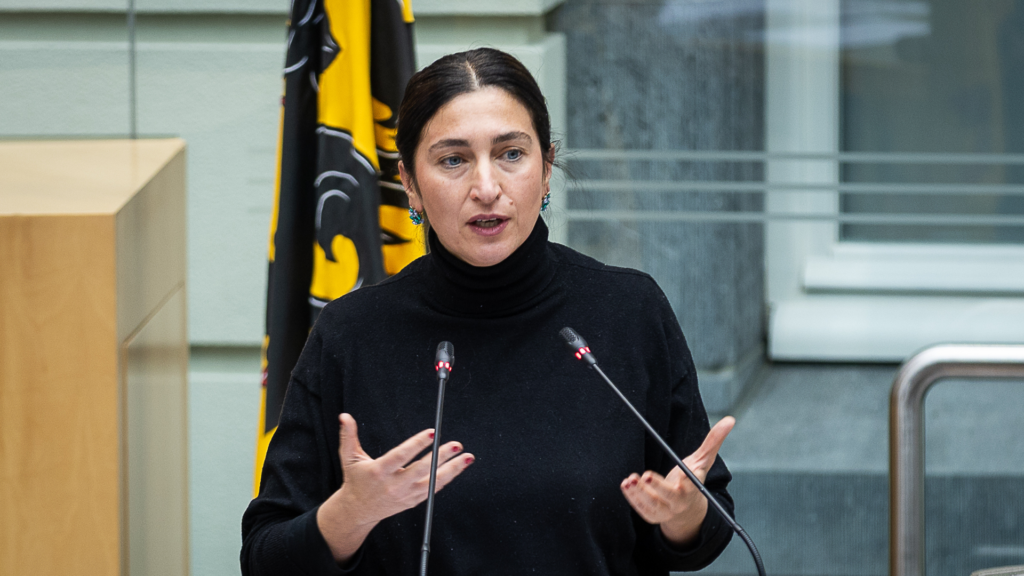
The Flemish Parliament has approved new minimum standards for nursery and primary education, introduced last month by Education Minister Zuhal Demir (Nieuw-Vlaamse Alliantie (N-VA).
An expert committee led by Professor Daniel Muijs of Queen’s University Belfast formulated the new standards, which outline essential learning outcomes for nursery and primary school students, replacing guidelines from 1997.
They draw on the English model, focusing on a knowledge-rich curriculum, effective teaching methods, and strong classroom management.
The underlying aim is to raise standards
The underlying aim of this redefinition of educational objectives is to raise standards, as Flanders has seen its educational performance decline in recent years, despite traditionally being at the top of the league.
In early May, the committee of some 70 experts presented the results of its work: a list of more than 1,000 items of knowledge or skills, all of which pupils are expected to learn in nursery and primary school.
Persons involved in education then had their say, and the list was trimmed down somewhat: some items were duplicates, others seemed too time-consuming and would not have left teachers enough leeway.
Common thread: early acquisition of knowledge
The list ranges from colouring evenly within the lines, for nursery school children, to knowledge of the principles of a democratic state, at the end of primary school, for example. The common thread running through these "minimum targets" is knowledge.
One of the aims is for children to start acquiring knowledge earlier. Whereas in 1997, it was expected that preschoolers would be able to distinguish the characters of a letter, they would now need to be able to recognise at least 15 letters and pronounce their sounds. In Mathematics, preschool children must have learned to count from zero to 20.
Another example: in the third year of nursery school, five-year-olds should soon know that they live in Belgium, know the name of a local river by heart and have already heard of the Nile.
Learning geography
In the fourth year of primary school, this evolves into the ability to locate one's own region, know all the Belgian provinces, and be able to name well-known places such as the Hautes Fagnes (High Fens), but also to know where Belgium is in relation to neighbouring countries.
A ten-year-old child should soon be able to say where the Mediterranean and the North Sea are and, with a bit of luck, will also know all the continents.
Sixth grade pupils will prepare fo geography, quickly learning all the countries of the European Union and their capitals, as well as identifying world powers such as China and Russia.
Gradual implementation
The Flemish government has opted for gradual implementation. Nothing will change next year, except for schools that wish to voluntarily integrate the new objectives already. In 2026-2027, nursery schools and Grades 1 to 3 of primary school will already integrate some of the new objectives in Dutch, Mathematics, Science and Technology.
In 2027-2028, Grades 1 to 3 must adopt the minimum targets in all subjects.
Grades 4 and 5 of primary school will change their curriculum at the same time in the core subjects (Dutch, Mathematics, Science and Technology), with Grade 6 following in 2028-2029. All objectives will be compulsory in Grade 4 from that same school year onwards, and then in the higher years in subsequent years.
Opposition parties questioned the feasibility of rapidly implementating the new standards. Groen proposed postponing the entire reform by a year, but this was rejected.
PvdA, Groen oppose bill
Education organisations also called for adequate time and resources, warning of potential disparities between “A” and “B” schools.
The opposition Open VLD party supported the decree, with party member Stephanie D’Hose emphasising the importance of early investment to reduce remedial efforts in later years.
Vlaams Belang abstained, calling for a broader societal discussion..
The Belgian Workers’ Party, PvdA, voted against the draft. PvdA's Line De Witte highlighted the challenge of achieving high standards which, she argued, requires making teaching more attractive.
Groen also voted against the draft. The Flemish Greens anticipate problems due to inadequate preparation in secondary education and in model schools, which are not yet completed. Moreover, the Flemish tests have not yet been adjusted, Groen’s Kim Buyst noted.
