
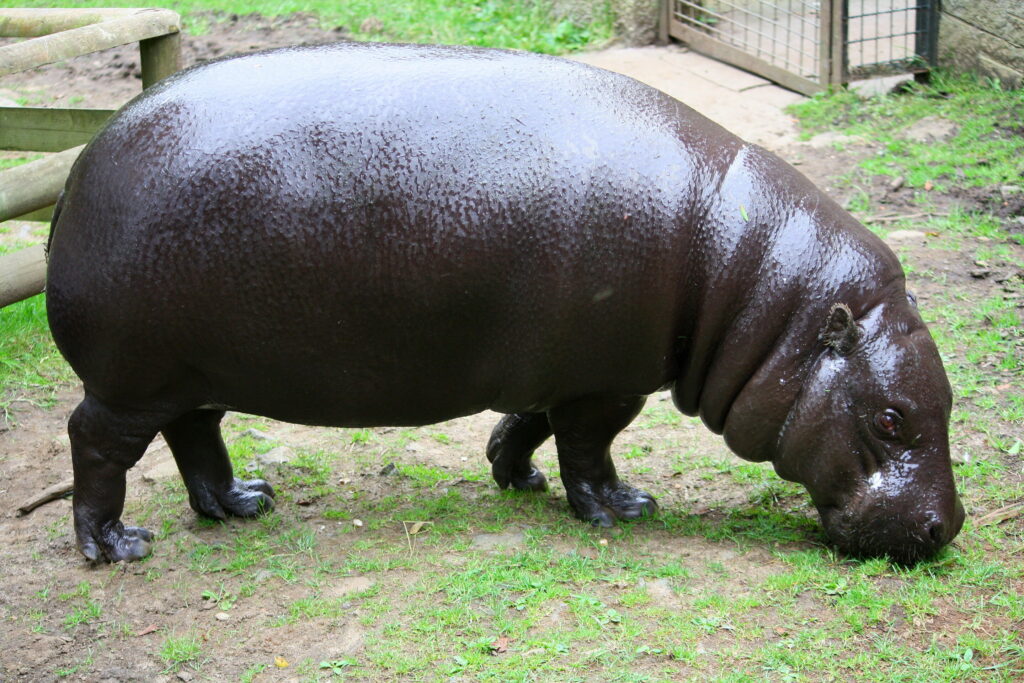
Zoo Antwerpen has joined a breeding programme for pygmy hippos, a species under threat.
Female Nimba from Denmark and her French partner Dabou, who will move to Antwerp this autumn, will be housed in the historical Hippo House at the Marsh Biotope. This marks the return of pygmy hippos to the zoo after a 26-year absence.
It is estimated that only 2,500 pygmy hippos remain in their limited West African habitat, which includes Liberia, Sierra Leone, Guinea, and the Ivory Coast. Their environment is being lost due to deforestation, and they are hunted as bushmeat. Besides humans, crocodiles and leopards are their natural predators. Currently, 130 pygmy hippos reside in 64 European zoos.
A mature pygmy hippo weighs between 180 to 275 kg, roughly a tenth of an ordinary hippo’s weight. “The pygmy hippo is much smaller and somewhat shyer than its larger relative,” says zookeeper Gunter. “They live alone and spend more time on land. We’ve provided spaces where they can retreat, but visitors can still admire them without disturbing them. They have a charming look. I believe everyone will quickly become fond of them, just as we have.”
The pygmy hippos will reside in the Hippo House, which was originally built in 1885 but largely destroyed during World War II. It was reconstructed in 1952 with its original water basins and expanded in 2003 with Hippotopia, an area that includes swampbirds, curly-haired pelicans, coypu, and tapirs. The building has now undergone a sustainable renovation, including exterior upgrades and expansion of the sun terrace for an elevated view of the habitat. An indoor shelter with warm stones enhances the enclosure, prioritising animal welfare.
Alongside the pygmy hippos, a pair of white-crested turacos and white-headed buffalo weavers share the Marsh Biotope, along with a group of palm fruit bats, a first for Belgium. They roost in trees or the vines hanging from the ceiling. Palm fruit bats have a wingspan of up to 80 centimetres and resemble dogs or foxes with their pointed, long snouts. Unlike bats, they rely on their keen sight rather than echolocation and dine on fruit and specialised bat food.
The carers are already fans. “They’re incredibly charming creatures. They’re quite curious, with ears that swivel in all directions. Their bead-like eyes twinkle kindly, and each bat sports a unique appearance.”
