
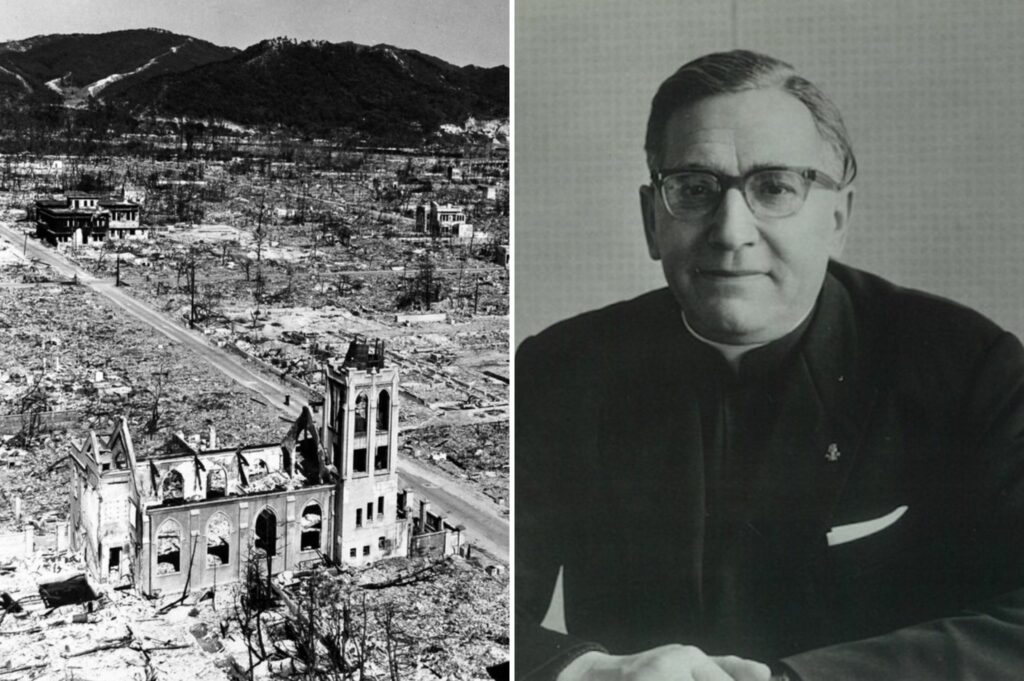
In the wake of Hiroshima’s nuclear holocaust, exactly 80 years ago this week, Belgian Jesuit priest Father Ernest Goossens returned to the city in 1945 having been moved to tears by its destruction.
On 6 August that year, the United States detonated an atomic bomb on Hiroshima, targeting Nagasaki three days later. The damage was unquantifiable, with up to 140,000 people killed in Hiroshima and some 60,000 in Nagasaki. Many died from the blast itself, while others suffered the adverse effects of radiation for years.
Father Goossens vowed to be part of Hiroshima's reconstruction. He embarked on a new project to help survivors heal from the trauma of this nuclear attack – which led to the end of the Second World War – with the power of music.
Prior to the war, the Jesuit priest had been working in Japan as a missionary at one of the city's Catholic churches. It is unclear when he exactly arrived to the country, but there is evidence of his internment during the war.
When Japan, allied with Nazi Germany, declared war on the United States and Britain on 8 December 1941, it was decided that same day to intern all the residents from the enemy countries. They were accused of having spying and engaging in subversive anti-Japan activities – which also happened to Japanese people in Allied countries.
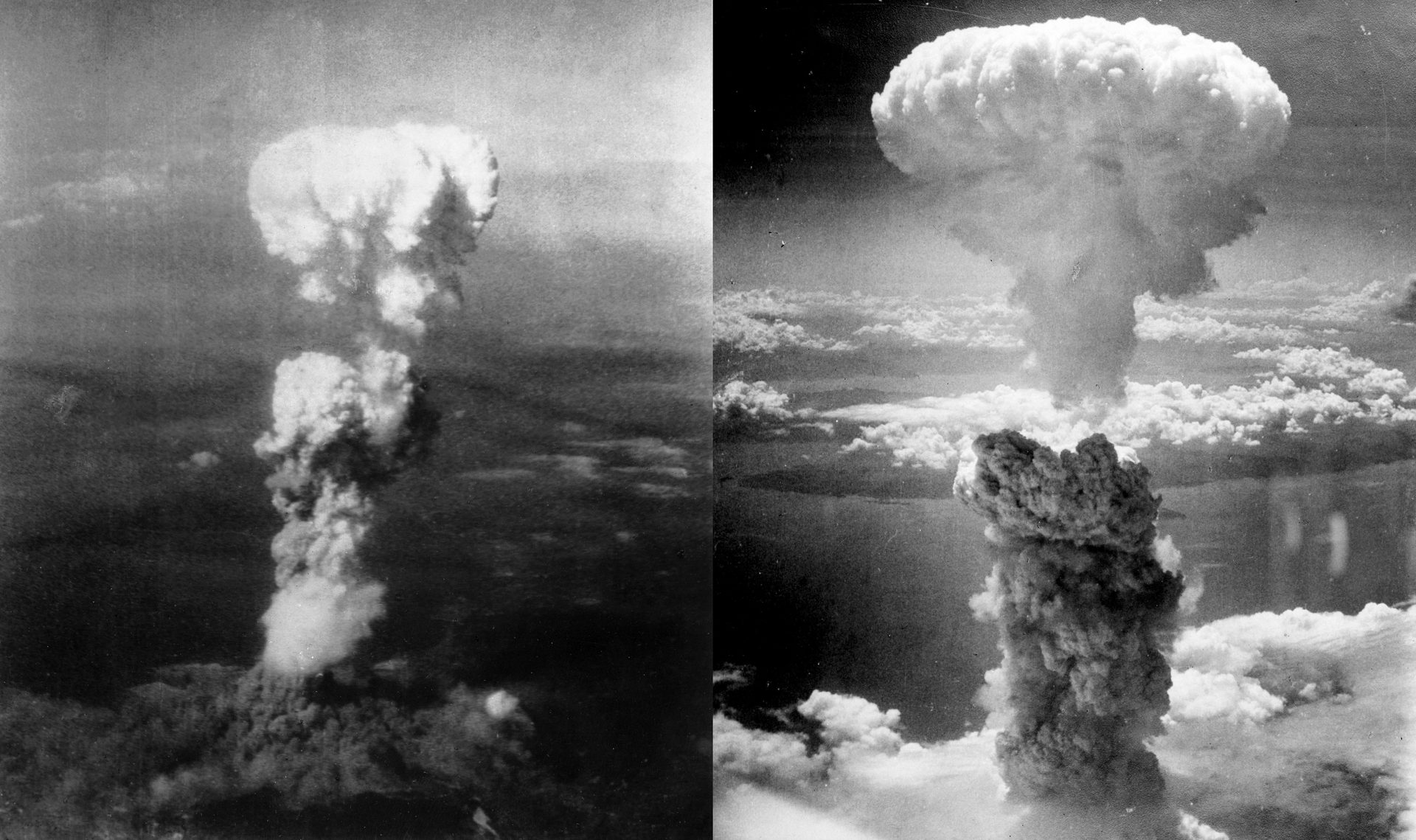
The nuclear bombing of Hiroshima (left) and Nagasaki (right).
Goossens was a part of these 'foreign enemies'. He was taken a rudimentary camp in Miyosih-cho, Futami County. It was located in the middle of a large rice field, which was surrounded by a wooden fence in 1942 when it officially became the Internment Camp of People from Enemy Countries.
The treatment of prisoners of war (POWs) in Japan was brutal due to the regime's policy of forced labour. Most POWs were made to work on intense construction projects, war-related industries and infrastructure projects for hours on end in awful conditions. They were beaten for minor infractions, starved and denied medical treatment.
Luckily, civilian internees like Father Goossens did not face the same level of labour demands as military prisoners, even if they still faced hardship and high death rates.
Goossens was interned with other Catholic sisters from Europe and the US, as well as a number of Dutch and British civilians. They remained there until they were forced to return to their home countries by an exchange ship, in September 1943, according to an account of Hiroshima prison camps by Japanese historian, Shigeaki Mori.
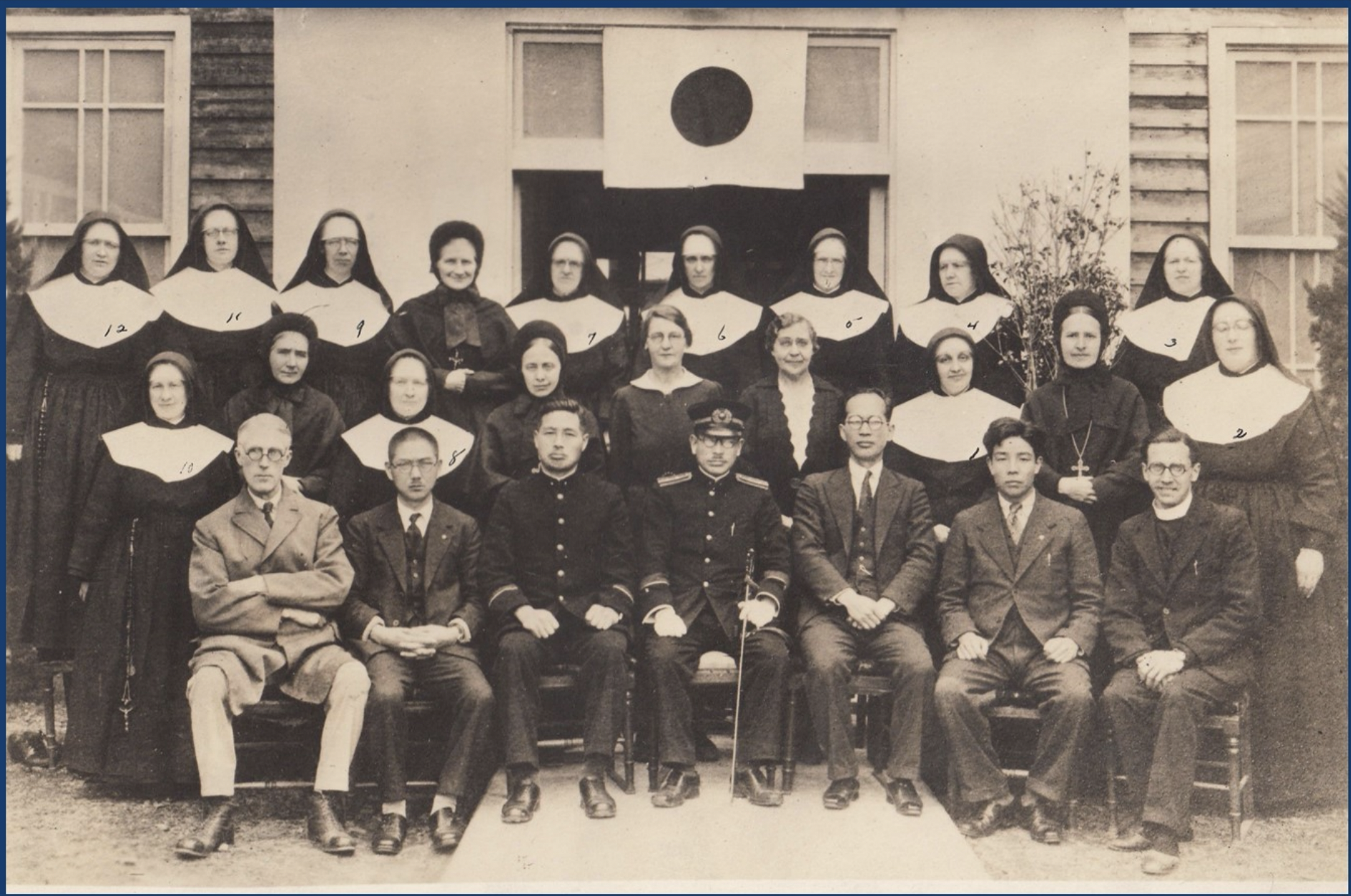
Staged photograph of Japanese internment camp: Father Goossens is front row, far right. Alongside him are Sisters of Notre Dame de Namur, other lay sisters, Protestant missionaries, an English doctor, and Japanese police officials who ran the camp.
Having been spared from one of history’s most deadly moments, Father Goossens must have reacted with horror as the first reports of Hiroshima being razed to the ground by an atomic bomb on 6 August 1945.
On that fateful day, a number of German and Spanish Jesuit priests, who having avoided internment due their country's allegiances, miraculously survived the blast despite having been a few kilometres away from the epicentre.
The priests were located inside the Assumption of Mary Cathedral, also known as the Noboricho Catholic Church, where Father Goossens is also believed to have worked prior to his internment.
Amid a sea of destruction, a large part of the church’s original structure survived the nuclear attack. Today, the Memorial Cathedral for World Peace stands in its wake, which the surviving Jesuits helped rebuild in the 1950s.
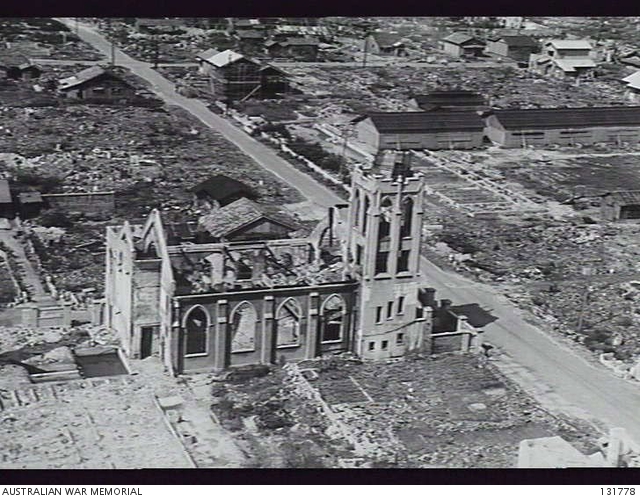
The ruins of the Hiroshima Noboricho Catholic Church one year after the atomic bomb was dropped (1946).
After the war, Goossens was also determined to help rebuild the city. He sought to convey a message of peace and inner healing for nuclear attack survivors through music. Next to the church, he opened a small music school for young people in a Quonset hut on the ruins of the city in 1947.
Amidst the chaos of post-war Japan, Goossens saw the school as a unique tool to give the young a new meaning in their quest for healing through the arts. In a short space of time, the school attracted around 100 students.
In April 1948, it officially became the Hiroshima Music School after having received official recognition. A few years later, the school received the official patronage of Belgian Queen Elisabeth, wife of King Albert I, who also gave her name to the institution in 1951.
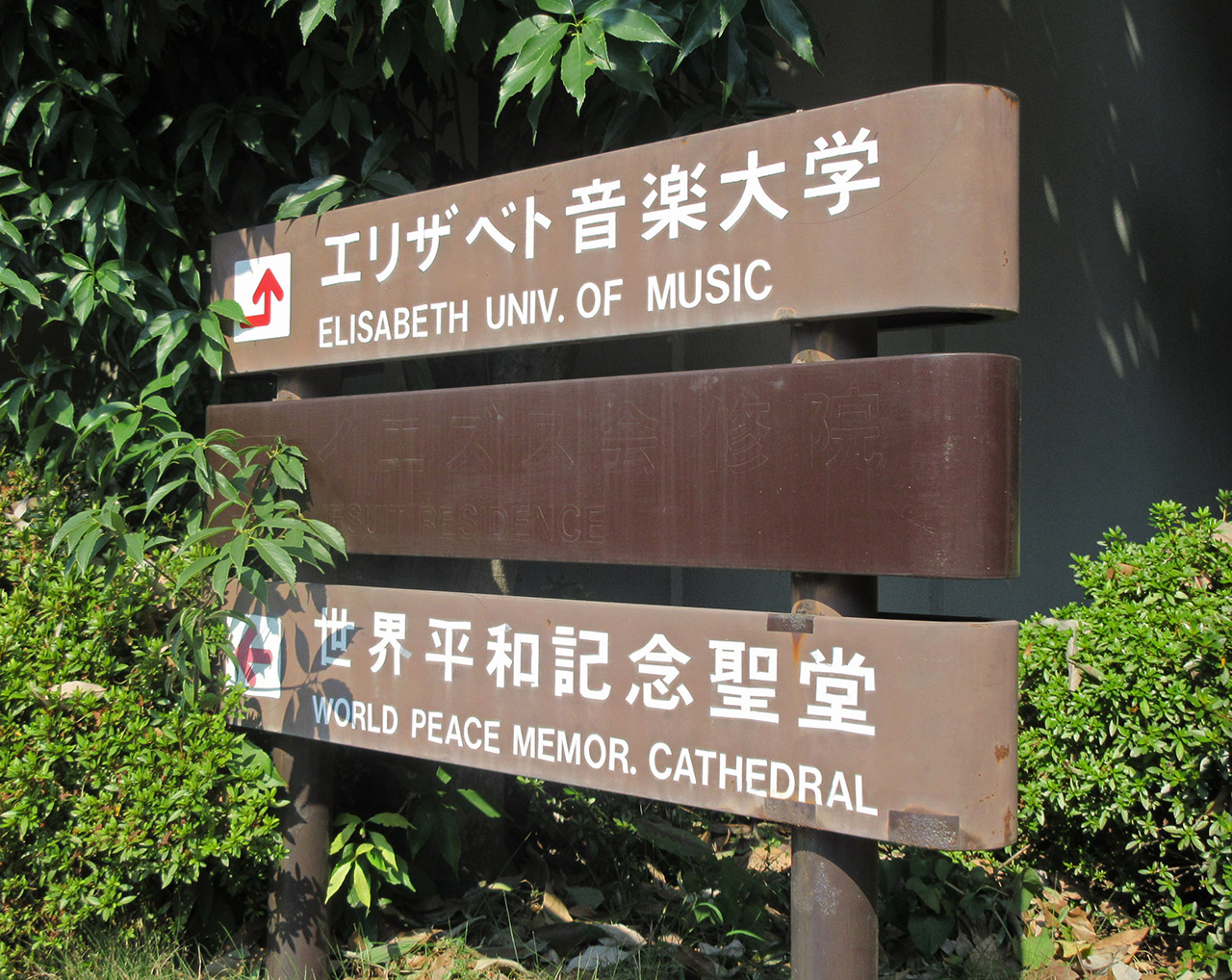
Sign for the Elisabeth University of Music and the World Peace Memorial Cathedral. Credit: Jesuits Global
It became the Elisabeth University of Music after becoming an official university in 1961, with Father Goossens still at the helm. It was run by Jesuit priests but also secular professors as the university began to expand receive support from the government in the 1960s.
Father Goossens welcomed Queen Elisabeth's grandson, King Baudouin and his wife Queen Fabiola during an official visit in 1964. At the university, the Monarchs were treated to a concert before sitting down to meet students and parents.
Today, the university remains a centre of musical excellence, notably for its teaching of the organ, the study of Gregorian and polyphonic chant, its institute of oriental religious music, and its support for Japanese religious music composers.
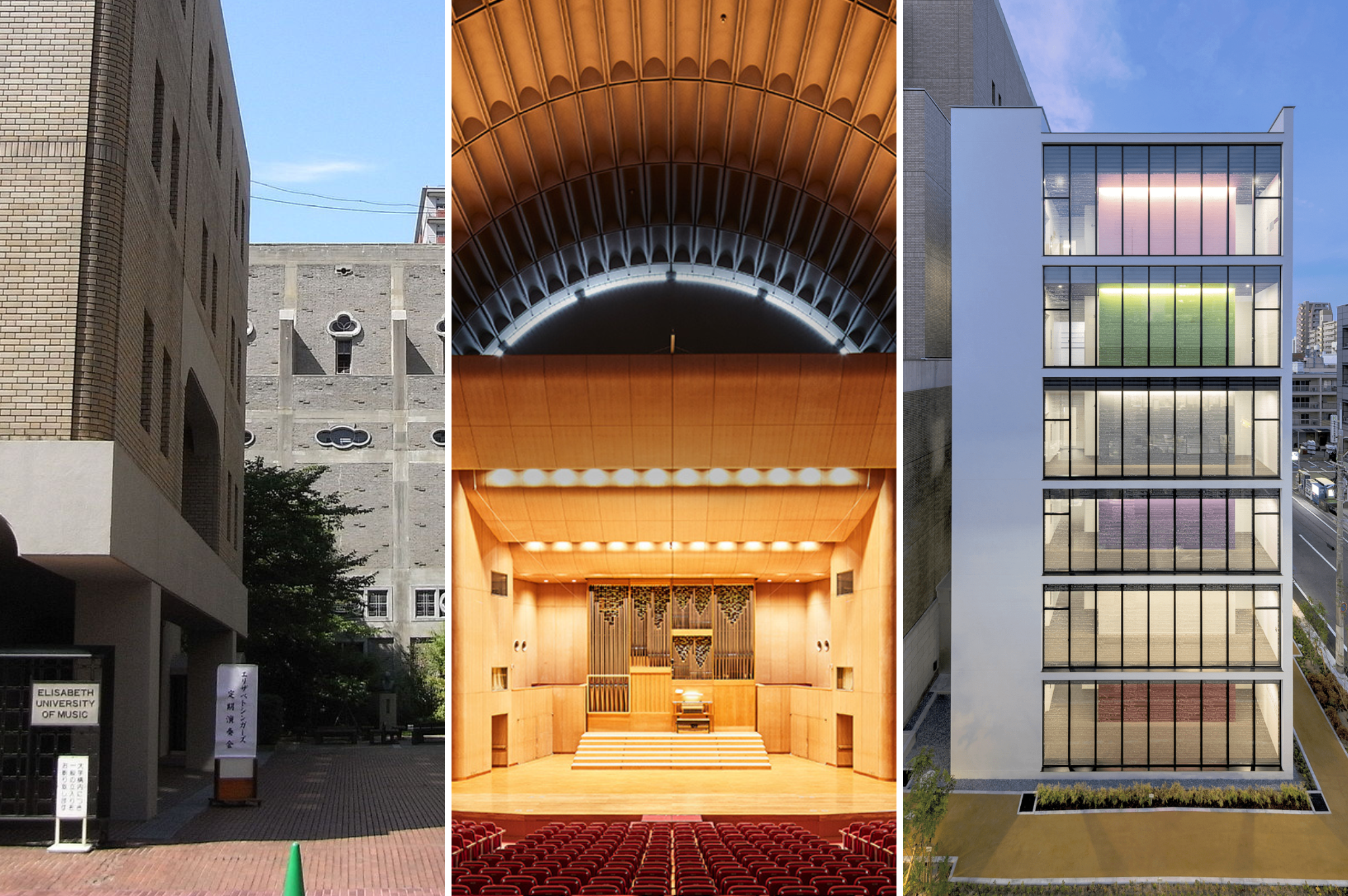
Elisabeth University of Music in Hiroshima today. Credit: Official Website / Jesuit Conference of Asia Pacific
Goossens died in 1973, yet his contribution to Hiroshima’s post-war spiritual reconstruction has been largely forgotten in his home country, with sparing details about his life.
But the university still lives on, as does the memory as its founder, 80 years since the dropping of the nuclear bomb on Hiroshima.
This week, some of the last remaining survivors of the bomb issued a warning to the world to not repeat the same mistakes of the past in an era of growing international instability.
They called on world leaders to avoid nuclear wars at all costs – showing Father Goossens’ message extended well beyond music, with its call for global peace (through music) still echoing today.
