
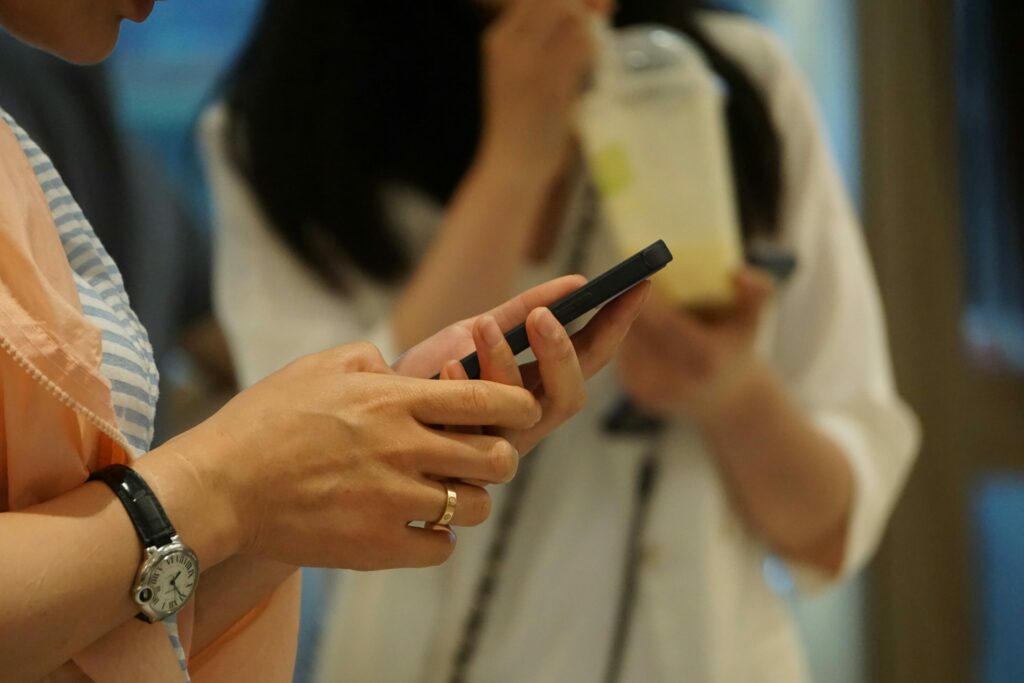
From the 2025-2026 school year, the use of mobile phones and other electronic devices will be banned nationwide in primary and secondary schools, with just a few exceptions.
Belgium’s regional governments have adopted different strategies for regulating the ban on smartphones and other connected devices in schools.
While all regions enforce strict bans for primary and secondary schools, Flanders has chosen a decentralised approach. Schools across Belgium will, however, decide their own policies on sanctions.
French-speaking community (Wallonia and Brussels)
In Wallonia and the Brussels-Capital Region (collectively under the Wallonia‑Brussels Education Network (FWB/WBE)), the use of smartphones and other connected devices in primary schools is completely prohibited, starting from the 2024‑25 school year. In secondary schools, their use was strongly discouraged rather than banned outright.
Further formalising this, the Government of the French Community has enacted a decree that from the start of the 2025‑26 school year, recreational use of mobile phones and connected devices is banned in pre‑primary, primary, and secondary schools across all networks.
Exceptions apply for educational purposes, urgent contact with parents, and health-related needs (e.g., medical devices). Schools retain flexibility in how they implement the ban and set penalties; however, the prohibition itself is non-derogable.
German-speaking community
The German-speaking community has closely followed the French-speaking community. From the start of the 2025-26 school year, the use of smartphones, smartwatches, and other connected devices will be banned in all primary and secondary schools, not only during lessons but also during breaks.
Schools will determine the practical details, exceptions, and disciplinary mechanisms, with support available from regional health bodies such as Kaleido for implementation.
Flanders (Dutch-speaking community)
The Flemish government has already introduced a ban in pre-primary and primary schools but not all secondary education. The new ban extends to secondary school but restrictions are tiered by grade level:
For the first and second grades of secondary education, a total ban will apply, both during lessons and in the playground. For the third grade, the ban will only apply during the lessons. The same rules apply to other devices such as smartwatches.
Exceptions are permitted for medical reasons, care responsibilities, or educational purposes, such as media literacy lessons. Schools may determine sanctions for rule-breakers
Broader context and rationale
The Belgian bans are part of a wider European movement to curb the influence of smartphones in schools. Flemish Education Minister Zuhal Demir emphasised last December to VRT (following the Flemish government’s decision) that the disconnection measure is intended to improve pupils' concentration as well as the overall school climate.

Flemish Education Minister Zuhal Demir emphasised last December to VRT (following the Flemish government’s decision) that the disconnection measure is intended to improve pupils' concentration as well as the overall school climate. Credit : Unsplash
European policymakers argue that constant access to devices undermines students' ability to concentrate in class, contributes to rising levels of stress and anxiety, and facilitates cyberbullying. Studies across Europe have suggested that reducing screen exposure during the school day can improve both academic outcomes and pupils' overall well-being.
UNESCO has repeatedly called on governments to regulate the use of digital devices in classrooms. In its 2023 Global Education Monitoring Report, the organisation noted that around one in four countries worldwide already restrict or prohibit mobile phones in schools, with particular momentum in Europe. France, for example, introduced a nationwide ban in 2018 for all pupils under 15, while the Netherlands applied similar restrictions only last year.
The rationale is not only about classroom discipline but also about tackling what some researchers call "digital dependency". Adolescents spend an average of three to four hours per day on their phones outside school, raising concerns about attention spans, sleep quality, and mental health.
Bans during the school day are seen as a way to create a "digital break" and encourage direct social interaction among pupils.
