
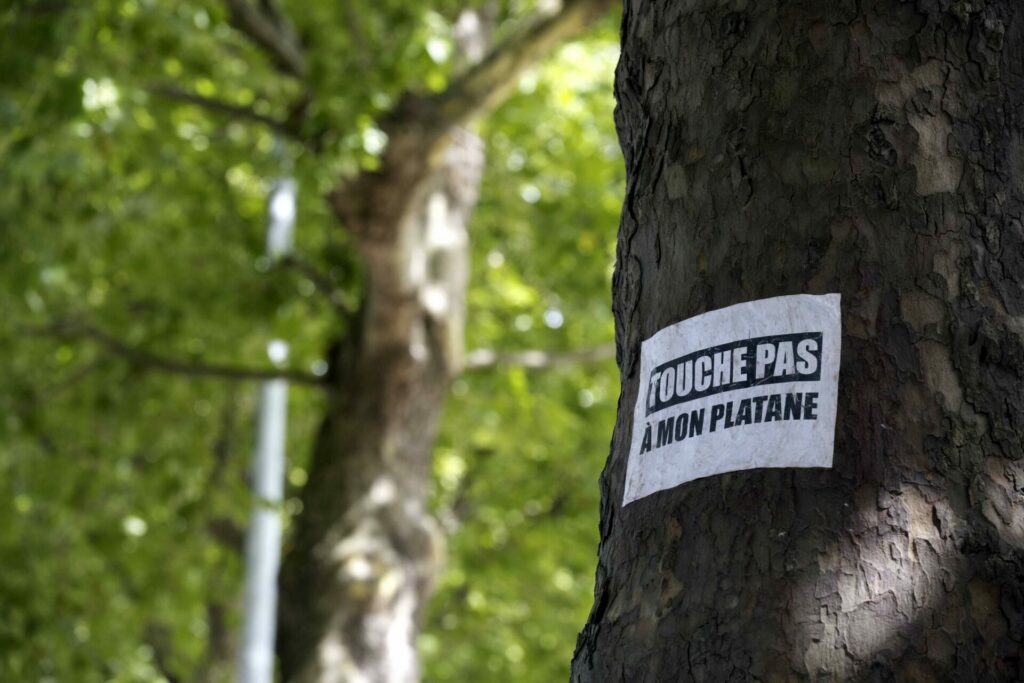
Hundreds of people gathered on Sunday in Te Boelaer Park, Borgerhout, for a protest organised by Collectief Ongehoord against the felling of trees across the city.
The group called on Antwerp’s city council to better protect urban greenery, highlighting their demands in an open letter signed by over 1,900 people so far.
Tensions escalated recently when authorities cut down around 50 trees on Drakenhoflaan and Boekenberglei in Deurne-Zuid to make way for a new tram turning loop. Strong opposition from local residents, including protests that led to several arrests, prompted the city to temporarily halt the work.
“After everything the neighbourhood has been through this week, it would be a small step to go back to the drawing board, this time actually consulting the community,” said Lode Daelemans of local action group Juiste Spoor during a speech that was met with loud applause.
Other neighbourhood groups also took the stage during the event to voice concerns about additional tree losses linked to planned infrastructure projects. These include redesigns of the R11-Prins Boudewijnlaan intersection and new cycling highways at Saffierstraat in Berchem and Wouter Haecklaan in Deurne.
Mobility expert Dirk Lauwers criticised Antwerp’s alderman for mobility, Koen Kennis (N-VA), in a scathing comment. “This overly powerful alderman fails to understand that removing trees for traffic projects is no longer acceptable in today’s climate.”
The speeches were interspersed with music and poetry as part of the protest festivities. Collectief Ongehoord estimated the event attracted approximately 800 participants. “We’re not surprised so many citizens are concerned about greenery in our city,” said Lily Smeyers of Allez Allée and Collectief Ongehoord. “This action aims to raise awareness about urban green space loss and push the city council to reconsider projects that threaten trees, offering alternative solutions in consultation with local communities.”
The group revealed that 2,000 trees are currently at risk due to approved municipal projects. “Many of these projects have viable, less invasive alternatives that would preserve the greenery,” Smeyers explained. While praising Antwerp’s goal of becoming climate-neutral and climate-resilient by 2050, she criticised the ongoing felling of trees, including mature Future Trees, as “incomprehensible and unacceptable,” given their vital role in cooling, providing shade, and supporting biodiversity.
