
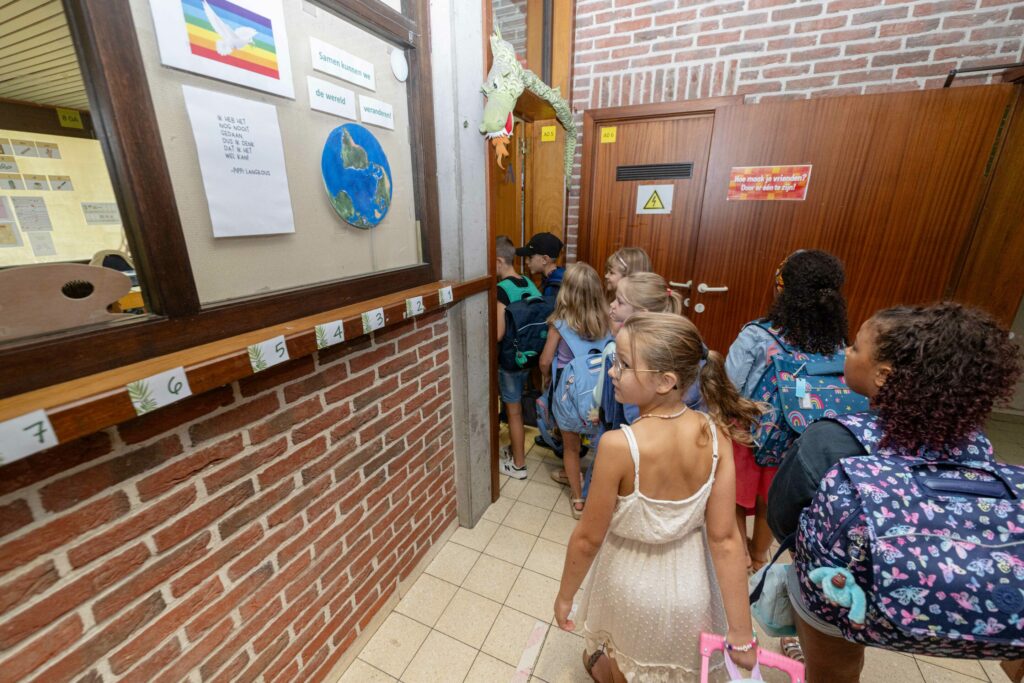
As the school year has again started in French-speaking Belgium, Francophone education minister Valérie Glatigny (MR) said that she hopes that Flemish education will adopt their school calendar, with shorter summer holidays.
The French Community changed its school calendar in 20222. Since then, pupils in Wallonia and French-speaking schools in Brussels have a summer holiday of six weeks (instead of eight), and longer autumn and spring breaks to make up for it.
This means that pupils in Belgium's French-speaking education system had their first day of school on Monday 25 August, while those going to school in Flanders or Brussels' Dutch-speaking schools will only go back to class on Monday 1 September.
Gatigny told La Libre that she would like the entire country to use the new Francophone calendar to structure the school year, but there is little enthusiasm for harmonisation in the Flemish and German-speaking communities. "For the time being, the minister has no plans to tinker with the holidays," the office of Flemish Education Minister Zuhal Demir (N-VA) told The Brussels Times.
Summer learning loss
A recent VRT survey showed that 45% of Flemish people would be in favour of a somewhat shorter summer vacation, compared to 28% who want to keep the current two months. The remaining respondents have no opinion on the matter.
Numerous education experts agree that Flemish education should follow the new French-speaking calendar, as it has been scientifically proven that long summer holidays are detrimental to children on an educational level.
"The phenomenon of summer 'learning loss' occurs in all children," sociologist Ignace Glorieux (VUB), who has been researching the subject for over 25 years, previously told The Brussels Times. "However, it occurs all the more in children from lower socio-economic classes, who often receive less or no stimulation at home. As a result, their learning loss is greater in September, which only exacerbates inequality."
An empty classroom. Credit: Belga/Eric Lalmand
While most middle-class children are stimulated at home and do things like go to summer camps, pick up a language abroad, visit a museum with their parents or read a book, some children do not speak Dutch for two months.
"Because the learning process comes to a complete standstill, teachers need up to a month after each summer holiday to get back to the language level before the holiday," he said, stressing that this is "obviously detrimental to the child's development."
"The summer holiday, as we know it today, is actually an anachronism that dates back to the agricultural society and is completely outdated today," Glorieux said. For him, shorter summer holidays and a more logical division of the school year could have "a major impact" and help to reduce the inequality between lower and higher social classes.
Overlapping
Additionally, the differing school schedules lead to considerable confusion for some families, particularly in Brussels, with children in both language networks. This is not only the case because the children's vacation periods do not coincide, but also because extracurricular activities and childcare during the school year have different schedules.
Teachers in the French-speaking schools system with children going to a Dutch-speaking school (or vice versa) also face organisational challenges.
As an interim measure, Glatigny decided last year to always aim for a week where holidays of French and Dutch speakers coincide during the autumn and spring breaks (with one extra week before or after for the French-speaking pupils). However, this is not always easy in terms of the calendar.
