
While gun violence in Brussels has taken over much of the public, political and media discourse this summer, knife crime remains a persistent issue in the capital year upon year. However, the current efforts to tackle it are not always effective.
In June, The Brussels Times looked at the official figures of stabbing incidents across the country, as reported by the Federal Police. The image it painted was unclear, with no distinct overall rise or decrease over the last decade.
Until 30 September 2024, for example, 118 stabbings were recorded in the Brussels-Capital Region, a somewhat comparable figure to the 120 incidents recorded almost a decade prior, in 2015.
The cause of the persistent problem is in part the ease of access to knives, according to Dr. Mattias Lucien De Backer, professor at the Department of Criminology at the Vrije Universiteit Brussel (VUB).
“It is much more difficult to purchase a gun somewhere than to find a knife because you basically have it already in your home,” he said.
Knife vs gun?
While gun violence in the capital is often connected to drug crimes and gangs, the trends behind knife crime can be more complicated for authorities to trace.
“I can imagine that in some cases [knife crime] does actually connect to drug violence, but I think the violence between different gangs will probably be done more using guns, if not only because of the fact that it's more spectacular and that it sends a stronger message,” said De Backer.
“Whereas if you use a knife in close combat, so to speak, then the purpose is much more direct,” he added. ”There's a bit of a criminological difference between the use of guns and knives.”
Police tape. Credit: Belga/Hatim Kaghat
Nonetheless, like gun violence, knife crime remains a persistent issue in the Region. But the attention it gets is often insufficient. “I think part of it is the Hollywood image of gangs that is easily adopted by the news media,” said De Backer. “The spectacle indeed adds to this dynamic.”
Additionally, he points to the fact that guns are illegal, whereas having a knife at home, for example, is not. “That also makes the media more eager to talk about gun violence.”
'Criminogenic spaces'
For the professor, solutions to knife crime cannot be found through more legal restrictions. “Knives are so democratically available,” he said. “I think from the viewpoint of the police, it's basically almost impossible to do something about knife violence.”
Instead, he argues that “the only thing” that can be done is to “tackle the reasons for wanting to perpetrate violence,” which would address more than just knife crime. “The specific type of weapon that is used is no longer relevant then,” he added.
This, in part, involves addressing “vulnerabilities” found in different neighbourhoods in the capital. “In criminology, we talk about criminogenic spaces as if spaces create crime. That is, of course, not true. But some places are much more vulnerable to the creation of crime,” explained De Backer.
The official data on stabbing incidents illustrates this theory to a certain extent. For example, Anderlecht, Molenbeek, and the city of Brussels were often the areas where most stabbing incidents were recorded.
“Some of these areas are typically areas with high poverty, high population density, with a lot of resident mobility as well,” he said. “So there's less ownership of the neighbourhood, less control, less willingness to intervene if something happens. All these things have an effect.”
'Invisible work'
Amid financial pressures across the country, preventative social measures are typically the first to be sacrificed, whereas more “repressive” measures tend to have more resources, according to De Backer.
The professor believes part of it tends to be due to the fact that repressive measures tend to have a quicker and visible consequences. “They arrest people so you can see what they are doing,” he said, adding that the impact in the long run is not effective.
Contrastingly, preventative approaches are slower, more work-intensive, and invisible. “You cannot really measure the output of the work, because what you do is prevent people from perpetrating something. How do you measure that?” he said.
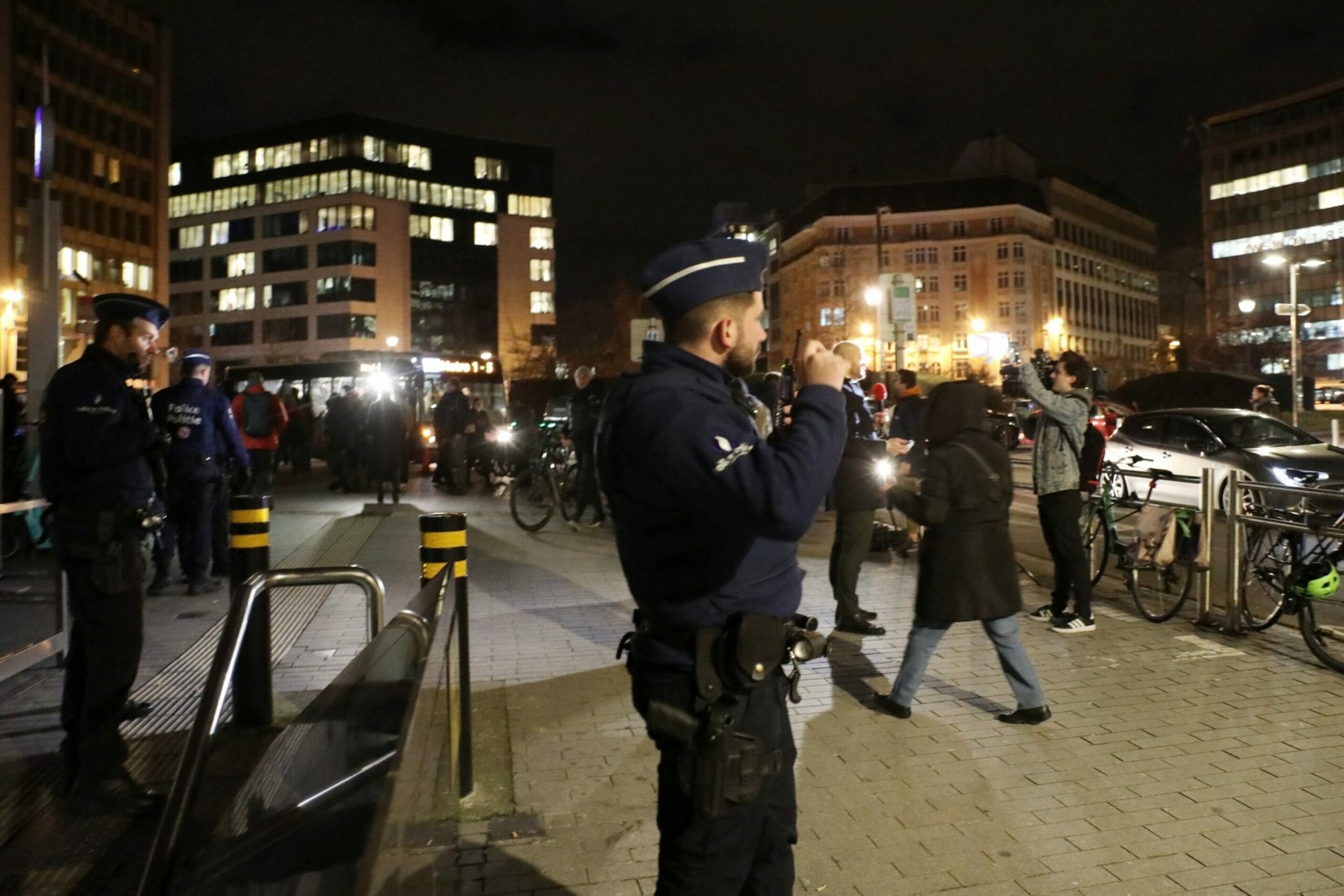
Police officers. Credit: Belga/Hatim Kaghat
However, despite the lack of crucial budgetary support, ongoing projects are stepping up efforts to tackle violence in the city.
An example is initiatives by youth organisations such as JES in Brussels, which try to get young people in vulnerable environments to engage in supportive social activities at youth club. For De Backer, this makes the youth more resilient and less likely to engage with violent activities.
“It's mostly quite invisible work, but it's still the best thing we've got, actually, if we want to tackle this kind of complex phenomenon,” he said.
