
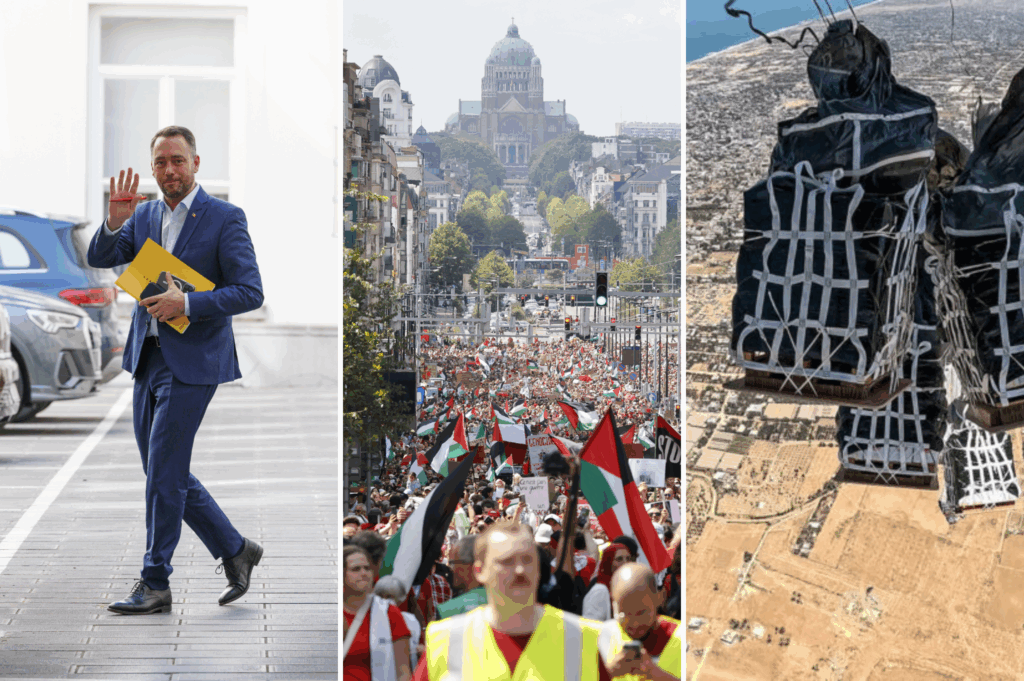
Belgian Foreign Minister Maxime Prévot (Les Engagés) has welcomed the late-night deal reached by the Federal Government on Monday night on Palestinian sovereignty and the crisis in Gaza.
After weeks of pressure from inside the coalition, the Federal Government was able to find a compromise on recognising Palestine and imposing strong sanctions on Israel, which could avoid starting the year with an early "major" crisis.
Inside the coalition, Les Engagés, CD&V and Vooruit have been vocal in wanting a firmer stance taken to end the conflict, while N-VA and MR had been blocking sanctions and Palestinian state recognition.
On Monday, the Belgian Government met again to discuss Prévot’s list of proposals, which form the basis of the government agreement. The meeting took place without Prime Minister Bart De Wever (N-VA), who opted to attend the Flemish Chamber of Commerce’s reception instead.
'No choice'
Yet a deal was announced at around 02:00 in the morning, which could help diffuse tensions inside the coalition government.
"In light of the humanitarian tragedy unfolding in Palestine, particularly in Gaza, and in response to the violence committed by Israel in violation of international law, Belgium had no choice but to take decisive action," Foreign Minister Prévot told The Brussels Times on Tuesday.
"These measures are not aimed at punishing the Israeli people, but at ensuring that international and humanitarian law is upheld by its government, and at acting to help shift the situation on the ground," he underlined.
Recognition of Palestine
At the heart of the agreement was the issue of recognising Palestinian statehood.
Belgium says it will join the group of countries to recognise Palestine, albeit with certain conditions. Among these are the return of all Israeli hostages and the dissolution of Hamas, which would need to hand its weapons to the Palestinian Authority.
"Belgium has always advocated a two-state solution and reaffirms this position by joining the co-signatories of the New York Declaration," the agreement reads.

Prime Minister Bart De Wever arrives for a 'core cabinet' meeting gathering selected Ministers of the Federal Government, Monday 01 September 2025 in Brussels. Credit: Belga
In the agreement, Belgium has cited the resumption of settlement activity in the West Bank, the E1 project targeting East Jerusalem, the "total" military occupation of Gaza and the "indescribable" humanitarian crisis as raising fears that "peaceful and sustainable coexistence between two states may no longer be possible."
In the text, they reject the notion that support for international law can be interpreted as a reward for Hamas, and acknowledge the trauma experienced by Israelis following the armed group's terror attack on 7 October 2023. They also "strongly" call for the recognition of the State of Israel by all Arab countries.
EU level
At the European level, Belgium will support the "complete" suspension of the trade, research and technological cooperation components of the EU-Israel Association Agreement. This includes Israel’s participation in EU programmes such as Horizon Europe.
There are other suspensions for economic and technological cooperation, including the Open Skies Agreement, a cheap airline travel deal which connects Israel to European countries with cheap fares.
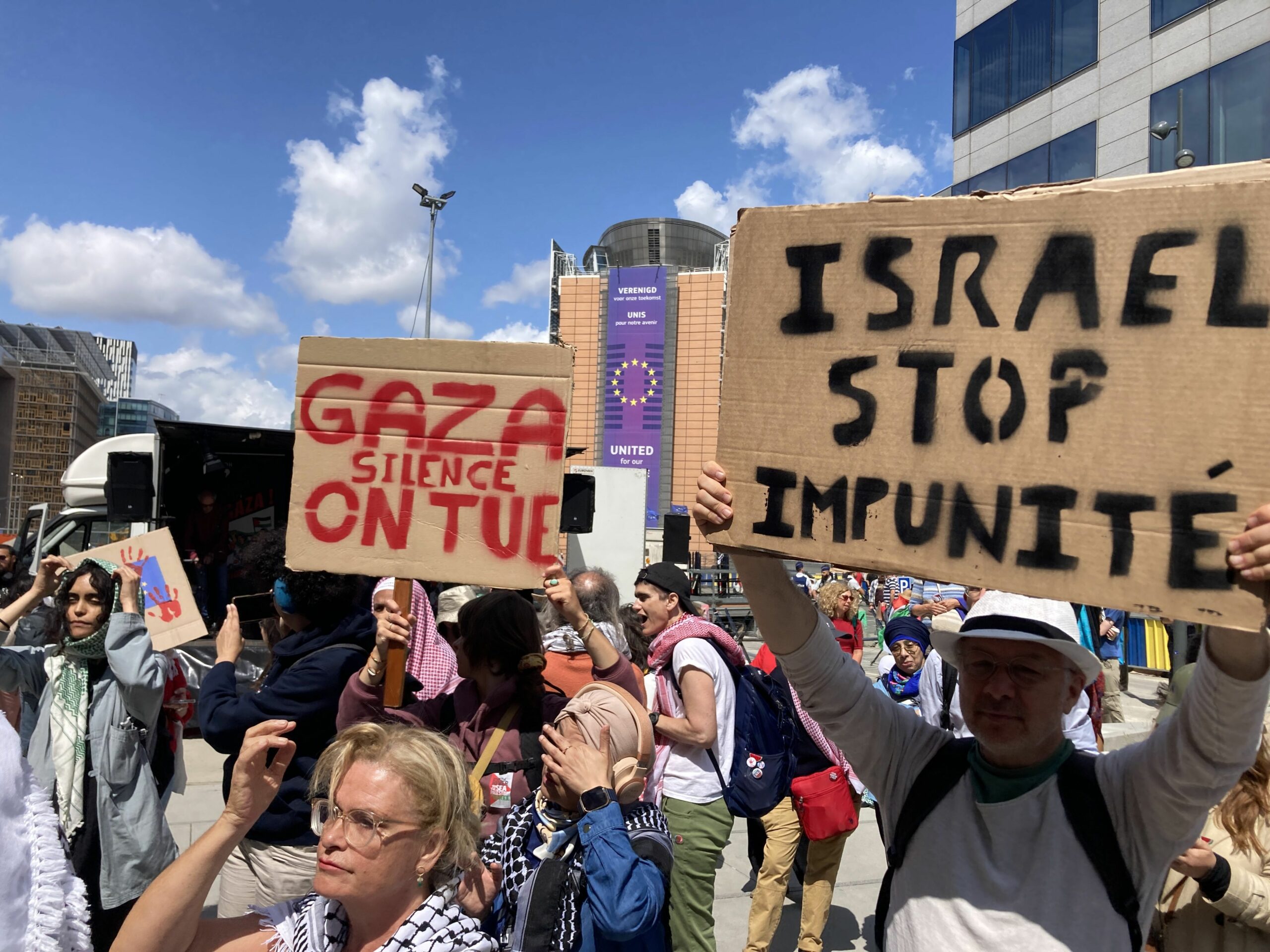
Arrival of the citizens' march for Gaza which left Paris on June 15, to call on European leaders to act against the "ongoing genocide in Gaza", in Brussels, on Monday 23 June 2025. Credit: Belga / Lou Lampert
Belgium will also call on the European Commission to present other possible measures, such as looking into Israel’s cooperation with the European Investment Fund (EIF), the European Investment Bank (EIB) and Europol, while also reviewing Israel’s access to European satellites and sea ports.
Settlement import ban
An EU ban on imports of products and services from illegal settlements will be supported by Belgium, to "comply with the opinion delivered by the International Court of Justice on 19 July 2024."
On this, the Belgian Government is also preparing its own national ban, via royal decree, on imported Israeli settlement goods from illegally occupied territories. It will also create the necessary controls to implement the import ban.
Weapons ban
No more weapons will be allowed to transit through the country, while ensuring this is implemented at the regional level. A previous ban from 2009 will be extended to the prohibition on the export of weapons (and other military goods) produced in Belgium intended for use by Israel, and not just the Israeli army.
The Ministry of Defence will be instructed not to buy any equipment, spare parts or maintenance contracts from Israeli companies. A review of all public procurement in Israel will also be carried out, in part to boost the overall strategic autonomy of Belgium and Europe.
For as long as the war continues, the Federal Government will also instruct the Minister of Foreign Affairs to refuse requests from the Israeli authorities for military flights to overfly Belgian airspace.
Humanitarian aid
The core of Belgium’s agreement is to continue its efforts in improving the humanitarian crisis in Gaza.
This will be done by examining how to repeat the successful humanitarian aid operations by air, which has seen Belgium work with Jordan and the UAE for aid drops.
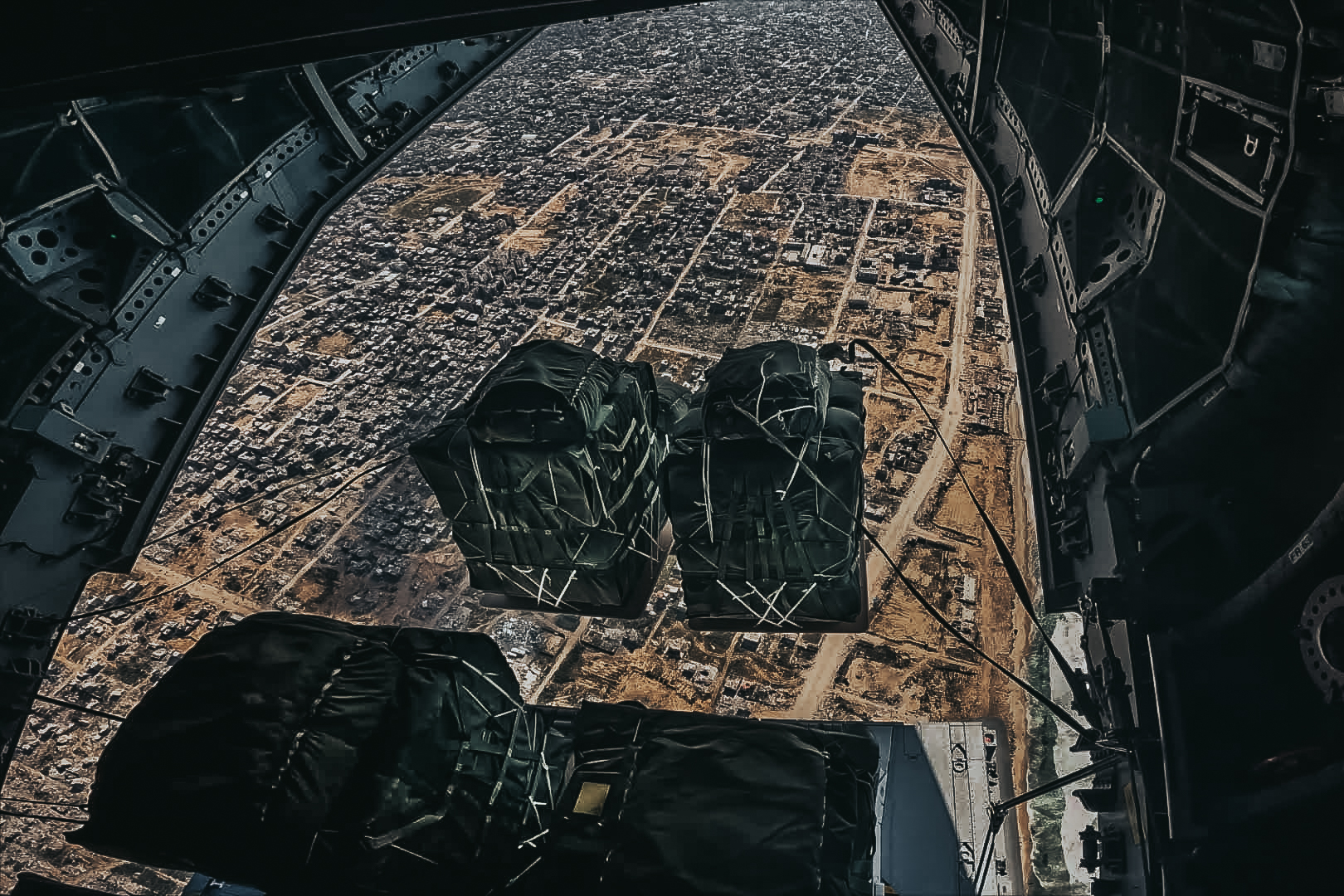
Belgian humanitarian aid airdrop over Gaza Thursday 7 March 2024. Credit: Belgian Ministry of Defence
"Belgium will intensify its efforts to provide humanitarian aid to Palestinians through all possible channels. In addition, €12.5 million will be made available by the Minister for Development Cooperation, on top of the €7 million already committed this year for humanitarian aid to Gaza,” the agreement says.
Belgium will advocate for the establishment of UN-mandated intervention in order to guarantee humanitarian corridors for the distribution of food aid and the protection of populations.
The reconstruction of Palestine will also be a priority, with a special programme supported by Belgian development cooperation to enable the reconstruction.
Belgium will also continue to "actively and financially" support the UN agency for Palestinian refugees, UNRWA.
Belgians and Israelis
On the ground, Belgium will also propose clear sanctions against both violent Jewish settlers and Hamas officials, following the example of the EU, Canada and the UK, which see financial restrictions and entry bans.
Israelis living in illegal settlements could also soon be refused visas, pending a legal analysis carried out by the Minister for Asylum and Migration.
Belgian nationals living in Israel or in the occupied Palestinian territories, who are guilty of a serious violation of international humanitarian law or a terrorist offence, will be prosecuted in Belgium – including dual nationals.
Extremist Israeli ministers Itamar Ben-Gvir and Bezalel Smotrich, as well as the political and military leaders of Hamas, will be declared as persona non grata, with a view to proposing a suspension of visas in the Schengen area.
Hamas and Iran
In the current context, Belgian security services will further strengthen their vigilance against potential anti-Semitic threats.
Iran’s support for terrorist movements and hostage diplomacy has pushed Belgium to advocate for the Islamic Revolutionary Guard Corps to be added to the European list of terrorist organisations and to advocate for tougher economic and other sanctions.
Alongside allies, Belgium will continue preventing Iran from acquiring nuclear weapons. They are also calling removal of the artificial distinction between the political and military wings of Hezbollah.
Reaction
Government partners have largely welcomed the agreement. Vooruit leader Conner Rousseau called it a "compromise with teeth", pointing to sanctions such as a ban on imports from Israeli-occupied territories and travel bans on two far-right Israeli ministers.
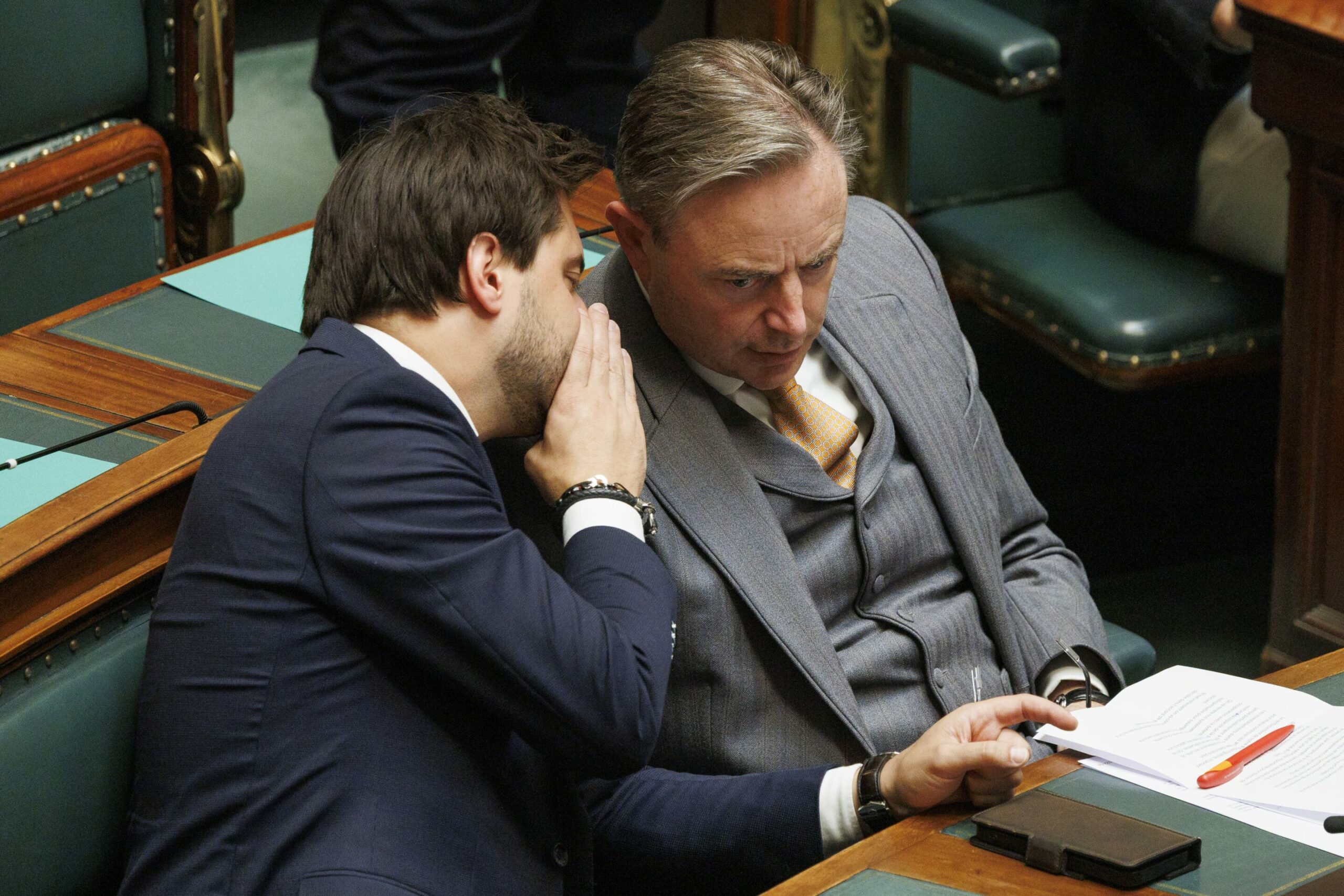
MR leader Georges-Louis Bouchez and Prime Minister Bart De Wever pictured during a plenary session of the Chamber at the federal parliament, in Brussels, Thursday 05 June 2025. Credit: Belga
On the other side of the government divide, MR leader George Louis Bouchez, reacted by underlining the conditionalities of Palestinian recognition, such as Hamas losing power and the release of all Israeli hostages.
Opposition parties were less impressed, with Groen calling it "too little too late" while PTB-PVDA said the agreement was made to save the government coalition. Open VLD welcomed the steps forward but regretted the "ifs and buts" that still surround recognition of Palestine.
Separately, the regional Flemish Government also reached an agreement on Monday after being faced with a similar political crisis. The agreement is largely similar to the federal one, but with a few extras. This includes the Flemish office of Flanders Investment & Trade (FIT) in Tel Aviv, which will not close, but will have its operation limited.
