
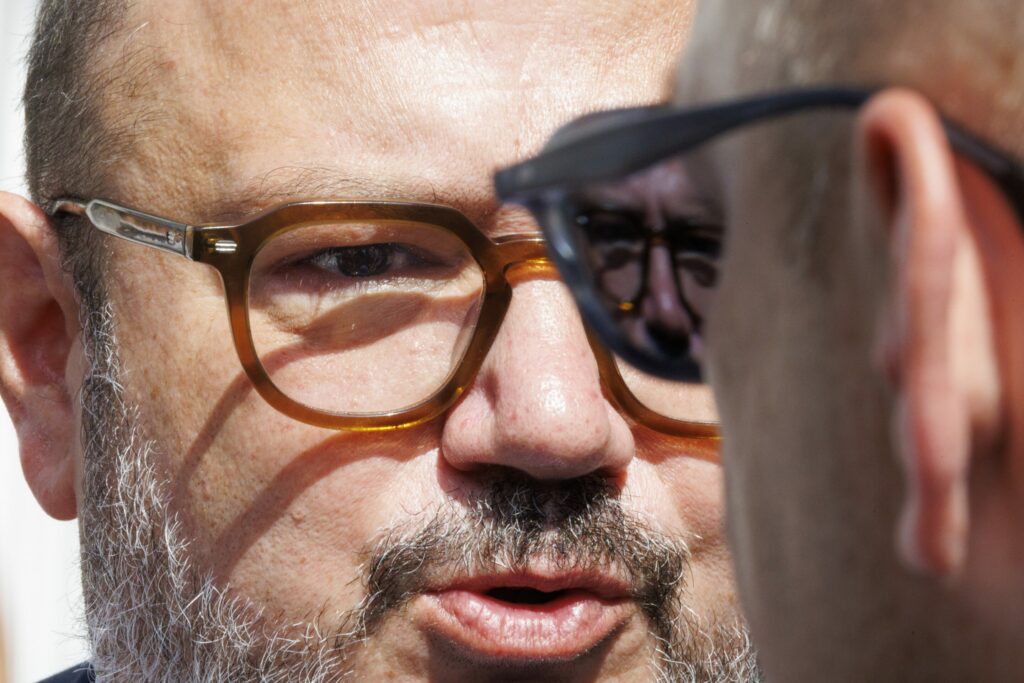
After a summer of brutal violence and two deaths in Brussels, Interior Minister Bernard Quintin (MR) wants more police, more cameras and soldiers on the streets of Brussels.
They should appear on the streets before the end of this year, Quintin says in an interview with The Brussels Times. "We can also deploy soldiers in other cities."
Brussels is licking its wounds after a particularly rough summer. Violence flared up in the capital again, with two deaths, stabbings, and shootings in broad daylight. Criminal gangs are becoming increasingly brazen, says Home Affairs Minister Bernard Quintin (MR). "A catastrophe", he calls it.
Quintin has a plan ready to combat organised crime in Brussels and Belgium's other major cities. "It's not just shootings in Brussels; grenades and Molotov cocktails are being thrown in Antwerp. There are also problems in Liège, Charleroi and Ghent. We therefore wanted to come up with a comprehensive plan for the major cities. We are starting with Brussels, because that is where the problem is greatest.
The most visible measure is the presence of soldiers supporting police officers. We are working with mixed teams of officers and soldiers in criminal hotspots in Brussels."
In addition, Minister Quintin is allocating 20 million euros for cameras. "We are setting up a network that connects all ANPR cameras (for automatic number plate recognition) and have an agreement with the NMBS so that the federal and local police have access to the 8,000 cameras that the transport company has. We also need to have cameras in places where they are needed. If municipalities or cities do not have the resources for this, we can help them. Cameras not only help afterwards, but they can also help to take action in real time. I have also asked the federal police to restart the FIPAs (full integrated police action), where local and federal police can work together to tackle drug dealers. We are tackling every link in the chain."
Why the military? Isn’t that an admission that police have lost control?
No. For me, it is fundamental that the state shows its citizens and criminals that it is doing everything it can to fight organised crime and ensure the safety of Belgians. Organised crime gangs try to create no-go zones where they can develop.
Fortunately, such zones do not yet exist in our country, but we must prevent them from emerging. A police uniform no longer deters them. The intention is not to keep soldiers on our streets for years, but to create a shock effect, to deal a blow to organised crime.
Soldiers on the streets sounds tough, but will it actually achieve anything?
Whether it sounds tough or not doesn't matter to me. The idea that it won't work is a comment made by people who never come up with a solution themselves. I can fill this whole building with people like that. They are the same people who are at the head of Brussels municipalities that are falling into decline.
We have seen in the past that the presence of soldiers on the streets reduces crime. It also has a deterrent effect. Is it a miracle solution? No, but it does help. Soldiers complement our effort; they don’t replace it.
Will soldiers also be deployed in other cities?
That is quite possible. We are starting in Brussels because that is where the need is greatest, but we will see if it is necessary in other cities. Antwerp is also affected by drug-related crime, just like other cities.
How many soldiers do you want to deploy?
I don't want to commit to figures or a timetable yet. I do think that we should be able to have the necessary protocols in place by the end of this month and that soldiers can be deployed in Brussels before the end of the year.
They will receive training and will have the same tasks and powers as police officers. We are currently working on this. I know the military and police unions still have questions, but we will sit down with them to clarify that. I’m sure we will be able to convince them.
'The problems only occur in the rotten neighbourhoods of Brussels,' said Brussels government commissioner Alain Hutchinson (PS), in an attempt to reassure the international community.
I have to watch my words, but I found that a terrible, contemptuous statement. There are difficult neighbourhoods, that's true, but I went to visit the people there in August. In Clémenceau, Bonnevie Park, and Bethlehem Park.
These are people who live there, sometimes for 20 years or more. I'm not going to tell them they live in a slum. What good would that do?
Isn’t the real issue that police lack resources?
If there is one minister who gives the police more resources, it is me. I have strengthened the Brussels judicial police with 31 units and at the same time we are continuing to recruit. In November, I am organising a major conference on the attractiveness of the police profession.
My problem is that there is a general shortage of 15% in the police force, both locally and nationally. And that is not something that has just happened today. The police are doing their job very well with the resources they have at their disposal, both in terms of personnel and equipment.
I think everyone agrees that these things take time. Recruitment will take time. I am working on strengthening the police force. In two or three years, things should be fine. If we do nothing in the meantime, we will lose ground.
Who is responsible for the escalating violence?
Most shootings, including those last summer, are linked to drug trafficking. There are several gangs fighting each other for territory. We have had the Mokromafia for quite some time. Then there is the Marseille mafia, which has ties mainly to mafia gangs in Algeria. And there is the Albanian mafia, which seems to be above everything else.
We want to tackle them every way we can, but we also want to address the drug users.
How?
I would like to put forward the idea that there should be prevention campaigns. There are campaigns against cigarettes and alcohol or mobile phone use behind the wheel, but not against the dangers of drugs.
If you use drugs, you are part of a criminal chain. I'm not going to tell Netflix what to broadcast, but in a series like Elite, about secondary school pupils who spend their time not at school but in nightclubs drinking and taking drugs, drugs are given a sympathetic image. That’s wrong.
The people behind it are ruthless. I worked as a diplomat in Mexico. There, criminal gangs do not hesitate to behead 200 people. I have discussed with a few colleagues what we can do to set up information, awareness and prevention campaigns. We want to take a tougher approach to users, with more intensive and thorough checks.
Meanwhile, the mayors of Brussels are resisting a unified police zone.
I listen to people when they disagree with something. I also want to take criticism into account, but when I hear a mayor on the radio saying that he fears he will lose control of the police, I think: 'Yes, that may well be one of the objectives.' There is no reason why individual mayors should have control. We have six police zones with six different policies. That is one of the problems facing the city.
Choices have been made that I find difficult to accept, such as the abolition of the COBAN brigades, which worked very locally and made life difficult for local dealers. We want to improve that and tackle the problems in a more targeted way.
To me, it’s not logical that a city like Brussels has six different policies when it comes to security and law enforcement. I’ve never said it was thé solution, but I’m certain it will help."
Quintin’s promise of troops in Brussels before the year's end is bold, but the reality is more complex. Feasibility and legal protocols could stand in the way of a swift deployment. Read more about the process and timeline in this article.
