
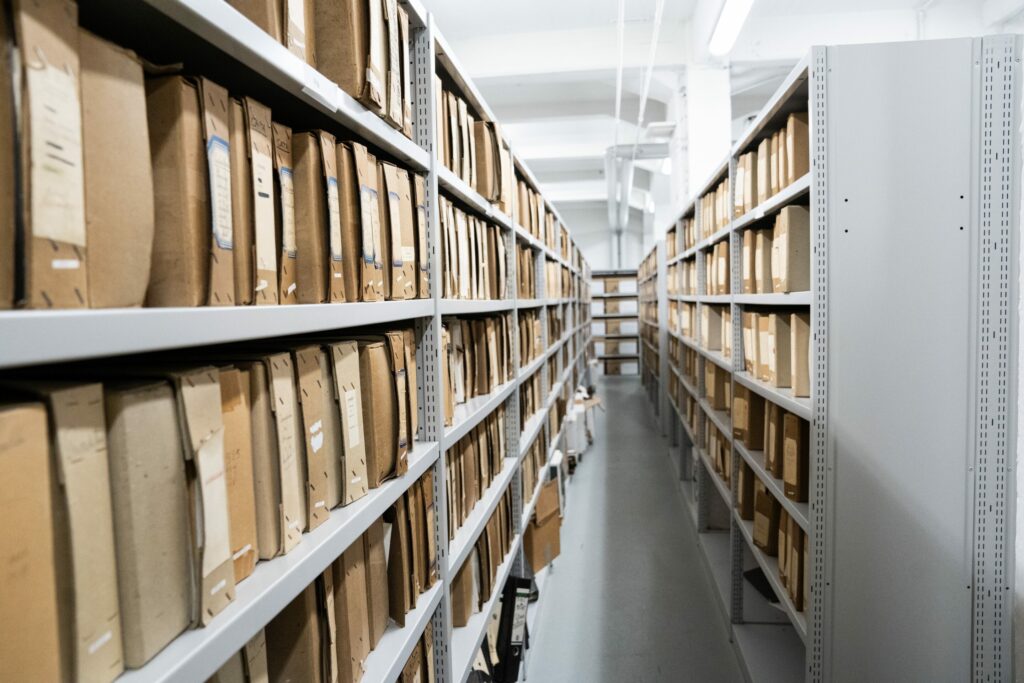
Since June, visitors to the Joseph Cuvelier depot of the State Archives have been greeted with a simple but devastating message: due to technical problems, new reservations cannot be made.
The culprit is painfully mundane - a broken central lift. For many researchers, the consequences are anything but trivial.
“The central lift connects the various parts of the archive with the reading room, where researchers, scientists, and citizens consult documents,” Margot Luyckfasseel, research professor of Modern African History at the University of Antwerp, told The Brussels Times.
She supervises several doctoral students now at risk of delays. “For some, this is a disaster," said Luychfasseel. "They have deadlines or temporary projects. Being blocked for an indefinite period could impact their careers.
“Others travel from abroad and are forced to leave empty-handed. The Cuvelier repository is very popular; the reading room was always full, with a waiting list exceeding a month because there are only 20 seats.”
The repository, located in a 1970s building on Hopstraat in the Dansaert neighbourhood, houses documents tracing Belgium’s colonial past and its role in the Second World War.
Among its holdings are the files of Union Minière, the Belgian mining company in Congo, 87,000 personnel records of Belgian staff in Africa, and documents on mixed-race children forcibly removed from their mothers - a dark chapter of the colonial era.
The archives also contain records of collaboration during the war and the ensuing persecutions. It is impressive in size. In total, the documents stretch over 50 kilometres if laid end to end.
A symptom of a much bigger problem
Initially, staff attempted to mitigate the problem by manually transporting archive boxes to the reading room via narrow staircases. This proved impractical due to the building layout, heavy workloads, and staffing shortages.
It also strained the staff physically. “Every year, tonnes of archives have to be moved. Carrying them manually is physically impossible,” explained Pierre-Alain Tallier, head of the Brussels department at the National Archives.
The broken lift, however, is more than just an anecdote; it highlights a much larger problem. According to Tallier, the National Archives are already in a precarious state.
“The collective memory of our country was already clinically dead. Now, the broken lift is just adding to that,” he told us.
The building is managed by the Buildings Agency (La Régie des Bâtiments), a government body that reportedly lacks sufficient resources for maintenance.
“The problem lies with the owner, the Belgian state, which has been negligent for years,” explains Tallier. “Our buildings are in terrible condition and overflowing, while our staffing has dropped by a quarter even as the archive’s size has doubled.”
Funding cuts to a vital resource
Funding cuts have exacerbated the situation. Over the previous government term, the State Archives lost 10% of its funding, and it now faces another 9% reduction. The effects are stark.
“On average, we only preserve 10% of government-produced archives. The remaining 90% is discarded,” Tallier said. “That 10% is indispensable; it includes state security, defence, and foreign affairs records. Yet we have no space even for these essential documents and have to refuse them.”
Why are the National Archives in such a terrible state? Margot Luyckfasseel argues that politicians “simply don’t see the importance. Archives aren’t election issues”.
Digitisation, which could mitigate some access problems, is barely underway. According to Luycksfasseel, Belgium is “far behind in this area”. Only 3% of the archive has been digitised, leaving endless rows of boxes and folders as the only means of consultation.
Tallier believes there could be profound societal consequences if Belgium fails to act on this issue. “It won't be long before we have to record the first digital archives, but Belgium has no policy and certainly no resources for this task," he said. "
"In times of artificial intelligence and fake news, it has never been more important to keep reliable and accurate information about our past and make it accessible. Being archivists, we are the safekeepers of democracy.”
Losing our collective memory?
The responsibility for change now rests with Minister for Science Policy Vanessa Matz (Les Engagés), but progress appears slow.
A spokesperson told The Brussels Times: “The State Archives are undergoing a restructuring plan to ensure financial equilibrium. We are examining the grouping of different sites and depots, which should lower operating costs, reduce the ecological footprint, and improve operational efficiency.”
Meanwhile, the Buildings Agency reports that a company will conduct a risk analysis, with adjustments based on the findings. Only if the inspection is successful will the lift return to service, though no timeline has been provided.
Tallier isn’t optimistic about the long-term prospects for the archives. “This isn’t just about inconvenience. Without proper funding, maintenance, and digitisation, we risk losing Belgium’s collective memory,” he says.
“Future historians, students, and citizens may never have access to documents that are crucial for understanding our past.”
