
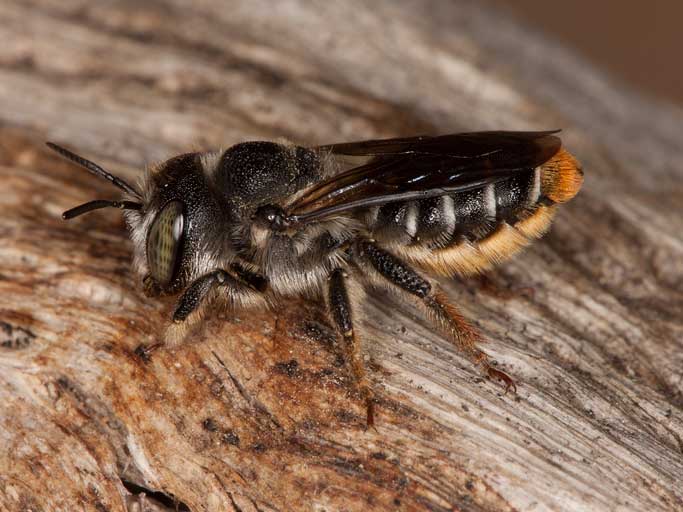
The species was found in the provincial domain of De Gavers in Flanders, an area that has already proven attractive to bees.
At the beginning of August, a rare bee species was observed for the very first time in Belgium at the provincial domain of De Gavers in Harelbeke, West Flanders. The insect in question is the orange-tailed mason bee (Lithurgus chrysurus), which until now had only been recorded around Paris and Frankfurt, the Flemish environmental organisation Natuurpunt announced on Monday.
This discovery is remarkable as it marks the very first sighting of this type of bee in Belgium. Only three species of this group live in Europe: two in Central Europe, including the orange-tailed mason bee, and a third which inhabits more southern regions.
The orange-tailed mason bee is a medium-sized insect, measuring between 10 and 15 millimetres, with a robust build. Females are recognisable by their orange hair on the underside, used to carry pollen, and by the dark orange tip of their abdomen. Like other bees of their genus, they have a prominent ridge between the eyes.
This species feeds almost exclusively on the pollen of knotweeds, thistles and other purple flowers.
According to Natuurpunt, De Gavers provides an ideal habitat thanks to the management of sunlit hedges and wooden structures that create nesting sites. At the same time, flower-rich zones with knotweeds and thistles supply ample food.
The provincial domain is steadily gaining a reputation as a hotspot for unusual bee species, the environmental organisation noted. The first dwarf wool-carder bee of West Flanders, recognisable by its black body with yellow bands and spots, was discovered there, and the rare woolly-armed leafcutter bee has also established a population. All three species are thermophilic and feed exclusively on flowers from the same family.
