
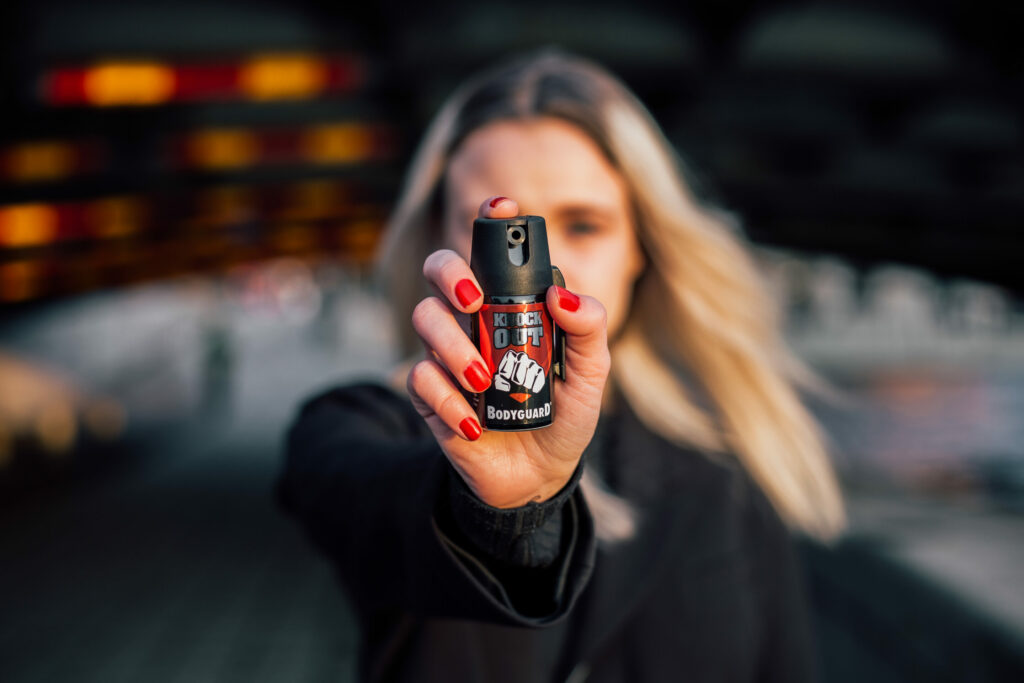
Although it is illegal to do so in Belgium, Romane says she carries a pepper spray with her everywhere she goes.
Having endured street harassment in Brussels and other cities, Romane - who is in her late 20s and lives in Schaerbeek - wants the government to legalise pepper sprays for the purposes of self-defence.
“I experienced bad situations in the city centre - catcalling, men following me,” she told The Brussels Times.
“This summer, I had a violent incident in Marseille. After that, I decided I'd better have one [a pepper spray] at hand. It is a small tool to defend myself. I’d support legalising it.”
The Belgian Weapons Act classifies self-defence sprays as prohibited weapons, meaning they are banned for sale to the general public, whether they are used for self-defence or not.
However, women such as Romane find ways to get around the rules.
Animal-repellent pepper sprays are widely accessible in neighbouring Germany and are often repurposed as self-defence tools by women. Under German law, they must be clearly labelled as animal-repellents and may be used for self-defence against humans in case of an immediate unlawful threat.
Recently, Belgium's Minister for Equal Opportunities, Rob Beenders, opened the door to legalising pepper spray in Belgium. He promised to conduct a "thorough investigation" into legalising self-defence sprays in response to women's safety concerns.
He also mentioned the possibility of legalising so-called “smurf-spray” - a spray containing a blue dye that stays on an assailant for several days, making them easier to identify.
The scourge of street harassment
Street harassment is widespread in Brussels, and stories like Romane's are all too common in the Belgian capital.
In a 2023 survey of 1,000 women in Belgium conducted by Stand Up Against Street Harassment and Belgian non-profit Touche Pas À Ma Pote, 83% women of questioned had suffered some form of street harassment. In Belgium as a whole, 32% of women reported carrying an object in hand as a weapon, most often keys, while in Brussels, the number reached 42%.
Many of the women we spoke to for this article said they had endured some form of harassment.
“I noticed a persistent problem with catcalling, which was much more common when there were fewer people around to intervene or witness it,” said Kaoutar, 22, who comes to Brussels for work.
“This constant background of harassment made it difficult to ever fully relax or feel at ease. I regularly encountered harassment at the train stations and on public transport, ranging from verbal comments and catcalling to men following me despite my clear attempts to ignore them.
"I even witnessed a man with a knife running after passengers inside Brussels North station, which was deeply unsettling.”
'In threatening situations, I tend to freeze'
Unlike Romane, however, Kaoutar says she has never carried a weapon for self-defence. “In threatening situations, I tend to freeze," she said. "I doubt I would have the presence of mind or courage to actually use something like pepper spray if I had to. In fact, I worry it could even escalate a situation.”
Most women we interviewed expressed similar scepticism about the use of pepper sprays.
Sara, 42, who lives in Etterbeek, said, “I feel more comfortable having done self-defence classes. They teach you the tricks to get out of the situation, to catch the attacker off guard for an opportunity to escape. In my case, this was more helpful than having a pepper spray would be.”
Raquel, 40, who lives close to Saint Josse ten Noode, argued that putting the responsibility to protect themselves on women is not the answer. “Safety is for the government to take care of. The police must take care of it,” she said.
“I’d support stricter punishments, but not to put the burden on the citizens. I think it would lead to more division in society. For me, pepper sprays are the same as weapons. Do I feel unsafe sometimes? Yes. Have I experienced violence? Yes. But having more weapons is not a solution. Pepper sprays won’t make us more united, happy, and free.”
The politics of legalising pepper sprays
Far-right Flemish nationalists Vlaams Belang have been calling for the legalisation of self-defence sprays for some time. In September 2019, Vlaams Belang submitted a formal legislative proposal to allow pepper spray use as a legal means of defence for individuals aged 16 or over. The legislation has not been passed into law.
For feminist organisations, legalising self-defence sprays would only serve as a sticking plaster for dealing with violence against women.
“Even with sprays legalised, violence itself remains unchanged,” feminist think tank and action group, Furia, told The Brussels Times. “Self-defence sprays are not a structural solution to gender-based violence. Such a policy shift responsibility onto victims instead of perpetrators and risk reinforcing victim blaming.”
Instead, according to Furia, the government must invest in making public spaces safer, installing good illumination, multiple exits, and surveillance, educating young people on consent, boundaries, and rejection, while also enhancing victim support systems.
“Sprays do nothing to address root causes of violence, which stem from patriarchal power structures reinforced by racism, sexism, neoliberalism and (post)colonialism. Gender-based violence is systemic; that’s the real issue, not whether women should arm themselves.”
