
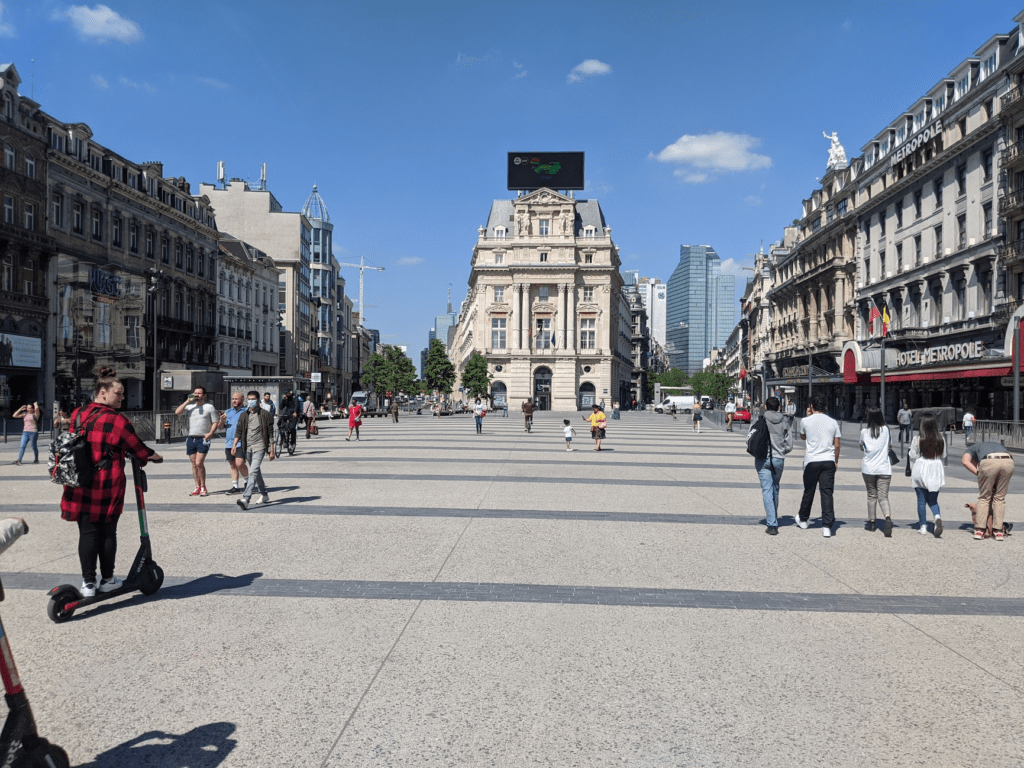
The City of Brussels has extended its alcohol ban for large parts of the centre for another year.
On Monday, the municipal council – led by a socialist-liberal coalition between PS and MR – voted to keep in place the ban which has been effective since 2019, and was due to end on 6 October.
The measure, which forbids consuming alcoholic beverages in certain streets and squares, has been renewed by the City of Brussels due to the ongoing issues of public drunkenness and related nuisances.
The areas where the ban applies are in the pedestrian zone (around Place de Brouckère and Bourse), the Alhambra district (around Yser station), the Vismet (around Sainte-Catherine) and the nearby Quay district.
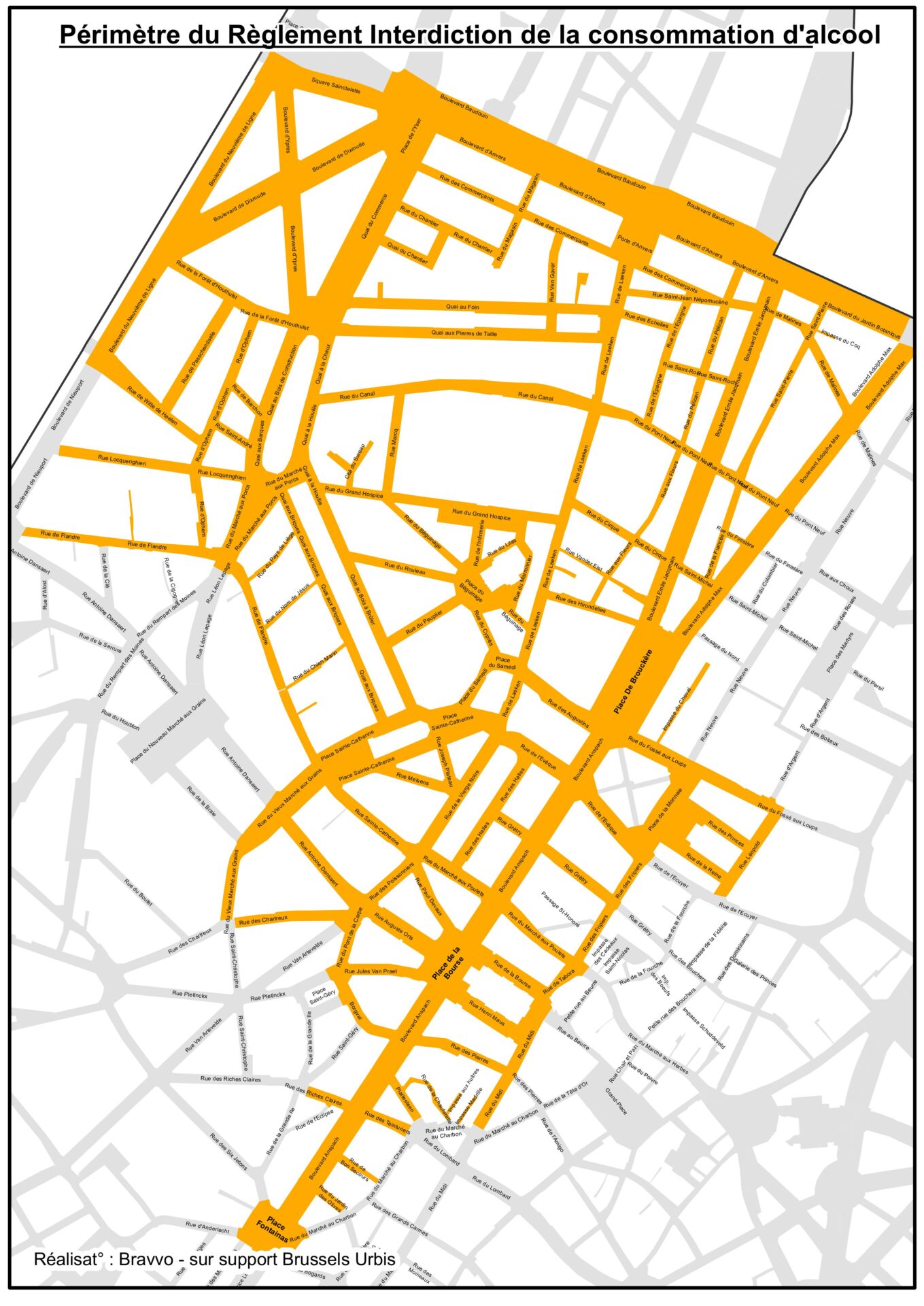
Alcohol is banned in the yellow areas of the map shared by the City of Brussels
Reports from the local police and concerned residents have shown that anti-social behaviour persists in areas where alcohol is banned, prompting the need for further controls to combat the issue.
The number of fines issued by police for street drinking rose between October 2024 and July 2025, according to Dutch-speaking media Bruzz.
Inquiries made with the office of Mayor Philippe Close (PS) reveal that 594 fines were issued in that period. This is higher than the 576 handed out between October 2023 and September 2024, which is over a longer period of time.
Fights, crack and urination
A police report, shared in Monday’s council meeting, sheds more light on the problems on the street.
It found that police officers regularly observe individuals, defined as "vagrants" in the report, gathering in the controlled locations to consume alcohol or narcotics "to the point of being in a state of drunkenness".
In these parts of the city, the police have noted an increase in drug users, mainly cocaine and crack, as well as street dealing. In these cases, the consumption of drugs is often paired with street drinking.
This has coincided with rising complaints from locals amid recurring disturbances to public order and public peace, including instances of noise, commotion, rowdiness, fights "with or without knives", according to the report.
The report also notes these disturbance also affect public cleanliness, via the littering of cans and glass alcohol bottles, but also crack pipes, public urination and vomiting.
Fallen through the cracks
Police stress that the concerned individuals are a "vulnerable and marginalised groups", who in addition to their addictions, "often suffer from psychiatric or similar disorders".
They require access to psychological, medical and social support services, the reports stresses, alluding to the social element of these public disturbances which cannot be solved by policing alone.
Credit: Pixabay
Within the municipal council meeting, left-wing opposition councillor Bruno Bauwens (PTB-PVDA) was not in favour of the ban extension, Bruzz reports.
"Of course there is nuisance from some people, but why do we have to answer that with a general ban for everyone? Young people who buy a beer and drink it on Place Sainte-Catherine will also be punished in this way," he said.
Mayor Close responded to say that the ban is only one of the measures to combat nuisance. He added that homeless people are also helped by the police Hersham cell, a police unit that provides an administrative path for those who have fallen through the cracks.
According to Close, the City will also conduct another communication campaign around the ban, to inform as many users of the centre as possible.
The ban will remain in place until 6 October 2026, pending further review. With an exception for cafe terraces and festive or sporting events organised by the City of Brussels, consuming alcohol in public spaces is prohibited 24 hours a day in the aforementioned perimeter.
Those found breaching these rules risk fines of up to €500, with repeat offenders (within two years) facing increased fines. All alcohol will be seized.
Last week, the City of Brussels also announced its plans to ban to electric bikes and scooters from the city centre's pedestrian zone.
