
One could hazard a guess that Pistache was named after the nut given that her fur has a soft brown colouring, although darker patches leave room for doubt.
The lop rabbit’s former owners brought her into the Veeweyde animal shelter in Anderlecht due to allergies to said fur, and she’s now been at the facility for five months. This, I’m told, is a long time for a rabbit to be housed in the shelter and reflects her size.
This floppy-eared bunny is big, and a prospective new owner must be able to offer more space than that which would be acceptable for her smaller lapine cousins with whom she shares a room. It’s clear that finding the right match – adoptee and adopter – is an aspect of the shelter’s work that is taken very seriously.
All the animals that the centre accepts have names, even the stray cats that might require some on-the-spot invention. Veeweyde mostly advises callers concerned about strays to contact a specialist organisation that carries out sterilisations and notes that such feral animals commonly don’t make suitable domestic pets.
In fact, all the animals available for adoption have their own online profile, and visitors will often inquire about a specific animal. Instagram stories can also help find owners for difficult-to-rehouse animals, such as older dogs and cats. Pistache is described online as “kind but very independent” – i.e. not really wanting cuddles, even if you have a lap big enough!
The stories of a couple of her furry companions indicate that arriving at Veeweyde can be considered good fortune. Cracotte (‘Cracker’ in English), a seven-year-old Angora rabbit, was discovered in his cage on a random street with a note attached, while another exotic-looking rabbit was found in Brussels, alas, in a less fluffy state.
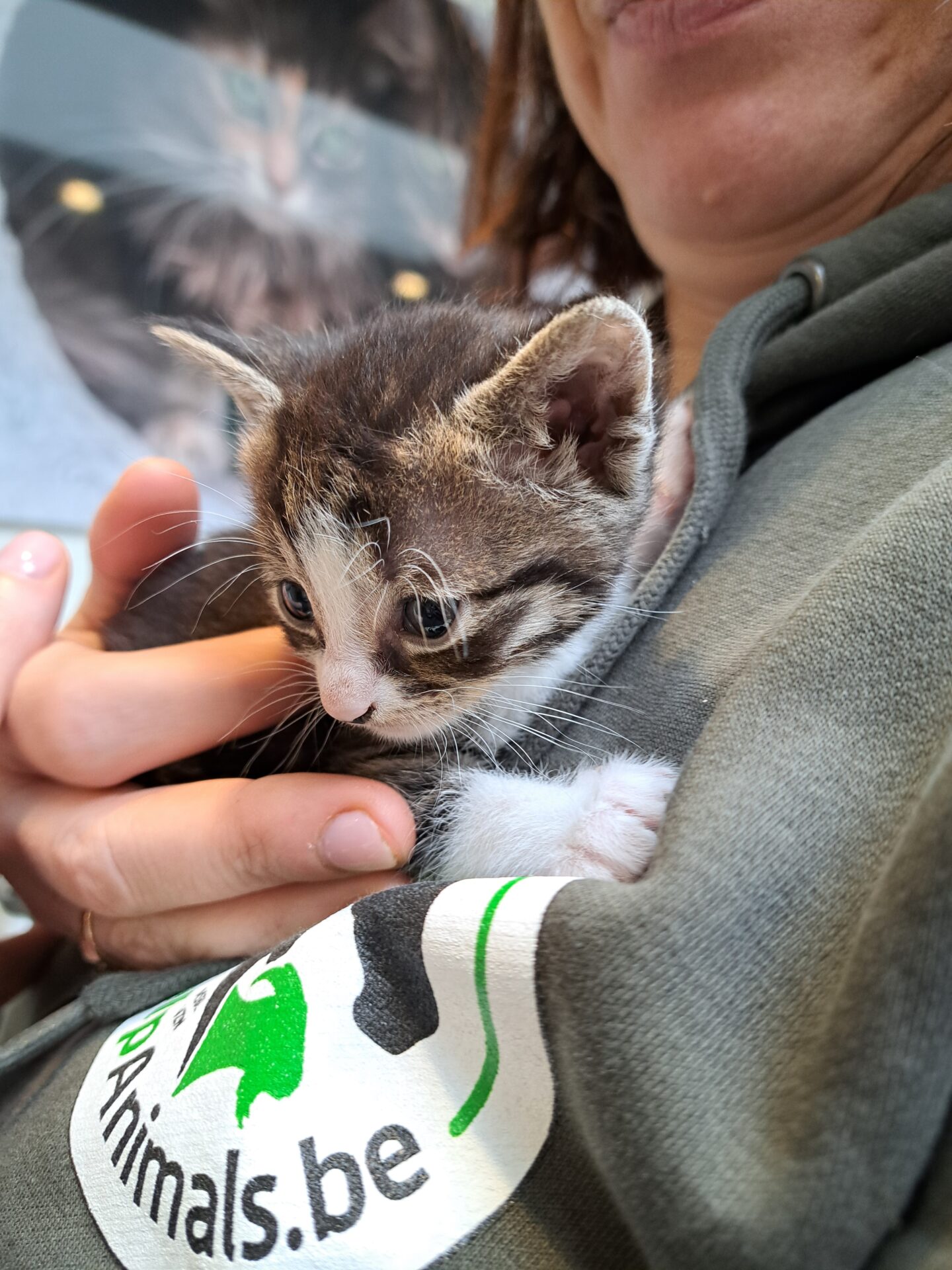
Dogs and cats are the most common animal shelters
However, most animals are handed in to the centre by owners whose circumstances have changed (maternity, home move or a new job, etc). Veeweyde and Help Animals, a smaller shelter also in Anderlecht, also develop contacts with the police, and will occasionally receive calls asking whether they have space to receive a seized dog who has been badly treated.
High demand
Places at shelters in Brussels are limited. At Help Animals, they are wary of passing on callers to other centres when there is no space for receiving an animal, as these too will be struggling. The problem is particularly pronounced in the summer when the steady pace of adoptions is interrupted by holidays, according to Leisha Koderitz, a volunteer at Veeweyde.
However, both these centres are currently undergoing renovations to comply with new Belgian regulations requiring the provision of larger cages. Extensions at Veeweyde will more than double the number of dog places from 35 to 71 by October, while five separate catteries will be able to accommodate up to 80 cats.
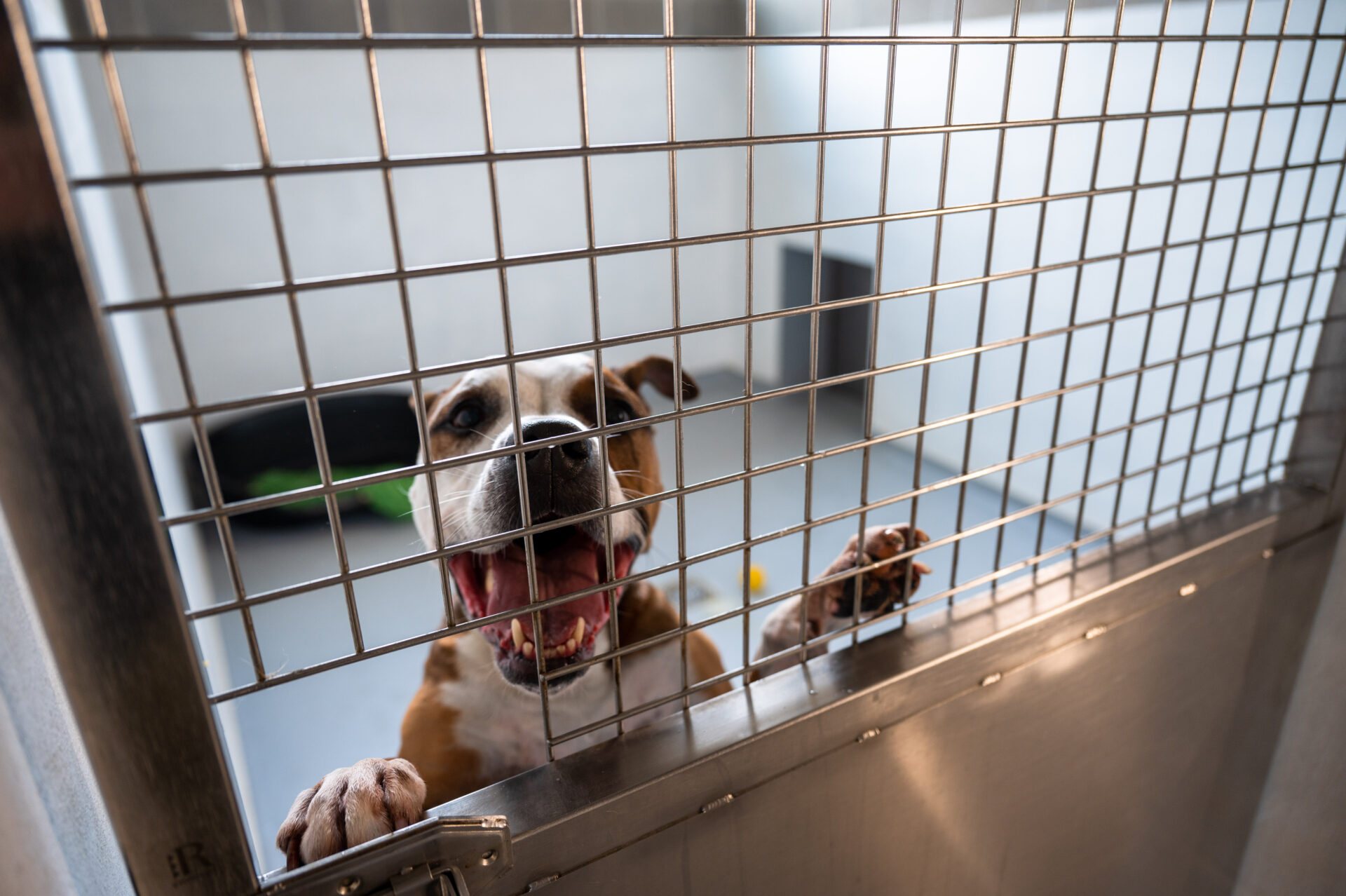
A dog in a shelter. Credit: Belga/Maxime Asselberghs
Typically, a cat or a dog will need to be quarantined for 10 to 14 days upon arrival after receiving the required injections, Koderitz explains. Several cat rooms are therefore needed to isolate new arrivals, kittens or, as at present, a cat with a urinary infection.
She points out that the rooms are equipped with all the toys, high places and scratching mats that a mog could desire, and while most appear to be hiding in their beds, one top cat seems to be enjoying the run of the place. “It’s usually the most confident that are the first to be taken,” she says, although most arrivals find a new home within a few weeks.
The dog enclosures contain information about the animal pinned to the front and have a semi-outside section backing onto a courtyard. The centre also features several small green park areas, and the dogs are regularly walked farther afield. Dogs of known breeds tend to be more in demand than mongrels.
Changing times
Veeweyde grew out of the Society Against Cruelty to Animals, which was founded by Jules Ruh in 1908. Along with the facility of La Croix Bleu, it is one of the largest centres in the capital and was known to euthanise animals for which it no longer had space.
Communications manager Ludivine Nolf tells me the centre’s policies have changed since new management took over at the end of 2018, and the facility employs specialist trainers to help correct behavioural problems. Both Help Animals and Veeweyde say they will only put down an animal under exceptional circumstances, usually due to illness.
Help Animals has started employing an osteopath to treat difficult pets since anti-social behaviour can often stem from physical problems. However, Help Animals secretary Deborah Folye acknowledges that for a “handful of dogs, the ideal situation is to be adopted by a sort of ‘man of the woods’ who lives alone without family and children.”
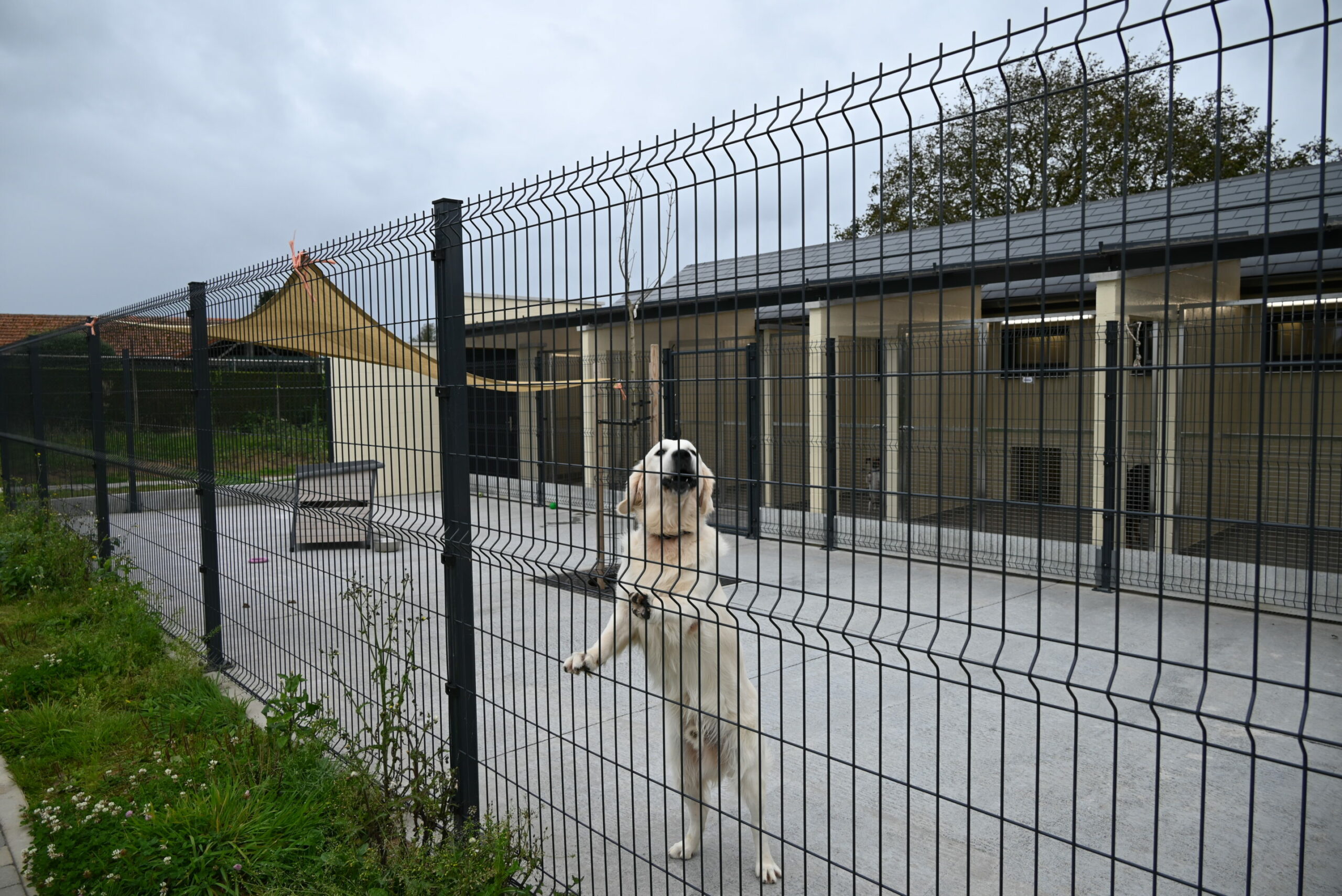
Dog outside a shelter
While even a chihuahua can bite, larger breeds, including American Staffordshire terriers and Belgian shepherd dogs, which have acquired popularity as status dogs, pose the biggest adoption challenge.
Such dogs may be deemed unsuitable for an urban dweller and are moreover, likely to be accepted only by larger shelters outside the city. Indeed, the shelters will assess a prospective owner’s living situation before the signing of any agreement contract, which includes a follow-up visit several months to a year after the adoption.
However, both shelters give the impression that their processes and safeguards are working well, with Help Animals telling me that it’s extremely rare that an adoption doesn’t work out and the animal is returned, while Veeweyde says that fewer than a dozen of its around 400 adoptions a year are unsuccessful.
Ziggy’s stardust
Several years ago, some friends adopted a dog from Help Animals. They tell me that their visit to the shelter was initially unpromising, with their ‘intrusion’ setting off a chain of mad barking. “There was none of, ‘Oh, I've fallen in love with this dog, and I'm going to take it home with me’. And we were on the verge of leaving when this bloke arrived with Ziggy.”
Ziggy, it should be explained, was a large, loyal and slightly loopy five-year-old Labrador cross and was being taken to the shelter due to the owners’ space and time limitations.
Knowing first-hand the dog’s history was reassuring to his new owners, and Ziggy became a beloved family member who lived to age 11. A match made in the stardust?
As his designated ‘dogfather’, I should know: I looked after him on numerous occasions, even after he tried to get into bed with me! The family have recently adopted two dogs, which came as an inseparable pair from Sans Collier near Perwez. Rearing a puppy would not have been appropriate as elderly parents are now part of the household.
New horizons
Help Animals has planned a launch weekend for its new facility dedicated to horses in Waterloo in September. The event, which promises a tombola, food and refreshments, is a way of generating funding for the organisation’s activities.
While a small proportion of the facilities’ several million-a-year budget is covered by adoption fees (around €165 for a dog or a cat), the centre – along with other such private shelters – depends on bequests, donations, sponsoring of animals and fund-raising initiatives. Along with Veeweyde, the centre will also occasionally receive state funding for specific educational projects.
Veeweyde also has several other sites outside Brussels catering for larger animals, including farm animals, which I’m told are the most likely animal category to have suffered from neglect – often driven by economic factors. In fact, the centre says the number of incidents requiring intervention has increased over the past couple of years.
As I watch several rescued goats munch happily in a small field at the Anderlecht site I’m reminded of my own first family pet growing up in suburban England in the less enlightened 1970s. These goats can also be adopted, but will most likely live out their lives at the centre.
