
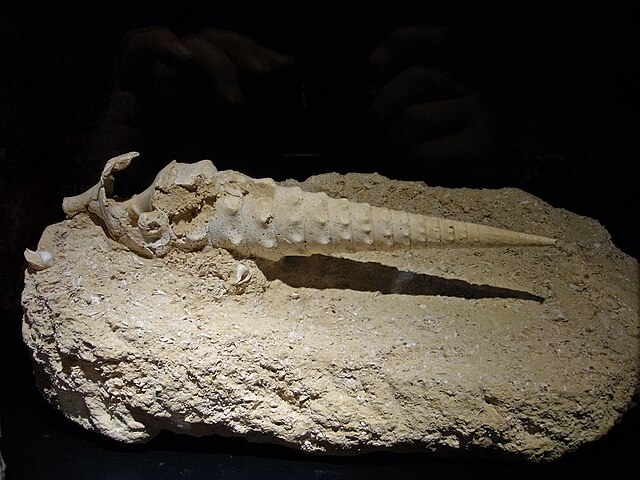
A Belgian-Dutch research team has studied the 45-million-year-old fossil of a giant sea snail to uncover insights about the impact of climate change.
The fossil, known as 'Campanile giganteum,' was discovered in Champagne, northern France. Researchers have analysed its calcium carbonate layers, which reveal crucial data about past climate conditions.
The study, published in the journal Nature Communications, highlights that the snail lived during the Eocene epoch, a geological period between 56 million and 33.9 million years ago. This era was marked by exceptionally high concentrations of CO2.
The snail’s shell, which grew at an extraordinary rate, contains growth lines that provide a detailed record of the climate and weather patterns of millions of years ago. These findings may help scientists better understand how current and future climate change could unfold.
The analysis indicates that western Europe experienced monsoon-like conditions during the Eocene. Winters were mild, springs were warm and dry, and summers were hot and humid with heavy rainfall, a climate reminiscent of modern-day Bahamas.
Lead researcher Johan Vellekoop, a geology professor at KU Leuven, noted that the Eocene serves as a natural experiment showing how Earth’s climate responds to elevated CO2 levels.
He warned that without efforts to curb greenhouse gas emissions, western Europe could face a similar climate scenario within the next century.
