
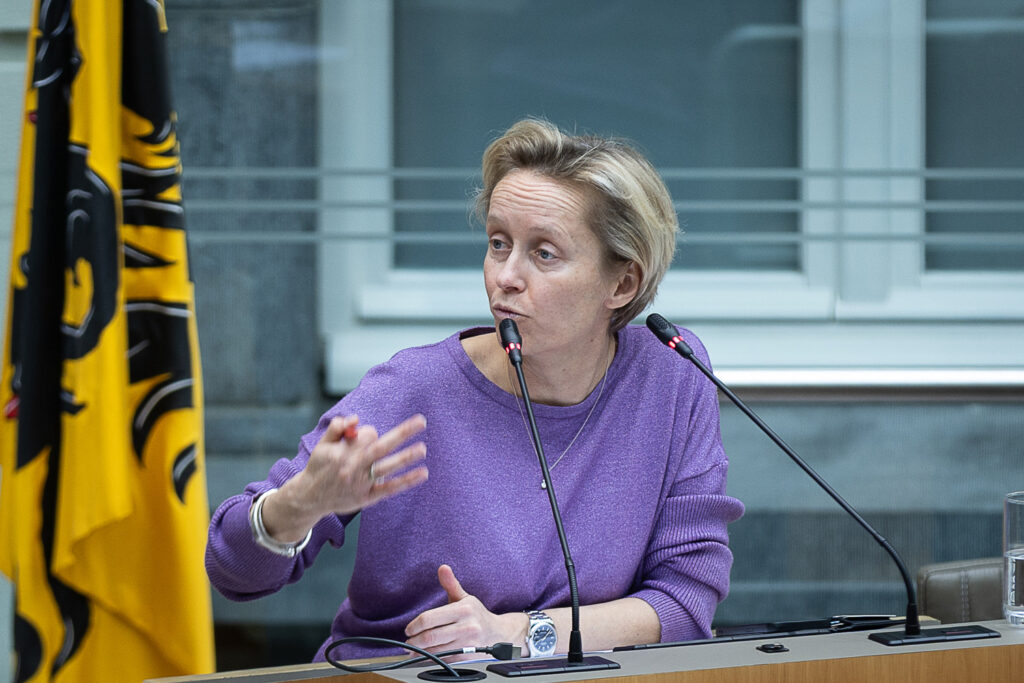
The Flemish Minister for Mobility, Annick De Ridder, has defended mobile apps like Flitsmeister, saying they improve road safety and will not face a ban despite criticism from coalition partners.
Flitsmeister, an app by Belgian company Be-Mobile, has faced controversy, following television and public transport advertisements.
Critics include the police, traffic safety institute VIAS, and the Parents of Children Lost in Traffic Accidents organisation, all of whom oppose radar-detecting apps.
Apps support speed limitation efforts, minister says
VIAS has called for a ban.
Responding to questions from legislators Stephanie Vanden Eede, Tomas Roggeman, An Christiaens, and Bogdan Vanden Berghe in the Flemish Parliament, De Ridder explained her stance.
She argued that enforcement needs public support and suggested that such apps encourage drivers to follow speed limits more closely.
Additionally, she pledged to reinstall notice boards for average-speed checks.
Coalition partner Vooruit strongly opposed De Ridder’s position. Stephanie Vanden Eede criticised the app, stating that it contradicts efforts to eliminate traffic fatalities by undermining adherence to speed limits.
App enables selective compliance - Vooruit's Vanden Eede
She argued that the app enables selective rule-following, contrasting it with stopping at red lights, where compliance should not depend on external prompts.
De Ridder defended the advertisements on De Lijn vehicles, asserting that they comply with regulations. She explained that ads are assessed based on advertiser reliability, product legality in Flanders, and adherence to ethical guidelines, all of which were met in this case.
Complaints to the Jury for Ethical Practices in Advertising (JEP) had already been dismissed.
Coalition partners reject minister's claims
Despite this, Vanden Eede called the advertisements “absurd.” CD&V also rejected De Ridder’s reasoning, with An Christiaens criticising the promotion of such apps on government-owned buses and trams.
She emphasised that the mere fact that they are legal does not justify advertising them on public services.
Bogdan Vanden Berghe argued that the minister’s claim that the app benefits road safety was scientifically inaccurate. He underscored that similar apps are banned in other countries, yet the app is not only allowed in Belgium but also advertised on public transport.
