
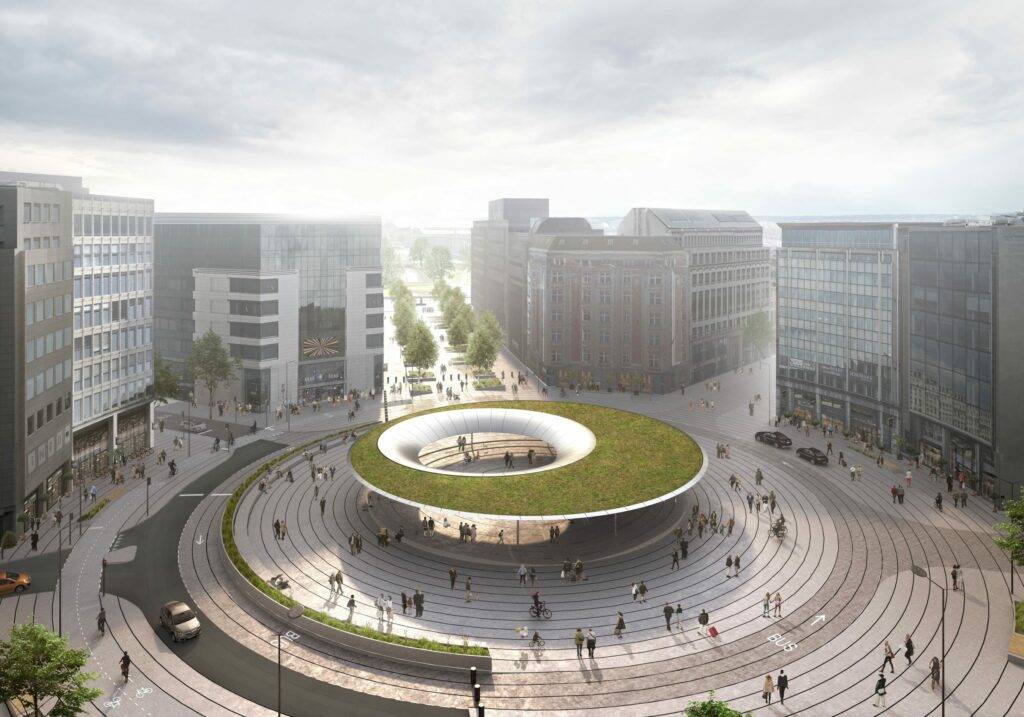
The city of Brussels has said it doesn't have enough money to complete the construction of a stylish showpiece in the Schuman roundabout.
The canopy project has been shelved after an EU funding plea failed, resulting in tension between regional and federal bodies and laying bare Brussels party politics.
The idea has been fermenting for years. Discussions about how to improve the space and reduce the frequent traffic jams have been ongoing since 2015, but the works to turn the hectic, car-heavy Schuman Roundabout into a "real town square" began in autumn 2023.
The overall philosophy is to create a central point around which mobility is organised in concentric circles. These circles widen across the entire space to emphasise the site's central position and encourage visitors to meet at its core. The heart of the square is set to be topped by a stylish awning and dominated by greenery and bikes.
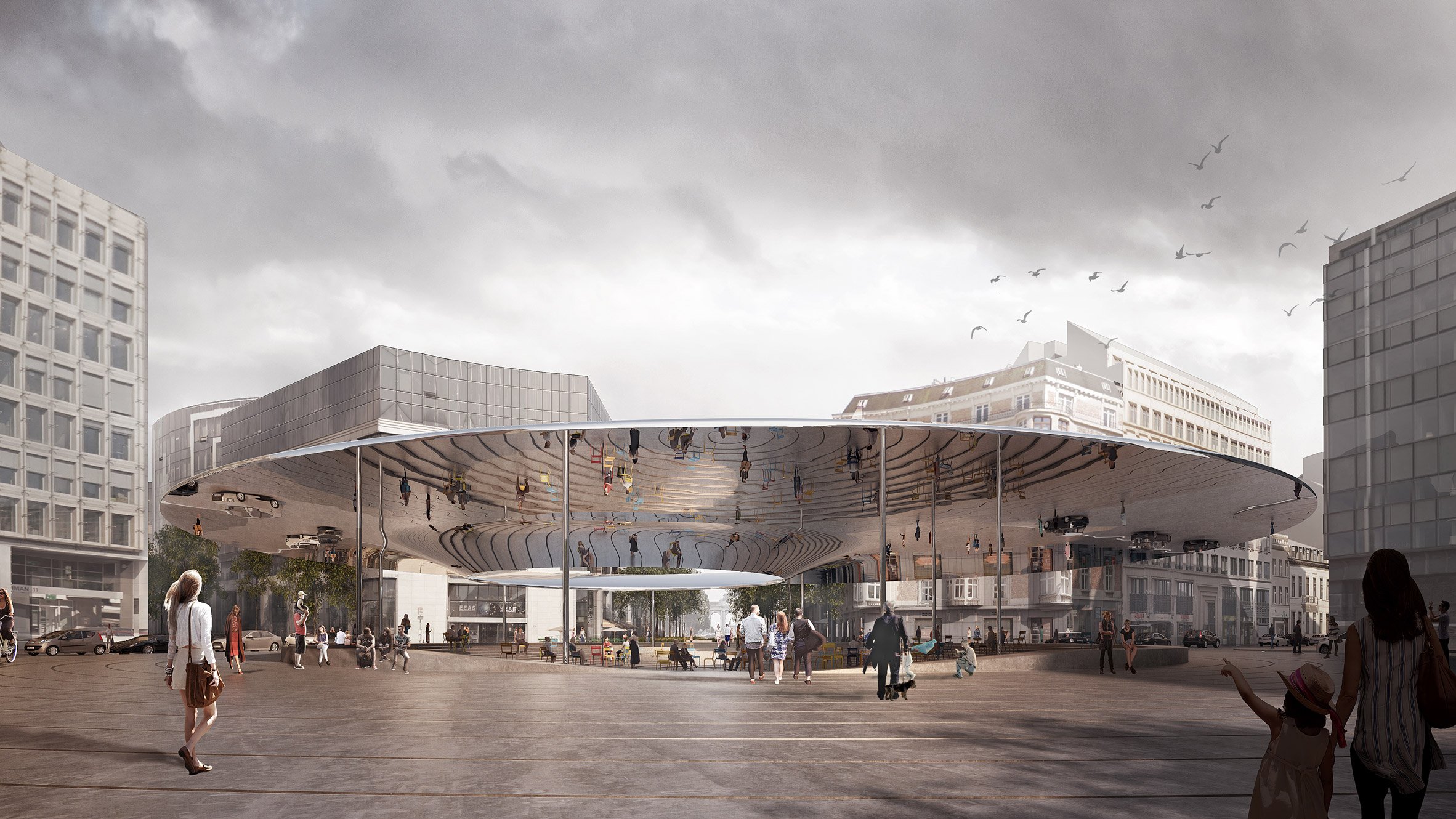
Credit : COBE/BRUT
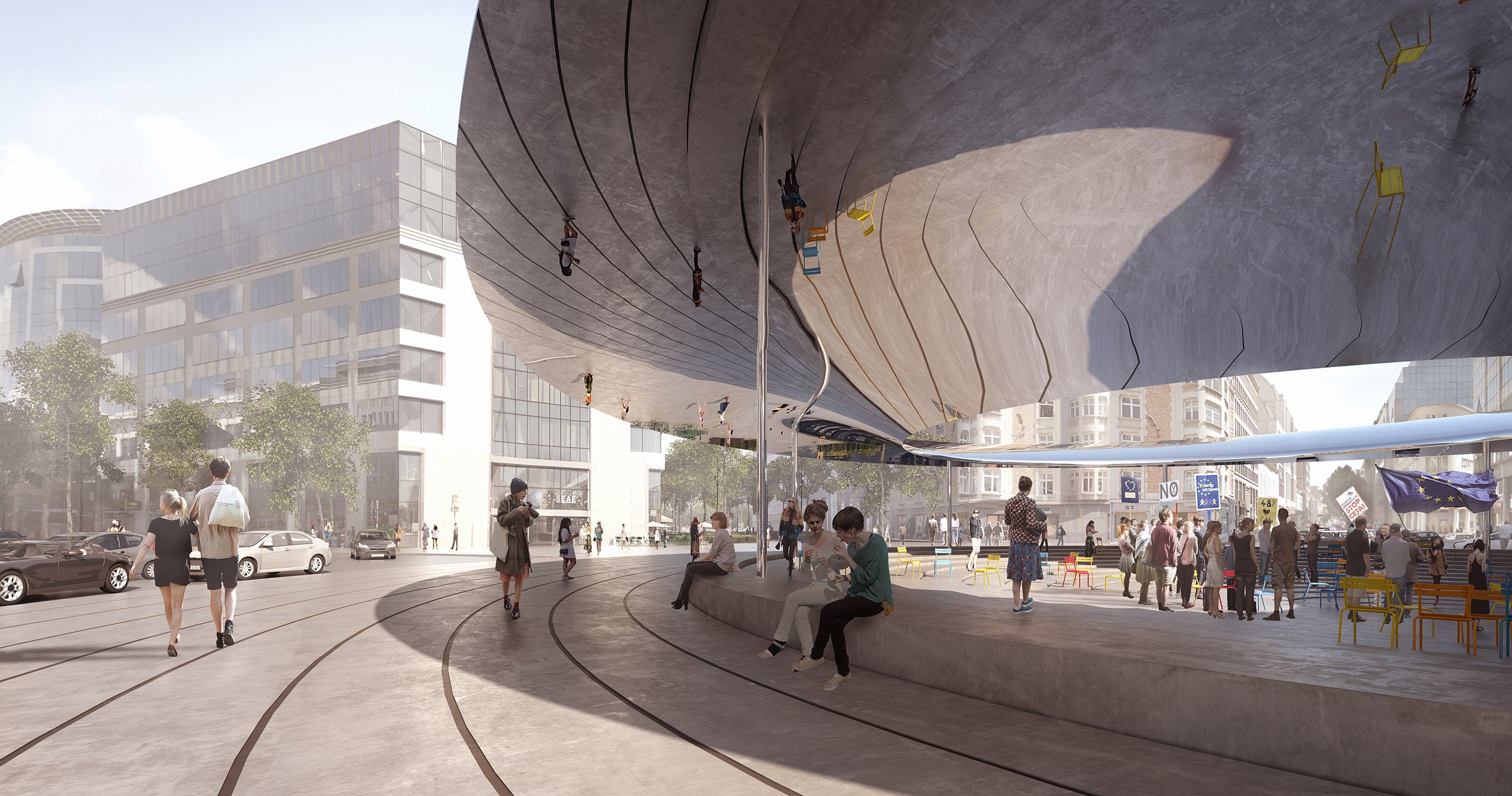
Credit : COBE/BRUTT
The EU granted Brussels a loan of €17.4 million under the NextGenerationEU recovery plan for the development of the shared space and the cycle lanes. Because of the pivotal position of the roundabout, the EU demanded a series of security guarantees, bollards and far more expensive equipment, mainly due to frequent events and summits.
This meant adding anti-terrorism infrastructure, including retractable bollards to allow certain vehicles through, various materials and equipment, and camera systems, all of which increased the overall expense.
The chances of the square getting an awning began to diminish after the Brussels government failed to provide assurances that it would cover the funding needed to build the structure.
In June, the outgoing Brussels government 'begged' the Commission for financial assistance to fund the canopy, which is estimated at €15 million, but in vain.
This angered Prime Minister Bart De Wever, whose party (N-VA) is often critical of the Brussels region, during a meeting over the summer on the relations between the Federal Government and the EU. De Wever told Belga "It is a real disgrace, a complete humiliation. The Brussels Region is going to beg for money to redevelop a square. I had to apologise."
During the meeting, Alain Hutchinson (PS), the liaison between Brussels and the EU, was scolded over the situation. He then explained that the EU itself advised Brussels to write to them.
Cut to today and Urban, the city's planning authority, formally reminded Bruxelles Mobilité and Beliris last Tuesday of their obligation to respect the planning permission for the square.
"This is a standard administrative step. When a permit is granted, you must build what has been authorised," Brussels Secretary of State for Urbanism Ans Persoon's office told The Brussels Times. "If the canopy is not executed, or if the design is altered, a modified permit must be filed. Funding and permitting are separate questions."
Urban fears the project is now advancing without the showpiece being built, putting the entire works at risk of being declared non-compliant. In such a case, the authority could draw up a formal report and refer the matter to the courts.
"In the absence of a modified permit, Bruxelles Mobilité and Beliris expose themselves to prosecution by the public prosecutor or by the planning inspectorate for breaches of the planning code," Persoons' office responded.
Beliris rejects any suggestion that it has been formally notified. "We continue the roadworks and await a political decision on the canopy. The central area is closed off temporarily, but that does not mean the canopy cannot be built later," Sophie Saerens, Beliris spokesperson, told The Brussels Times.
Beliris says the only reason the work has stalled is the absence of a decision from Brussels on how to fund the cost increases. "There is no technical disagreement. It is a budgetary issue. With the region's deficit, choices must be made. We are waiting." She added.
However, the scolding from the city's administration seemed to be directed at Bruxelles Mobilité this time which can not do much due to the absence of a government.
Speaking to The Brussels Times, Minister of the Brussels-Capital Region Government, responsible for Mobility, Public Works and Road Safety, Elke Van den Brandt's office said that Urban cannot issue a formal notice before the works are finished and received. "We are not yet at the canopy phase. The site is currently being waterproofed, which is required whether there is a canopy or not." the office said.
From their perspective, the inspection looks less like a neutral oversight and more like a political manoeuvre triggered by parliamentary questioning in the plenary session.
Beyond funding
When asked why the project is stuck, all three administrations point to the same culprit: Brussels' political gridlock.
The region has been without a new government for more than 500 days. In caretaker mode, no one can alter the budget, unlock new funds or redirect unused envelopes.
Without political authority, no one can decide whether to finance the canopy or formally abandon it through a modified permit.
"It is an example of a project that risks not being completed because of the political situation," Van den Brandt's office said. "If we had a government, we would already have a solution."
Frustration is palpable across administrations. The project is described as a prime example of 'belgo-belge' politics, where regional-federal tensions, party rivalries and symbolic posturing have overtaken practical problem-solving.
Some parties support the canopy as an architectural statement; others dismiss it as an unnecessary luxury at a time when social services and drug treatment budgets are strained.
The roundabout facelift is meant to show a confident, modern Brussels, given its strategic position. But it also uncovers its Achilles heel.
