
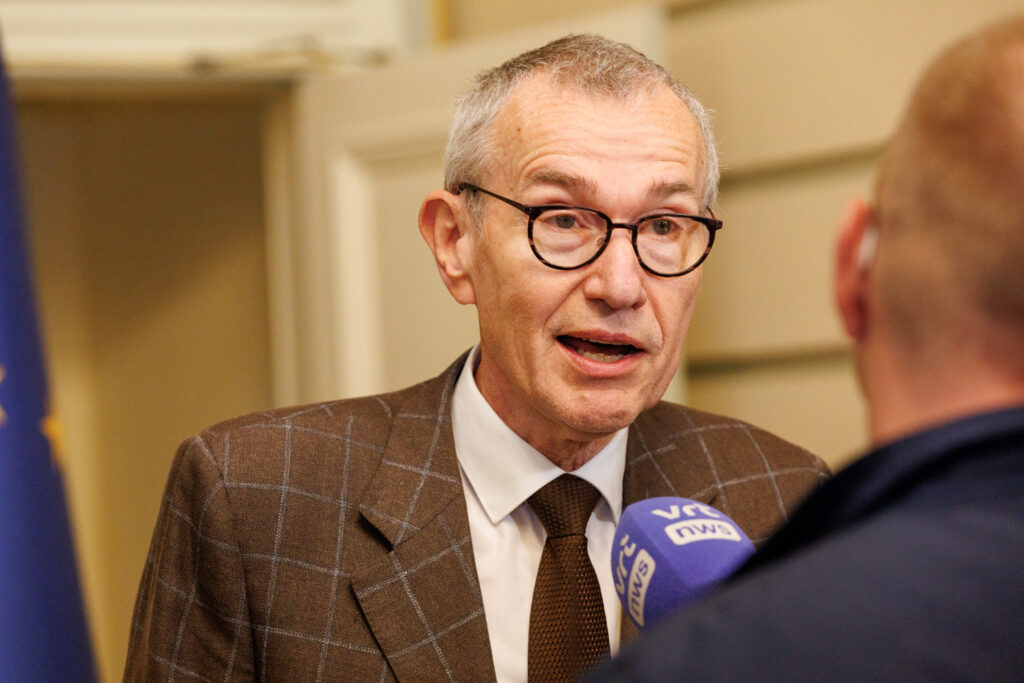
Belgian Health and Social Affairs Minister Frank Vandenbroucke plans to recover €1.8 billion net by 2029 and €2.2 billion by 2030 through measures aimed at getting long-term sick individuals back to work.
Speaking at a parliamentary commission session on Wednesday, Vandenbroucke revealed that the measures are part of a broader plan to tackle the growing number of long-term sick people in Belgium, which has topped 500,000.
Another wave of measures is expected next year.
Health assessments for persons on long-term sick leave
The minister has proposed 218,000 health assessments of persons on long-term sick leave by the end of the legislative term. Under the plan, a person’s classification as a long-term sick individual will not exceed one year without a health evaluation.
The push for reintegration into the labour market is a focal point in the federal government’s budget discussions. Prime Minister Bart De Wever has identified the issue as a critical element of his cost-saving strategy.
Vandenbroucke remains committed to implementing his plan but highlighted that its success depends on reaching a balanced and unified federal budget. Negotiations on the 2026 budget have so far been delayed.
Bonus-penalty system
The plan proposes introducing a bonus-penalty system to hold employers more accountable. Companies adhering to policies designed to reintegrate employees on sick leave will pay reduced social contributions, while those that fail to comply will face increased contributions.
These changes are expected to generate €311 million in 2029 and €320 million in 2030.
In light of the plan’s scale, a roundtable discussion will be convened, bringing together mutual insurance organisations, medical professionals, trade unions, and employers.
“It’s not only about maintaining the financial health of social security; it’s also about people’s actual health. For many individuals, returning to work is an essential part of their recovery,” Vandenbroucke stressed.
The proposals have sparked debate among political parties amid Belgium’s current budgetary challenges. A controversial RTL-TVi report highlighting cases of alleged abuses in the system has drawn amplified attention to the issue.
'Punitive' and 'inhumane'
Nieuw Vlaamse Alliantie (N-VA) legislator Axel Ronse called for an overhaul, accusing the system of fostering dishonesty. “Do we want to destroy social security? The system needs total reform,” he stated.
Julie Taton (Mouvement Réformateur, MR) added, “We are here to combat abuse, not target sick people.”
Aurore Hansez of Les Engagés criticised the plan for overlooking prevention measures, while Parti Socialiste MP Caroline Désir suggested looking to the Dutch model, where companies bear more responsibility for supporting ill employees.
On the left, Ecolo and the Belgian Workers' Party,PTB, voiced serious concerns about the approach. Sarah Schlitz of Ecolo-Groen described it as “worrisomely punitive.”
PTB's Sofie Merckx condemned the fact that it applies to all sick individuals regardless of their circumstances, including cancer patients undergoing chemotherapy. “It’s utterly inhumane,” Merckx said.
