
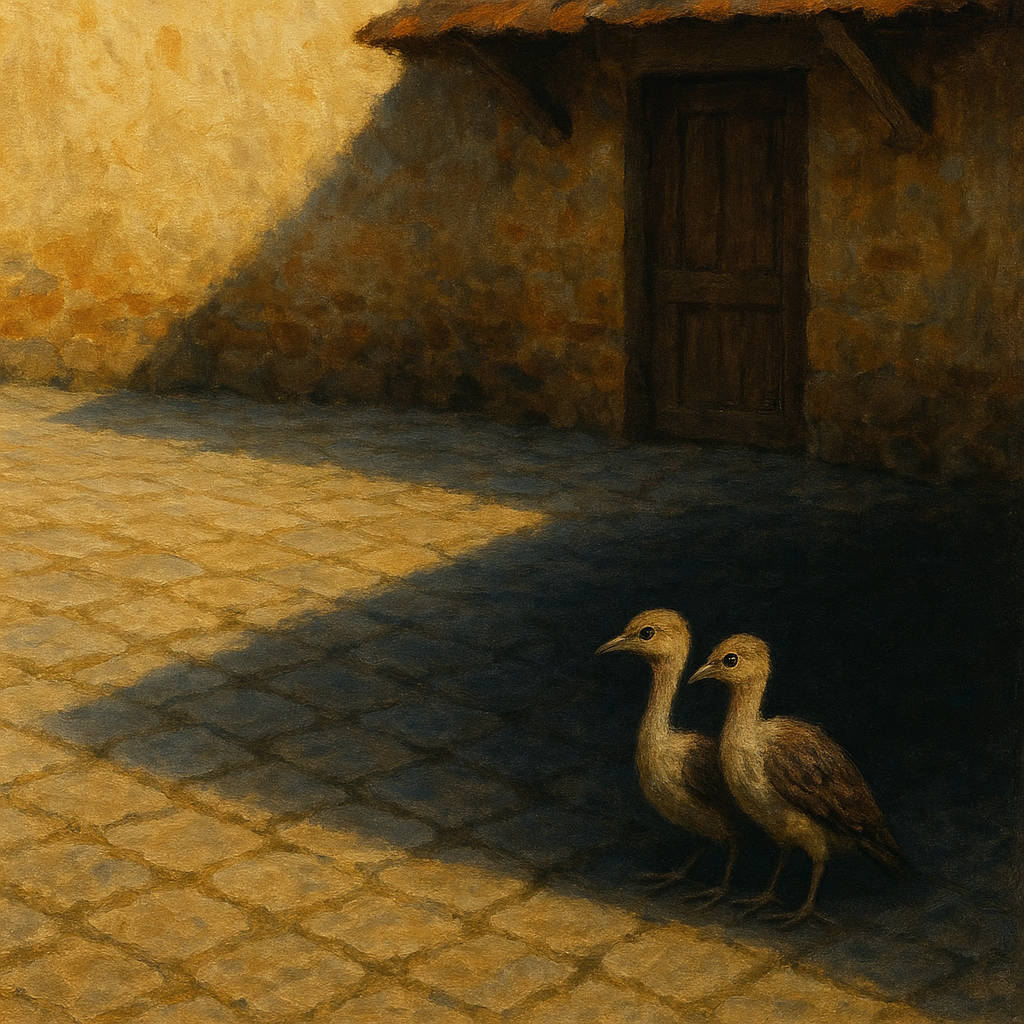
Lesley searches the large cobblestoned courtyard for a sign of her grandson Clyde. Apart from two birds sheltering in the small strip of shade from the farmstead overhang, the place looks empty. It’s rare to spot one bird these days, let alone two.
She doesn’t recognise the species. They aren’t the sparrows that built nests here when the smallholding still looked like a proper farm, and the sand hadn’t yet consumed everything in its path. These birds are a tad bigger than the sparrows, about the size of Clyde’s hand. Their necks are long and featherless, the bare skin as buff as the sand they’re bathing in. As they cock their heads to observe her, their beaks blink like razors in the midday sun. Undoubtedly, birds of prey.
Under normal circumstances, Lesley would’ve been excited by their presence. Though merely pocket-sized versions of proper predators, these birds sit at the top of some food chain. There must be prey for them to feed on and, therefore, enough vegetation to sustain that prey. If she hadn’t been worried about Clyde, she would’ve thought them auguries of good news. Evidence that her and the wider community’s efforts to free land from erosion’s ruthless grip might be fruitful. Now, they only ignite a parching panic.
Clyde is aware of the dangers of being outside, but at eight, he’s too young to really gauge them. She doesn’t know how long he has been gone – Ten, 15 minutes? Half an hour, perhaps? However short, every minute could be one too many in this blistering heat. How could she let him slip out of sight?
“Clyde!”
Startled by her call, the birds hiss in an eerily human-like manner. She listens intently for her grandson’s response, but except for the bird murmurs evaporating in the statically charged, dry air, she doesn’t pick up anything.
“Come out! Please,” she yells again, her voice sharper with alarm.
Still no reply.
Shielding her eyes from the light, Lesley scans the enclosure for a second time, but there’s no sign of Clyde. Her gaze flicks over to the oak gate across from her, its teal varnish peeling and glistening in the scorching sun. Then it hits her: one of the double doors is slightly open.
Her heart sinks. Sure, her daughter had played outside at Clyde’s age too, but those were greener times. It all changed so quickly – almost in the blink of an eye – especially after the fires had carved out racing tracks in the landscape, allowing erosion to pick up unprecedented speed. This is a far more brittle era. She needs to find him and fast.
The growing patch, where Lesley thinks Clyde went, is located behind the dunes in the shallow valley – once the bed of the river, her grandson is named after. It is normally a five-minute-stroll from her farm, but although relatively tame, the wind makes the sand drift, which weighs down her steps. Frustrated about her slow progress, she stops to shout Clyde’s name, but the dunes absorb her voice.
A day by the river by Josje Weusten
Picked up by the breeze, some sand grains land in her eyes. She wishes she’d brought her protective glasses. Being in a hurry to find Clyde, she didn’t bother to put on all her gear. She just strapped on two full water bottles, threw on an all-covering caftan, and grabbed one of her tightly woven scarves on the way out to wrap around her head. The goggles are still on the coat rack. While the airborne sand continues attacking her face, she struggles forward, refusing to close her sore eyes.
Lesley knows very well how Clyde managed to get away. She should’ve been more responsible. Her daughter relies on her to look after Clyde during the long summer holidays when the heat makes school impossible. Being a bioengineer, his mother is doing important work in one of the regrowth labs, where they try to generate plants and trees that will withstand the drought and the intense temperatures.
Lesley has been testing some of them for her daughter in the valley, without much success so far. The latest batch, however, seems to be holding on, though their scaly stems and spiked leaf blades make them look like soldiers ready for war rather than shrubs, and their hoary fruit appears barely edible.
She had still promised Clyde to take him there to have the first bite out of the fruit tomorrow morning – if he’d help her clean the storage room in the basement today. It’s filled with plastic crates, some holding dried food from last year’s harvest, nothing much. The rest are packed with photo albums and paper keepsakes. The ink and sheets would perish quickly in the sweltering climate above ground.
Clyde had taken the albums out of the plastic crates, which were supposed to close air-tight, but somehow the sand always found a way into them. Instead of sweeping them clean, he’d opened one of the photo books.
Lesley was on the other side of the room, checking the dates on three lonely cans of beans. They would expire soon; those soldier plants had better be some good.
“Grandma,” Clyde’s falsetto echoed towards her. “Are these trick pictures?”
“Trick pictures?” She repeated, walking over to see what he was looking at.
Clyde tapped his index finger on one of the pages in the album. “Like the fake ones I make with my phone.”
“Of course not. And you know what I think of that phone of yours. Keep staring at it as much as you do, and one of these days, your brain will fry. Mark my words.” Lesley leaned closer to see what had caught his attention.
It was a shot of her as a little girl in the middle of the farmland. Dressed in an innocent baby-blue playsuit, she was leaning against a willow, her soft brown curls outdoor-wild. The slope behind her was thickly covered with luscious, long grass.
“It looks so green,” Clyde whispered uncertainly.
“I can hardly believe it once was real, too.” Lesley searched her mind for the memory behind the snapshot. She vaguely recalled her mum taking it after they’d had a picnic.
Clyde cautiously flipped the thin glassine slip sheet to view more pictures. These she remembered better. They’d been taken close to the river when they would still celebrate the beginning of summer. In one photo, she and the other children from the village were dancing around a colourful maypole, crowns of daisies and buttercups on their heads. The next showed her sitting next to her father, building a sandcastle with a plastic bucket and a tiny red spade.
Clyde frowned at the image. To him, sand was something to watch out for, something you learned to live with, anything but a plaything.
Lesley didn’t answer his questioning look. Instead, she murmured that they should get back to work and turned away. The contrast with the little that is left today of the past depicted in the pictures had unsettled her.
She ignored Clyde for much of the morning afterwards. He had plenty of chances to slip away unnoticed.
Battling against the sand’s downward current, Lesley wishes she’d been more alert. At the very least, she should’ve let Clyde keep his phone so she could reach him. But no, she insisted he put it in the kitchen drawer the moment he arrived a week ago, only allowing him to take it out for half an hour each evening to call his mum and check messages from his friends.
Panting, she reaches the top of the dune, where she has a clear view of the garden just a few meters below. She pauses to take stock and sip from one of the bottles tucked beneath her caftan, the water now warm from the heat. The army plants have grown high and thick enough to offer protection, but they merely cover two strips of land.
Afraid of what she’ll find in the sunbaked expanse, she directs her gaze to the shrubs-shielded areas, but red and black after-sun spots blur her vision. Lesley curses under her breath. If she’d only brought her goggles, she wouldn’t have to waste precious time waiting for her light-beaten eyes to adjust. The gobs dissolve agonisingly slowly before she can determine Clyde hasn’t sought refuge in the first shadowed patch.
Hesitant, she shifts her attention to the second one – what if he isn’t there either? What if he didn’t make it? How will she ever break that news to her daughter?
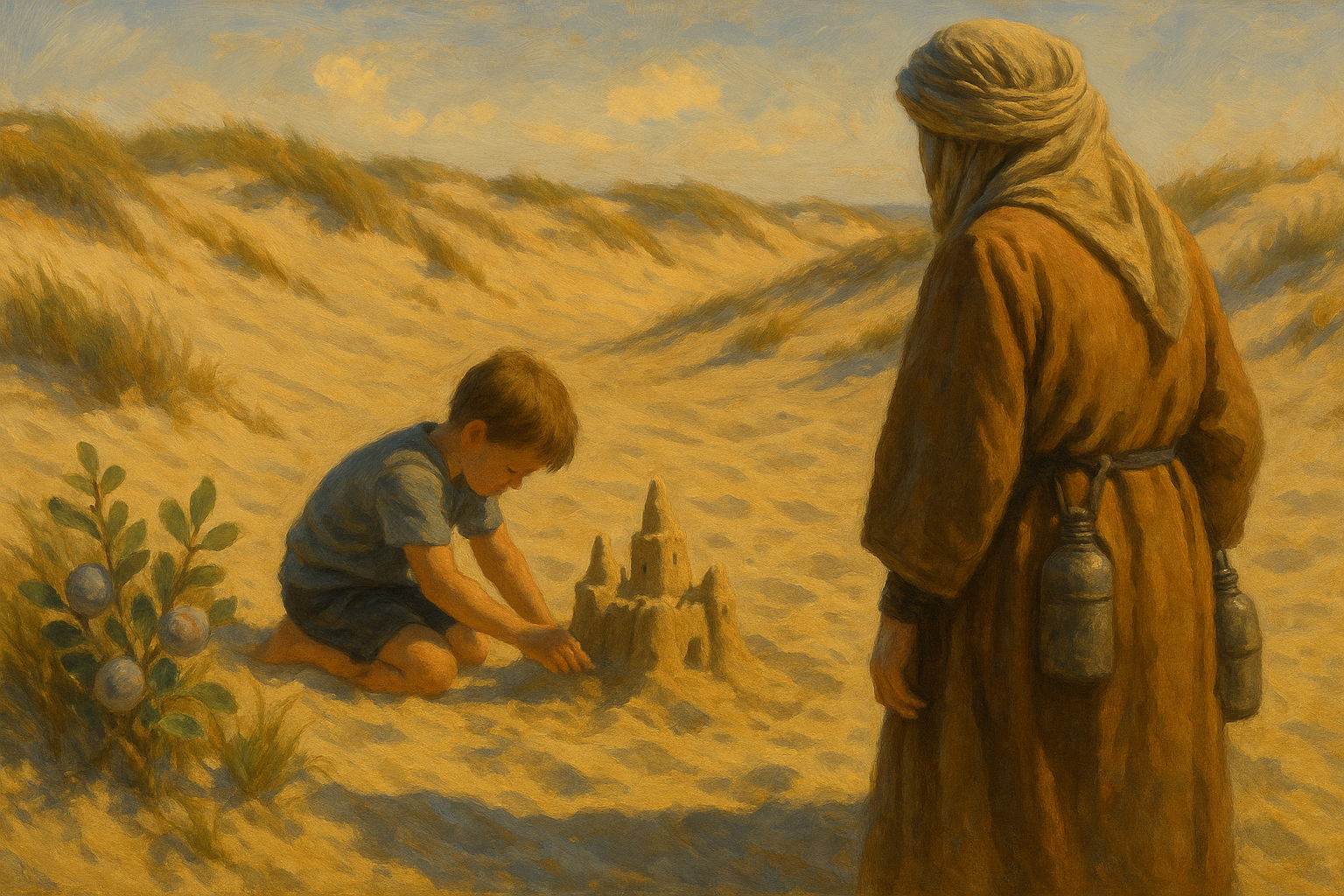
Praying the space isn’t empty, she steadies herself and peers into the dimness. One doom scenario after another fills her mind, so she doesn’t expect to find Clyde sitting beneath a cluster of looming leaves. Her heart pounds as she takes him in. His back is turned, but he appears unharmed, bent over in what seems to be full concentration. Placing a hand on her chest, Lesley exhales, releasing the breath she hadn’t realised she was holding.
Clyde looks up from whatever he’s been doing and waves at her like nothing has happened, a big smile on his face. Lesley’s relief about having found him quickly gives way to anger. What had he been thinking? Putting himself, but also her, in danger like this! Capping the bottle, she straightens her back and strides over, ready to let him have it.
A day by the river by Josje Weusten.
“What were you...” she starts reaching him, but the words freeze on her lips when she sees what he has been doing. “Is that…?”
“Do you like it?” Clyde pleads, eager for her approval.
Lesley falls silent. The castle isn’t identical – it looks less firm and the moat he dug isn’t filled with water like hers was – still, it comes very close.
“Grandma,” Clyde impatiently urges her to answer.
“It…it’s…” The emotion feels too big and complex to capture. Not knowing what to say, Lesley bends forward and pulls her grandson into a tight hug.
“I think you deserve that fruit now,” she smiles when she lets go of him a minute later, reaching for the closest branch. Despite their defensive look, the fruits come away easily.
“We should bite at the same time,” Clyde insists as she puts one of the soldier fruits in his hand.
“Ok,” Lesley answers. “You count down then. From three.”
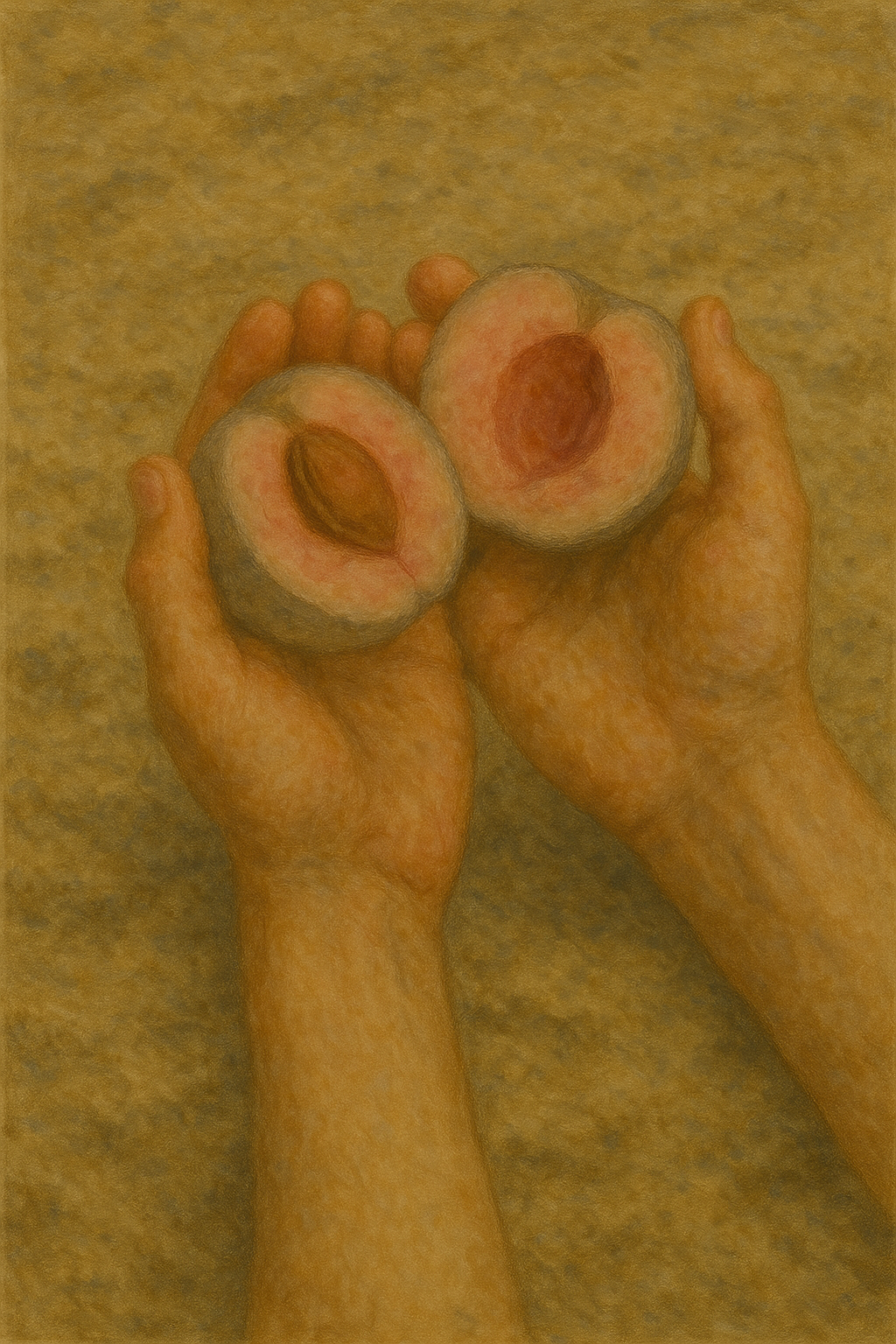
With a flair for the dramatic, Clyde raises the fruit high in the air and starts the countdown. As they synchronously sink their teeth into the shale-grey skin – Lesley a tad careful, Clyde without any reservation – she is surprised the fruit is bewilderingly pink inside.
“It’s only a little bitter,” Clyde munches before taking another mouthful.
Lesley nods. Though the flesh is oddly odourless and indeed tastes somewhat acidic, the fruit faintly reminds her of apricots.
“I think your mum should call these Clyde fruits,” Lesley muses, the juice dripping down her chin.
“She can do that?” Clyde’s face beams with enthusiasm about the idea.
“Even if she can’t, we can still call them Clydes,” Lesley replies, once more taking in every detail of the sandcastle her grandson built.
Each wall feels like a promise, each tower like a beacon of hope.
Never could she have dreamed of sitting out here, cross-legged, next to her grandson, in the middle of the day. She lets their knees touch and closes her eyes. If she listens closely, she can almost hear the river flowing again.
Josje Weusten is a writer, poet, essayist and a senior lecturer in literature, poetry and creative writing at Maastricht University, as well as the founder and chief editor of the literary journal Telling Stories Magazine. Her debut novel, Fake Fish, is published by Sparsile Books Ltd
