
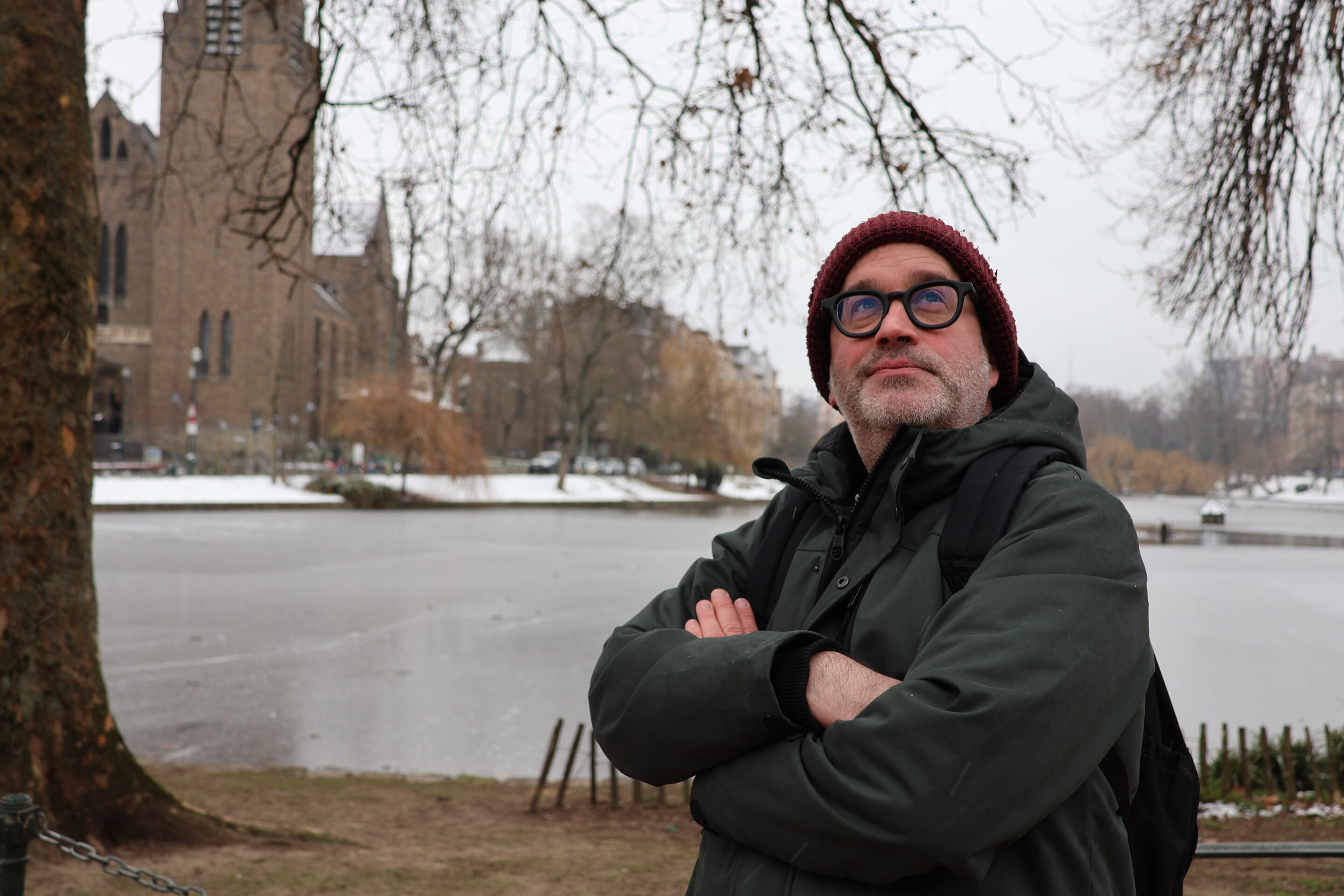
Manuel Schmitz has lived in Brussels for more than 20 years. Most he has spent walking around, guiding architecture tours. In the last four years, he has also walked every street in Brussels - about 2900 kilometres.
Schmitz has been guiding architecture tours in Brussels since 2016. He is a member of an urban planning action group, L’Atelier de Recherche et d’Action Urbaines (ARAU), and Walk Brussels, an advocacy group for pedestrian space in the city.
He wrote a book about the architectural history of Brussels, titled Monumental: Power and Architecture in Brussels, and published his debut novel, Nimmerleinstage (German for Forever Days), three months ago.
I met Manuel Schmitz at the corner of Rue des Champs Elysées and Rue Mercelis in Ixelles, on a cold afternoon – just an hour before it started snowing in Brussels. He told me he first resided on the Rue des Champs Elysées when after moving to the Belgian capital from Germany in 2004.
"First thing I noticed when I moved here was how many old buildings still stand," Schmitz said. "Brussels is also international. For someone like me, a German, it is easy to feel at home here."
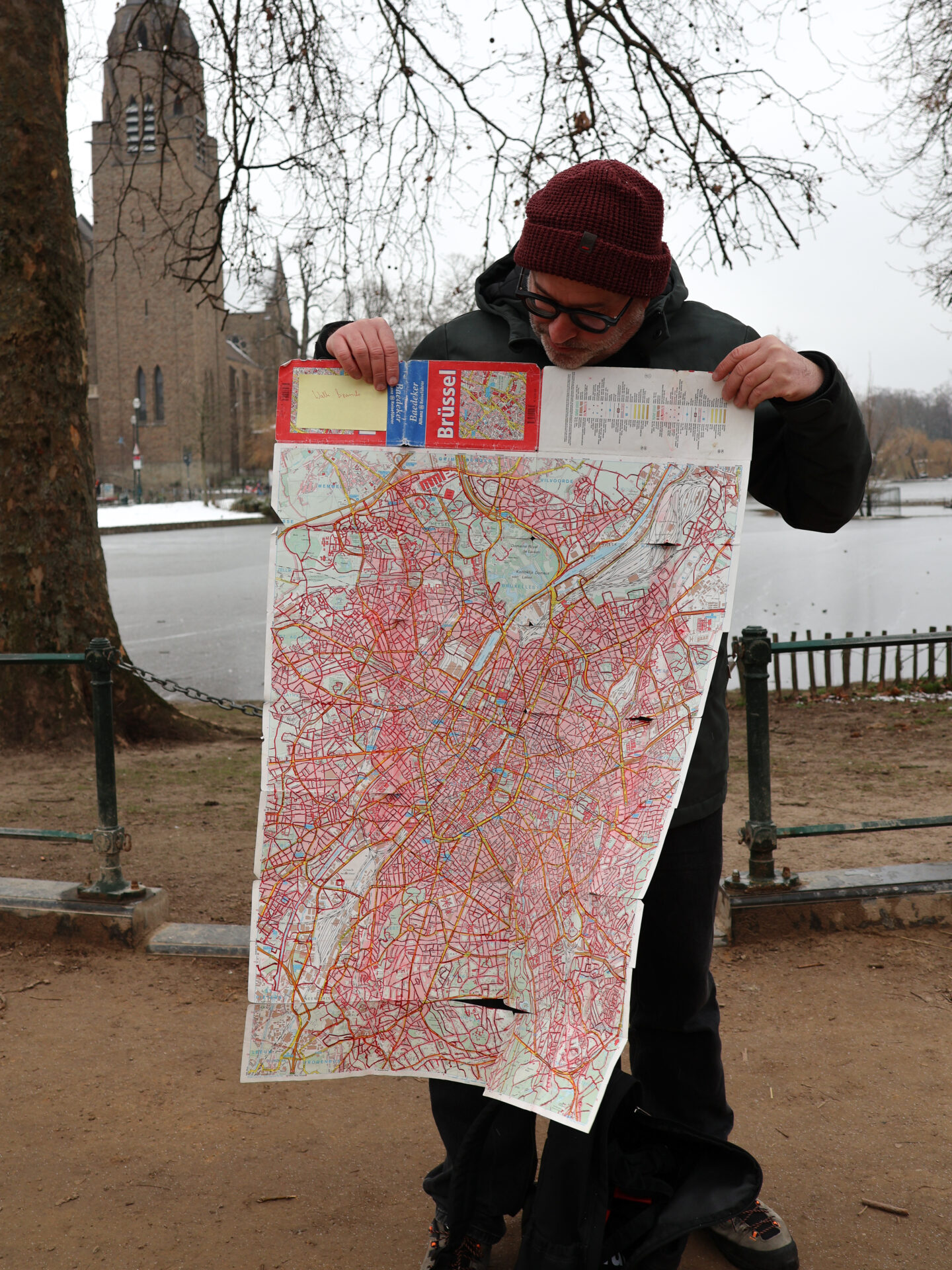
Manuel Schmitz with the map he used to track his walks around Brussels. Credit: The Brussels Times
Besides his work, Schmitz goes for walks every day. Between October 2021 and September 2025, he walked every street in Brussels, meticulously marking his path with a red pen on a paper map.
He walks fast, with no headphones on and often stops to look around when something in a building captures his attention. He also thinks of what the details tell him. "I want to read the street, and it is annoying when I can't."
This happened to him with a building on the Rue van Elewyck. "I was not sure if it was built before World War II or after." He looked at black and green tiles and numbers, which suggested that it must be later than the 1930s and before the 1960s. "The rest I could not tell because they changed window frames; windows tell a lot about the building."
He then checked the online registry, but it was not there either. The answer he found on the Bruciel website for historical satellites revealed that this building was constructed in 1938. "I can be obsessive," Schmitz admitted, laughing.
'I prefer honest architecture'
At the end of Rue des Champs Elysées, Schmitz and I stopped for a moment and pointed at the house of architect Philemon Wachtelaer, built in 2020. "It doesn't make an effort to blend in. But on the other hand, Wachtelaer made an effort for it to fit in with the street."
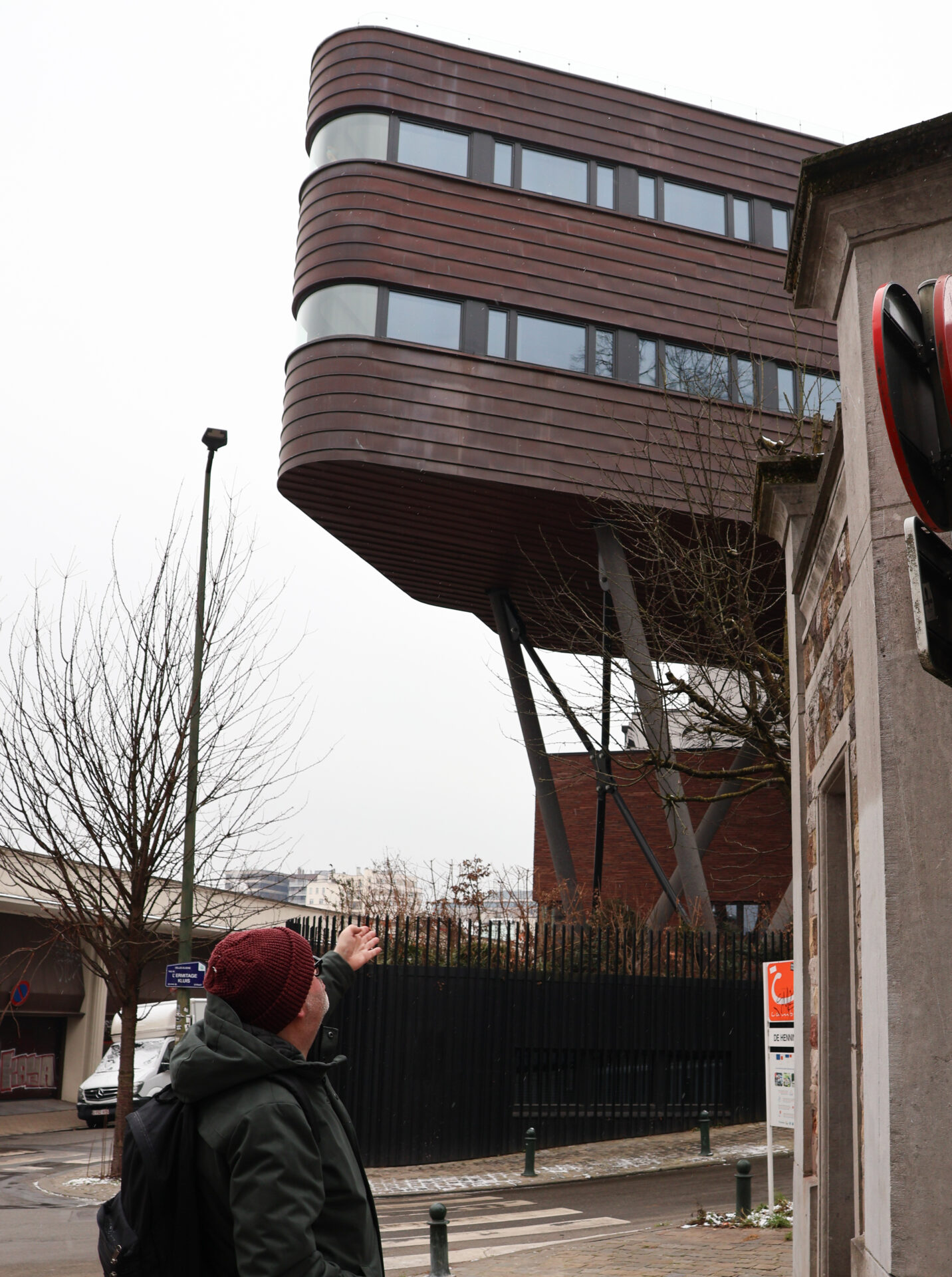
The house of architect Philemon Wachtelaer, built in 2020. Credit: The Brussels Times
"I am not a fan of pastiche. I prefer an architecture that is honest and doesn't want to fool me. However, I appreciate it when an architect makes an effort to look around and take something out of the context. For example, the colour, the building materials, or the dimensions."
"Brussels has a reputation for not taking care of its architectural heritage," said Schmitz. Uncontrolled and often destructive urban redevelopment with careless introduction of modern high-rise buildings of the 60s and 70s in Brussels even inspired the term Brusselization.
Today, there are certain rules. "You cannot demolish a building just like that, of course. But it is not a museum, it is a city, so there is some pressure. I am still surprised how, sometimes, it is permitted to demolish certain buildings."
The abundance of historical buildings in Brussels makes it harder to protect them. "To a certain extent, all these old buildings are also a curse," Schmitz explained. "For example, neoclassical buildings tend to look quite similar to each other. So, you cannot say 'we have to protect it because it is so extraordinary', and then there comes pressure, because the city is growing. Tastes also change."
The pleasure of walking
"I like small details, and I always take pictures of them. That’s the pleasure of walking compared to using a bike: you can stop, look, and notice things, like an old doorbell. For me, walking is about details and about the ordinary. I’m not looking for adventure. I like repetition. Doing the same walk every day wouldn’t bother me. I keep noticing something new."
Since Brussels introduced a general 30 km/h speed limit, walking in Brussels also became far more enjoyable, said Schmitz. "Otherwise, you have to watch out for the cars all the time. It does so much when they slow down. So that is positive development."
He pointed to the building across the Wachtelaer's house. "I can tell those are from the 1930s, looking at the balconies and railings, and how the stone is cut, the materials, the roof. I like when the city is readable; It is nice to have surprises, but also understanding the history and which part of the city you are in gives a certain comfort."
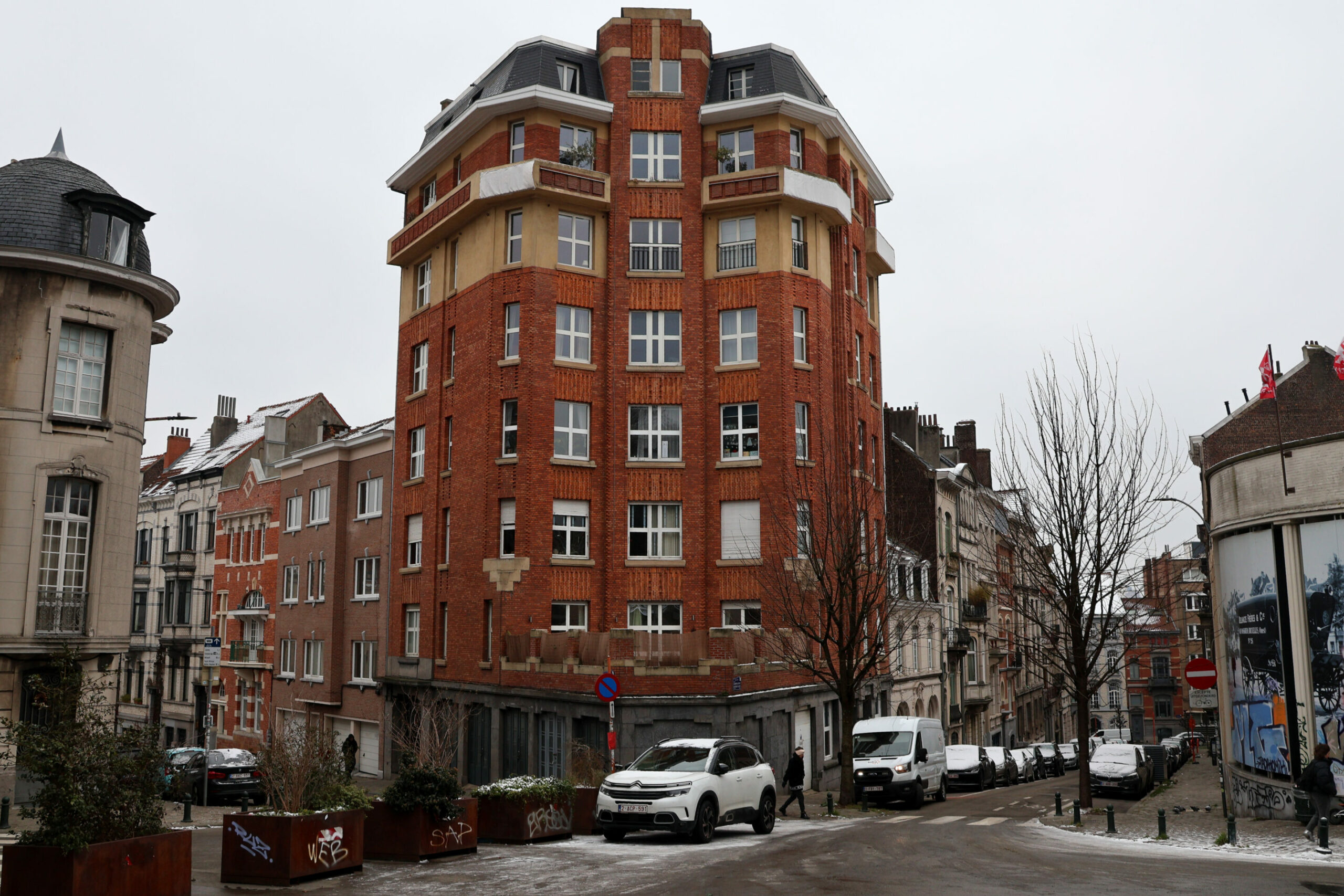
Rue de l'Ermitage(on the left) and Rue des Champs Elysées (on the right) across from the house of Philémon Wachtelaer. Credit: The Brussels Times
Schmitz looked at another building across the street, with the wide panel windows on the penultimate floor. "You can immediately tell that that was a house, built for an artist, likely a man, because the building is old and there were fewer female artists around. The windows face north, which makes sense for the light to be stable."
'A lot to discover in the north'
Koekelberg is one of his favourite areas – the National Basilica of the Sacred Heart and the park around it are "absolutely amazing". The church was designed in the 1920s and finished in the 1970s, and is widely seen as an Art Deco gem.
"There is a lot to discover in the north. It’s a different side of Brussels, not like Ixelles or Saint-Gilles with their cafés. Yet, it has a good feel to it. So that would be my recommendation. Everyone should check out the north of Brussels a little bit more," he said.
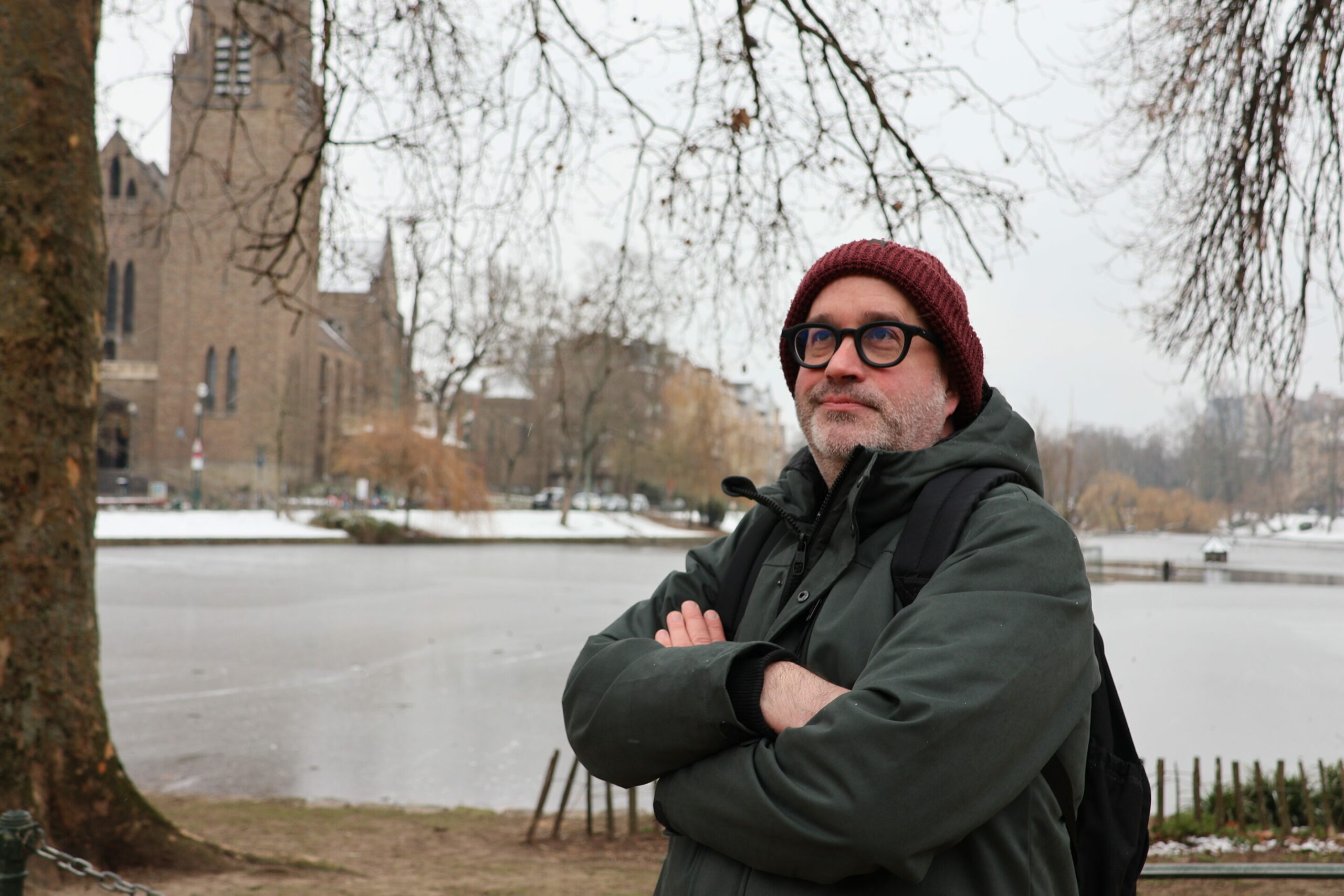
Manuel Schmitz in front of the Ixelles Ponds near Flagey Square. Credit: The Brussels Times
In the media, Brussels is more often mentioned as a shorthand for the European Union, rather than the Belgian capital.
"The problem is that people associate the EU with bureaucracy, and bureaucracy with something grey and dull," said Schmitz. "From there, they conclude that Brussels is a boring city, which is complete nonsense. Brussels is extremely colourful, precisely because so many people from different places live here."
