
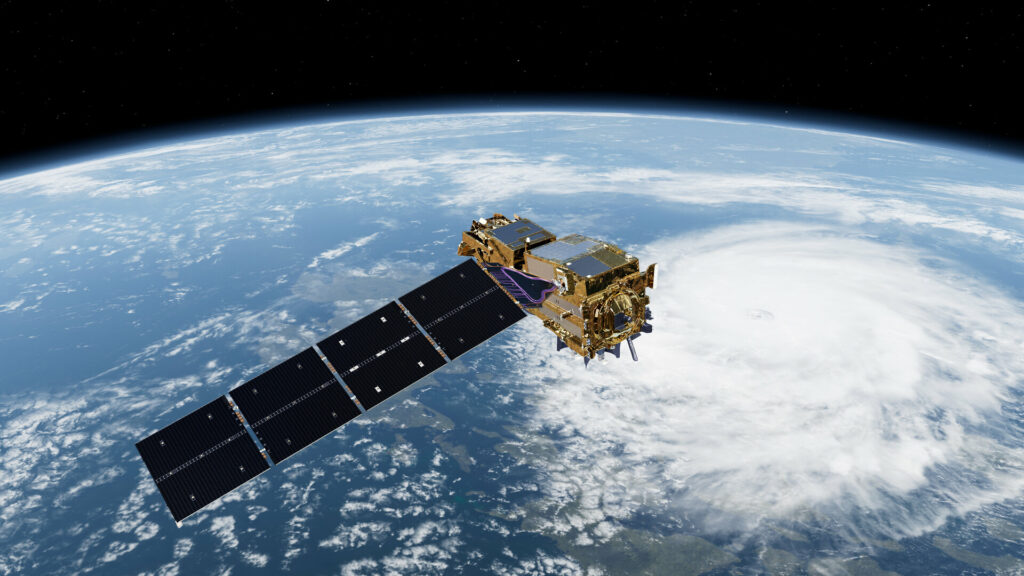
Belgium is participating in a new European programme to launch 20 weather satellites. This involves an investment of €24.3 million for the period 2025-2042, Minister for Science Policy Vanessa Matz (Les Engagés) announced on Wednesday.
The new series of satellites – called "Sterna" – should provide more accurate forecasts, and also enable forecasts to be made above the currently under-observed polar regions.
"Accurate weather forecasts make it possible to predict storms, heat waves, floods and droughts and help to take measures to protect the population and infrastructure," Matz said. "Good weather forecasts are also crucial in economic terms. A third of economic sectors – energy, transport, construction, agriculture, tourism and aviation – are highly weather-sensitive."
Additionally, she stressed that the polar regions are also becoming increasingly important strategically, particularly due to the increase in shipping traffic.
Investing in European capacity
The satellites are being developed within EUMETSAT, a European intergovernmental organisation. Its data is being used by Belgium's Royal Meteorological Institute (RMI), among others.
EUMETSAT is collaborating with the European Space Agency (ESA) on the construction of the satellites. The first six are scheduled to be launched in 2029 and will orbit the Earth in low orbit (800 km altitude).
Incidentally, the United States recently decided to decommission six weather satellites in the short term. This could lead to a significant loss of observation capacity, according to Matz. Therefore, she believes it is important for Belgium and the European Member States to continue investing in their own capacity.
