
Compact, cultured and effortlessly convivial, Leuven sits just east of Brussels but feels worlds apart.
Belgium’s oldest university city brims with Gothic beauty, lively student energy and a beer heritage second to none. Cycle its cobbled streets, sip a local brew on the Oude Markt, and discover a city built equally for learning and living.
In September, Leuven was named European Capital of Culture 2030, coinciding with the 200th anniversary of Belgium. It comes after this year’s celebration of six centuries of Leuven University (now known as Katholieke Universiteit, or KU Leuven).
Today, the city’s bustling squares overflow with lively pubs, cosy cafés and trendy eateries. Festivals are frequent and beer heritage is well celebrated. This is a city shaped by knowledge and resilience, drawing thinkers from around the world, filling this small Flemish city with languages, laughter and the easy rhythm of student life.
History
Once a fortified Viking camp in the late 9th century, Leuven rose in ranks in the 14th century as the residence of the Duke of Brabant, who inspired the creation of the university. If the Northern Renaissance had had a Silicon Valley, it would have been in Leuven, with scholar Erasmus, cartographer Gerardus Mercator and father of human anatomy Andreas Vesalius as thought leaders – while skilled artisans and traders contributed to the development of advanced instruments and luxury goods.
Leuven continued to flourish as an academic, religious and cultural centre until the First World War when up to a third of it was destroyed, including the revered library. It was bombed again in the Second World War, but the city rebuilt once again.
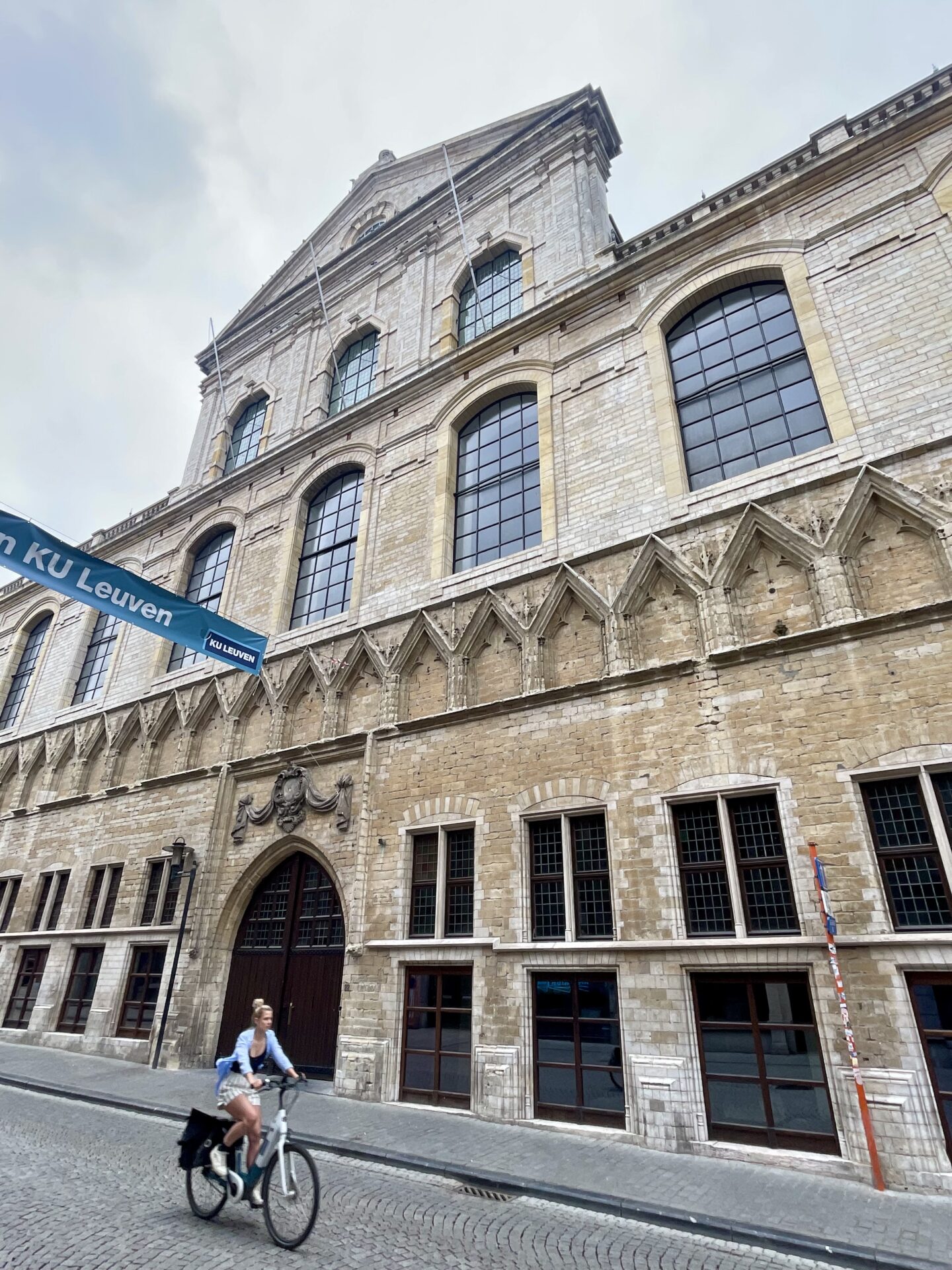
KU Leuven's former library. Credit: Angela Dansby / The Brussels Times
Exquisite landmarks
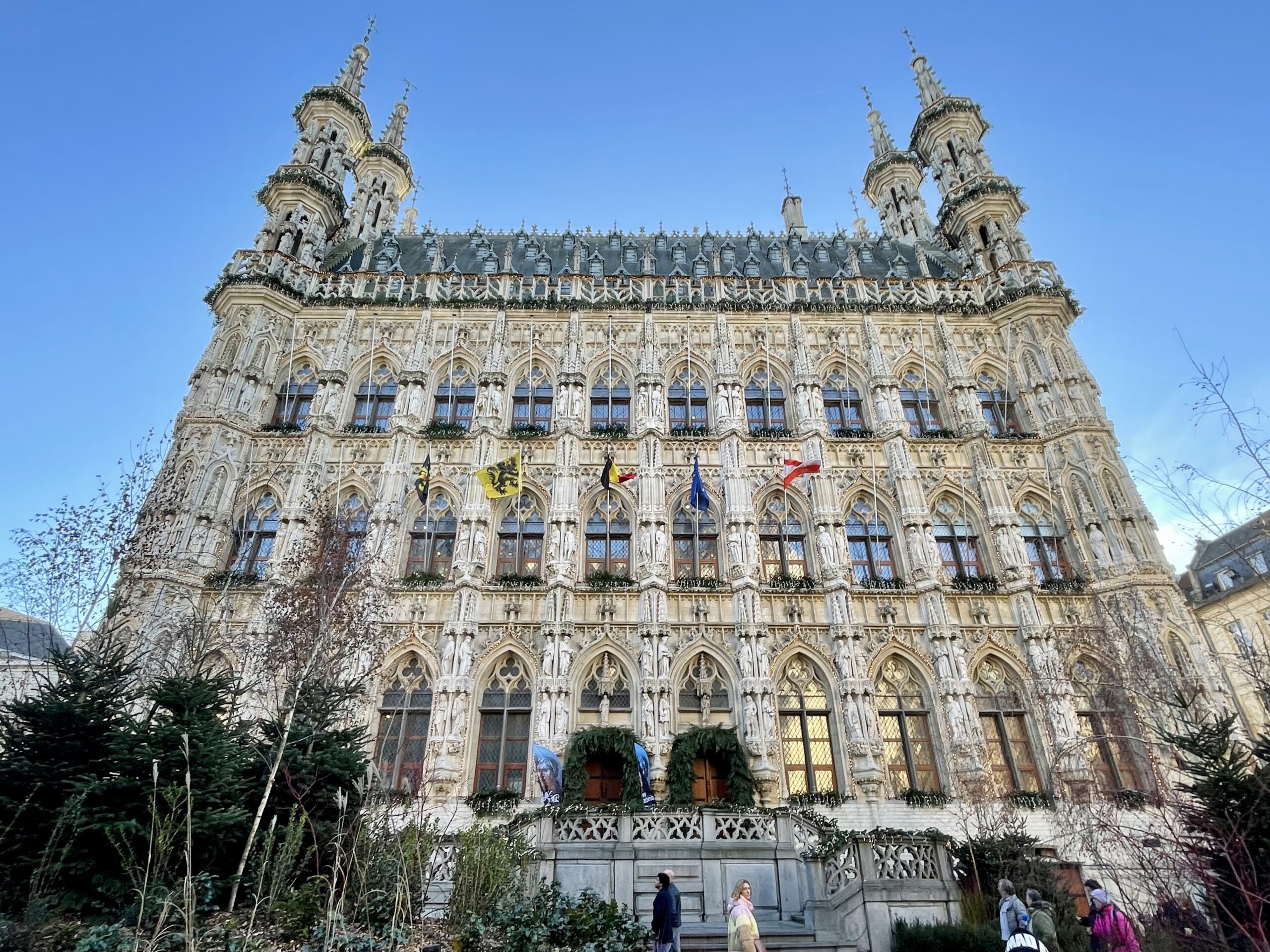
The 15th century Stadhuis (City Hall) on the Grote Markt (Main Square) is Leuven’s architectural star and one of the world’s finest examples of late Gothic architecture. It has an ornate façade with a lace-like design that took 30 years to complete. The final touches were added in the 19th century when the façade was embellished with 235 larger statues representing historical figures, patron saints and noble provincial rulers. The four-century age difference between smaller and larger sculptures is evident in colour upon close examination. The Stadhuis survived World War I because it was the headquarters of German troops. It is currently closed for renovation to make an accessible visitor and administrative centre, set to be completed by 2030.
The University Library and Tower was paid for by 640 American universities and other institutions corralled by US businessman and later President Herbert Hoover. It was built as both a grand library and war memorial commemorating Allied victory after it was twice destroyed by German fire during the World Wars, losing invaluable manuscripts and books. It was meticulously rebuilt each time according to its original neo-Renaissance design. Designed by American architect Whitney Warren, it has a symbolic façade featuring Madonna and child armed and armoured, heraldic animals and stones honouring US benefactors. The library's striking bell tower, 99 meters high, houses one of the largest carillons in Europe. Visitors can climb the five-story library tower, which has permanent photo exhibitions on each floor about its turbulent past. Atop the fifth floor is an open-air balcony with panoramic views and placards about iconic Leuven buildings.
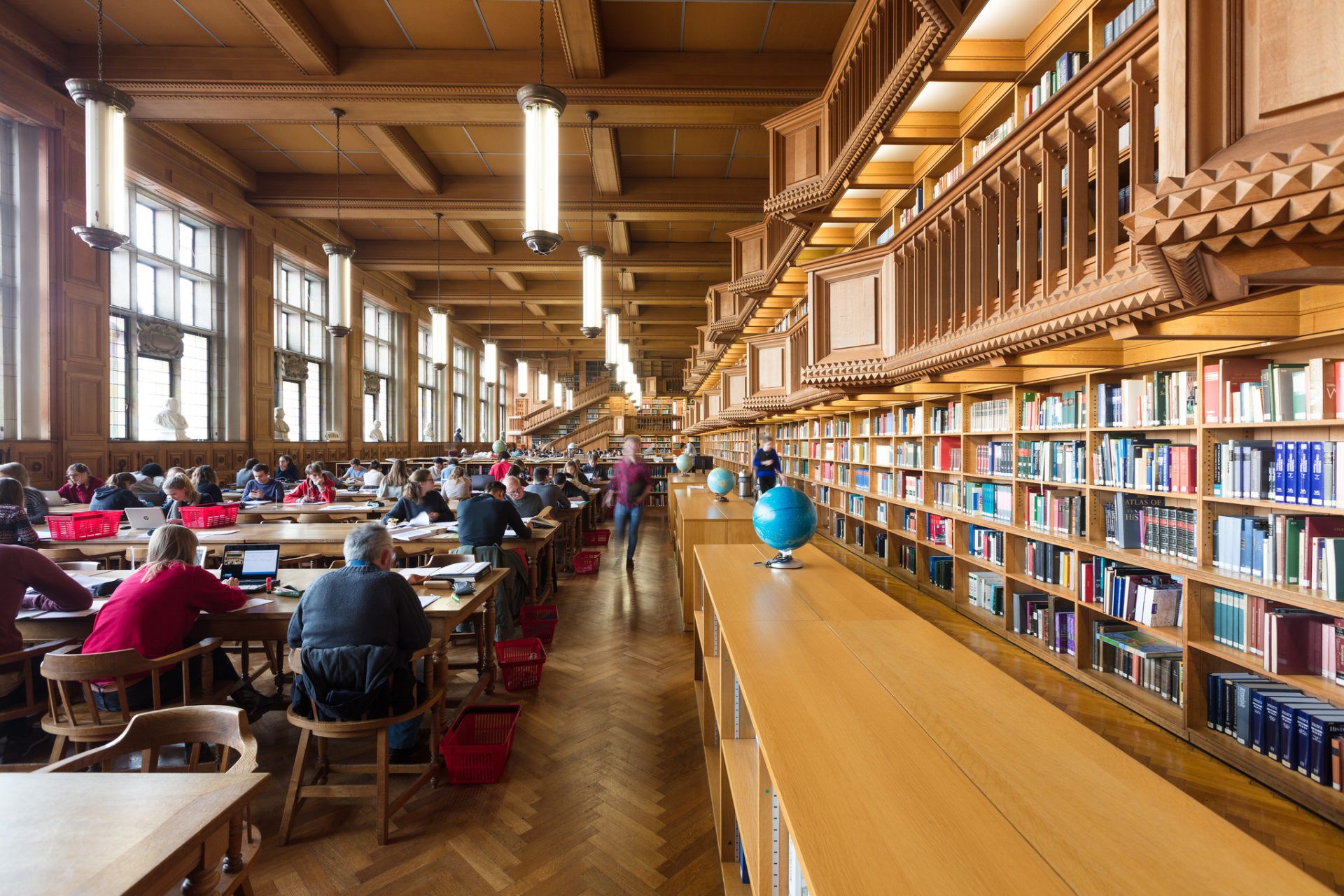
KU Leuven library.
Credit: Visit Flanders
The library sits on Ladeuzeplein, the largest square in Leuven, which is marked by Totem, a jarring sculpture of a giant jewel beetle skewered by 23-metre-high “entomology pin.” It was designed by Belgian conceptual artist Jan Fabre in celebration of the 575th anniversary of KU Leuven in 2004, symbolising scientific inquiry and the fragility of existence. Ladeuzeplein also hosts a farmer’s market every Friday.
The Oude Markt (Old Market) boasts Europe’s longest bar and the epicentre of Leuven’s student nightlife with about 40 bars. Summer music festivals are anchored here as well. A bronze sculpture, De Kotmadam (student caretaker), sits on a bench holding a coffee pot in the square as a nod to the landladies who used to rent rooms in their homes to students.
The Groot Begijnhof (Great Beguinage) from the 13th century, once home to some 360 beguines (unmarried, semi-religious women), now houses students, staff and visiting professors of KU Leuven. A three-hectare UNESCO World Heritage Site, it has nearly 100 sandstone houses, a church, convent and network of streets, alleys, courtyards, gardens and parks.
Kasteel Arenberg and Park in the adjacent town of Heverlee – where the university has a satellite campus – was originally built in the 16th century and is distinguished by brick masonry alternating with sandstone window frames, large corner towers with octagonal spires and onion-shaped roofs. It was the luxurious residence of noble families for centuries. In 1916, the castle was donated to KU Leuven by an Arenberg Duke and after the First World War, it became the main building of the Faculty of Engineering, fittingly including the departments of architecture, urbanism and conservation. Despite damage in the Second World War, many of its original features remain. Surrounding Arenberg Park is a protected green space that contains notable landmarks like the 13th century Arenberg Watermill, one of the oldest of its kind in Europe, and modern art installations.
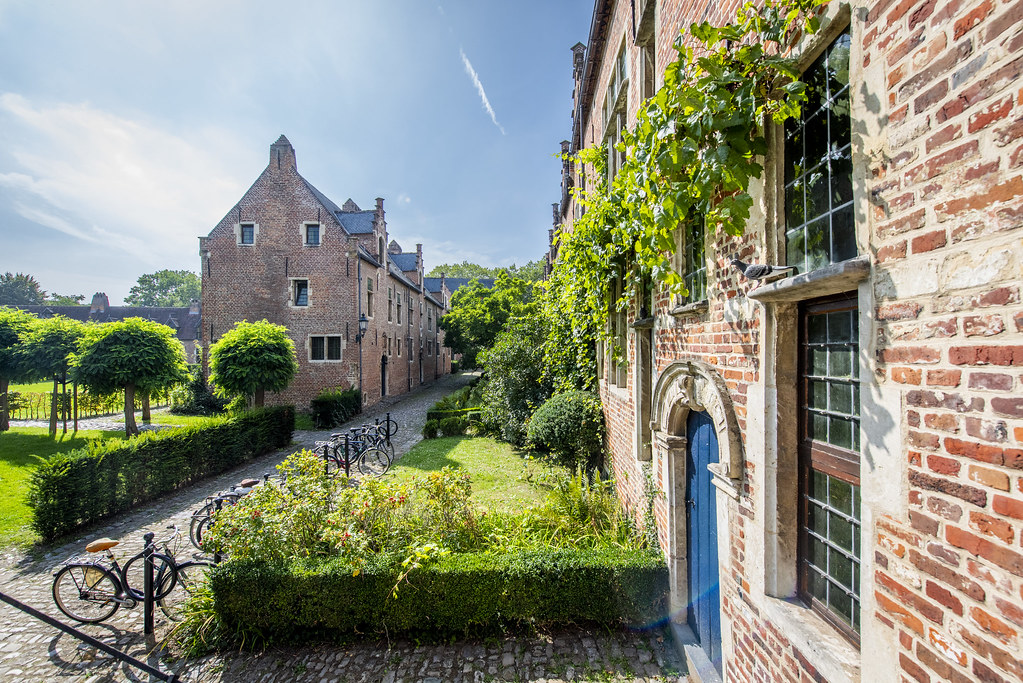
Great Beguinage in Leuven Credit: Jan Crab
University offerings
With origins dating back to 1425, KU Leuven has some 65,000 students, including 15,000 on nine satellite campuses. This year it celebrates its 600th anniversary, a remarkable feat considering that it was abolished under Napolean in 1797, recreated in 1835 and linguistically split in 1968!
In honour of its six centuries of existence, KU Leuven has two special exhibitions, heritage walks, and an art and science route. The latter features 16 new works of art, half of which are typographic poems, in and around Leuven. The exhibitions, Routes to Knowledge and The Pursuit of Knowledge, in the library and M – Museum Leuven, respectively, will run until February 22, 2026. Guided tours are available in Leuven and Heverlee as well as heritage walks on all campuses via the free app KU Leuven Walking Tours.
The Universiteitshal is the oldest university building, which contained the original library from 1317 to the First World War in a former cloth hall. It was burned to the ground during the war (a replica of what it looked like is in a ground floor window) but rebuilt. Today it houses KU Leuven registration and administration offices, co-working and event spaces, a shop and coffee bar.
The Erasmushuis and Erasmustuin (Erasmus House and Garden), named after the influential Dutch scholar who spent much of his life in Leuven, are home to KU Leuven’s Faculty of Arts. In the basement of the cruciform Erasmus House is the Didactic Museum of Archaeology with models of buildings and plaster casts of famous ancient statues. The beautiful garden designed by Belgian landscape architect Jacques Wirtz contains a small amphitheatre and sculptures by renowned Belgian artists like Rik Poots.
The Baroque, octagonal Anatomisch Theater was built by KU Leuven in 1744 for medical students to observe human body dissections. This protected building is currently under restoration to become part of a new Vesalius Museum about science, healthcare and society that’s scheduled to open this December in honour of the university’s 600 years. The museum will partly be housed in the historical, renovated Pathological Institute. KU Leuven and UZ (University Hospitals) Leuven are behind the project, which will also include a new experience centre called Vesalius Next on a former hospital site.
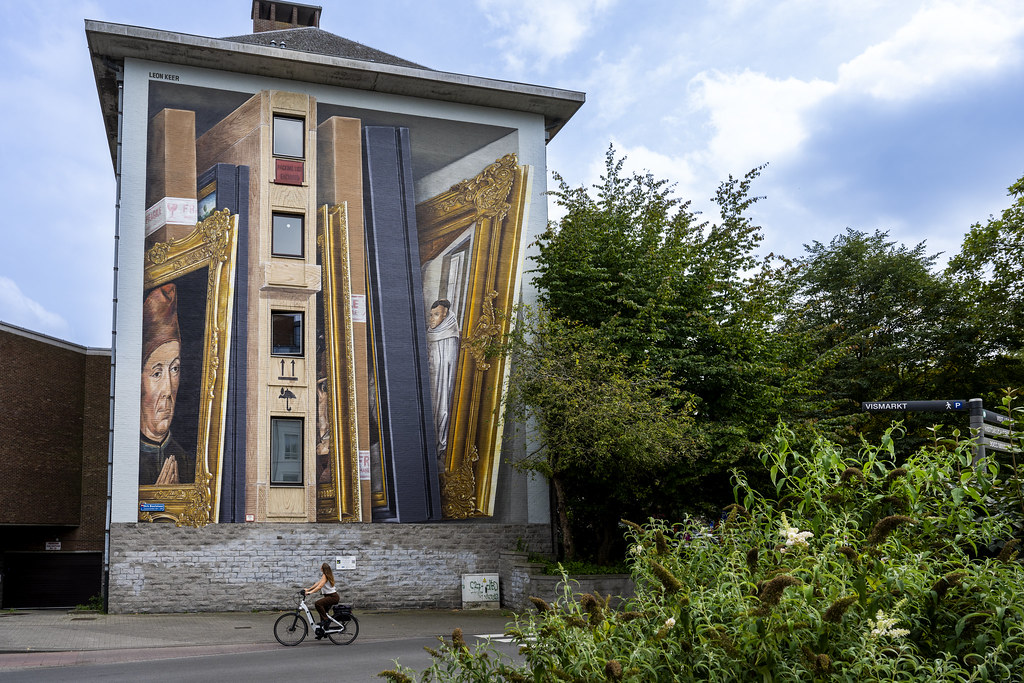
Street art mural by Leon Keer-Leuven. Credit: Karl Bruninx
Other public education spots include KU Leuven’s Health House, an interactive experience centre about the future of healthcare, science and well-being; KADOC (Katholiek Documentatie en Onderzoekscentrum), a documentation and research centre focused on religion, culture and society; and the Museum for Zoology with an extensive collection of specimens, skeletons and taxidermy from many animal groups.
The following university buildings are of architectural interest: The stately Paus Adriaan VI-College en Heilige Geestcollege (Pope Adrian VI College and Holy Spirit College), originally the professor-pope’s home in the early 16th century that expanded into student housing.
College de Valk (College of the Falcon), a historic academic building founded as a pedagogy that’s now KU Leuven’s Faculty of Law (the falcon is reflected in its coat of arms and motto, and the building is flanked by busts of notable figures linked to legal history)
The neo-Gothic Seminarie Leo XIII, once for priests in training and now a residence for international students, which has a roof decorated with the emblem of Pope Leo XIII and Belgian lion
Hogeschool Groep T, a campus within KU Leuven's Faculty of Industrial Engineering Sciences, which is an architectural replica of the Guggenheim museum in New York with a slanted glass roof column
Beer culture
Leuven is frothing with beer as headquarters of the world’s largest brewer, AB InBev, which has a heritage in the city spanning more than 600 years, originating from the Artois brewery.
Brouwerij Stella Artois, part of AB Inbev, remains local, offering tours with tastings on weekends. De Hoorn in the Vaartkom – a former industrial and brewery district around the Canal Leuven–Dyle (Vaart) – is where Stella Artois was first brewed in 1926 until the 1980s. Now the building houses a restaurant and hospitality venue of AB InBev.
Leuven also boasts craft breweries, including Domus Microbrewery, Brouwerij De Coureur, Brouwerij De Vlier and Brouwerij Hof Ten Dormaal, plus MALZ craft beer bar and shop. Beer tasting tours, optionally paired with food or chocolate, are available via LeuvenLeisure.com.
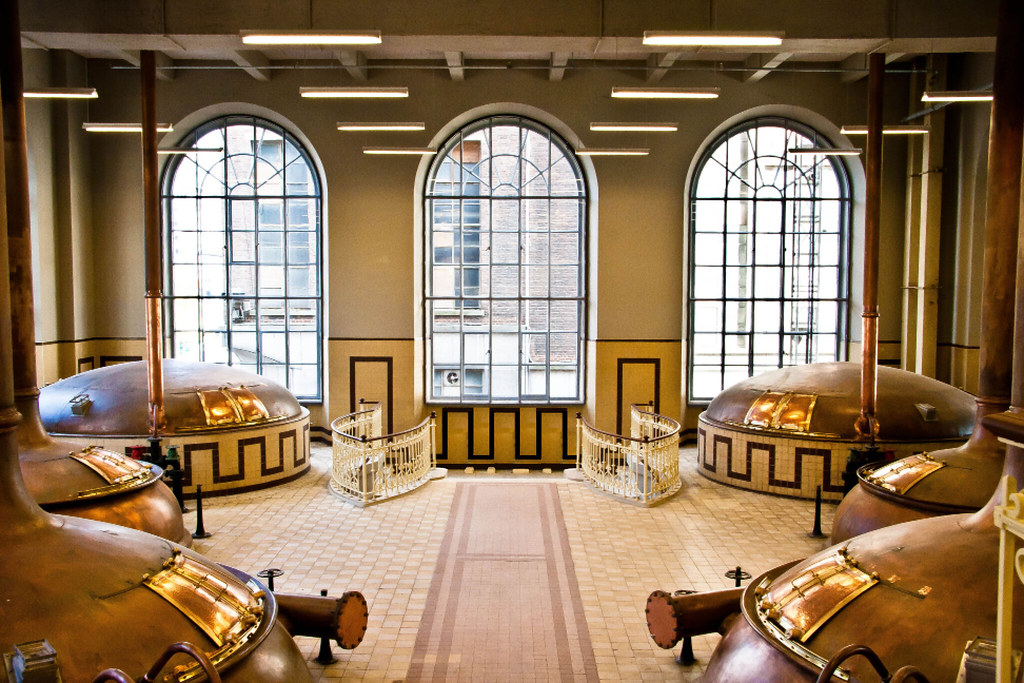
De Hoorn brewing hall Credit: VisitLeuven
A hilarious annual Bartenders’ Race in the Oude Markt challenges locals to pour beer and run with loaded trays around an obstacle course downtown. It occurs during the Hapje-Tapje food festival the first Sunday of August.
Every April, Leuven Beer Weekends celebrate beer heritage and innovation in three events: Leuven Innovation Beer Festival, which showcases unique beers from around the world from about 20 breweries; Food & Hops, which pairs beer with gourmet cuisine; and Zythos Beer Festival, Belgium’s largest beer-tasting event featuring hundreds of Belgian brews from numerous breweries.
City Beer Golf combines tourism, beer tasting and urban golfing where the "holes" are watering holes (bars) around Leuven.
Places of peace
The lush, colourful Kruidtuin is the oldest botanical city garden in Belgium, created by KU Leuven in 1738 for its medical students. It is open to the public daily.
The large Stadspark Sint-Donatus (City Park of St Donatus) contains a tower and section from a 13th century city wall. It also has an artificial waterfall, ponds, sculptures and a new art installation of a giant rock sitting on chairs. The latter, one of several artworks throughout the city commemorating KU Leuven’s 600th anniversary, represents the weight of missing knowledge.
The Dijlepark is a small, romantic city park near the Great Beguinage with a blue, curved bridge arching over a pond and gazebo for picnics. Behind De Hoorn is Sluispark, an urban green space with a giant Leuven sign, fish trap and children’s water playground.
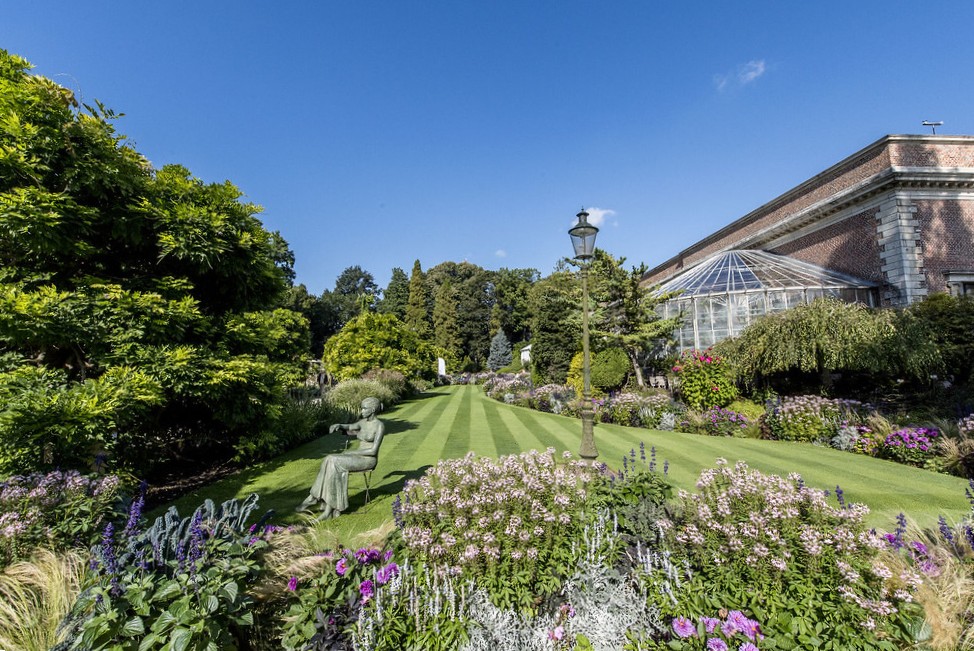
Kruidtuin, the Botanical Garden in Leuven. Credit: Belga / Jan Crab
Park Abdij Keizersberg (Keizersberg Abbey Park) was a ducal castle in the Middle Ages, then a Benedictine abbey, which now houses both monks and students. It resembles an old fortress set apart otherwise by a large statue of the Virgin Mary. The surrounding park on the Keizersberg (Emperor’s Hill) offers lush gardens, scenic walking paths and panoramic views of Leuven.
Abdij Van Park in Heverlee contains a well-preserved Norbertine abbey dating to 1129 and 42 hectares of meadows, orchards, gardens, ponds and natural areas. The abbey has 17th-century stucco ceilings and stained-glass windows as well as the PARCUM museum about religious heritage and art, Peace Carillon and House of Polyphony. The Peace Carillon was inaugurated in 2018 to celebrate 100 years after the Armistice. It hosts concerts every Wednesday. The House of Polyphony is an international centre dedicated to the research and preservation of the musical heritage of the Low Countries. The Park Abbey also includes a 16th-century watermill containing Brasserie De Abdijmolen, a brewery called Braxatorium Parcensis, gatehouses, walking and cycling paths, and special exhibitions.
Heverleebos is the name of beautiful woods spanning Leuven and Heverlee, with well-maintained trails for both walkers and cyclists. The Trolieberg on the outskirts of Leuven is an open area with wonderful views of the city skyline.
Provinciedomein Kessel-Lo (Provincial Domain) in the suburb Kessel-Lo is a recreational area with an outdoor swimming pool, educational playground and a pond with pedal boats. The Abdij Van Vlierbeek in Kessel-Lo, founded by Benedictine monks in 1125, still has its parish as well as beautiful grounds for walking and cycling. Also in this district is Park Belle-Vue, a long, narrow green park between the railway tracks and Martelarenlaan street. Nearby Kesselberg is a protected, hilltop nature reserve and archaeological site with remains of a fortified settlement from the Iron Age.
Kayaking on the Dijle River is possible from the nearby village Korbeek-Dijle to Heverlee. The route is 6.5km and takes about 1.5 hours. The Shelter in Korbeek-Dijle provides equipment, parking and facilities. A Viking boat tour on the Dijle, Noormannentocht (Norman tour) by Dijle Floats, takes people back to the Viking history of Leuven with authentic clothing and storytelling about Danish Norsemen.
Art parts
M Leuven evolved from a cabinet of curiosities in the 18th century into a major city museum with more than 58,000 regional artworks. It covers the Stone Age to the present, particularly the Renaissance and 19th century. It also has a valuable collection of contemporary art, with many works by Belgian artists, plus a gift shop.
The OPEK (Openbaar Entrepot voor de Kunsten), meaning Public Warehouse for the Arts, is a vibrant cultural centre featuring performing and visual arts as well as literature. It sits in a former customs building in the heart of the Vaartkom. Within walking distance is Rocketman, a metallic man dangling from atop the old Stella Artois malt house.
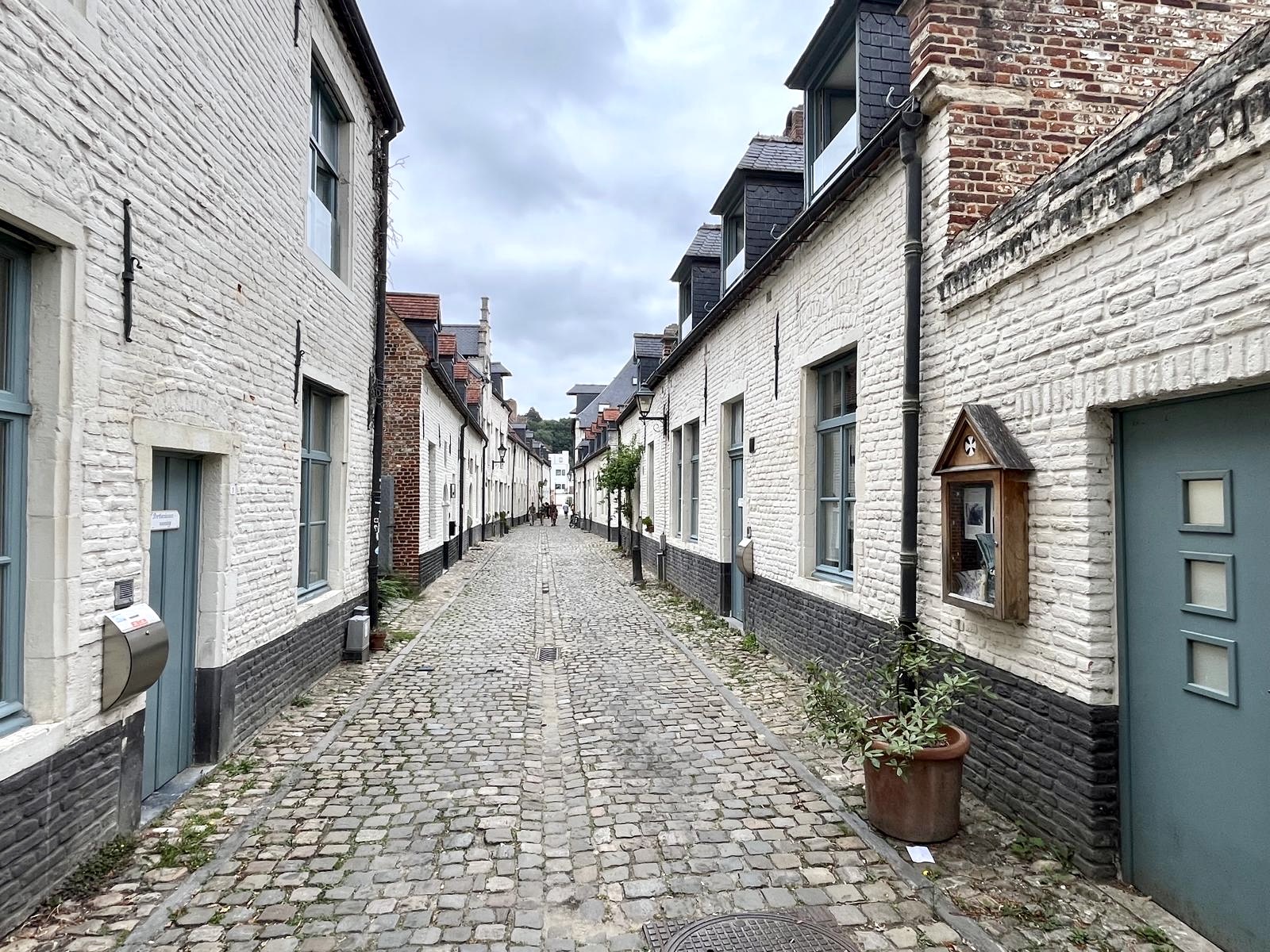
Klein Begijnhof in Leuven. Credit: Angela Dansby / The Brussels Times
The huge, 15th-century Sint-Pieterskerk (St Peter’s Church) across from City Hall has several masterpieces by Flemish Primitives, pioneers of Renaissance oil painting whose works profoundly shaped European art. Most notably, the church contains The Last Supper triptych by Dieric Bouts. This and 11 other masterpieces can be viewed via a hololens to bring them to life with spectacular 3D images and animations. The Gothic belfry, part of the UNESCO World Heritage Site listing of Belfries of Belgium and France, features an external bell rung by a brass “man”.
The Baroque façade of Sint-Michielskerk (St Michael’s Church) from the 17th century survived the church’s destruction otherwise in the First World War. This ornate façade has Ionian columns, pilasters and friezes like an exterior altar. Inside, a Baroque pipe organ occupies the entire rear wall.
Across the street from the old city wall along St Donatus Park is an industrial sculpture of Pieter de Somer, the university’s first rector after its linguistic divide in 1968. Adjacent on the Aula (Auditorium) Pieter De Somer is a street art mural of Sanda Dia, a KU Leuven student who was killed in 2018 by a fraternity hazing incident. Other notable street art includes a mural of stored artworks by Leon Keer, a giant electric heater by Bisser and Primeval Atom, a network of 80 medallions representing a scale model of the universe in tribute of the Big Bang Theory, conceived by KU Leuven Professor Georges Lemaître in 1931 (a bust of him is in the courtyard of College van Premonstreit). Nearby are fascinating sculptures of a cloaked archangel in the courtyard of Van Dalecollege and a Chinese globe in front of the Ferdinand Verbist Institute.
Near Martelarenplein (Martyrs’ Square) is the memorable sculpture De Ballon van de Vriendschap (The Balloon of Friendship) of a hot air balloon with four friends in its basket. It was made by living Belgian sculptor Dany Tulkens.
Architecture
The Stationsgebouw (train station) from the late 19th century is stunning with French and Italian influences. Inside is a modern overhang above platforms that resembles sheets flapping in the wind, ironically designed to reduce train noise.
In front of the station on Martyrs’ Square is the Peace Monument, an obelisk erected in 1925 to honour more than 200 civilians who were executed by German troops there in the First World War. At night, the obelisk has illuminated red windows at its peak to represent the great fire that led to the Sack of Leuven in 1914.
Sint-Geertruiabdij (St Gertrude’s Abbey) and the Klein Begijnhof (Small Beguinage) dating from the 14th to 17th centuries feature stone and brick craftsmanship and white rowhouses, respectively. The tower of St Gertrude’s Church was built without nails, featuring an openwork stone spire with no wooden elements.
The pointy, dark brown Wiptoren de Toewip (Shooting Tower) from 1936 is the last of its kind in the province and a throwback to the old practice of manufacturing bullets by dropping molten lead down a vertical shaft into a water basin. The Provinciehuis Vlaams-Brabant, seat of the provincial government, is a modern gem by Portuguese architect Gonçalo Sousa Byrne denoted by an exterior bright yellow balcony. Its ground floor conference centre is open to the public.
Other noteworthy architecture includes the Klooster Conventuelen (Conventual Monastery) on Herbert Hooverplein with a façade of silhouettes of active people; Flemish Neo-Renaissance Notarishuis (Notary house); and stately, 19th-century Stadsschouwburg (City Theatre) with a parterre garden.
Curiosities
Flemish celebrity chef Jeroen Meus records his television cooking show, Dagelijkse Kost, in a former 18th century inn at Schrijnmakersstraat 11. Passers-by peering through the studio window can sometimes see him filming.
IMEC (Interuniversitair Micro-Elecktronica Centrum), once part of KU Leuven, is the largest independent European research centre for nanotechnology and digital innovation. Based in Heverlee, a guided tour can be arranged by emailing visit@imec.be at least two months in advance.
Experience
Christmas Market: A longtime local tradition covering two large squares with more than 140 stalls, pop-up bars, an illuminated tower, live entertainment and more
Hapje-Tapje: An outdoor culinary festival the first Sunday of August with hundreds of tasting dishes from local restaurants and a Bartenders’ Race where participants run with trays of beer on an obstacle course
Hear Here: Every three years, a walking tour in May featuring about 15 sound art installations on heritage sites around Leuven, next in 2028
Het Groot Verlof: A cultural festival each July/August that includes Beleuvenissen (free open-air concerts on Friday nights), open-air films, street food, cultural events and guided tours
Jaarmarkt Leuven: A long-time annual fair the first Monday of September with a draught horse and cattle competition, huge street market and concerts
Leuven Beer Weekends: A series of three two-day festivals focused on beer innovation, food pairings and tastings
Lichtjeswandeling in het Groot Begijnhof: A candlelight walk in the Great Beguinage one weekend evening in December with thousands of candles illuminating the historic space
Markt Rock: A two-day music festival every August featuring Belgian and international talent
Savour
Bar Louis: A sultry bar and restaurant on the Grote Markt with a covered terrace offering Belgian and international cuisine
El Sombrero: This Mexican restaurant is a colourful and popular spot offering classic dishes
GUZZI: An off-the-beaten-track, Michelin-recognised pizzeria with a terrace featuring wood-fired pizzas and other
Italian food
Troubadour: An upscale restaurant featuring traditional Belgian cuisine, such as Flemish stew and chicory with ham and cheese
Zappaz: A gastronomic star offering multiple “taste experiences” of different techniques, preparations and flavours
Sip & Snack
Barbóék: A café and bookstore combined, this is a place to sip coffee while reading
Het Moorinneken: Next to City Hall, a café with seasonal dishes in a historic building named after a bust on its façade
Café Entrepot: In the OPEK building with a spacious terrace overlooking the Vaart canal, an artsy, casual spot for good-value spaghetti and more
Coupe Matadi: A unique ice cream parlour on a moored, retrofitted freight ship on the Leuven canal featuring homemade, artisanal ice cream
Sips: A newish, upscale wine bar with fine selections that can be paired with tapas and/or dinner meals
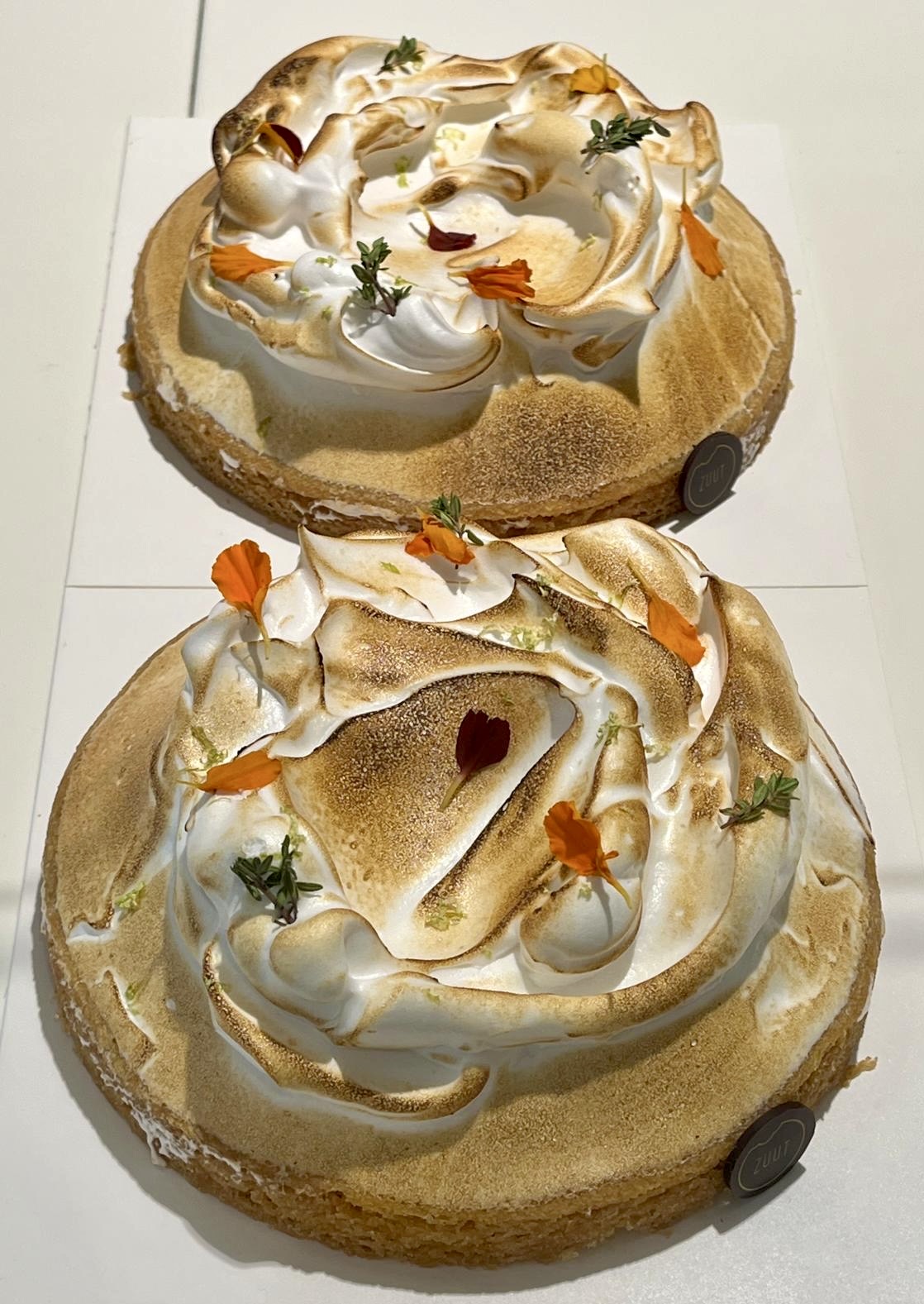
ZUUT: A tea salon with gourmet pastries, desserts and homemade ice cream
Stay
Begijnhof Hotel: Overlooking the Great Beguinage in green space, a peaceful resting place including a buffet breakfast
Hotel De Pastorij: A cosy, three-star bed and breakfast in a restored 1830 building with six rooms and a garden within walking distance of downtown
M Street Art Lodging: A modern, self-check-in hotel in the city centre with one-of-a-kind rooms decorated with works by famous Belgian artists
Martin’s Klooster Hotel: In a beautifully restored monastery, a four-star hotel near the Dijle River with modern luxury, a chic bar and garden
The Fourth Tafelrond: A historic national bank turned four-star hotel on the Grote Markt with modern rooms and gastronomic restaurant Tafelrond
Shop
Animaux Speciaux: An unusual shop featuring small animal and insect taxidermy, books, stationery, decorations and plants as well as taxidermy- and mini biosphere-making workshops
Bittersweet: A creative chocolate shop with fun, unique praline and other product flavours, designs and names
Hops ‘n More: A beer bottle shop with an outstanding selection of international craft beers, ciders, wines, meads, kombucha, bio sodas and take-away draft beer
Loqual: Featuring made-in-Belgium gifts and curiosities, including T-shirts with Flemish phrases and jewellery
't Rood Huys: The art studio and shop of local potter Jan Vander Elst who sells ceramics with abstract, bird and cycling designs
