
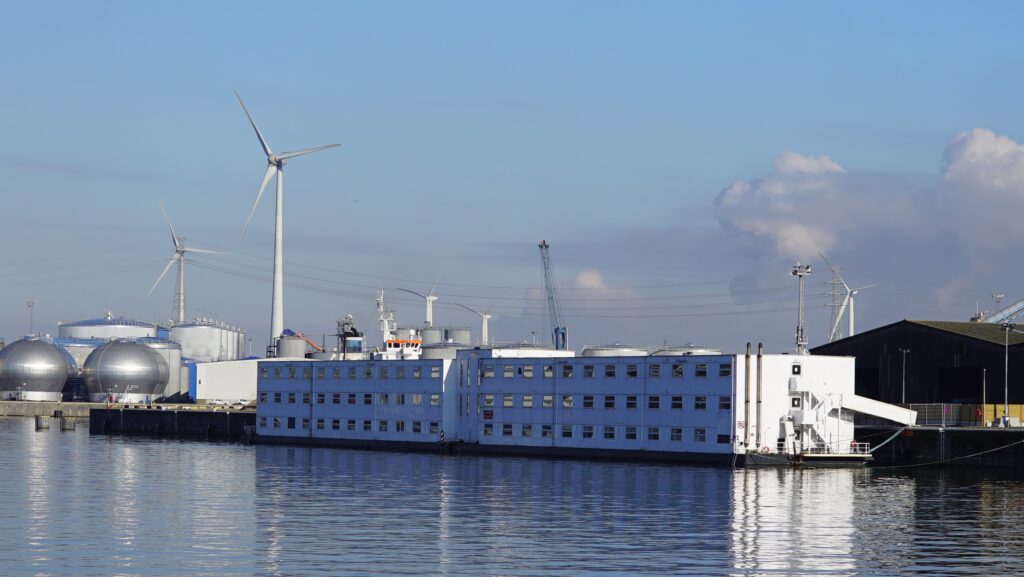
Belgium's Justice Ministry is looking into building a floating prison to accommodate more than 300 inmates due to severe overcrowding, De Tijd and L'Echo reported last week.
Belgian prisons are at full capacity, with over 13,000 people per 11,040 places. In December last year, about a record 600 prisoners had to sleep on mattresses on the floor, nearly double from the 300 reported in late June.
The Federal Government has considered multiple options, including sending foreign convicted criminals to other countries to serve their sentence.
At present, the Justice Minister Annelies Verlinden (CD&V) also examines whether a floating prison, moored in a Belgian port, could help ease the pressure on existing facilities.
The prison administration sounded another alarm in December. With the prison population at an "unprecedented" high level, they described the situation as no longer manageable.
In Flanders, overcrowding is most severe in Antwerp, Dendermonde, and Ghent, with about 340 prisoners across 10 institutions not having beds.
Walloon prisons in Mons, Nivelles, Marche and Leuze are among the worst affected, with 220 prisoners sleeping on the floor at nine institutions.
At Brussels' Haren prison, about 34 prisoners are sleeping on mattresses, despite the recent addition of 43 beds, as reported in December.
Easier said than done
The concept is far from novel. The Netherlands has been using "floating" detention centres for irregular migrants since 2007. A former Dutch prison boat, installed in the North Sea Port in Ghent, had also been used to house about 250 asylum seekers.
Private companies have shown interest already. A consortium including Belgian security firm Protection Unit has put itself forward to run the facility. The company's director, Steven Van Doorne, believes that a Dutch-style pontoon could be ready by the summer.
However, Verlinden stressed that the project is far from approved. Permits would be required, along with onshore security infrastructure such as fences, staff facilities and visitor parking.
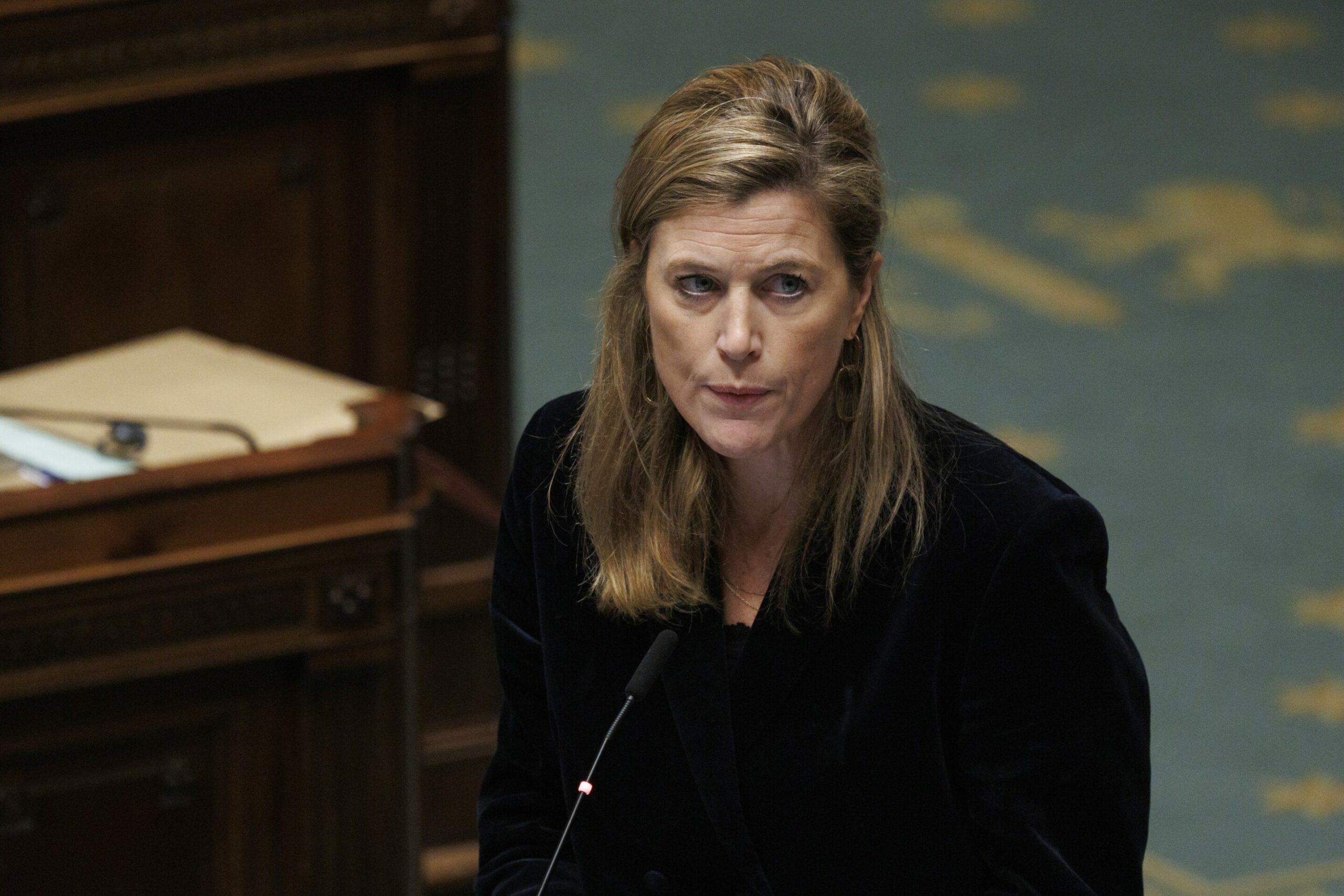
Minister of Justice Annelies Verlinden pictured during a plenary session of the Chamber at the federal parliament, in Brussels, Thursday, 05 February 2026. Credit: Belga / Nicolas Maeterlinck
It would also require spaces for inmates to exercise, fire-safety tests and possibly changes to legislation. The implementation is further complicated by the lack of prison staff. Verlinden even considered deploying private security guards in overcrowded prisons to compensate for the acute staff shortage, Het Nieuwsblad reported.
The imminent opening of a new prison in Antwerp in April 2026, with a capacity for 440 inmates, is a further cause for concern, as additional staff will be needed there.
On this, Verlinden has considered adapting the entry requirements for certain jobs in prison, including lowering the educational level required and removing the need for candidates to be Belgian nationals.
More options in question
The minister said all options are being examined, with nothing ruled out. For the past months, Belgium has scaled up efforts in negotiating leasing capacity overseas. At present, undocumented foreign prisoners account for roughly one-third of the total inmate population.
Taking an example from Copenhagen's policy, Verlinden has previously explored renting or constructing prisons in Albania and Kosovo. Last week, she also went to Estonia to negotiate renting prison spaces; however, the following day, the Estonian Justice Minister Liisa Pakosta ruled that out.
In the meantime, Belgian Prime Minister Bart De Wever(N-VA) has suggested the wider use of ankle bracelets; Flemish Justice Minister Zuhal Demir(N-VA) said that Flanders would consider expanding the use of electronic tags for some short-term offenders, but needs clarity on timing, funding and numbers.
Earlier in November, the Federal Government released €1 billion in extra funding to the Ministry of Justice. From then on, €60 million per year has been allocated to tackling the overcrowding, of which 50 million was designated for Justice, Belga reports.
When announcing the plan in August 2025, Verlinden set a target to add 1,105 spaces by 2027, followed by an additional 932 by 2030.
