

A university degree, but no job? In Belgium, this is no longer an exception. The number of vacancies requiring a university degree has fallen to an all-time low. Experts point to artificial intelligence, but not only.
For years, a university degree in Belgium was synonymous with a good chance of finding a good job. Today, that is much less the case.
Between December 2024 and November 2025, the Flemish employment agency VDAB received 273,032 job vacancies. In 27,951 of these, the employer required an academic bachelor's or Master's degree. That is the lowest number in eight years.
Since the end of 2024, vacancies for highly educated people have been falling much faster than the rest of the labour market. The picture varies depending on the profile of the graduates. It is mainly university graduates from fields unrelated to STEM (science, technology, engineering and mathematics) who are struggling.
Between December 2024 and November 2025, the VDAB received far fewer vacancies for financial profiles (-29%), public service providers (-27%) and legal service providers (-23%). In Brussels, the Actiris employment service is seeing the same trend.
Last year, there was a general decline in the number of vacancies (-23%) in the Brussels region, but those requiring a higher education diploma rose more sharply (-35%). "We are seeing a particularly sharp decline in administrative professions and IT profiles," spokesperson Nora Ed-Daoui tells The Brussels Times.

The EU quarter in Brussels. Credit Belga
White-collar meltdown
The trend is also visible abroad. In the United States, there is talk of a “white-collar meltdown”, an implosion of the labour market for office jobs. Companies have been cutting jobs en masse in recent months.
Swiss food giant Nestlé announced it would be cutting 16,000 jobs worldwide, consultancy firm McKinsey has plans to lay off thousands of people, and Dutch bank ABN Amro is cutting 5,200 jobs.
Last year, Microsoft announced that it would be cutting 15,000 jobs because it could automate thanks to AI processes. Salesforce cut 4,000 jobs for the same reason. This is fuelling fears that AI will have far-reaching consequences for the labour market.
Structural mismatch
Speaking to The Brussels Times labour market expert and sociologist Valeria Pulignano (KULeuven) confirms the impact of AI, but emphasises that it is certainly not the only reason.
"There is a structural mismatch between the qualifications of graduates and available jobs in Belgium. That is an existing problem, which is now exacerbated by AI. Graduates are particularly affected. Entry-level roles - traditionally the ‘gateway’ jobs for graduates - have grown more slowly or stagnated compared to graduate supply. AI reconfigures certain jobs. It changes the skills and competences you need in a job."
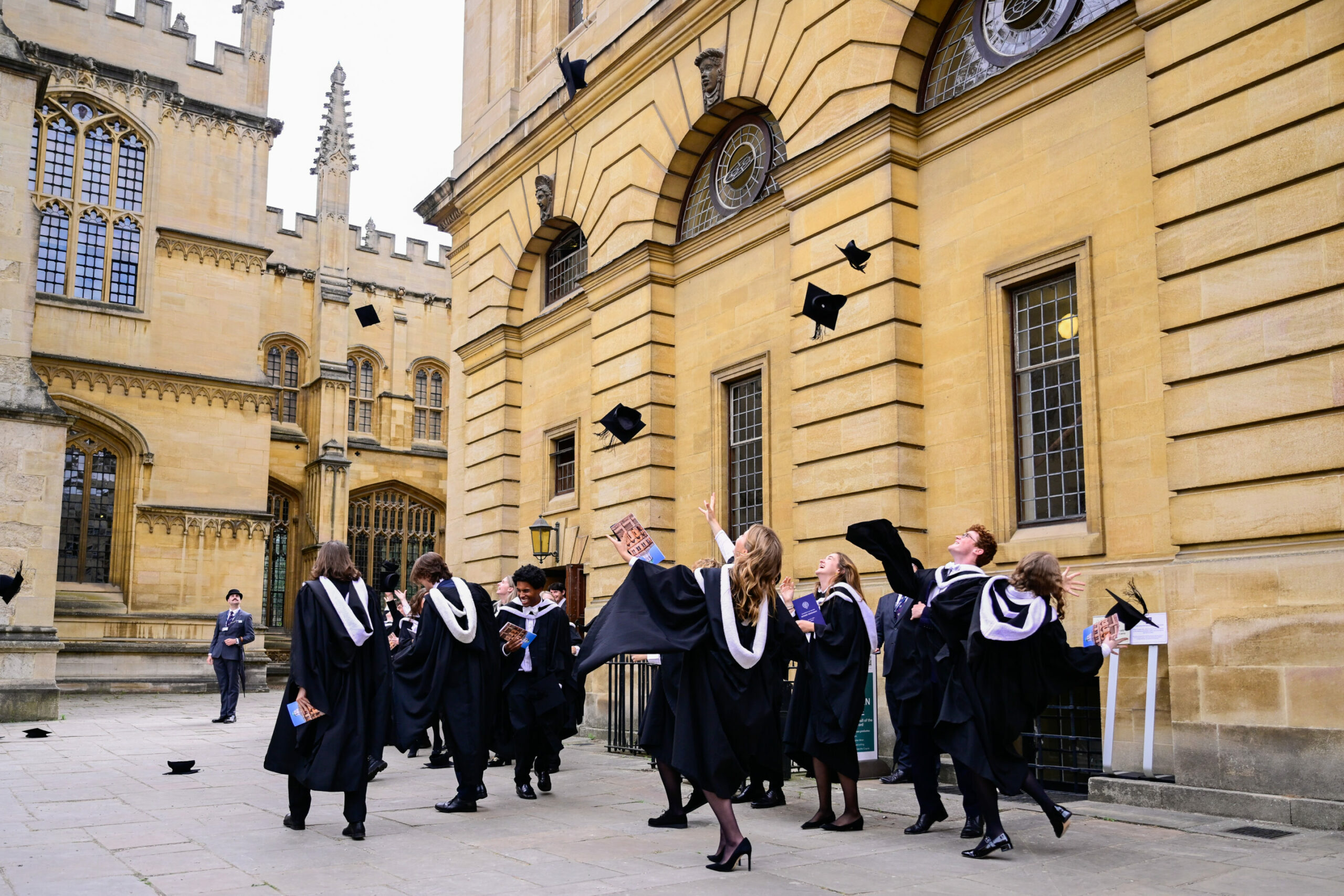
Crown Princess Elisabeth (C) and her fellow students throw their graduate hats in the air at the graduation ceremony of the university of Oxford, at the Sheldonian Theatre in Oxford, United Kingdom, Tuesday 23 July 2024. Credit: Belga
Labour market expert Jeroen Franssen, who advises various sector federations, also points out several reasons.
"There’s a general decline in the number of job vacancies - not entirely surprising, since economic growth is faltering. We are coming out of a period of significant job creation. Between 2017 and 2023, 414,000 jobs were created. That is a really high figure. I think we have now reached a tipping point. In the past, economic growth was achieved by recruiting extra people. From now on, part of the growth will come from automation, in the form of artificial intelligence. It remains to be seen what the exact impact will be, but you can see that companies are either working with it or looking into doing something with it."
150 job applications in six months
Despite his degree, Rune Bisschops (23) is having difficulty finding a job. He obtained a master's degree in political science at Ghent University and has submitted around 150 job applications since August last year. Not one has led to a job.
"First, I started looking in the direction of my degree, international politics. Then I looked for government jobs. In defence, foreign affairs, international organisations such as NATO and the EU, embassies," Bisschops told The Brussels Times.
"I also applied for traineeships. I then started looking outside my degree, at banks, companies in the port of Antwerp. I think the education system in Belgium is not well attuned to the labour market. In Belgium, many people obtain higher degrees, but at the same time, the labour market is desperately seeking people who can work with their hands. There is a mismatch."
Pulignano nods: "That is absolutely right. There is also a reason why this problem is greater in Belgium. Belgian firms often display a preference for hiring experienced workers, reduce internal training investments and rely on externally acquired skills. They prefer it to training juniors. That creates a bottleneck for labour market entry."
Bisschops experiences this first-hand: "When I apply for a job, I am sometimes told that they prefer people with experience."
Fewer jobs due to cutbacks
Simon Truwant (38) has been looking for a steady job for some time. He graduated in philosophy and works as a teacher, author and speaker. He does so on a freelance basis, but wants to combine it with a part-time job.
"I have responded to around 35 job vacancies since September. The response is very often the same: there are an extremely large number of candidates. There are often around a hundred candidates applying. I would prefer to work in the socio-cultural sector, but due to government cutbacks, associations are often broke," Truwant tells The Brussels Times said.
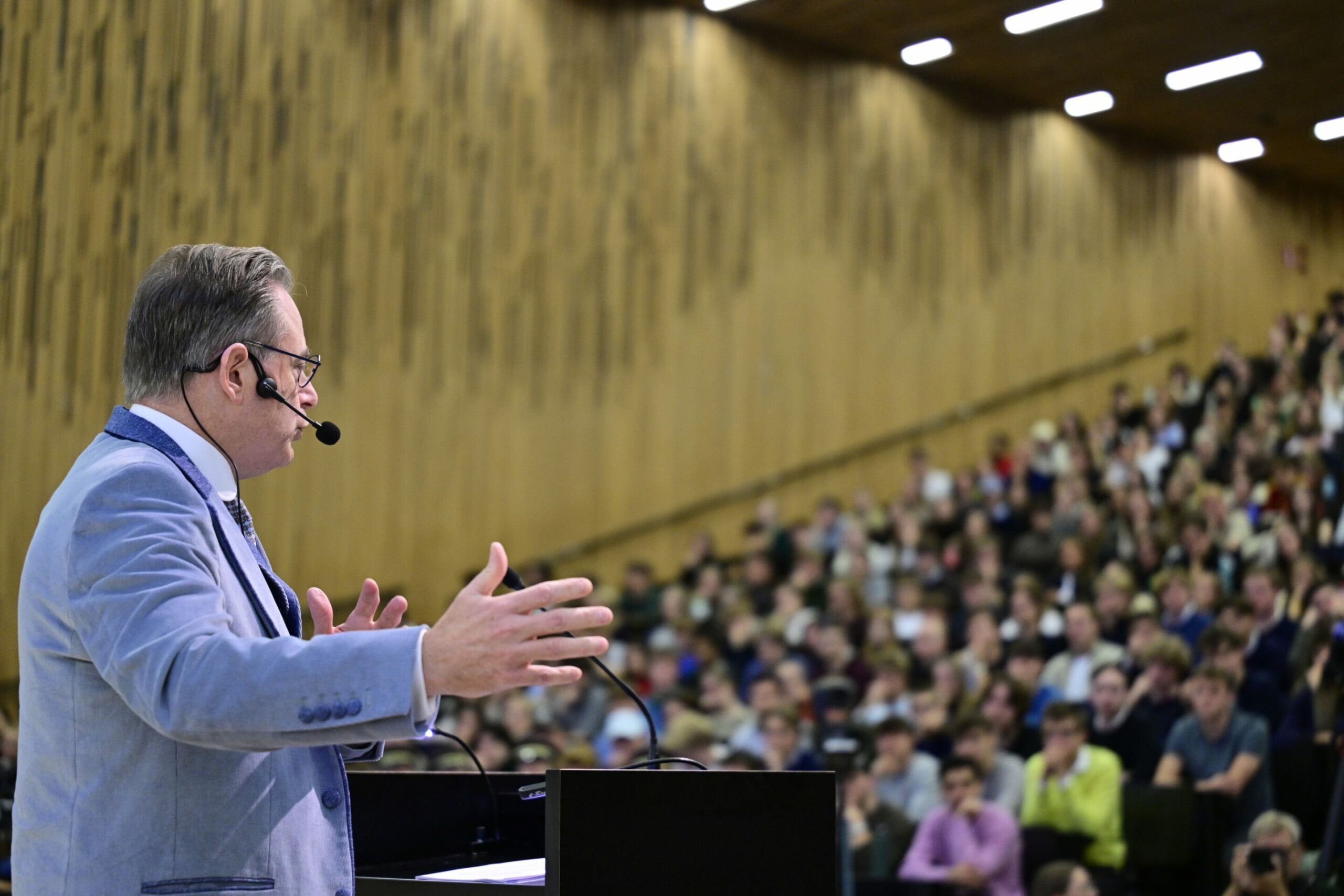
Prime Minister Bart De Wever delivers a speech at the opening college of Political Sciences at the UGent university in Gent, Tuesday 07 October 2025. Credit: Belga / Dirk Waem
In Brussels, the political situation plays an important role, says Nora Ed-Daoui, the spokesperson for the Brussels employment office, Actiris.
"The lack of a new Brussels Government was leading to reluctance to recruit in the social sector, which also employs many highly-educated people. Political uncertainty and slow economic growth have been holding back companies' investment decisions. This is leading to recruitment being postponed or frozen," she said.
Eliminating the mismatch
The impact of AI is expected to be even more noticeable in the labour market in the future. This will be at the expense of university graduates and other highly educated people. How can this problem be addressed?
"I think the solution is twofold. In education, they need to look at which courses they offer that give school leavers a better chance on the labour market. There also needs to be more practical focus. I haven't done many internships. Other programmes offer more, but there is still work to be done there. Companies also need to create more starter jobs for people who have just left school, in which they can also be trained," says the MA graduate, Bisschops.
"One solution is to rebuild and redesign entry-level roles. Technology is not our enemy. We can work with AI. It's not replacing us, but it is changing a lot of jobs. We also have to try to make junior graduates more attractive to companies. Public incentives could be a way to offset training costs for companies. That requires some investment and political choices. The government needs to encourage transition jobs with roles specifically designed for graduates to gain experience."
Labour market adviser for various sector federations and defence, Jeroen Franssen, says it is important not to forget that there will also be a reaction to automation and digitisation.
"We have a great need for human contact and authenticity. We want people who know how to deal with AI and interpret it properly. There are opportunities for those who are good at this," says Franssen.
