
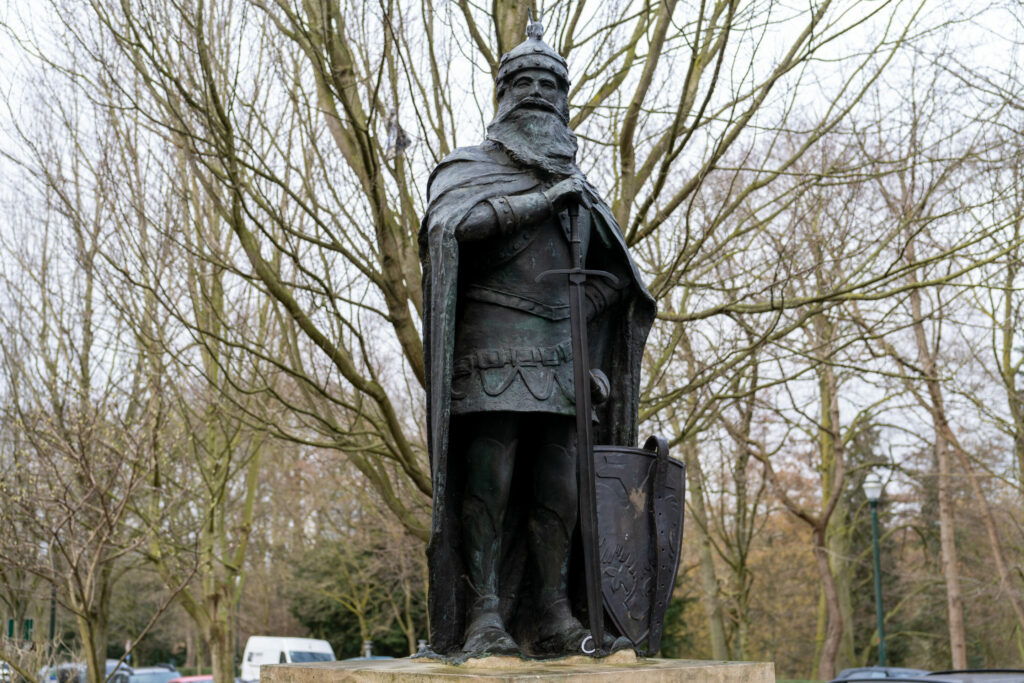
From the fries of Fritland to the statue of the medieval hero Skanderbeg in Schaerbeek, the Albanian diaspora has woven itself into the very fabric of Brussels, often so seamlessly that its presence feels like a well-kept secret.
With an estimated 60,000 Albanians calling Belgium home, the community’s journey is defined by adventure and resilience, beginning with a single train of refugees from former Yugoslavia in 1956.
INSTAT (the Institute of Statistics of Albania) estimates that the number of Albanians living abroad is around 2.2 million, with around 60,000 currently residing in Belgium, and around 40,000 living in the Brussels region (mostly in Schaerbeek).
Their presence is subtle compared to other diasporas in Belgium. However, if you pay attention, their mark has been left on the city, with a cultural centre in the Grand Place and even a statue of Gjergj Kastrioti-Skanderbeg, one of their national heroes, located in the Square Prévost-Delaunay in Schaerbeek, near Parc Josaphat.
Skanderbeg's relevance to Europe
Gjergj Kastrioti, better known as Skanderbeg, was born on 6 May 1405 into the noble Kastrioti family. In his youth, he was taken hostage by the Ottoman Empire, forced to convert to Islam, and trained as a commander in the Ottoman army.
In 1443, Skanderbeg deserted the Ottoman Army and reclaimed his ancestral fortress in Krujë, raising the Albanian double-headed eagle flag, marking the start of a war of liberation.
Skanderbeg was seen as not only fighting for Albania, but all of Christian Europe at the time; he was even named “Athleta Christi” (Champion of Christ) by Pope Callixtus III.
To many, Skanderbeg is seen as a historical figure who helped preserve European culture and helped many territories stay independent from the Ottomans.
How the diaspora formed in Belgium
According to the Maision Culturelle Belgo-Albanaise on August 1, 1956, a train carrying 700 refugees from communist countries in southeastern Europe arrived in Namur province.
These refugees travelled for 72 hours, and among them were hundreds of refugees from Albania. This marks the first big wave of Albanian migration to Belgium and paved the way for others to join.
Since their initial migration, there has been a big wave of ethnic Albanians who have come to Belgium, fleeing political instability, poverty and persecution, as well as armed conflict in the Balkans.
Many of the Albanians who migrated to Belgium have either naturalised and become Belgian citizens or hold passports from Kosovo, North Macedonia, or Montenegro, which skews the official number of Albanians residing in Belgium.
Following Kosovo’s declaration of independence on February 17, 2008, Belgium became one of the first nations to formally recognise the new state just one week later. In honour of this milestone, The Brussels Times sat down with members of the Albanian diaspora to discuss their culture and how it bleeds into their lives in Belgium.
Tirana-born artist Dastid Miluka
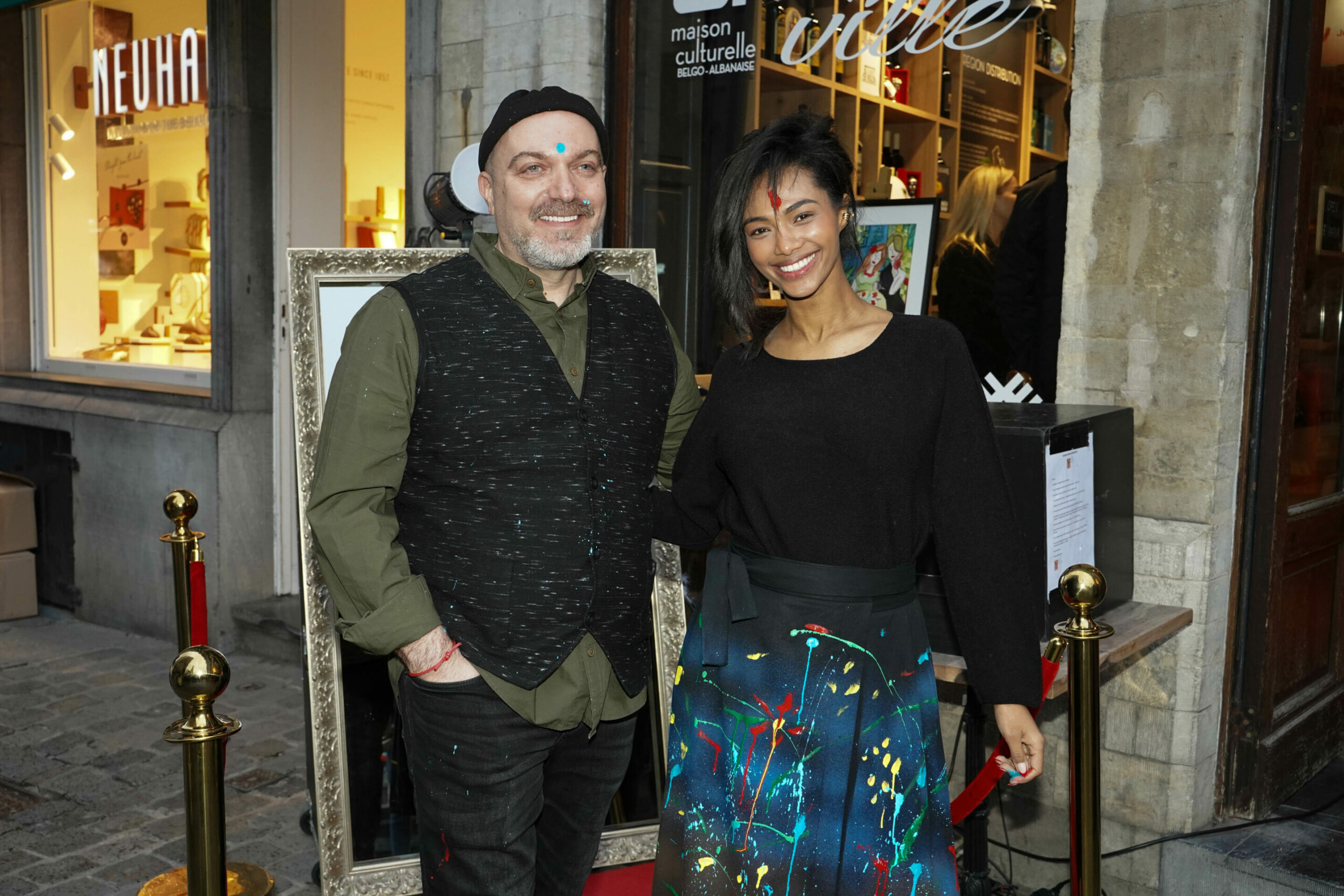
Dastid Miluka pictured with Kedist Deltour (Miss Belgium 2021) at Balkan Sustainable Fashion Night. Credit: Vicente Torre Hovelson.
"Tirana and Brussels are both very important cities for me. So I'm not saying that Tirana is more and Brussels is less or vice versa. They are both important; for me, they are both home," said Dastid Miluka, a Tirana-born painter and illustrator who moved to Brussels in 2002 at the age of 28.
Miluka claimed that, being trained in an Albanian art school, he learned a school of art more associated with soviets or the socialist school of art, and after moving to Brussels, he was introduced to a lot of new art, which in turn opened up a new chapter of his life and work.
"When I was doing my studies, it was a country that was isolated from other parts of the world. So we didn’t have the opportunity to visit museums outside of the Albanian border," Dastid remarked while explaining his early influences.
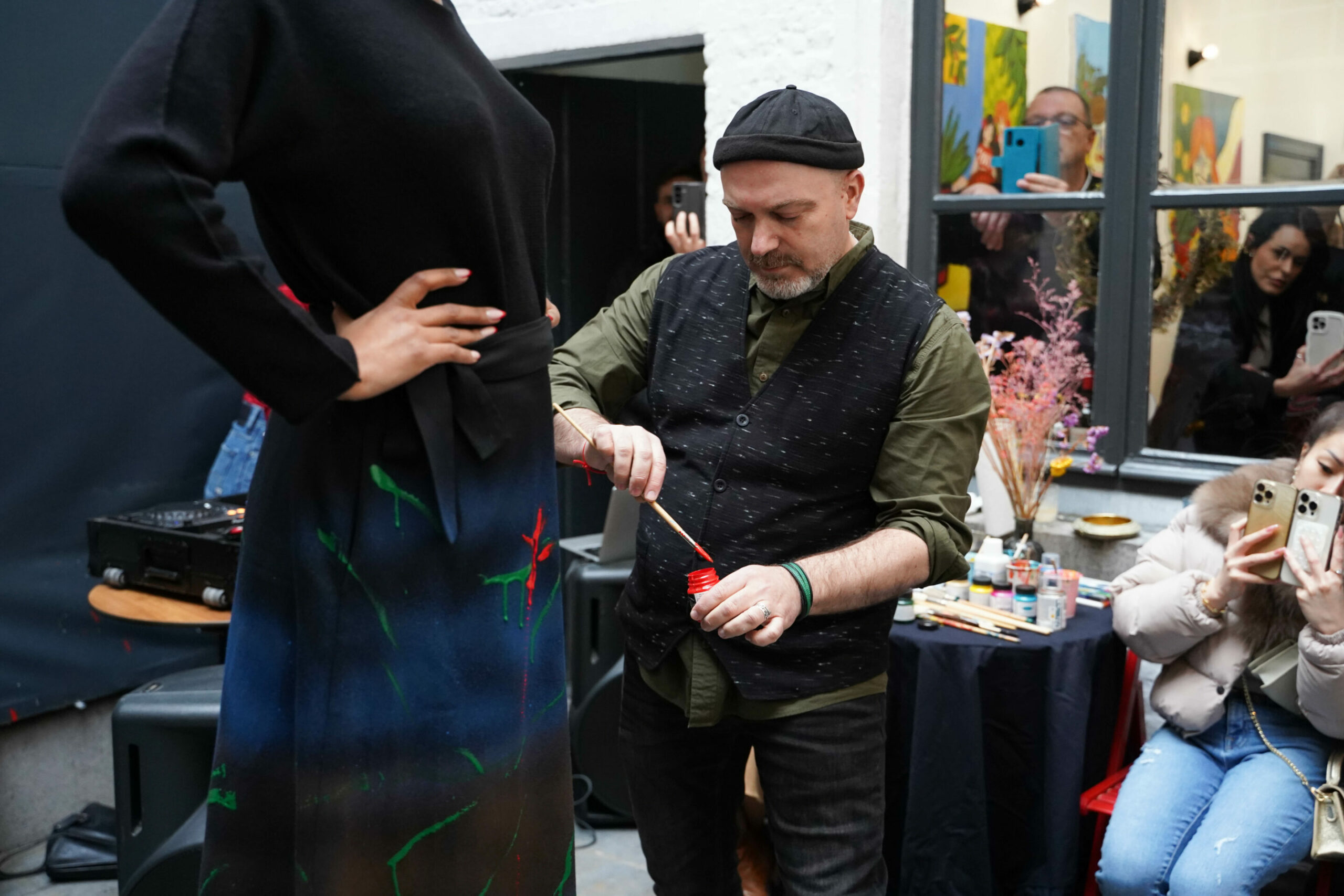
Dastid Miluka painting Kedist Deltour’s dress at Balkan sustainable fashion week. Credit: Vicente Torre Hovelson.
Miluka explained that coming to Belgium helped him further develop his artistic voice since he came from a sunny country with a different art culture to a rainy country with a totally different approach than he was used to. He ended up making efforts to combine the two in harmony.
"I was trying to be between these two emotions, but I was just not trying. Let’s say that I understood with time that I was going to bring something from the colours and the light of my country. That's why when you see my paintings, you can find the very bright colours and contrast, really strong contrast, but also I was integrating this kind of figurative surrealism, which I found here in Belgium.
"So when I go back and see the whole journey of my work, it’s some kind of mixture between the surrealism and the strong colours which I'm coming from my birth country."
Fritland, an Albanian-owned fry shop in Brussels
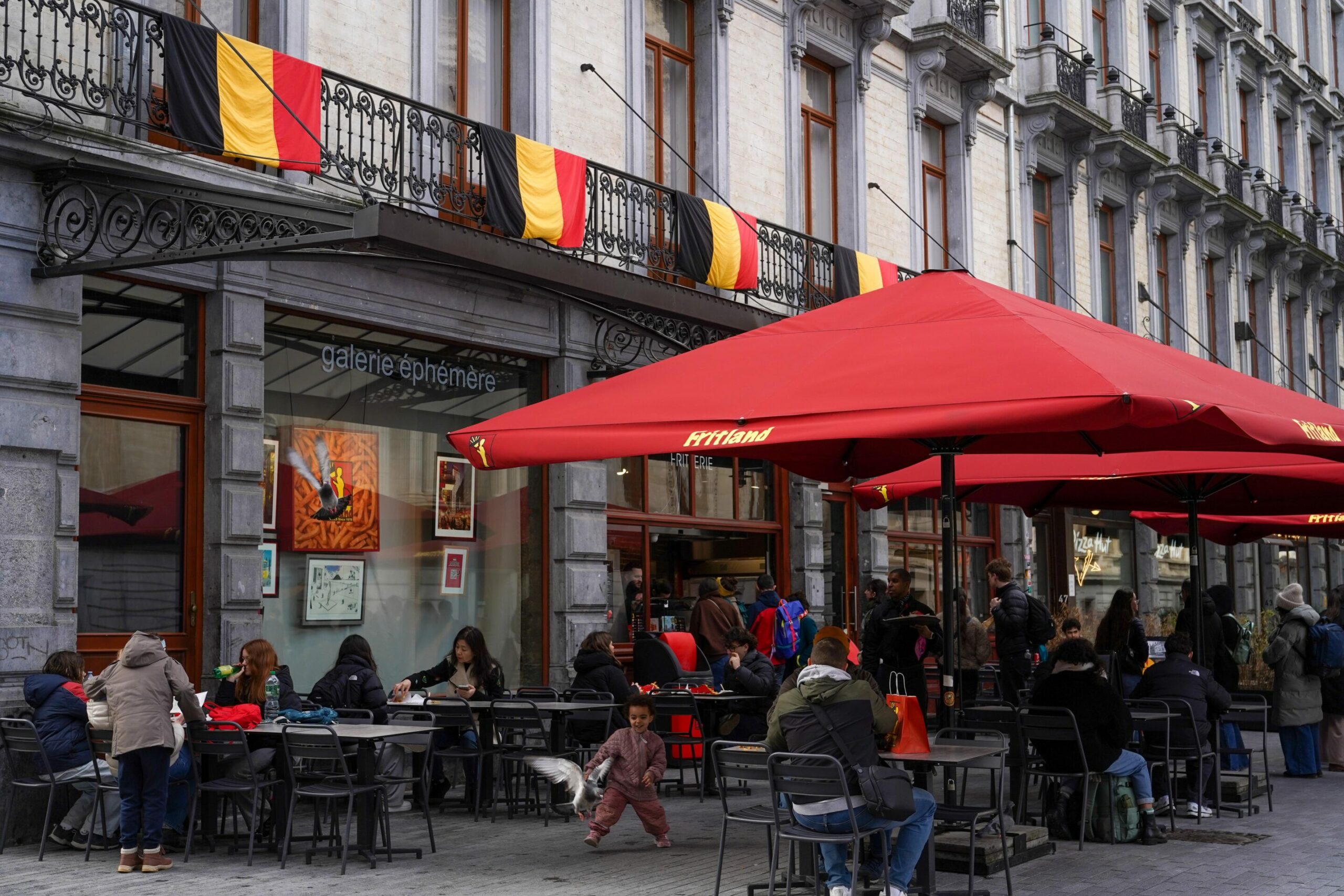
The Fritland fry shop is located 5 minutes away from the Grand Place in Brussels, Belgium. Credit: Vicente Torre Hovelson/ The Brussels Times.
Fritland is an Albanian-owned and operated fry shop located in the heart of Brussels, serving tourists and locals alike from 11:00 to 1:00 every day of the week.
"I am originally from Kosovo. But I chose to come to Brussels to live and work here. 24 years ago, and I have worked in Fritland for the last 20," said Artan Thaqi, the owner of the business.
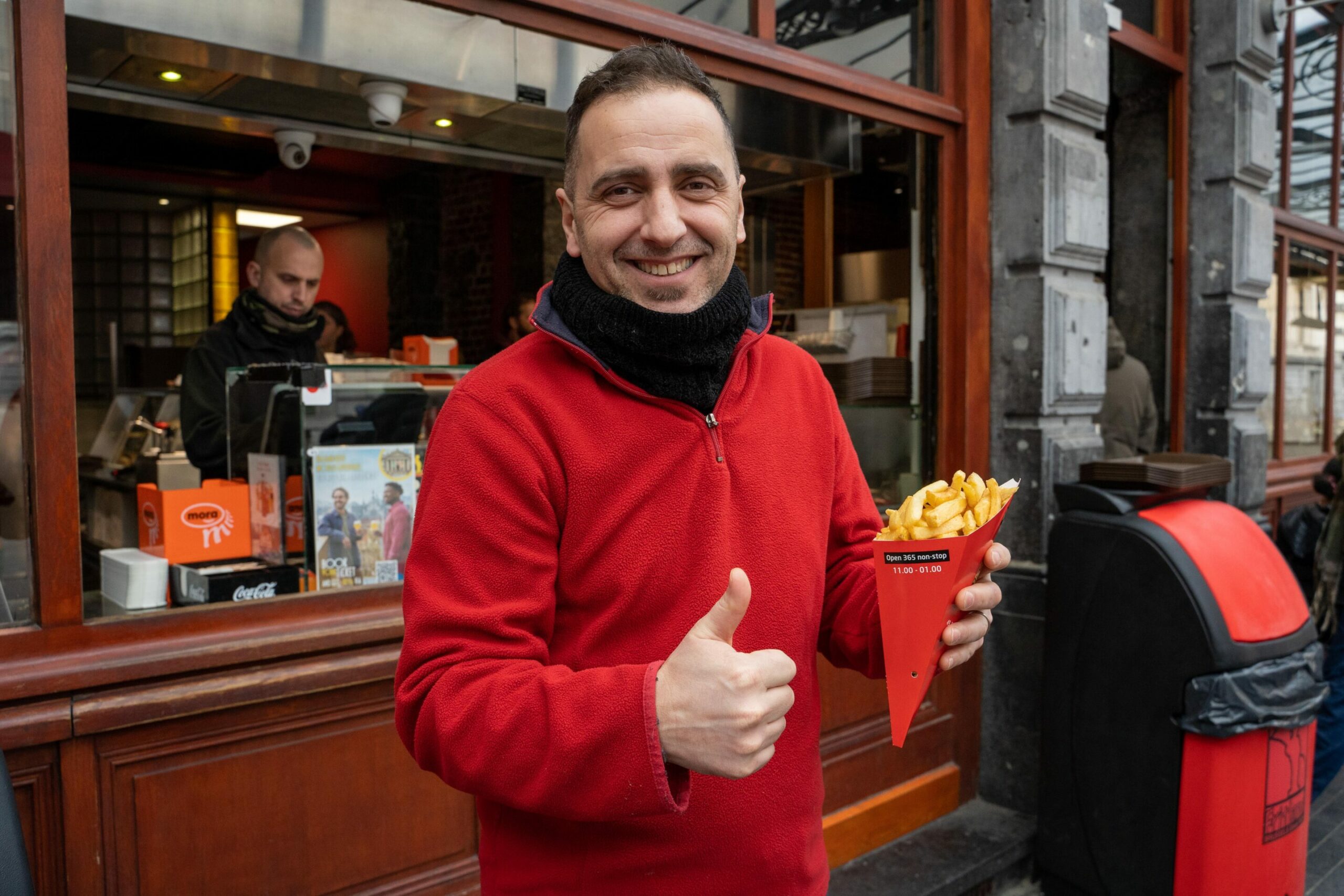
Artan Thaqi in front of his restaurant Fritland in Brussels, Belgium. Credit: Vicente Torre Hovelson/ The Brussels Times.
Thaqi came to Brussels for more opportunities due to the political instability in Kosovo at the time of his departure, but grew to like the city and decided to stay for the long run.
"I am split between two cultures. I like Brussels, it is my home now, I have spent more years here in Belgium than I did in my homeland. Maybe one day I will return to Kosovo, but not now because my life is here. I have two children who were born here and go to school here, and a business in Brussels, so I’ll definitely stay here much longer."
Safet Kryemadhi, Albanian author and speechwriter
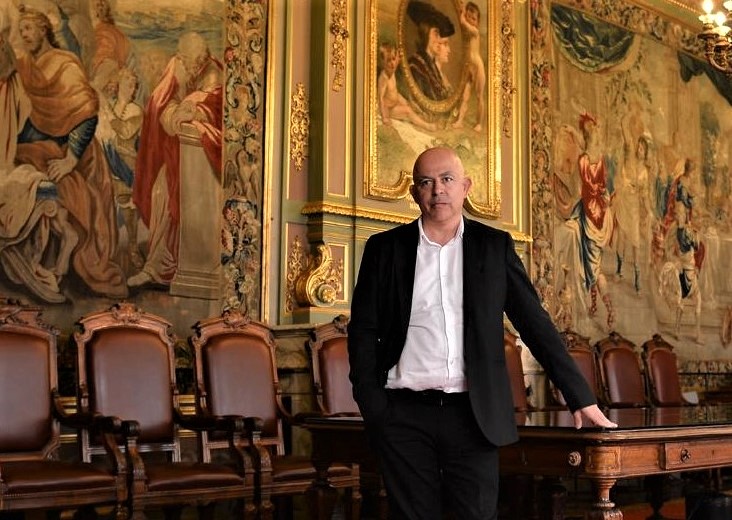
Safet Kryemadhi in the Brussels city hall. Credit: Safet Kryemadhi
"I was born in Brussels, although I am the son of a political refugee who escaped from communist Albania in 1953. And in 1956, came to Belgium with the first convoy of Albanian refugees who came from a camp in Yugoslavia," Said Safet Kryemadhi, an Albanian author and the current speech writer for Philippe Close, the mayor of Brussels.
Despite being Belgian-born, Kryemadhi has kept Albanian culture very close throughout his life, expressing that it is and will continue to be an important part of his identity. "In this global world, which we all live in now, it’s important to know one's origin. We maintain our culture with language, traditional dances, and food." Kryemadhi stated.
In doing so, Kryemadhi even wrote Contes Albanais, a book of Albanian fairy tales, translated into French and illustrated by Dastid Miluka.
"I began with the Albanian fairy tales book 10 years ago when my daughters were young. It was a way of communicating their cultural background to them. It was originally a gift from a father to his daughters, but like every book, you first write it for yourself and relatives, then it becomes for the public."
Kryemadhi explained that something he particularly liked about Brussels, and in a broader sense, Belgium was the fact that he feels that he has the freedom to be himself and stay connected to his Albanian side without feeling like a complete outsider, which was also expressed by Miluka and Thaqui.
"This is the strength of Belgium: you have the ability integrate into society, while also staying true to your own culture and traditions."
Related News
- 'It’s like being in your own hometown': Getting to know Belgium's only Chinatown
- Charleroi: Europe’s ‘ugliest’ city that tourists can’t stop visiting
- What is Carnival, and why do Belgians celebrate it?
- Life through a lens: Belgium’s streets as you've never seen them before
- 'The whole world is in this city': Meet the gregarious Greeks of Brussels
