

As private housing prices in Brussels continue to climb, public housing is becoming an increasingly relevant alternative.
Average rent in Brussels stood at around €1,321 per month in the first half of 2025, according to a report by KBC.
For buyers, the average price of a house was €582,930, while an apartment cost on average €298,874, according to figures from the Real Estate Barometer published by notaire.be – albeit with significant differences between municipalities.
Faced with these increasing price levels, many Brussels households are turning to the public housing system.
Tenants may save hundreds of euros per month in rent, while buyers can benefit from purchase prices that are 30% to 40% lower than those on the private market, depending on the programme.
The average rent for social housing stood at €412 per month last year, according to the Brussels Regional Housing Company (SLRB/BGHM). In absolute terms, this represents a monthly difference of €909 compared to the average on the private market. This could make a difference of €11,000 per year – highlighting the scale of financial relief that social housing can provide.
However, the financial comparison should be interpreted with caution. Social rents are income-based and typically correspond to homes allocated to lower-income households, while private market rents reflect a broad range of property types, sizes and neighbourhoods.
Therefore, the figures do not compare identical housing units, but they nonetheless illustrate the magnitude of the affordability gap between the two systems.
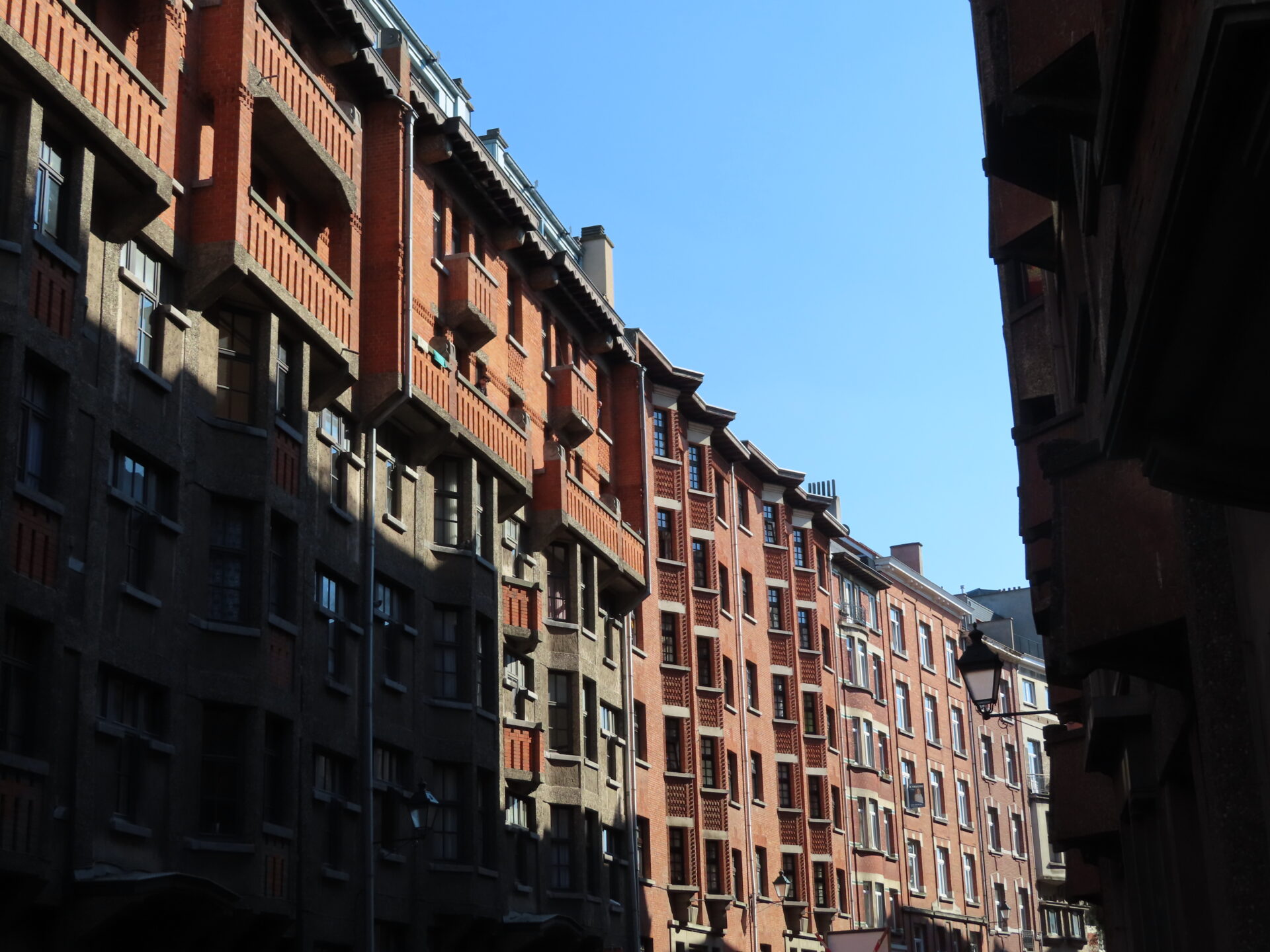
Social housing in Saint-Gilles. Credit: Ugo Realfonzo / The Brussels Times
Alongside public housing schemes, Brussels also offers rental allowances, interest-free loans for rental guarantees, and a registration tax abatement on the first €200,000 of a primary residence to ease access to housing. These measures can further reduce the effective cost of housing for eligible households.
Renting through the public system
The public housing landscape in Brussels involves several parallel actors and mechanisms.
Prospective tenants can register with one or more Public Service Property Companies (SISP/OVM), which manage social housing (“logement social/sociale woning”).
This category should be distinguished from housing for modest incomes (“logement modéré/woning voor bescheiden inkomen”) and housing for middle incomes (“logement moyen/woning voor middeninkomen”), which target households with higher income ceilings and operate under separate schemes.
Another option is to apply through a Social Rental Agency (AIS/SVK). These agencies act as intermediaries between private property owners who agree to rent out their homes below market rates and tenants who meet specific eligibility criteria.
For landlords, the trade-off includes certain financial and administrative advantages. They may benefit from property tax reductions, are relieved of day-to-day property management, and receive guaranteed rent payments – even if the tenant temporarily fails to pay.
Applicants may also turn to the Housing Fund (Fonds du Logement/Woningfonds), which not only offers social mortgages but also manages and rents out housing units.
Additionally, some municipalities directly manage their own housing units through municipal property management bodies (Régie foncière/De Grondregie).
Buying below market price
It is also possible to purchase a home through the public system, notably via citydev.brussels, the Housing Fund, and the Community Land Trust Brussels (CLTB).
These programmes offer access to newly-built or renovated homes at prices below market value, under specific conditions designed to preserve long-term affordability. In the case of the CLTB, for example, buyers purchase the home but not the land it is built on, which remains in collective ownership.
A similar gap can apply to homeownership schemes. Using the Real Estate Barometer figures as a reference point, an average apartment priced at €298,874 would correspond to roughly €209,000 at a 30% discount, or about €179,000 at a 40% discount – implying savings of approximately €90,000 to €120,000.
As with rentals, these figures are indicative. Public homeownership schemes differ by programme, location and property type, and often include specific eligibility conditions and resale restrictions designed to preserve long-term affordability.

Rain clouds above the Brussels skyline, Wednesday 23 October 2013, in Brussels. Credit: Belga/Kristof Van Accom
Eligibility criteria are broadly similar to those applied in public rental housing: household income must fall below a defined threshold – with income ceilings varying depending on the scheme and the number of dependents in the household – and applicants generally cannot already own residential property.
However, public housing remains subject to limited availability: as of 1 January 2025, 55,572 households were registered as candidates for social housing with Brussels’ Public Service Property Companies — an increase of 18% compared with 2020.
Waiting times can take several years, and access depends on both eligibility criteria and the number of units available.
These pressures have shaped recent policy responses.
The outlook
Policymakers have introduced a series of regulatory measures in recent years. The region tightened rules on short-term rentals, restricted rent indexation based on energy performance, introduced a reference rent system, and sought to expand public housing supply.
The new Brussels Government has indicated that improving housing affordability will remain a priority.
Its plans include refining the emergency housing plan, expanding social housing and rental support, and introducing additional financial tools – including zero- or low-interest loans and alternative ownership models. It also aims to boost supply through administrative simplification and office-to-housing conversions, while tightening oversight of abusive rents.
Ultimately, the impact of public housing policies will depend not only on the scale of financial support offered, but on the Capital Region’s ability to expand supply in line with growing demand.
