
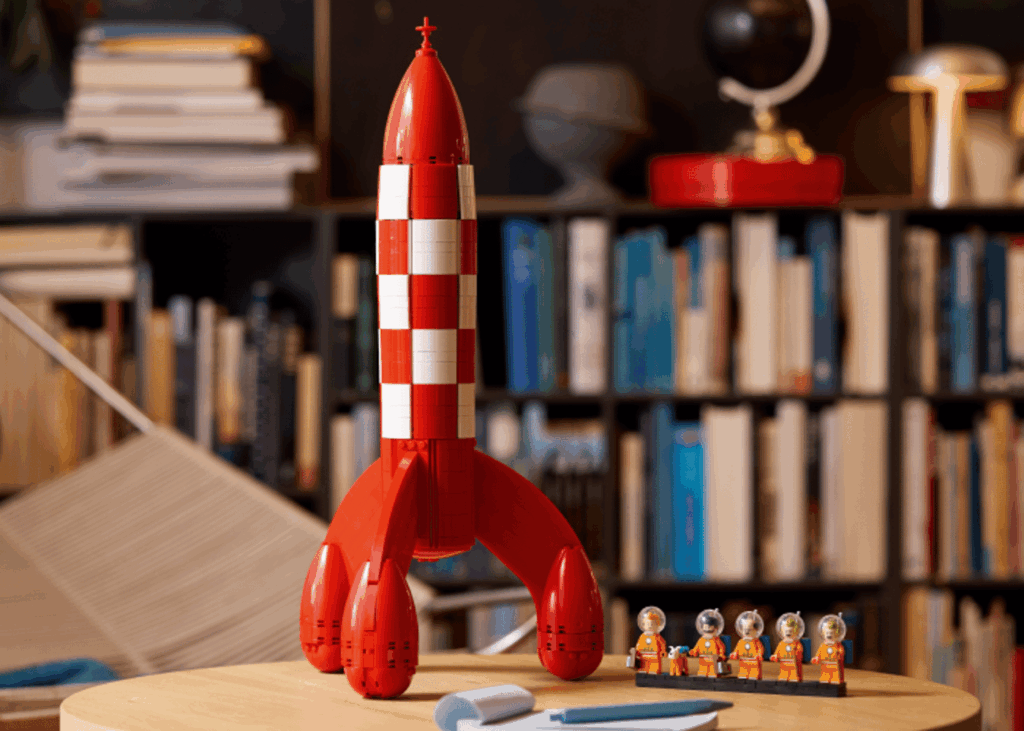
There are rockets. And then there is Tintin’s rocket.
Even if you have never opened a Tintin album in your life, you will probably recognise it: a tall, pointy spacecraft painted in a red-and-white chequerboard pattern that stands on its fins like a futuristic pepper pot.
And now, after more than 70 years of sitting on the pages of Hergé’s comics, that rocket has been rebuilt – piece by piece – as a new Lego set.
The Danish toy giant has just announced the rocket as part of its Lego Ideas series – a detailed model inspired by the classic Tintin adventures Destination Moon (Objectif Lune in the original French) and Explorers on the Moon (On a marché sur la Lune).
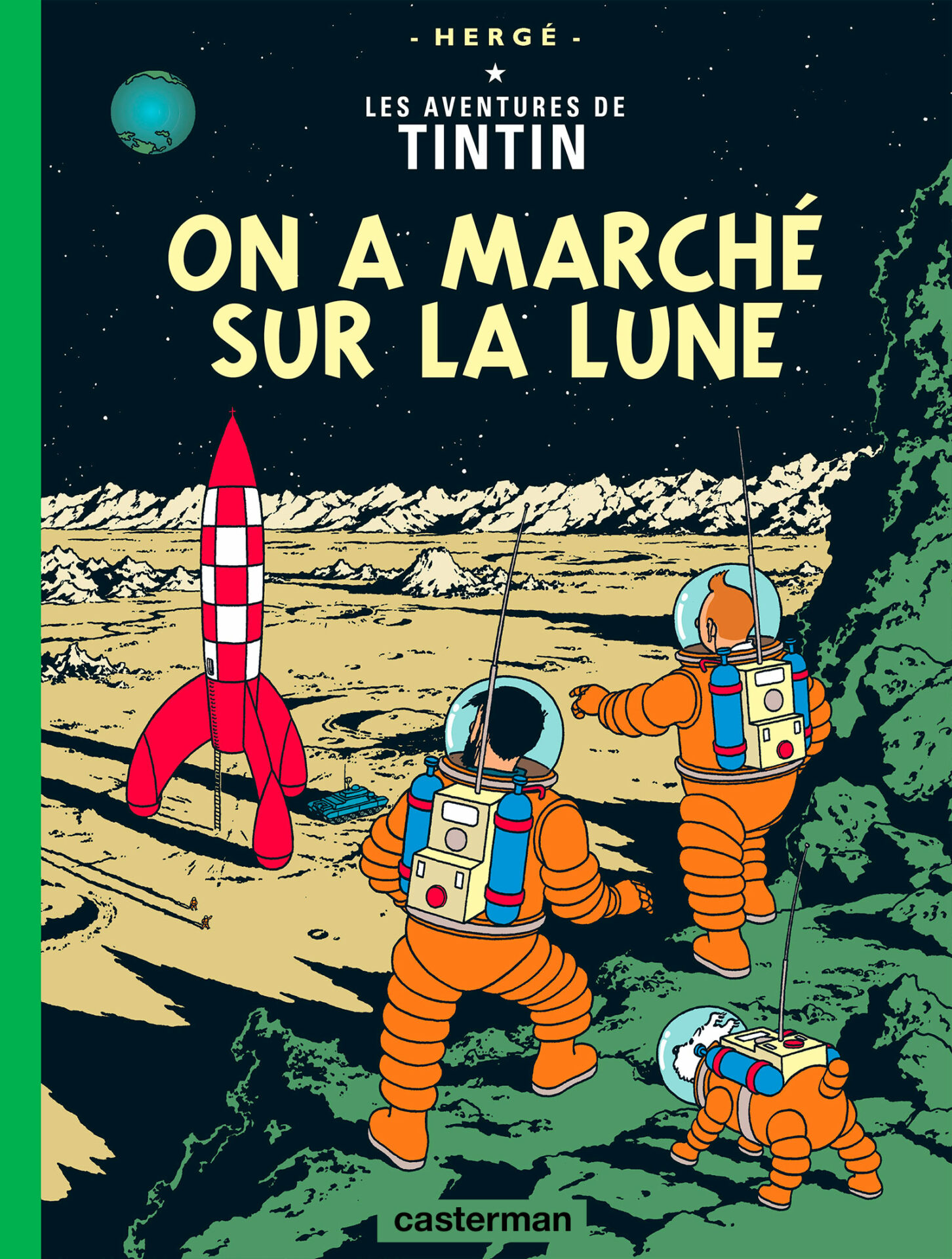
On a marché sur la Lune by Hergé. Credit: Casterman
The set contains 1,283 pieces and stands 49 centimetres tall – some 150 times smaller than the rocket is supposed to be, at 75 metres, according to the schematics seen in the albums; and 227 times smaller than the 111 metre NASA Apollo rocket that flew to the Moon in 1969. In any case, it is less a plaything and more a piece of decorative engineering.
A special crew
Naturally, the rocket would be rather lonely without its passengers. So, the set includes Tintin himself, the magnificently shouty Captain Haddock, the distracted genius Professor Calculus, and the gloriously inept detectives Thomson and Thompson.
Snowy is there too, because frankly it would be outrageous to go to the Moon without the dog.
All are dressed in detailed space suits with helmets and oxygen tank accessories. There is also a clever feature at the top of the rocket: a removable panel revealing a control room inside.
Builders can place a mini figurine there to recreate the moment when Tintin and his companions first gaze back at Earth from the lunar surface.
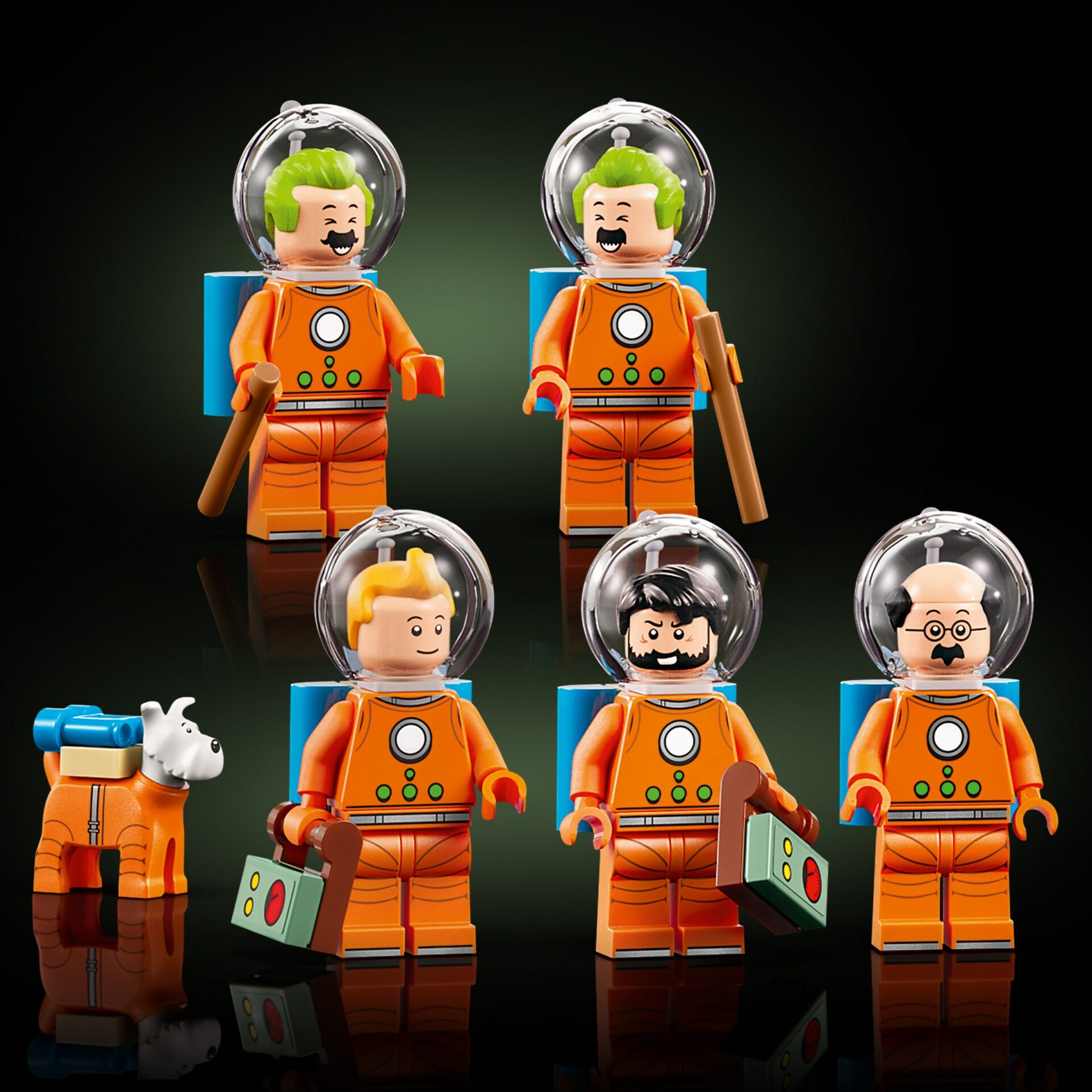
The Tintin-themed space crew. Credit: Lego
The set itself began life not in a Lego laboratory but in the imagination of a fan. Portuguese designer Alexis Dos Santos submitted the idea through the Lego Ideas platform, where enthusiasts can pitch designs to the company.
Once it gathered the required 10,000 votes, Lego’s designers took over and turned it into a fully-fledged product, working closely with Tintinimaginatio, which oversees Hergé’s rights.
Tintin: A space pioneer
When Hergé first published Destination Moon in the early 1950s, space travel was still largely science fiction. No human had left Earth’s orbit. Neil Armstrong’s famous lunar step was still 17 years away (and when Armstrong did set foot on the Moon, Hergé released a special image of the Tintin greeting the befuddled astronaut on the lunar surface).
Yet the Tintin story was astonishingly meticulous. Hergé worked with scientists to make the rocket and the journey feel believable, filling the pages with technical diagrams, launch sequences and carefully imagined lunar exploration.
In short, Tintin went to the Moon before anyone else – and did it with impeccable Belgian style. The rocket quickly became one of the most recognisable objects in comic-book history: bold, geometric and faintly absurd in the best possible way. Which makes it perfect Lego material.
The Tintin Moon Rocket set is available for pre-order now and will go on general sale on April 4, priced at €159.99.
