
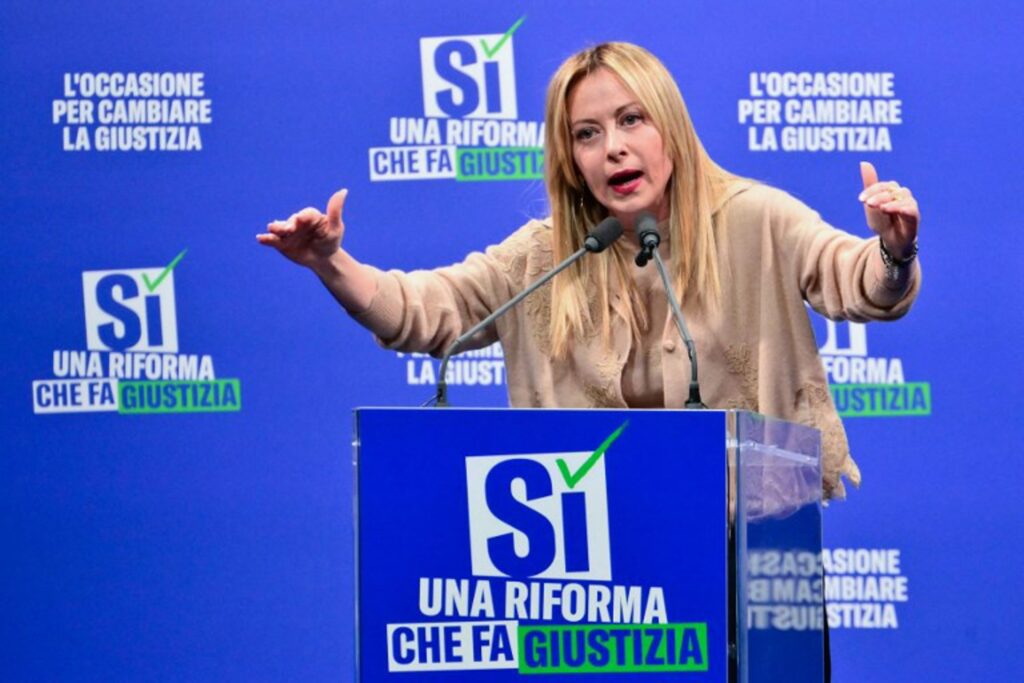
Italy’s Prime Minister Giorgia Meloni has entered a decisive weekend that will shape the remainder of her government’s term, as Italians vote on a justice system reform referendum.
Citizens will cast their votes this Sunday and Monday, responding to a complex constitutional amendment proposal with either a simple “Yes” or “No”. The outcome of the referendum, focusing on the functioning of the judiciary, will be valid regardless of voter turnout.
The referendum, driven by Meloni’s right-wing coalition, seeks to separate the career paths of judges and prosecutors, which currently overlap. It also proposes splitting the Superior Council of the Judiciary (CSM) into two entities and introducing a random selection method for appointing its members.
Supporters of the “Yes” argue the changes will enhance judicial neutrality, while critics warn they could weaken the CSM’s independence and fail to address broader issues such as inefficiency and trial delays.
Roberto D’Alimonte, a political scientist at Rome’s Luiss University, said, “The reform doesn’t solve the justice system’s structural problems—it doesn’t make trials faster or improve efficiency.”
The debate has become highly polarised, with the referendum transforming into a broader political fight over the government itself. The ruling coalition defends the “Yes” as a move to “depoliticise” the judiciary, which has long been accused of bias against conservatives. Meanwhile, the opposition, led by Elly Schlein’s Democratic Party, views the “No” vote as a defence of judicial independence and a rebuke of Meloni’s leadership.
“This referendum is being used by the opposition as a way to weaken Meloni,” D’Alimonte explained. “A loss could shift the political landscape and diminish her image as an invincible leader.”
The heated campaign has ignited fierce accusations on both sides. Former Democratic Party minister Rosy Bindi accused the government of seeking to “violate the Constitution and veer towards dictatorship.” Prosecutor Antonino Di Matteo claimed the “Yes” vote would favour “masons, corrupt architects, and mafiosi”. On the opposing side, Justice Minister Carlo Nordio stated that the reform would dismantle the “quasi-mafia practices” of the CSM, with one official describing the judiciary as a “firing squad” against the government.
Faced with rising support for the “No” camp, Meloni has escalated her rhetoric, abandoning technical arguments for stark warnings. In a speech in Milan, she claimed rejecting the reform would lead to lenient decisions by “negligent” magistrates, including the release of “illegal immigrants, rapists, paedophiles, and drug traffickers” who threaten public safety.
D’Alimonte predicted that a referendum loss could force Meloni to slow down on other reforms, such as electoral changes, and potentially erode her popularity further amid economic and international pressures.
