It is almost three decades since I first took a family holiday to Slapton, a tiny village on the south Devon coast. On that first visit, in 1999, I noticed the war memorial in the churchyard beside the gate. Among the names carved into the stone was one that stood out: Lieutenant William Bastard.
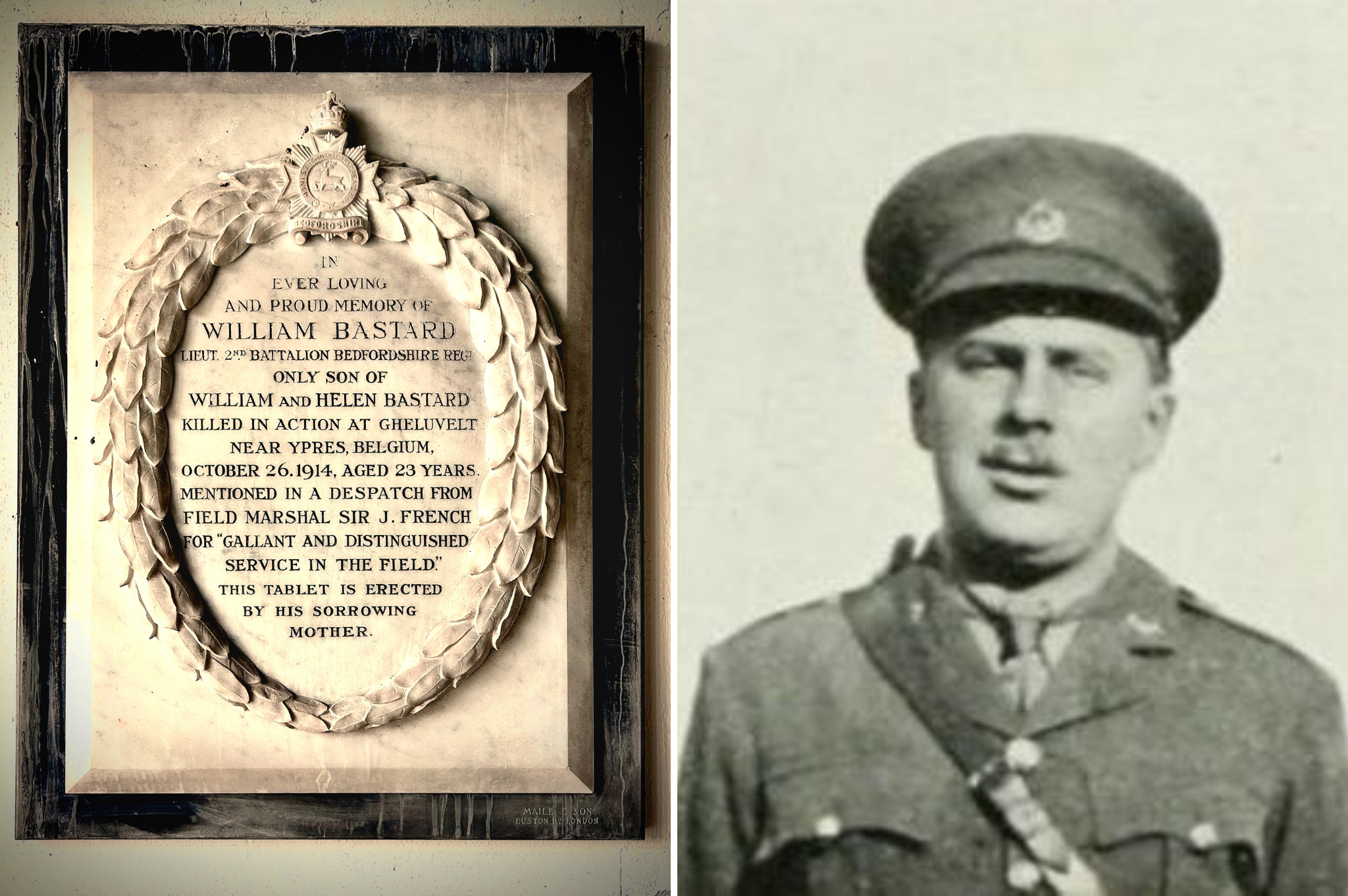
Inside the church, on the back wall, hung a marble plaque, topped by the cap badge of the Bedfordshire Regiment and framed by a carved laurel wreath. Its inscription was formal and devastating in equal measure:
“In ever loving and proud memory of William Bastard Lieut 2nd Battalion Bedfordshire Regt. Only son of William and Helen Bastard killed in action at Gheluvelt near Ypres, Belgium, October 26. 1914, Aged 23 years. Mentioned in a dispatch from Field Marshal Sir J. French for “gallant and distinguished service in the field”. This tablet is erected by his sorrowing Mother.”
It was a familiar First World War story, yet it raised immediate questions. Where was William Bastard buried? Why was there no grave close to the church where his “sorrowing Mother” had worshipped? And who were the Bastards, whose son merited such an expensive memorial, commissioned from a London firm?
Those questions stayed with me. Years later, as a British diplomat posted to Belgium, I discovered that Bastard had no known grave and that his name was carved instead on the Menin Gate in Ypres (Ieper), among more than 54,000 soldiers of the British Expeditionary Force missing from the fighting around Ypres. His story, I realised, belonged as much to Belgium as it did to Devon.
This, then, is the story of William Bastard – and of how both his life and his mortal remains came to be lost in the mud of Flanders. It is also the story of Belgium’s long, meticulous effort to recover the missing.
A Devon upbringing, a European war
William Bastard was born on April 20, 1891, at Higher Coltscombe, Slapton, the only child of William and Helen Bastard (née Adkins). His father was a fifth-generation yeoman farmer and landowner; on his mother’s side, he was connected to Devon’s professional elite, including Dr George Adkins, the county’s Medical Officer.
William was educated at Miss Tubb’s Preparatory School for the Sons of Gentlemen in Plymouth, before moving on to Blundell’s School in Tiverton. There he joined the Cadet Corps, part of the quiet militarisation of British education that followed the reforms of the War Secretary Richard Haldane. In 1910, he went up to Exeter College, Oxford, to study Military Science and joined the Officer Training Corps.
Commissioned in January 1912, William’s path seemed settled. Then, that same year, tragedy struck. His father died suddenly at the age of 55, leaving William to inherit more than 500 acres of land in Devon and Somerset, valued at a modern equivalent of several million pounds. Choosing a military career, he leased out the farm, and his widowed mother moved into the village.
In August 1913, William was gazetted into the Bedfordshire Regiment. When war broke out in August 1914, he was serving with the 2nd Battalion near Pretoria in South Africa. Within weeks, the battalion was ordered home, landing at Southampton in September. William was promoted to lieutenant just days before embarking for France.
On October 6, 1914, he arrived in Belgium with the British Expeditionary Force (BEF). Less than three weeks later, he was dead.
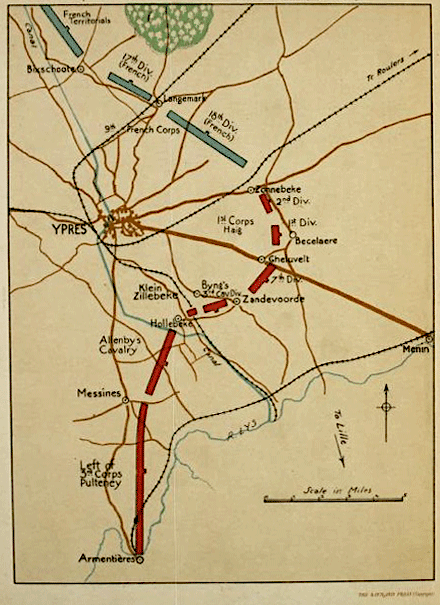
Geluveld – Gheluvelt in English – lies east of Ypres, beyond Hooge and the vast mine crater at Hill 62, beside what is now the N8 road. Today, it is an unassuming Flemish village, passed daily by commuters and battlefield tourists. In October 1914, it was one of the most violently contested points of the First Battle of Ypres.
The strategic importance of Gheluvelt lay in its position on a spur overlooking the main road into Ypres. Following the Allied loss of Zandvoorde, holding this line became essential if the British were to observe German movements and prevent a breakthrough into the city. The defensive line crossed the main road just beyond the village church. It was here that Lieutenant Bastard found himself.
A raging battlefield
The 2nd Battalion of the Bedfordshire Regiment landed at Zeebrugge on October 7 and marched 70km south through West Flanders to join the rest of the BEF along the Ypres–Menin Road. The landscape they entered was already beginning to dissolve under shellfire: fields churned to mud, woods shredded, villages reduced to skeletal outlines.
The regimental diary charts the slow tightening of the noose. Day after day, the battalion moved, entrenched, advanced, withdrew. Casualties mounted. Officers were singled out by German snipers, conspicuous in their uniforms and expected to lead from the front (although at the time the British Army General Staff refused to admit that the Germans had trained snipers specifically to target Officers as they deemed this bad for “morale”).
On October 26, 1914, the battalion held its trenches under sustained fire. At 10.30am, Captain Arthur Gordon Hall was shot by a sniper. Later the same day, Lieutenant Bastard was killed in the same way, reportedly while observing enemy positions through his field glasses.
The regimental diary records his burial with stark precision: “Lieut. W. Bastard buried by Capt. R. L. Thom on the N. edge of the wood S. of the road junction at the foot of the BECELAERE hill, in the centre of N edge on W. of road, close to the bend of the road.”
A wooden cross would have marked the spot. Captain Hall was buried nearby.
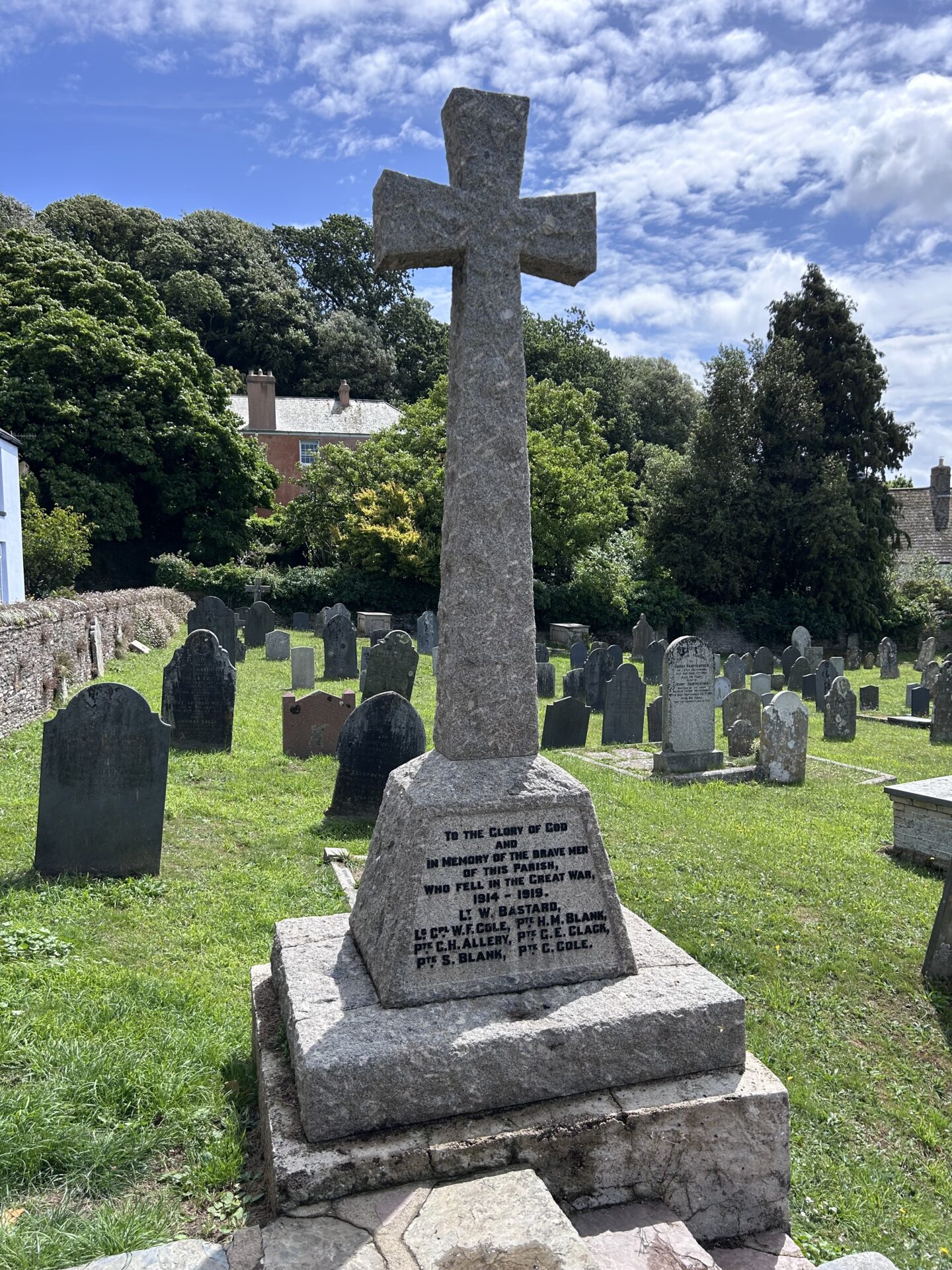
Memorial for Lieutenant William Bastard in Devon, UK. Credit: James Morrisson
The killing did not stop. Over the following days, the battalion was almost destroyed. By the end of October, it had lost seven officers killed and nine wounded; by early November, it was reduced to just four officers and 350 men.
At this stage of the war, battlefield burial was pragmatic and immediate. But the ground around Gheluvelt would be fought over repeatedly for four years. Trenches advanced and retreated. Shellfire pulverised the soil. Woods vanished entirely. Roads were obliterated and remade.
When news of William’s death reached his mother by telegram on October 30, she also received a letter from the battalion commander praising her son as “one of the best types of officers”. In April 1915, the War Office sent her a sketch map showing where he was buried. She asked whether the grave could be marked so that she might visit it after the war. She never did. She left Slapton later that year and died in 1919.
By then, the place where William lay had ceased to exist in any recognisable sense.
Belgium and the missing
After the war, the British authorities undertook the grim task of “concentration”: locating battlefield graves, exhuming remains and reinterring them in formal cemeteries across Belgium. Much of this work was carried out by the Chinese Labour Corps. Detailed colour-coded maps recorded where bodies were found and reburied.
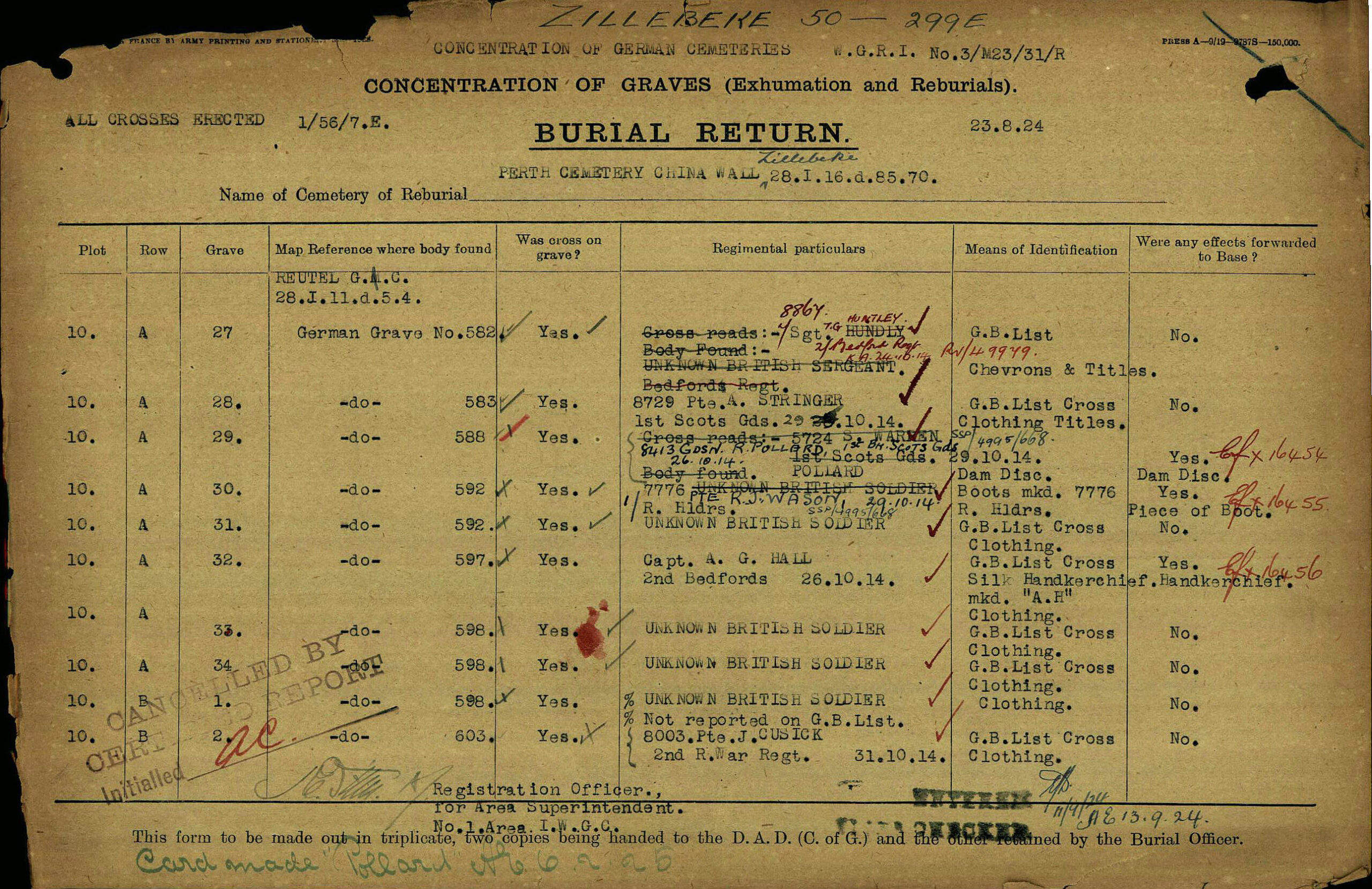
Captain Hall’s remains were identified by personal effects and now lie in China Wall Cemetery in Ypres. William Bastard’s were not. At the time of his death, British soldiers carried only a single identity disc, which was removed before burial. The second disc, left on the body, was not introduced until 1916. If Bastard’s remains were later recovered without identifying items, he would have been buried as “unknown”.
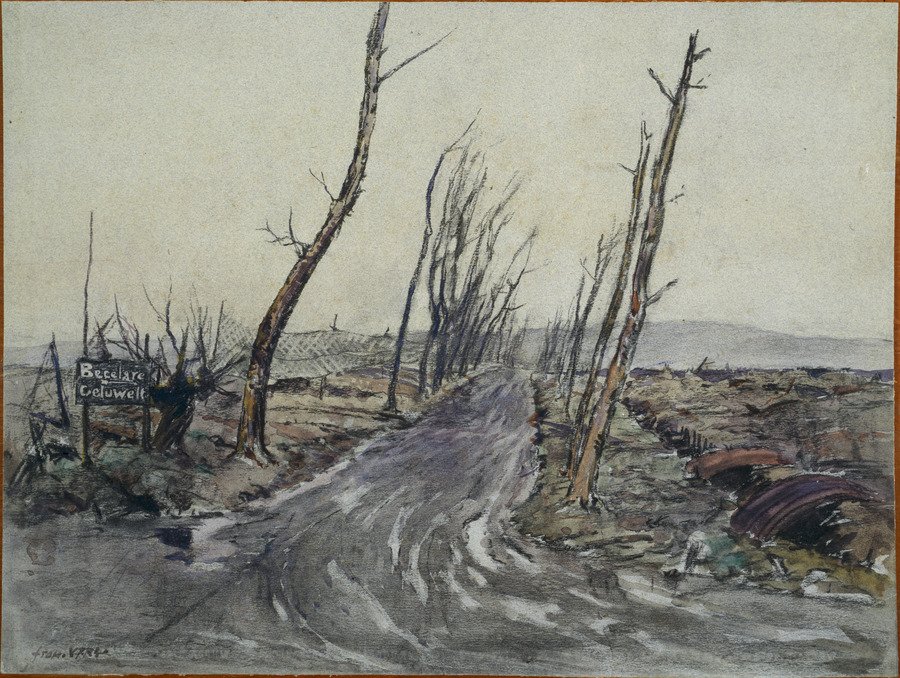
Ypres in 1914
The most likely location of his grave, based on the regimental diary, shows no recorded recoveries on post-war maps. Several other officers killed nearby in the same days are also listed on the Menin Gate. A German trench map from 1917 depicts the area as a cratered wasteland of no man’s land.
It is entirely possible that William Bastard still lies where he was buried, beneath Belgian soil.
Belgium has lived with this uncertainty for more than a century. Nowhere is this more visible than at the Menin Gate in Ypres, where Bastard’s name is carved among tens of thousands of others. Every evening, the Last Post is sounded beneath the arch – a ritual of remembrance performed not by British veterans, but by Belgians.
Archaeology, memory and care
In recent decades, Belgium has quietly led the effort to recover the missing. Volunteer archaeological teams, supported by the Province of West Flanders and institutions such as the In Flanders Fields Museum, have located and reburied the remains of hundreds of soldiers. Advances in historical aerial photography, pioneered by Ghent University’s Centre for Historical and Archaeological Aerial Photography (see separate article in this issue), have transformed the search, allowing researchers to identify likely burial zones invisible at ground level.
Sometimes the work succeeds. Names are restored to bones; families are notified; headstones engraved. Sometimes it does not. Fields yield nothing, or remains are discovered without identity.
If William Bastard is ever found, it will be through these Belgian efforts – a final act of care by the landscape that claimed him. And if he is never found, his story will remain what it already is: a British life absorbed into Belgian ground, remembered not by a grave, but by a name carved in stone, and by a country that still tends the memory of its missing.
Sometimes, as archaeologists like to say, a needle can be found in a haystack. And sometimes the act of looking is itself a form of remembrance.
Related News
- Pedalling through the past: Cycling the battlefields of Ypres
- Racing through the ruins: The epic bike contest of 1919
- Great War's horrific beauty seen from the sky
- Plight of Belgian refugees in WW1 echoes Gaza today, says museum chief