

To help people cope with rising energy prices, Belgium's Federal Government is allocating up to €80 million to provide energy support, spread over the next three months.
Just before midnight, Prime Minister Bart De Wever's (N-VA) so-called Arizona coalition finally reached an agreement to introduce a number of targeted and temporary measures to provide energy support. The package is expected to cost around €80 million and will be limited to the next three months.
Around €60 million (€20 million per month) will go towards easing commuting costs. The aim is to encourage employers to increase their existing mileage allowance (or to introduce such an allowance in the first place).
Any increase will be subsidised by the Federal Government up to 20% via a tax credit for the employer – with a maximum of €0.10 per kilometre.
In practice, this means that someone living 25 km from their workplace would receive around €250 over three months, which is estimated to be equivalent to two full tanks of fuel.
Importantly, this is a one-off measure, which must not affect the calculation of the wage margin and does not apply to fuel cards.
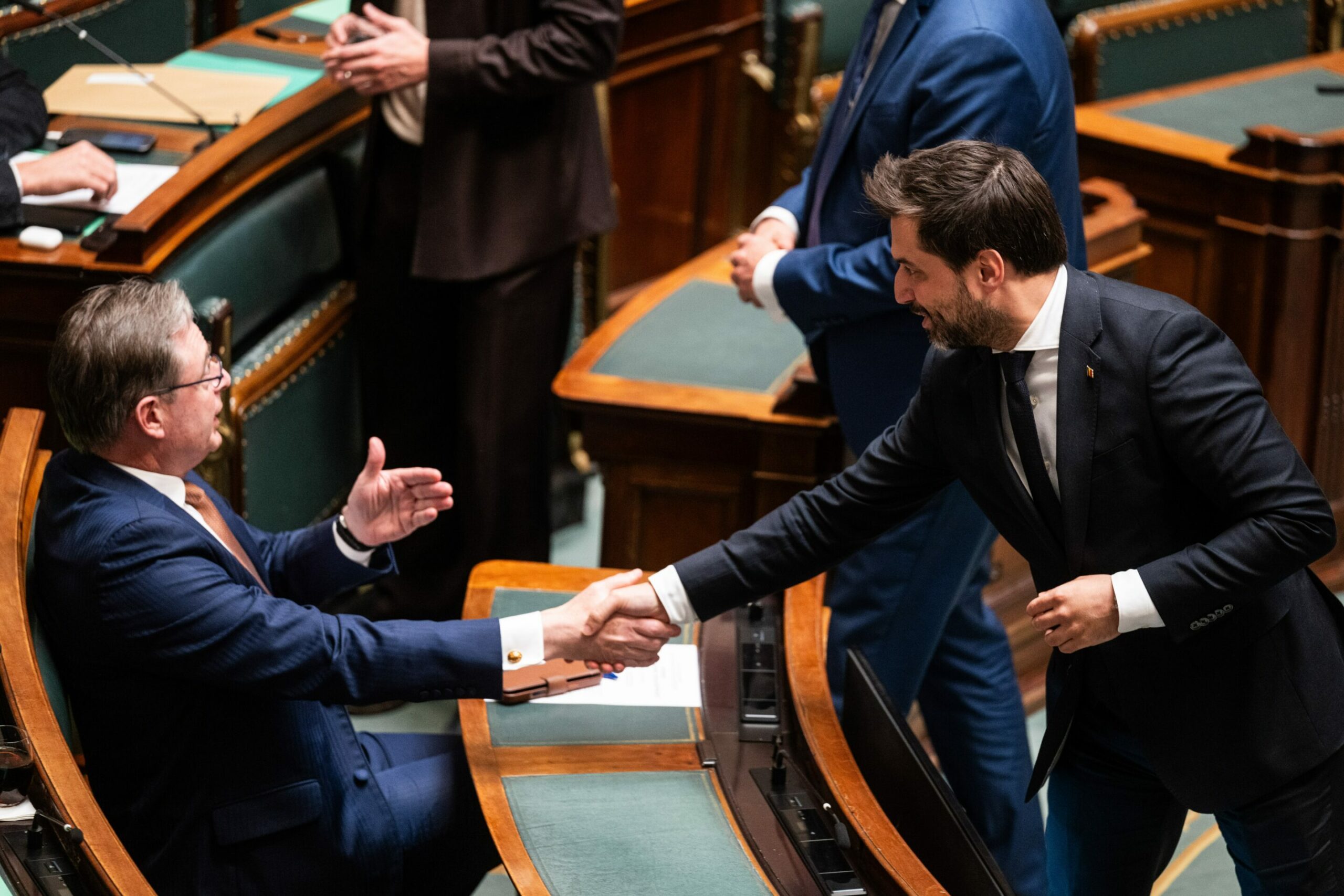
Prime Minister Bart De Wever and MR's Georges-Louis Bouchez pictured ahead of a plenary session of the Chamber at the Federal Parliament in Brussels, Thursday 16 April 2026. Credit: Belga/Emile Windal
While €20 million per month is being allocated for this measure, the total amount may turn out to be lower as it will depend on how many employers actually take up the offer.
Around €5 million will go towards a measure to help people who need their cars for work-related travel (such as home nurses or others who need their cars for their jobs). In the second quarter of this year, they will be able to increase the ceiling for the flat-rate mileage allowance on their tax returns.
The Federal Government is also setting aside €15 million for vulnerable families who heat their homes using fossil fuels.
This money will go to the social funds for heating oil, gas and electricity at the Public Centres for Social Welfare (CPAS/OCMW). The increase in excise duties on gas and heating oil, which was due to come into effect on 1 April but is currently stalled in Parliament due to opposition, will now be postponed until 1 August.
The Federal Government is also postponing a planned change to excise duties on gas and electricity until 1 August.
This change was actually due to come into effect on 1 April this year, but had not yet been put to a vote in parliament and is now being further delayed. It did not seem the right time to increase excise duties on gas, they said.
'Strong European framework'
Additionally, the Federal Government also approved a number of budget-neutral measures. For example, Consumer Affairs Minister Rob Beenders (Vooruit) and Energy Minister Mathieu Bihet (MR) are preparing an awareness campaign to encourage energy-efficient behaviour.
This campaign will, among other things, encourage (but not mandate) remote working, and promote carpooling, public transport and eco-driving. The authorities themselves will set a good example by only switching on the heating or air conditioning when certain temperature thresholds are exceeded.
Self-employed people affected by high energy prices will be able to defer their social security contributions for the first half of 2026 by one year. The application procedure for an exemption from these contributions will be simplified.
For farmers, who are facing not only higher energy prices but also very low prices for many of their products, an increase in the flat-rate deductible amount per hectare on the 2026 tax return will be applied.
Finally, they agreed that Prime Minister Bart De Wever (N-VA) will actively contribute at the European level to “a strong European framework” for a windfall tax on companies profiting from the energy crisis.
