
Police chiefs from Belgium’s coastal area have called for additional resources and capacity to tackle escalating transit migration.
The number of transit migrants has surged over the past year as intensified action by French authorities prompts more and more people smugglers to launch their small boats from Belgian beaches to the United Kingdom.
Federal police revealed that 33 boats attempted the crossing from Belgian coasts this year, carrying dozens of migrants each. Five vessels were intercepted prior to departure.
Migrant smugglers often escorted by ex-soldiers
Most migrants originate from Iran and Iraq, though there has been a recent increase in arrivals from Eritrea, Somalia, and Sudan.
Local police have struggled to prevent smugglers from deploying boats, especially since the latter are now accompanied by often violent ex-soldiers, which makes attempts to disable vessels on the beach too dangerous.
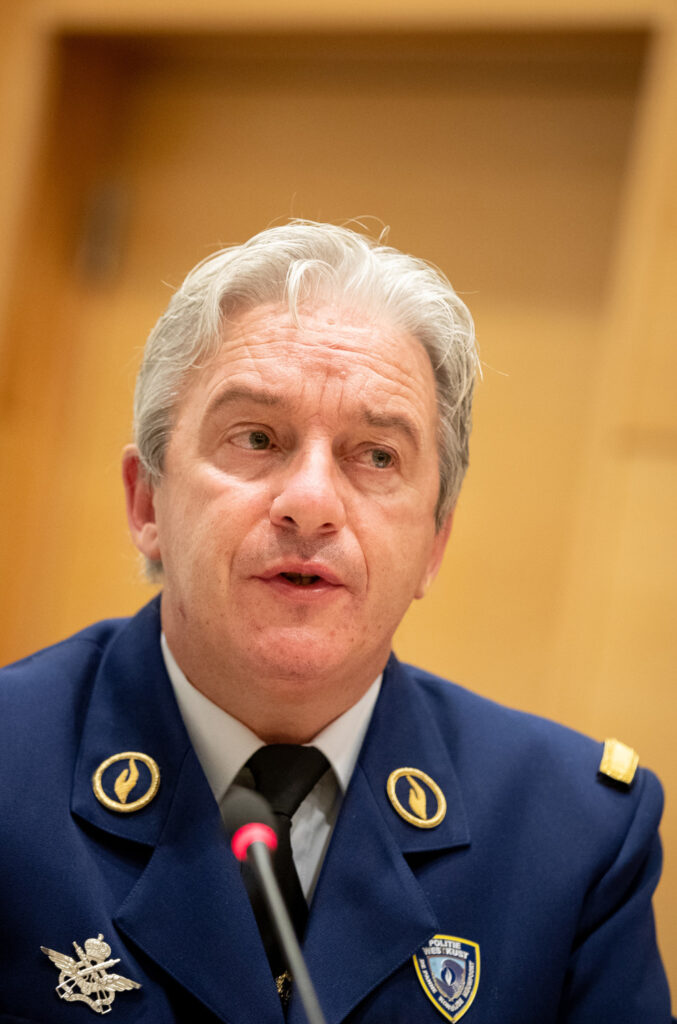
Westkust police chief Nicholas Paelinck highlighted the challenges at a parliamentary hearing on Tuesday.
Police resources are stretched thin
Smuggling methods are becoming harder to counter. Equipment like boats, fuel containers, and life vests are concealed on beaches or transported via public transit to avoid detection, and smugglers are also cramming more people onto smaller vessels.
Police resources are stretched thin, particularly with the busy summer season ahead. Ostend police chief Hannelore Hochepied explained that small boats often launch in the wee hours of the morning, straining daytime police capacity.
French intelligence suggests that large groups of migrants are waiting in camps near Calais, Grand-Synthe, and Paris to cross over to the UK during summer. Paelinck noted that Belgium’s limited manpower at the border with France cannot contain the growing crowds.
Local police call for better surveillance technology
Although supported by Federal Police, local police have stressed the need for advanced surveillance technology, including enhanced cameras, thermal sensors, drones, and beach access monitoring.
Hochepied also proposed a central processing hub equipped with interpreters and migration officials to reduce the time police spend processing apprehended migrants.
At the European level, improvements are needed: Hochepied criticised Eurodac—the EU database for migrant asylum claims—for being unavailable after 5 p.m. or on weekends.
Coastal mayors have submitted requests for more resources to Belgium’s Interior Minister.
Opposition party N-VA’s Maaike De Vreese emphasised urgency, comparing France’s strong UK-funded deterrence efforts to Belgium’s weaker capacity. She warned that the flow of migrants to Belgian beaches was inevitable without swift action.
'A blind carousel' of ineffective policies
Francesca Van Belleghem of Vlaams Belang called the police assessment “sobering” and urged immediate action on return agreements with migrants’ countries of origin, alongside systematic phone searches to dismantle smuggling networks.
Foruit MP Achraf El Yakhloufi expressed concern over a lack of enforcement, labelling the situation as a “blind carousel” of ineffective policies.
Franky Demon (Christen Democratisch en Vlaams, CD&V) suggested better collaboration with the UK as essential for addressing the issue.
