
In a former three-storey car park just off Place Saint-Boniface in Ixelles, Brussels’ most ambitious food court has taken shape.
Ratz is not simply a place to eat; it is a fully immersive environment – a dense, theatrical reconstruction of global street food culture, where visitors move through imagined alleys of Asia and the Middle East, stopping at counters, bars and cafés along the way.
“The aim was not to create a food hall but a total immersive space,” says co-founder and serial entrepreneur Thierry Goor, who also launched the Wolf, Fox and Galerie Bortier food courts. “It's a journey - a living food bazaar to eat, work, create, organise events, stroll or discover.”
The ambition is clear. Designed by interior designer and cinema decor creator Florence Mazzoni, Ratz aims to push the concept of the food court beyond functionality into spectacle – what Goor calls “eatertainment”. The result is a layered space: a central bar with 32 taps, a café serving speciality coffee and house-made desserts, a network of street food outlets, and upper floors dedicated to events, screenings and exhibitions.
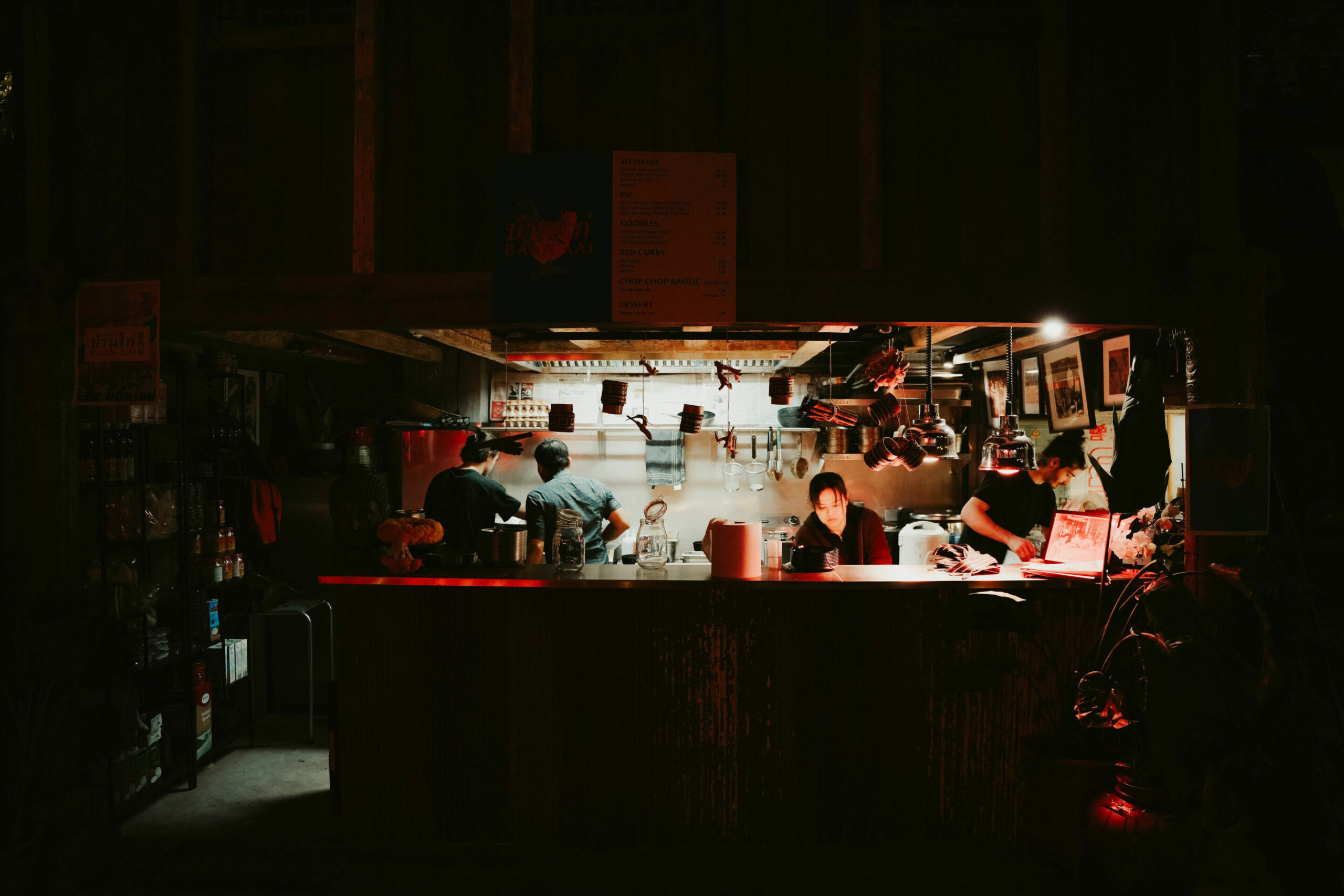
Ratz food hall
The opening, inevitably, sparked debate. Some critics accused the venue of cultural appropriation, pointing to its stylised recreations of foreign streets. Goor dismisses the charge. “I didn’t invent anything,” he says. “I shot a film with the best casting, actors, chefs and decor, to tell an impeccable story.” He is echoed by Syrian chef Georges Baghdi Sar, who says, "I feel like home.”
Controversial or not, Ratz marks the most advanced stage of a model that Brussels has embraced with remarkable speed. In less than a decade, food courts have evolved from experimental pop-ups into a central feature of the city’s culinary landscape – combining operational efficiency, commercial logic and social appeal.
To understand how that happened, it is worth going back to the beginning.
The initial experiment
Brussels’ first food court opened in May 2018 in the basement of the former Citroën garage next to the canal – and set to open later this year as the Kanal–Centre Pompidou arts venue. At the time, the building project needed a food offering that matched its ambitions.
Conveniently, two Solvay Business School students had just completed a thesis on the feasibility of a street food court in Brussels. They had two months to build one from scratch – 1,500 square metres in the Kanal basement – and they did it, recruiting an industrial designer and an architect along the way.
The court ran six days a week and offered over 300 seats, including a sun-drenched terrace on the water's edge. After a year, it closed to make way for renovation works that are still ongoing.
A genuine success, but nothing close in scale to what Wolf or Fox would later become: more a fortunate experiment than a commercial blueprint. In commercial terms, it was less a mature business than a proof of concept – an indication that Brussels was ready for something new.
At the time, food courts were already well established in cities such as Lisbon, Copenhagen, London, Barcelona and Amsterdam. In Belgium, however, the model was still novel. Brussels was only beginning to develop a credible street food scene, supported by pioneers such as Bia Mara and a growing cohort of food trucks pushing for permanent locations beyond the annual Brussels Food Truck Festival.
The appeal of the food court was simple – and remains so. "A street food court has the great advantage for groups – of colleagues, tourists, families and friends – of offering completely different food that can be enjoyed at the same table," says Gonzague Buckens, one of the founders of Kanal Street Food Market.
It also addressed a broader shift in eating habits. By 2018, accommodating diverse diets, allergies and preferences had become increasingly complex. The food court offered a practical solution: variety without compromise.
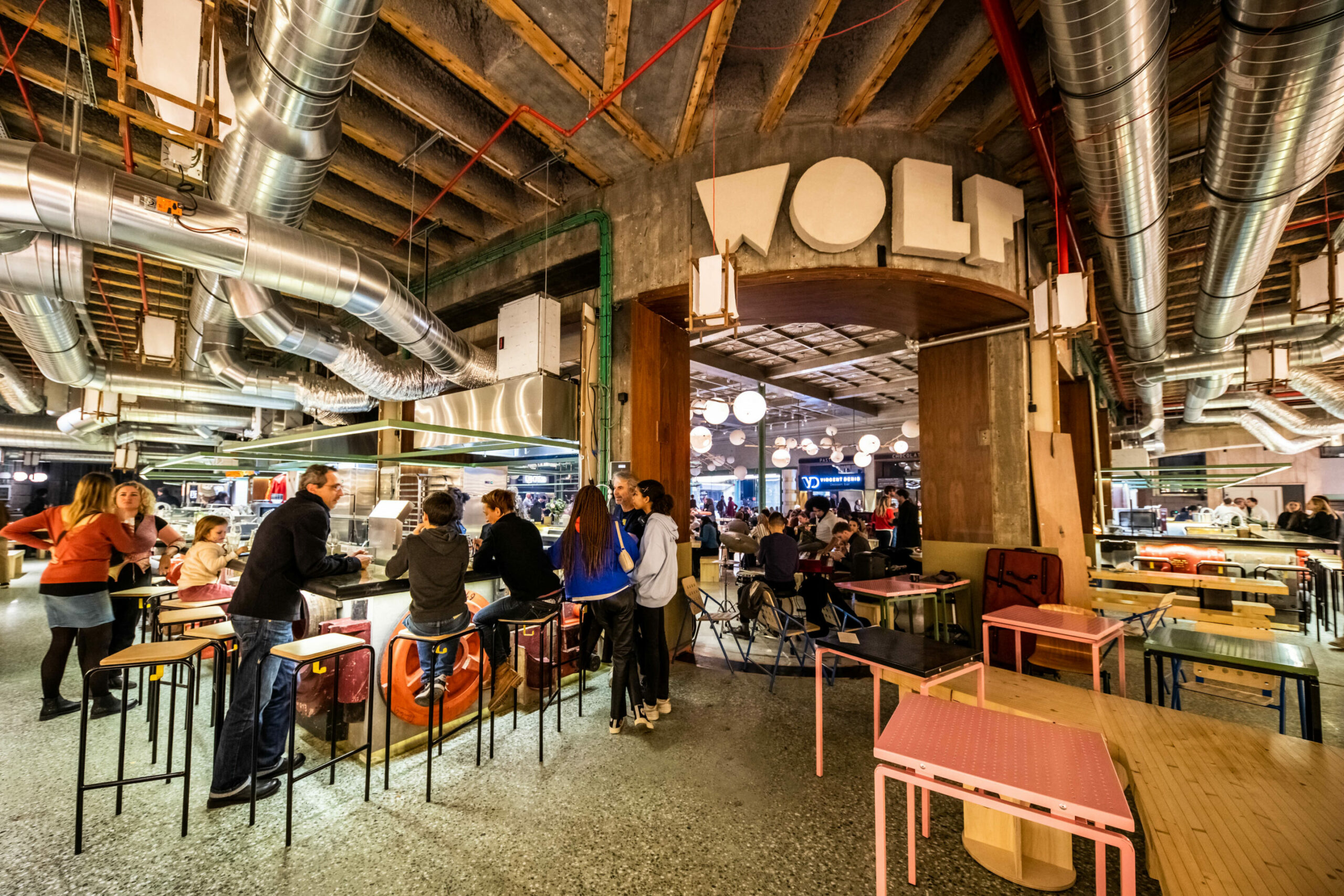
Wolf food hall in Brussels
Even at this early stage, elements of what would later define the model were already present. Kanal used recycled furniture – a nod to sustainability that now feels almost obligatory – and prioritised flexibility and informality over traditional dining structures.
Later that same year, communication and events agency We Are C launched another temporary food court, Food District, in the City 2 shopping centre next to Rue Neuve. Running from August 2018 to May 2019, it featured seven outlets offering salads, roasted chicken, sandwiches, Asian dishes, breakfasts, pizzas and desserts.
Food District served as a direct precursor to Eats! (sometimes stylised as EATS!), which opened in the same location in July 2019 and remains in operation today.
The first commercial model
Eats! marked a turning point. It was Brussels’ first permanent food court – and the first to establish a clear, scalable commercial model.
Located on the lower level of City 2, it spans 1,500 square metres and offers around 400 seats. Its concept is rooted in retail logic: food operators rent their space in the same way as shops in the mall.
Its target market is equally clear. Rather than creating its own destination, Eats! taps into existing footfall – shoppers already passing through City 2 or along Rue Neuve.
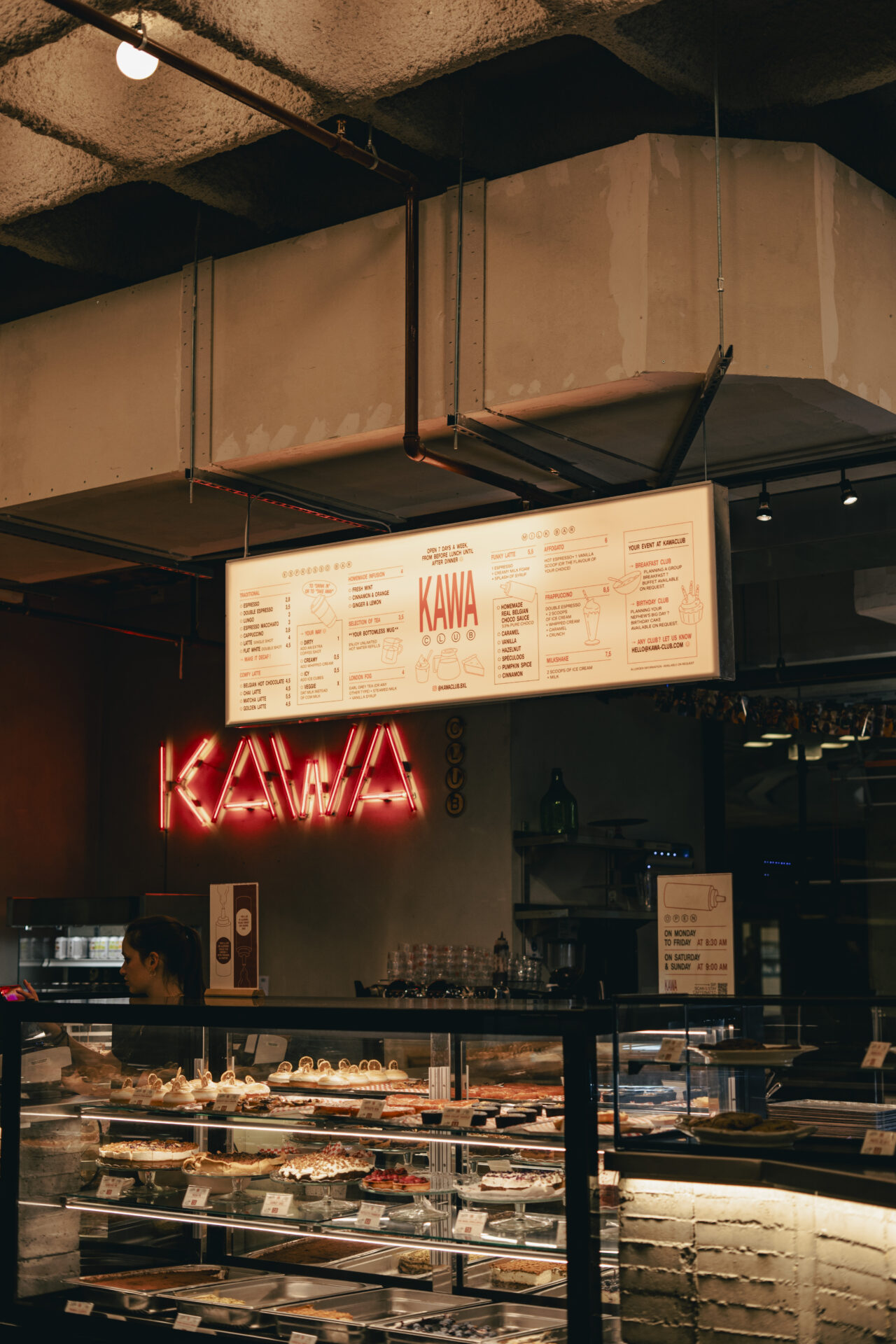
Kawa at Fox food hall
The offer reflects that positioning. Today, customers can choose from around 14 savoury outlets, ranging from burgers, tacos and pizza to sandwiches, pasta, sushi, poke bowls and noodles, alongside smoothies, coffee, donuts and ice cream. Many of the brands are familiar, even generic – part of the appeal.
At the time of its opening, Eats! represented a small revolution in Brussels’ food scene. Yet its strengths also define its limits. It is, above all, a place of convenience: efficient, accessible, predictable.
What it lacks is atmosphere – the sense of occasion that transforms a meal into an experience. That distinction would prove crucial.
“To create real attraction, you need four conditions,” Thierry Goor says. “An iconic place, a stunning design, an impeccable food outlets' line-up and to make these places come alive.”
It was this insight that would shape the next generation of food courts in Brussels.
Wolf: a howling success
When Wolf opened in December 2019, it did more than refine the concept – it redefined it.
Located in the former teller hall of the CGER bank (later Fortis), the venue occupies a vast, light-filled space beneath a listed ceiling made of Val-Saint-Lambert glass tiles. Designed by Lionel Jadot, it is a showcase of upcycling, with former bank counters repurposed as food stalls.
The venture launched as a partnership between the Haelterman family – Paul and Michel – whose conglomerate spans beverage import and property, and Thierry Goor and Pascal van Hamme of the Choux de Bruxelles catering group. The partnership dissolved in 2022, leaving the Haelterman brothers as sole owners and operators.
But the real innovation lies in the business model.
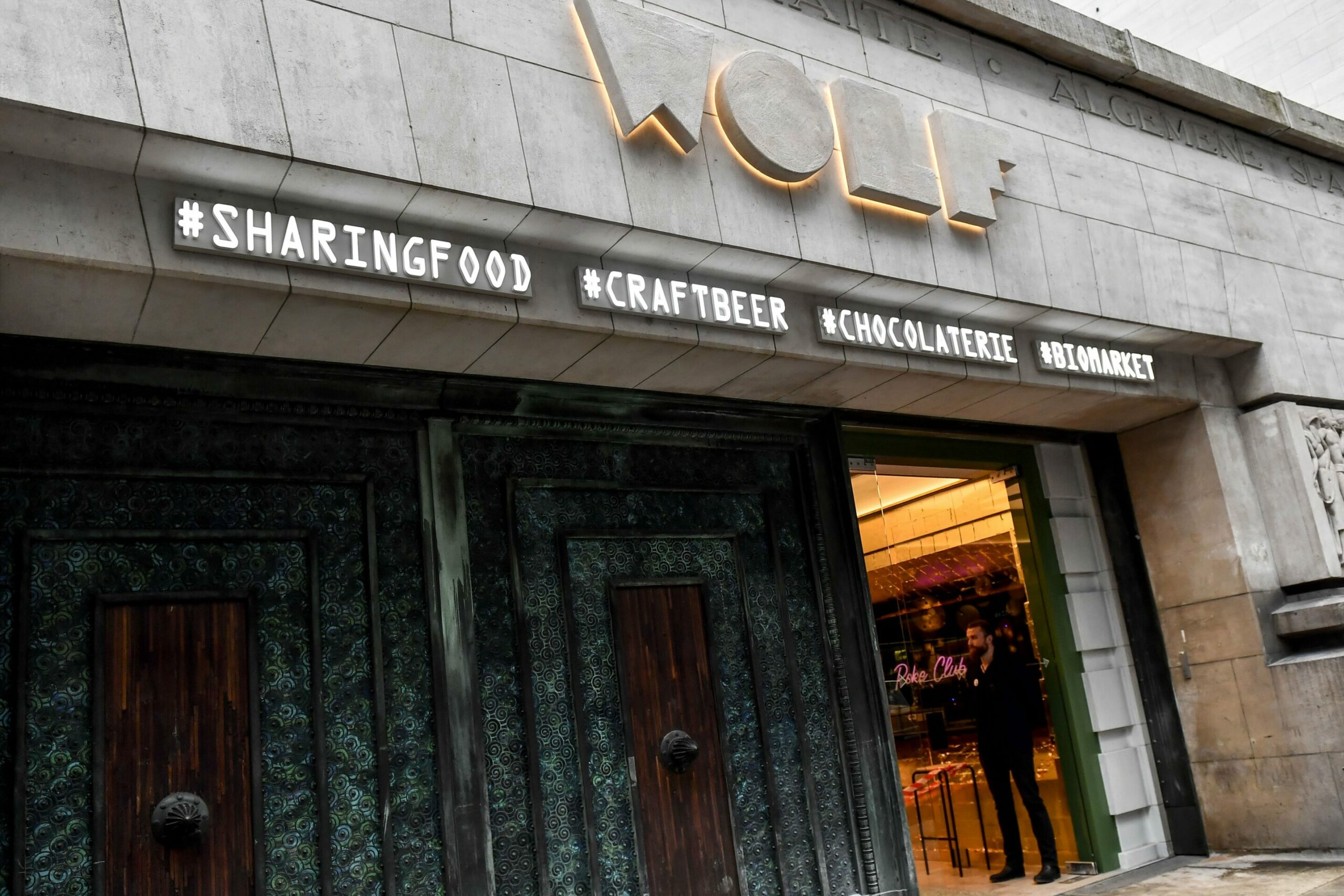
Illustration picture shows the Wolf food market in Brussels, Wednesday 11 December 2019. Credit: Belga / Dirk Waem
At Wolf, food operators do not pay traditional rent. Instead, they operate on a revenue-sharing basis, typically around 15% of sales. In return, the food court operator manages infrastructure, cleaning, service, communications and events, and runs the central bar. All transactions pass through a unified system of tills.
This model aligns incentives across the board. The operator benefits from overall footfall and atmosphere, while vendors share in the collective success of the venue.
Equally important is the curation. Wolf selects its vendors through a careful “casting” process, favouring independent operators and experienced restaurateurs over mainstream chains. The result is a stronger sense of identity – and, crucially, quality.
The success was immediate. By 2025, Wolf had recorded one million visitors and built a community of 50,000 followers, according to CEO Sebastiaan Van de Voorde. In 2024, the concept expanded to Antwerp, with a smaller site in the Felix Pakhuis building.
Today Wolf Brussels runs 16 permanent outlets plus one rotating pop-up, three event spaces and a 150-seat terrace – with capacity for 1,000 diners at a time. "We offer honest street food at fair prices, through outlets run by seasoned restaurateurs," Van de Voorde explains.
Its culinary offer is deliberately diverse. African street food at Toukoul sits alongside Mexican tacos at Socal, Syrian dishes at My Tannour, Italian pasta and pizza, smashed burgers, and a wide range of Asian cuisines – from Taiwanese bao to Vietnamese and Japanese dishes.
Wolf also runs its own microbrewery, which supplies half of the 150,000 litres consumed on site each year – a celebrated range that includes a bestselling blonde and regular collaboration brews with local microbreweries. Largely cashless, the court has a central till from which any outlet can be ordered. Events are a cornerstone: Halloween nights, chef cook-offs, plant markets, the 'Golden Grams' vintage clothing fair, quiz nights and cooking classes in the dedicated Wolf Lab behind the counters. In 2026, the programme will include DIY workshops, dance and fitness classes.
Wolf thus established a new standard: the food court not as a convenience, but as a destination.
Gare Maritime: scale and context
The success of Wolf coincided with a broader shift in behaviour. After the pandemic, there was a renewed appetite for shared, informal dining – for places where people could gather, eat and spend time together.
In November 2021, a new court opened inside the Gare Maritime, the beautifully restored hall at Tour & Taxis, transforming the whole site. The setting is impressive: a vast, restored industrial building filled with light, surrounded by breweries, an urban winery and other food-related venues.
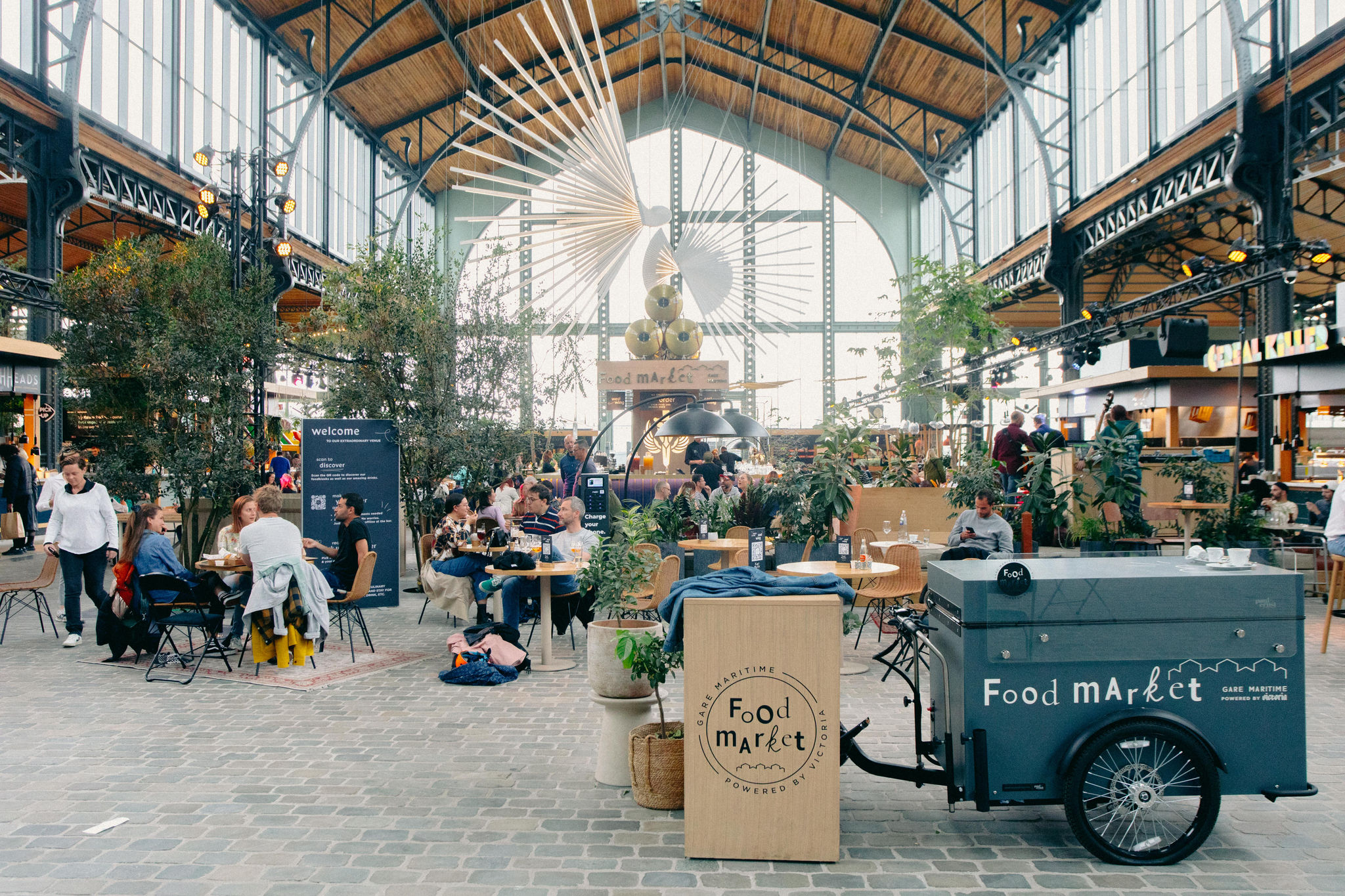
Food Market at Gare Maritime. Credit: Visit Brussels / Marin Driguez
The food court has 10 outlets and a central bar run by AB InBev under its Victoria brand. The company oversees operations, staffing and curation.
Initially, the concept leaned towards bistronomy, with several well-known chefs involved. Over time, however, the offer shifted towards more accessible, mainstream cuisine. Four years on, only three original outlets remain.
The result is a space that functions efficiently but lacks a strong identity. It is less a destination than a complement to its surroundings – a place to eat while visiting Tour & Taxis, rather than a reason to go there in itself.
Still, its role is not insignificant. “It’s precisely the food offer that was missing to accompany the area’s excellent breweries,” says Cédric Dautinger, editor-in-chief of beer.be.
Fox: refinement and setting
By 2023, the model had matured. Fox, opened in June by Thierry Goor and Pascal van Hamme, again in collaboration with Lionel Jadot, represents a further refinement.
Located in the former headquarters of Royale Belge in Watermael-Boitsfort – a striking Brutalist building near the Sonian Forest (Forêt de Soignes) – Fox combines architecture, landscape and food.
Despite opening while the building was still under renovation, it immediately attracted large crowds. The concept builds on Wolf’s foundations, but with an added emphasis on setting and atmosphere.
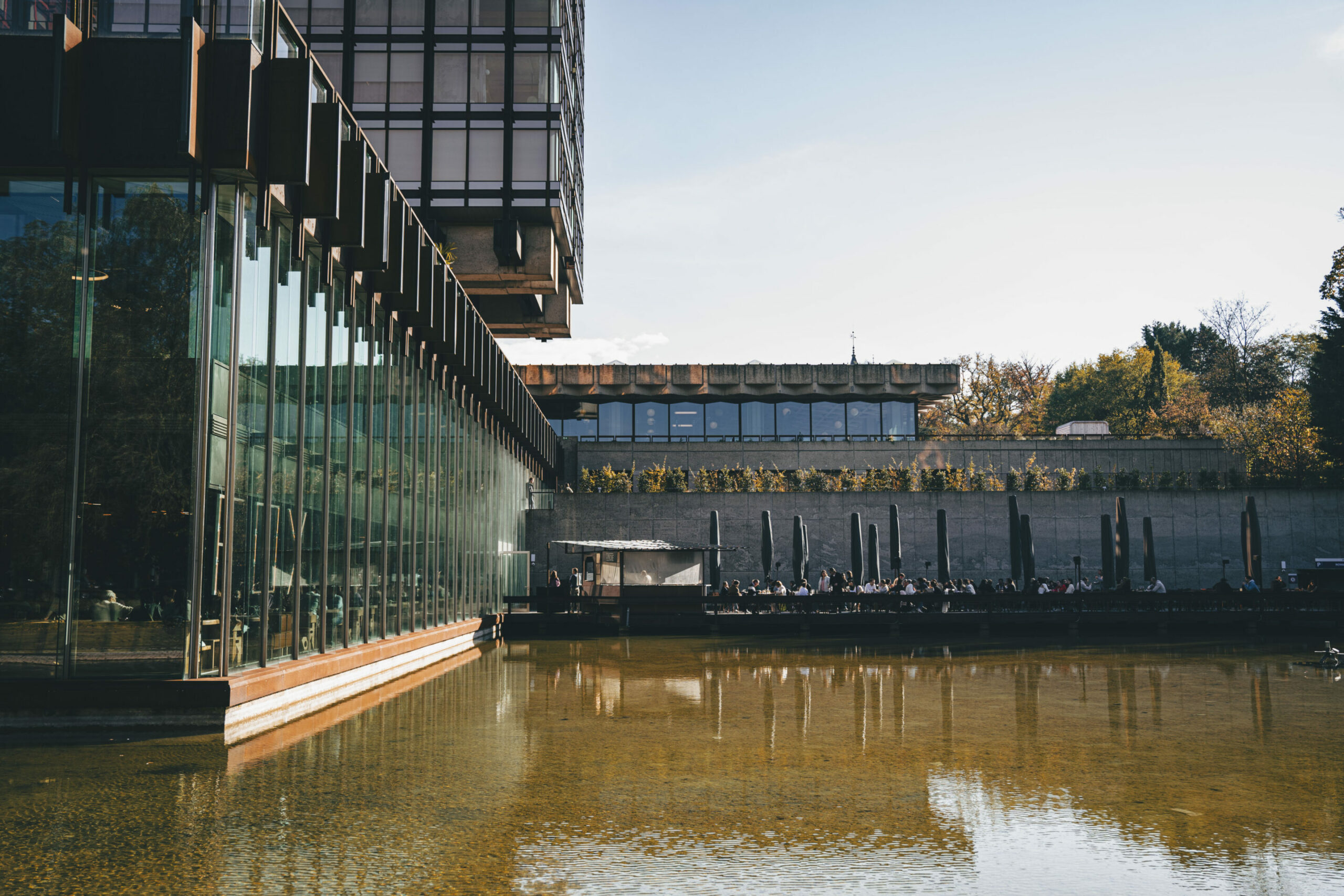
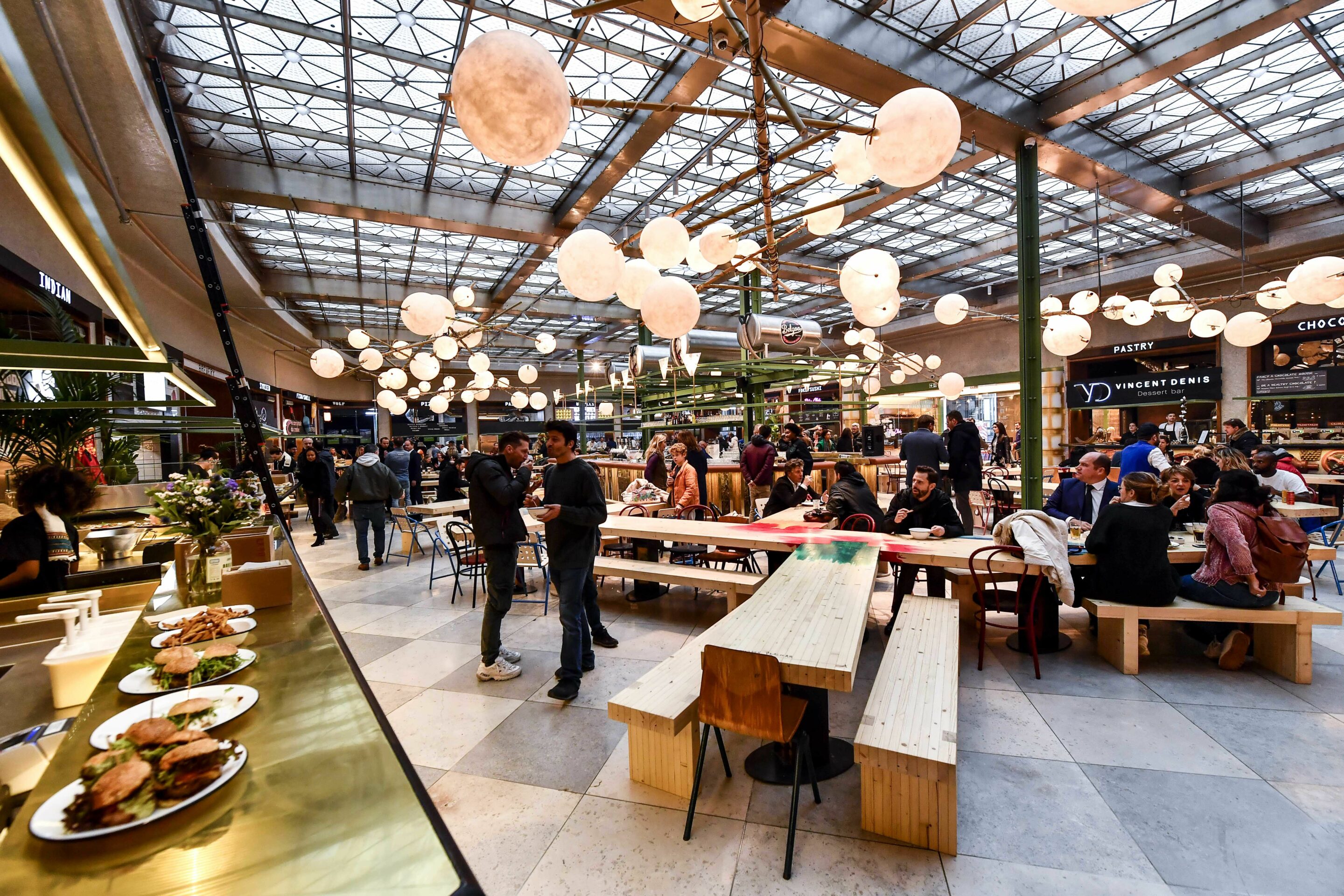
Fox food hall
Goor describes it as “streetonomy”: premium street food in an iconic environment.
Nine outlets offer a wide range of cuisines – Italian, Greek, Korean, Mexican, Indian and Japanese – alongside a central bar and dessert counter. There are 450 indoor seats, plus 300 on a terrace overlooking a pond.
As with Wolf, events play a central role. Plant markets, vintage sales, children’s workshops and other activities reinforce its function as a social hub.
Fox demonstrates how the model can be adapted to different contexts – in this case, a greener, more residential environment.
Bortier: hybridisation and tension
Not all adaptations have been seamless. Galerie Bortier, a 19th-century covered passage near the Grand-Place, illustrates the tensions that can arise when the model meets heritage.
Historically home to bookshops, the gallery was redeveloped following a city-led tender process that favoured a more commercial approach. The result is a hybrid space, combining food outlets with surviving bookshops and a “café littéraire”.
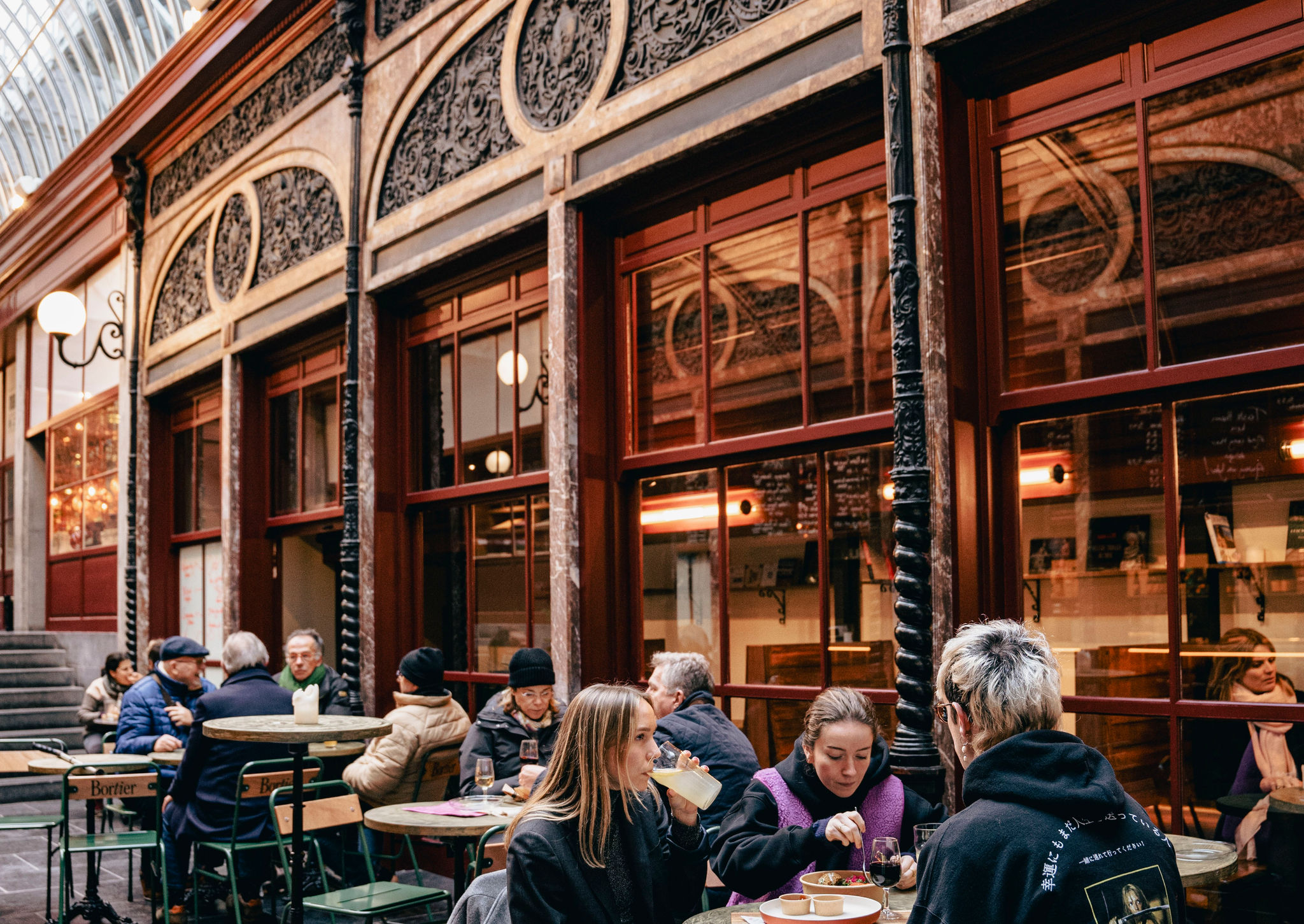
Galerie Bortier
The transition has been controversial. Increased footfall and food production have disrupted the gallery’s traditionally quiet atmosphere, prompting criticism from tenants and residents.
At the same time, the venue has developed a cultural programme – book clubs, concerts, theatre – attempting to reconcile its past with its new function. But Bortier shows both the flexibility of the food court model and its limits.
Ratz: culmination – and question mark
Seen in this context, Ratz is both a culmination and a test.
It takes the core elements of the model – diversity, shared space, centralised management – and amplifies them into something more theatrical, more immersive, more ambitious.
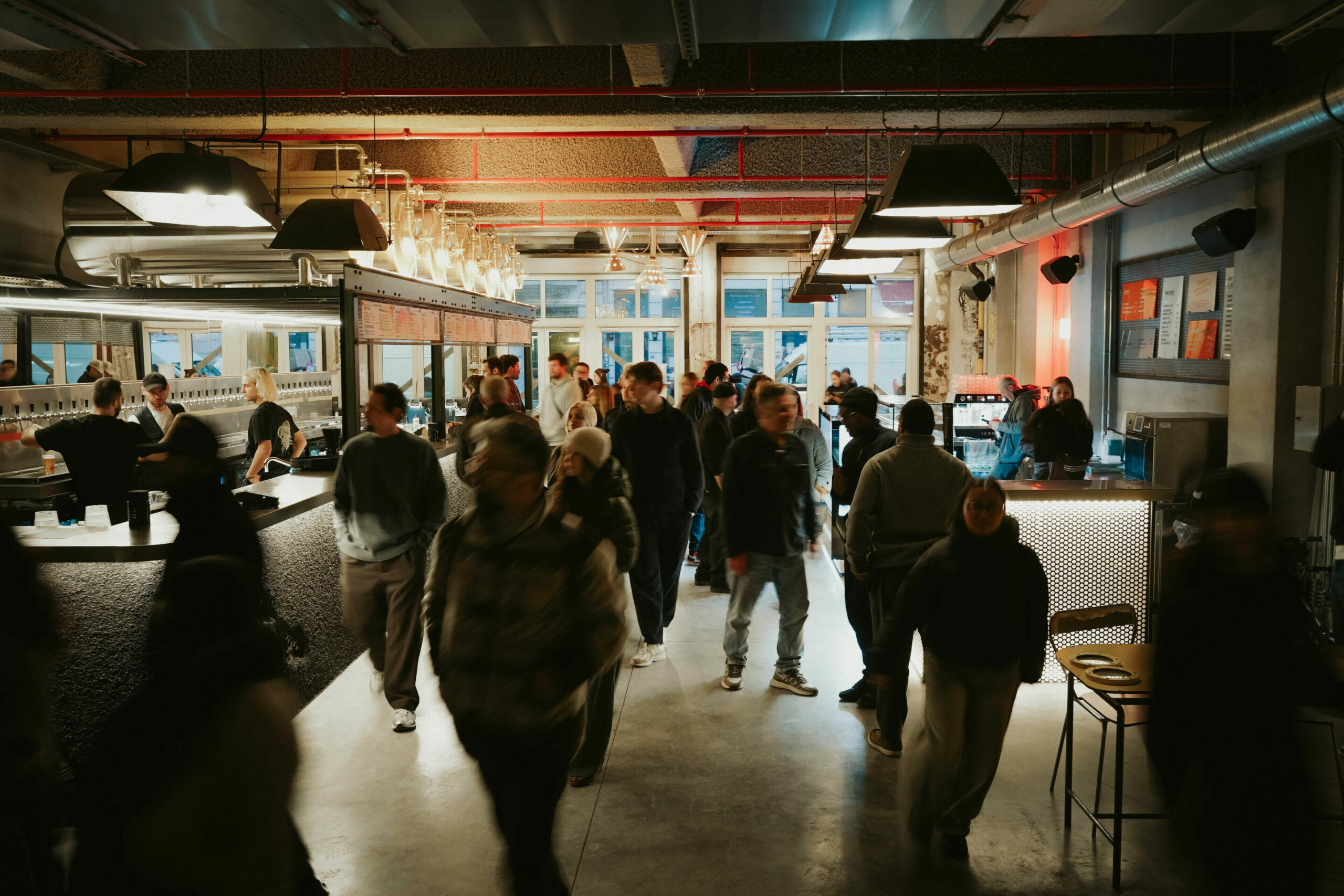
Ratz food hall
"Ratz is an experience," its website says. But its commercial logic remains consistent: shared infrastructure, multiple revenue streams, and a model that benefits from scale and footfall. But its success will depend on whether the “experience” it offers proves durable – or merely novel.
From novelty to norm
What began in 2018 as a temporary experiment has, in less than a decade, become a defining feature of Brussels’ food landscape.
Food courts offer a compelling combination: operational efficiency, shared costs, diversified income streams and a built-in response to modern dining habits – speed, variety and informality.
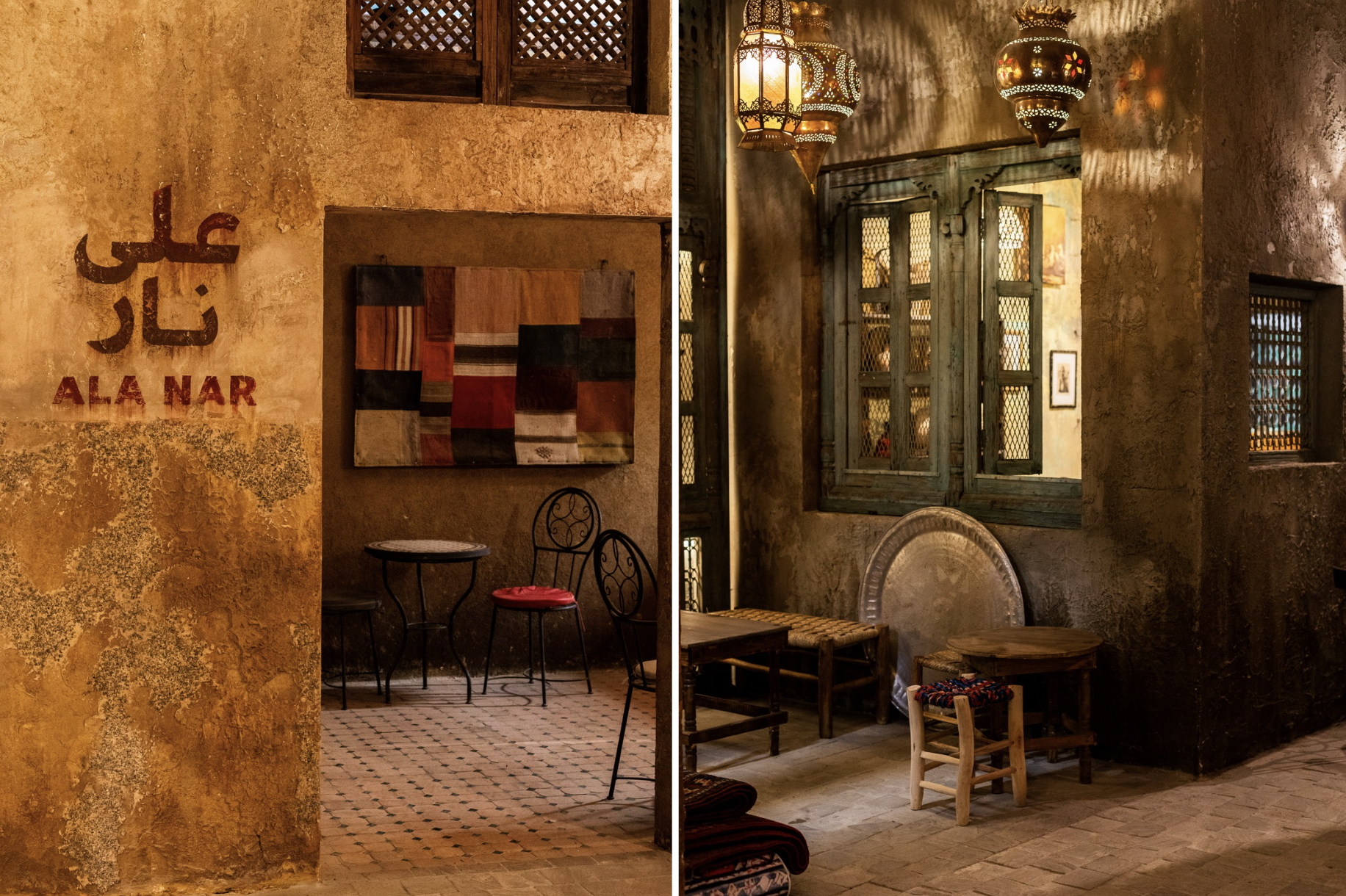
Ratz food hall
Is there still room – or appetite – for more food courts in Brussels?
Several communes have already approached Goor, seemingly unaware of the enormous administrative burden and time involved in setting them up. Whatever the answer, this shift is now firmly embedded in Brussels' food offer to residents and visitors alike. Liège, Antwerp and other Belgian cities are catching up, each adapting the model to local conditions. Even Kraainem, on the Brussels fringe, has its own multi-outlet takeaway market, Munchies.
"Today, people don't want to wait for food the way you do in a restaurant," Goor says. With food courts, they can have the cake and eat it too.
