
Anderlecht is the third-largest commune in Brussels after Brussels itself and Uccle. It was also briefly home to one of the world’s intellectual superstars, Dutch religious reformer Desiderius Erasmus Roterodamus. He was on the lam, having decided that Leuven was too religiously fevered and he might attract the unwelcome attention of church authorities. Nearby rural Anderlecht would surely be the place to lie low and enjoy green fields (or so he wrote). Alas no! After a few months there, he decided that the distant and staunchly Protestant city-state of Basel might be a safer environment for him. More of him later.
The commune is littered with historical buildings of note, starting with Erasmus’s house, which is now a museum. This is close to the Collegiate Church of St Peter and St Guido. It was built on the crypt of a 10th-century church, started 1350 and completed in 1557. In the history of medieval ecclesiastical construction, this is but a moment in time. One of the contributing architects was Jean van Rouysbroeck who was also responsible for the magnificent tower of Brussels city hall in the Grand Place. Judging by his name he was a local lad.
The ancient chapel in the Anderlecht district of Scheut was not so lucky, however. It was incorporated into a Victorian Gothic church that was ignominiously knocked down to build a supermarket in the 1970s! The-then curator of the Erasmus museum was quick-witted enough to save the corbels (ledges designed to carry a bearing weight) and keystones.
The district of Scheut was also the high ground chosen in 1695 from which to bombard Brussels in the Nine Years War, when French royalist forces destroyed a third of all the buildings in the city, including the total immolation of the Grand Place.
Anderlecht cemetery. Credit: The Brussels Times / Leo Cendrowicz
It would be churlish while introducing Anderlecht not to mention its football club. Emerging in the 1920s it is Belgium’s most successful team, with 34 championship titles, five European trophies and countless other baubles. It has intense rivalry with Club Brugge and Standard Liege proving that, even in football, rivalry follows exactly our linguistic groupings.
Roving graveyards
The story of Anderlecht’s cemeteries stretches back to a Merovingian necropolis of the 6th to 8th centuries, unearthed on the ruins of a Roman villa in the 19th century. In the Middle Ages, burial shifted to churchyards, with graves clustered around the parish of the Collegiate Church. Reform came with Joseph II’s 1784 edict banning burials in urban churches, paving the way for civic cemeteries. Anderlecht’s first municipal burial ground opened at Place du Repos in 1866, but rapid population growth soon overwhelmed it. The modern Vogelenzang cemetery, inaugurated in 1954 on a landscaped plateau, reflects a shift towards orderly, egalitarian design – where history, art and memory now coexist in carefully tended lawns.
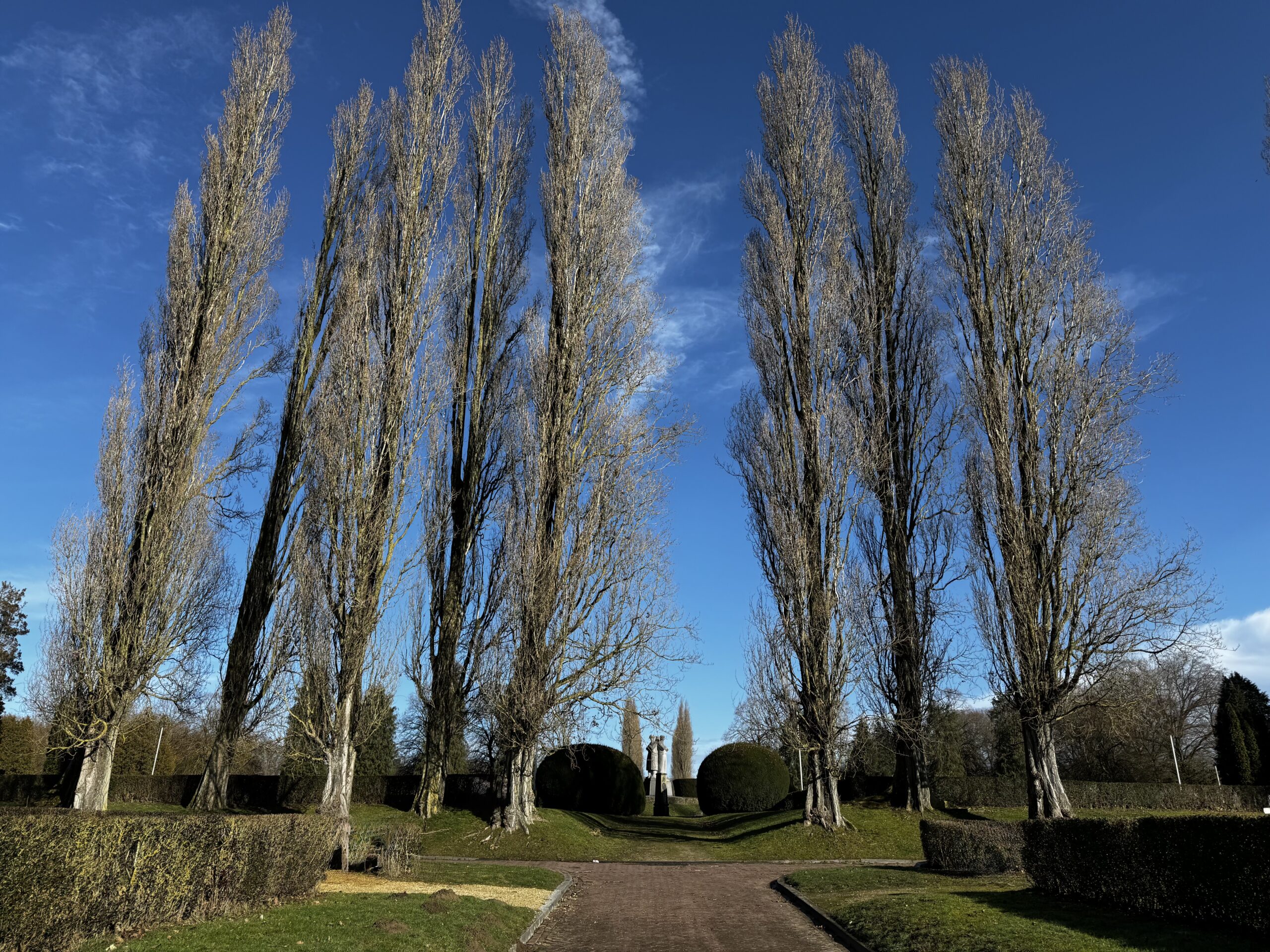
While the Brussels ring road largely encircles the 19 communes, bits of its territory do creep outside it. So with Anderlecht, which has a significant amount of land in what might be thought of as part of Flanders. Approaching the cemetery by car one must go under the ring road, gybe suddenly to starboard and then drive left up a broad avenue just before the Jacques Brel metro station. Two lines of pollarded trees march up a hill to quasi-military red-brick buildings that guard the entrance to the Vogelenzang Cemetery. And if we’re going to spend the rest of eternity somewhere, it might as well have a pretty name: Birdsongs!
Anderlecht cemetery. Credit: The Brussels Times / Leo Cendrowicz
The buildings, decorated with a striking frieze by sculptor Firmin Vandewoude, are quiet with blinds down and doors locked. A placatory poster apprises me that while the commune takes full responsibility for the lawns, pathways, trees, common areas, military graves and such it is the duty of the family of the deceased to ensure that the tombs, graves, vaults are kept in good order. The old folk song, See That My Grave's Kept Clean, drifts into relevance.
The first impression is of size. I feel I can almost see the curvature of the earth as I look towards the Pajottenland beyond. I read that the area is 18 hectares; but I confess to being confused by units of area. Acres, ares, hectares, square feet, square metres, metres squared et al tend to blend in my mind. But, to simplify, if my calculations are correct, the whole area is the size of about 40 football pitches.
The second impression is of far more tended and beflowered graves than in other cemeteries I have visited. There are two reasons for this, I think. One is that Vogelenzang is comparatively new which means that the, ahem, inhabitants are more likely to have living relatives. Certainly, in my peregrinations around the periphery, I saw five or six groups of people laying flowers, brushing dust away, even polishing the marble. “See my grave is kept clean” indeed!
The second reason is perhaps less uplifting and more practical and is also due to its comparative newness: it opened, in 1954, in the age of the car. The pathways, called “avenues”, are broad enough to allow vehicle access to any part of the 64 “lawns” which make up the entire area. Rather as the simple act of wrapping barbed wire around parts of the Brooklyn Bridge reduced suicides (I want to die but I don’t want to cut my hands and feet), so the ability to drive 100 metres rather than walking means I am more likely to see that your grave is kept clean. Cars, I must record, move at a respectfully stately pace and need to be authorised.
Although Vogelenzang is proud of its green credentials (grave tenders are urged not to use chemical weedkillers), there is no impression of rewilding. Indeed, the hedges are trimmed, the leaves are swept up, the flowerbeds tended lovingly, the pathways weeded and the lawns mowed.
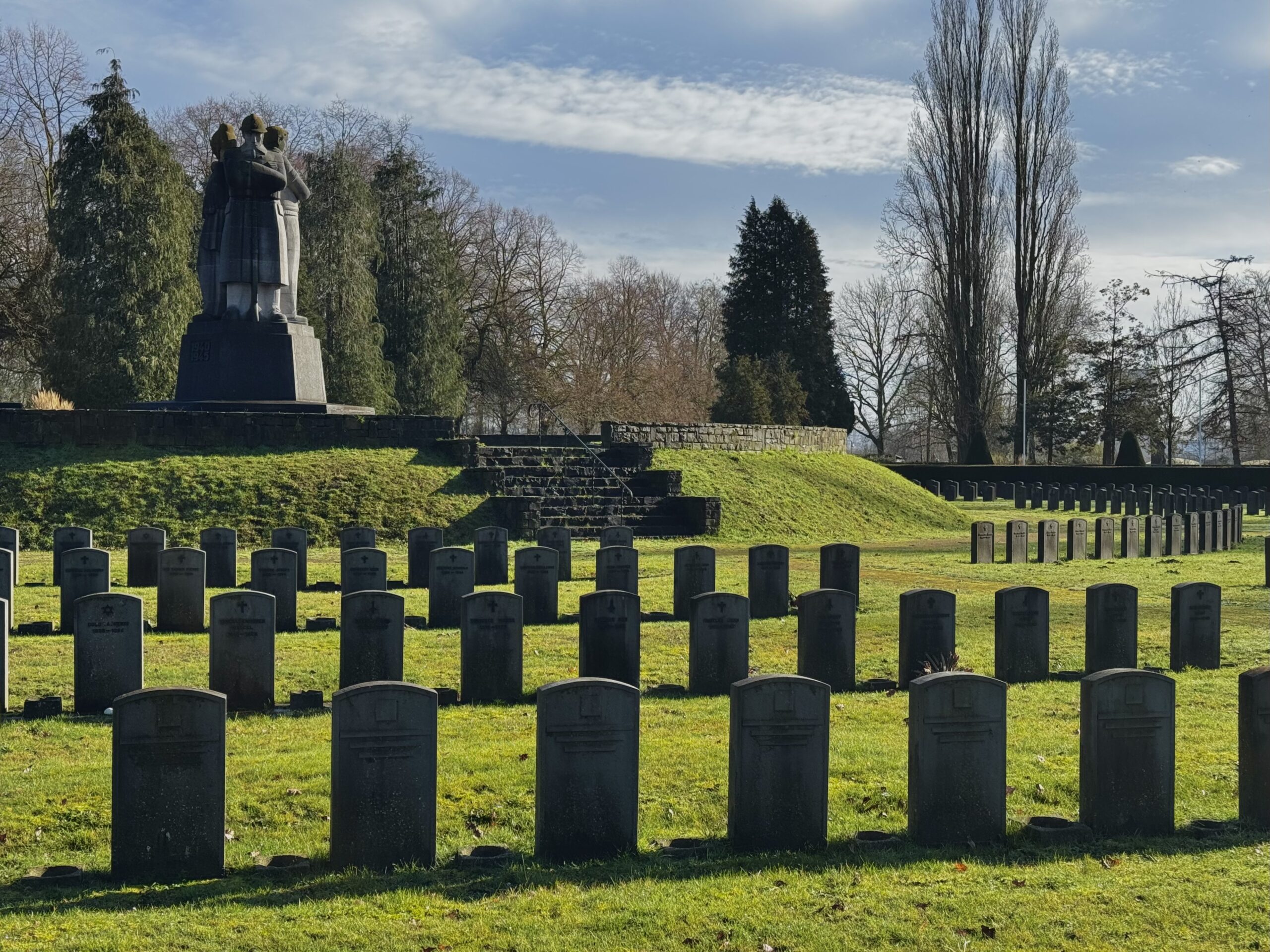
Nowhere is this love of good order more evident than in the “Pelouse d’honneur” or graveyard of the fallen. It is bang in the middle and can be seen from a long way off. A massive statue of a soldier, a stern looking civilian and a woman holding a baby – all at least double life-sized – stands upon a plinth engraved with “Pro Patria”, and the plinth stands upon a mound. The soldiers’ tombs are arrayed around and flowers, formal and beautiful, are everywhere. I make it my business whenever I am in a military graveyard – here, Britain, Northern France, Vietnam – to touch a gravestone briefly and transfer…what? Thanks, sadness, good wishes, man’s inhumanity to man, life is short and for some very short, just something human.
Transferring tombs
When the Vogelenzang cemetery opened, it was not conceived as a complete break with Anderlecht’s past, but as a careful relocation of it. Families were given the option to transfer existing graves from the old municipal cemetery at Place du Repos and around 1,250 funerary monuments were thus moved to the new site, ensuring continuity between generations and preserving the municipality’s funerary heritage.
Anderlecht cemetery. Credit: The Brussels Times / Leo Cendrowicz
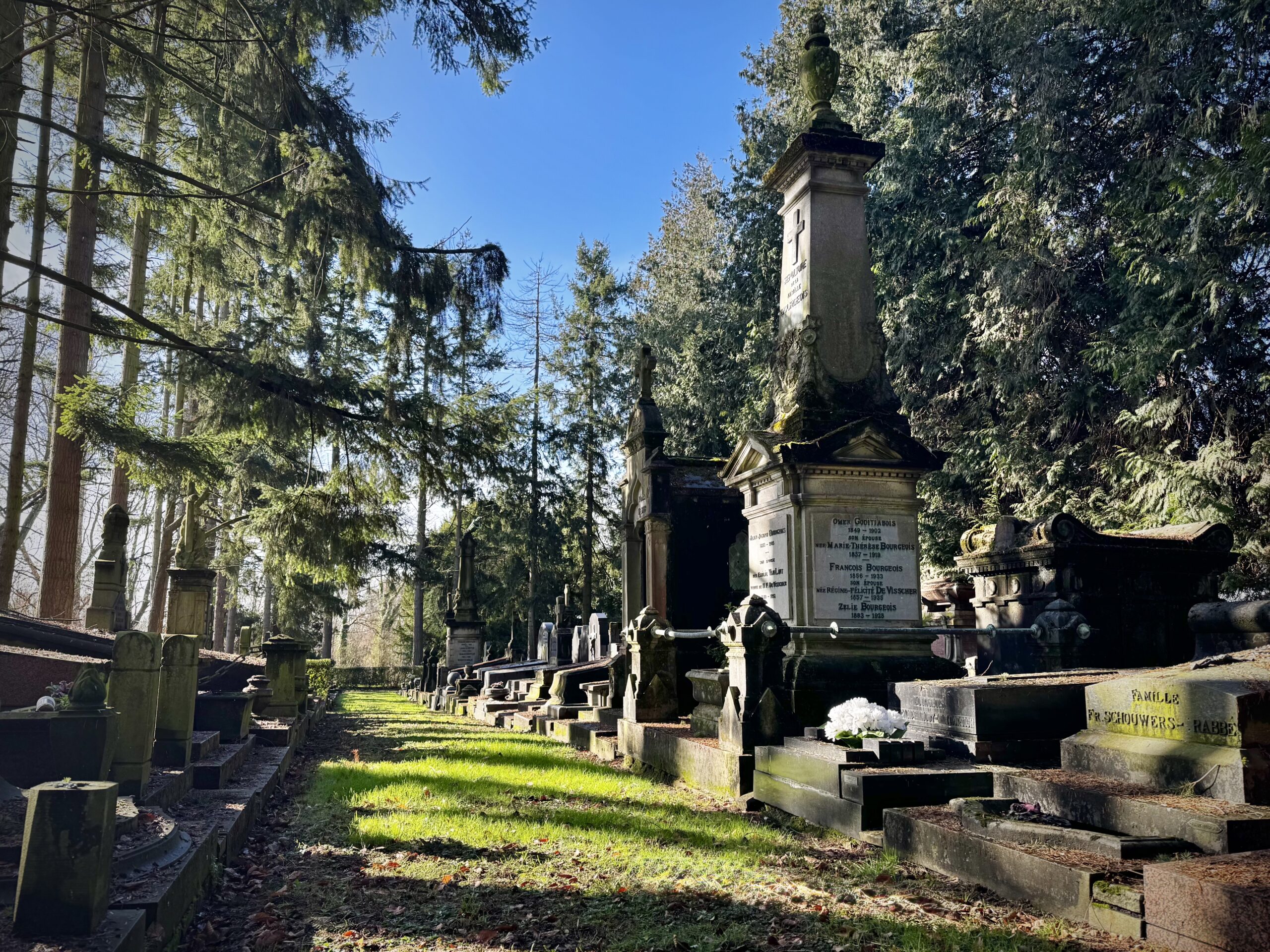
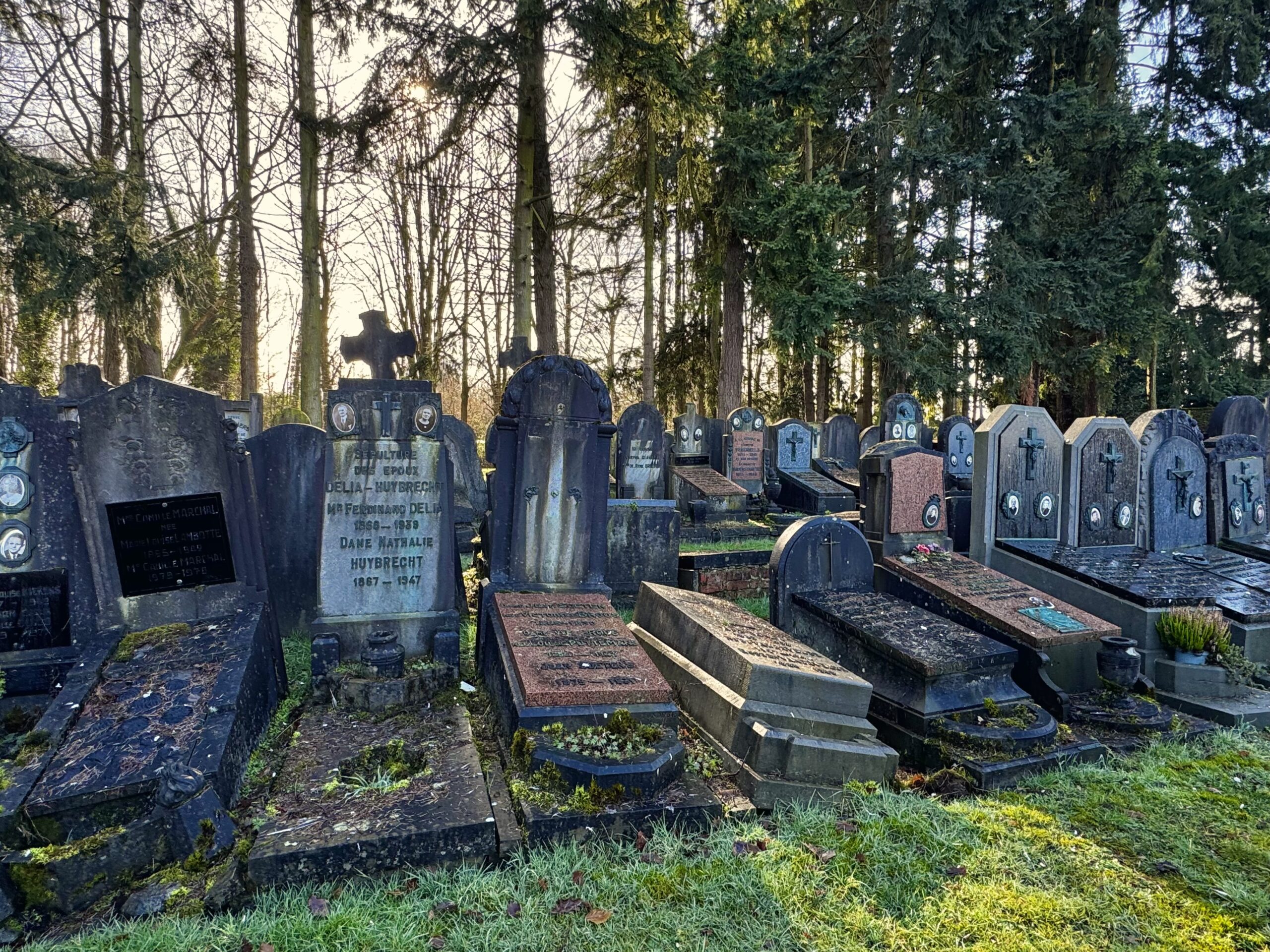
These transferred graves were not scattered randomly. Instead, they were grouped primarily at the rear of the cemetery, notably across lawns 61 to 64, forming what is described as a small “Père Lachaise” of Anderlecht. Here, the monuments from the old cemetery were reassembled into a kind of open-air gallery of funerary art, ranging from neoclassical obelisks to neo-Gothic chapels and more ornate eclectic structures.
Elsewhere, the cemetery was laid out with a more modern, ordered logic. The numbered lawns are bordered by hedges, with even and odd numbers flanking a central axis. This structured arrangement contrasts with the historic cluster at the rear, creating a dialogue between past and present: a curated memory of the old cemetery set within a rational, landscaped new one.
Here are some distinguished people, or people with unusual stories, who are interred there:
Constant Vanden Stock (1914–2008) contrived to have two entirely separate careers which materially affected Belgium’s two great passions: football and beer. Start with football. Constant was an Anderlecht youth player, was the Belgian national team coach in 1958, and became chairman of Anderlecht in 1971. It was during his 25-year tenure that Anderlecht reached its apogee.
A shadow hangs over him, however. In the 1984 European semi-finals against Nottingham Forest, opposition manager Brian Clough claimed vigorously that the referee was biased and had to have been paid off. One dodgy penalty and a last-minute disallowed goal let Anderlecht sail into the final.
Vanden Stock, of course, denied all malfeasance! However, his son, Roger, who took over from him not only discovered that the referee, Emelio Muro, had his hands crossed with silver to the tune of 1,000,000 Belgian francs (€25,000), but that his father was also being blackmailed about it. Roger, now expected to pay up, simply refused and went public.
Amid all this, Constant managed to change Belgian, and specifically Brussels’, taste in beer. He had inherited the Wiels brewery from his father. The speciality was gueuze, a sour brew, and he recognised that the taste for it was on the decline. He started making low-alcohol fruit flavoured lambics instead, bought up other fading breweries without his vision, moved the production to a larger Molenbeek facility, and finally sold out to InBev for an undisclosed sum.
Philippe Thys (1889-1971). Anyone who thinks that Belgian cycling was put on the map by Eddy Merckx will have to reckon with the ghost of Philippe Thys who won the Tour de France three times. His record stood from 1917 until 1963, when the great Jaques Anquetil won four times, and then the greatest of all, Merckx, topped them both. In 1913, Thys won despite having broken the fork of his bike and having to carry it to the nearest village to seek a bicycle repair shop. Times have changed! He broke his fork again, knocked himself out in the same fall, and was penalised for accepting help from his teammates to repair his bike. He still won by ten minutes.
Marius Renard (1869-1948) long-serving mayor of Anderlecht in the early 20th century, left a deep imprint on the commune’s civic and social development. His name endures locally – not least as the terminus of the 81 tram – and his burial among other municipal figures reflects his role in shaping modern Anderlecht.
Jean Van Lierde (1894-1945), not to be confused with Belgium’s first conscientious objector, who shared his name) is commemorated alongside fellow Anderlecht police officers Maurice Josée and Joseph De Vries, honoured as members of the Resistance and “victims of Nazi barbarity”.
Georges Moreau (1843-1919) was mayor of Anderlecht for 35 years, from 1884 to 1919, and is remembered through an imposing obelisk-shaped family monument. Encircled by chains and columns, it features the symbolic inverted torch – life extinguished yet hinting at resurrection.
Paul Ooghe (1899-2001). He contrived to live in three different centuries which, I contend, merits respect.
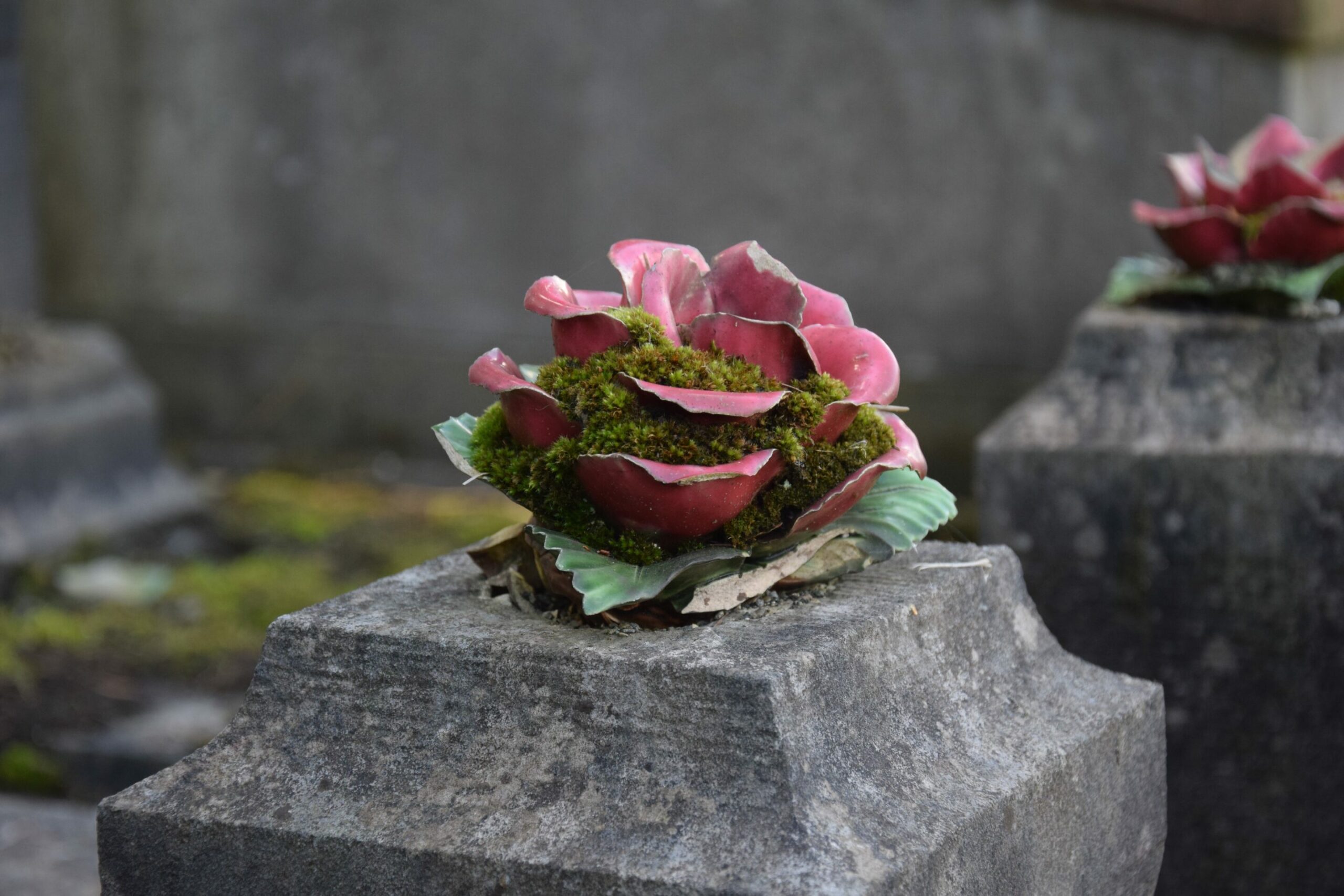
Anderlecht cemetery. Credit: The Brussels Times
Prosper-Henri Devos (1889-1914) was a novelist and translator into French. While working as a clerk for the commune he launched a magazine called La Belgique Française and translated Eduardo Marquina’s En Flandes se ha puesto el sol into French. He wrote two novels, Monna Lisa (sic) and Un Jacobin de l’an CVIII. He was described as promising but, like so many, his life was cut short by World War I. He died in November 1914, soon after the war started, hit by a stray bullet!
Patrice Braut (1970-2001) was an only child and, says his mother Paula, “adored by the whole family”. He attended Lycée Theadore Bracops, where he was described as, “if not the best or brightest pupil then the most tenacious.” Which is no small praise. He did better at university where he excelled at MBA level. He studied for his doctorate at Pace University in the States.
He landed a job with Marsh McLennan consultants and risk managers. He bought into the American Dream, and at an office Christmas party he danced all night with one Lupe Mendez. The next day she found a note on her screen in her midtown office saying she had left without saying goodbye. She felt like Cinderella! He took her back to Anderlecht to meet his Mum and Dad. He loved to cook, travel, play soccer, and photograph the Manhattan skyline.
The date of his death is September 11, 2001. He was on the 97th floor of the World Trade Centre that was hit by airplanes that day. He was the only Belgian who died in those horrors, although his employers, and of course their families, lost some 250 souls. The company was spread over ten stories where the planes hit and there was no exit. Everyone died. Marsh McLennan has endowed a scholarship for, not the best, but the “most tenacious” pupil at his Anderlecht Lycée.
Daniel van Damme (1893-1967) was a writer and intellectual from an artistic family. He assumed a modest position as secretary of the Anderlecht Historical Association. It was during his incumbency that he had the idea, “ex nihilo”, of founding a museum to Erasmus in the house in Anderlecht where the great humanist had stayed for a few months.
The building is one of the oldest in Brussels and is a truly magnificent example of Spanish-brick, Flemish-gothic style. Van Damme got his way and was the first curator of the new museum from 1930 to 1954.
Erasmus is one of the most influential thinkers of the Renaissance period. He rocked the Catholic church by satirising corruption and abuse of position, returned from Vulgate Latin to the original Greek of the New Testament, thus influencing the search for original documentation henceforth, and urged Christians to emphasise behaviour over ritual. His stay in the house was a matter of months, but he was six years at Leuven University where his influence was immense. He founded the trilingual college there (Greek, Latin and Hebrew) and was instrumental in the publishing of Thomas More’s Utopia.
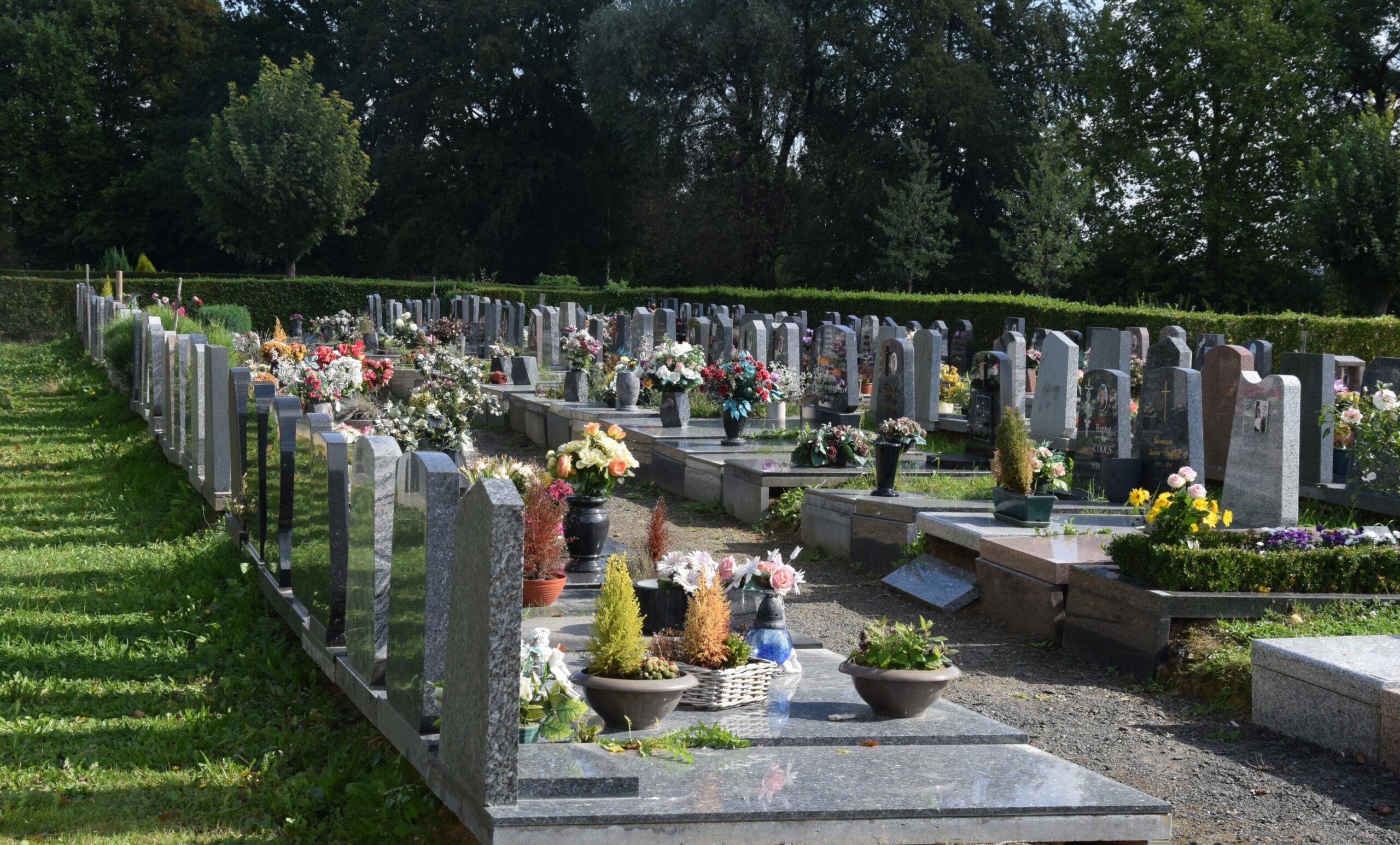
Anderlecht cemetery. Credit: The Brussels Times
Having been walking about for about two hours and drinking all this in, I feel pleasantly foot-sore, hungry and ready perhaps to drink in something other than knowledge. Belgium being Belgium there are three cafés outside the entrance. One is La Clef du Cimetière, one Millepertuis (quite witty: it is French for St John’s wort, the property of which is a reputed cure for depression!) and one with no name. I chose anonymity.
It is Brussels at its absolute best. As soon as you step in, you know you are in good hands: cheerful, cosy and serving quality home cooking. The patronne is smiling and authoritative; you wouldn’t mess with her. She gives an abstract bisou to most of those who came in. Regulars! Men kiss each other lightly on the cheek in a greeting denoting working-class francophones. The hubbub is genial but restrained.
I order a Lindeman’s Kriek for the first time in 52 years in this country. The man who put that beer on the map lays in eternal slumber not 100 steps from where I sit enjoying the good things of life. It just seems appropriate. When the beer arrives and is carefully poured – into a suitably branded glass of course – it is sweet and blissfully low in alcohol. The steaming platter which follows is as toothsome, unpretentious and copious as I knew it would be.
Vogelenzang, in all its infinite variety, has surely done me well! Now I am off to the eponymous metro station to see the bike upon which Eddy Merckx rode 49.431 kilometres in one hour, smashing the world record!
