
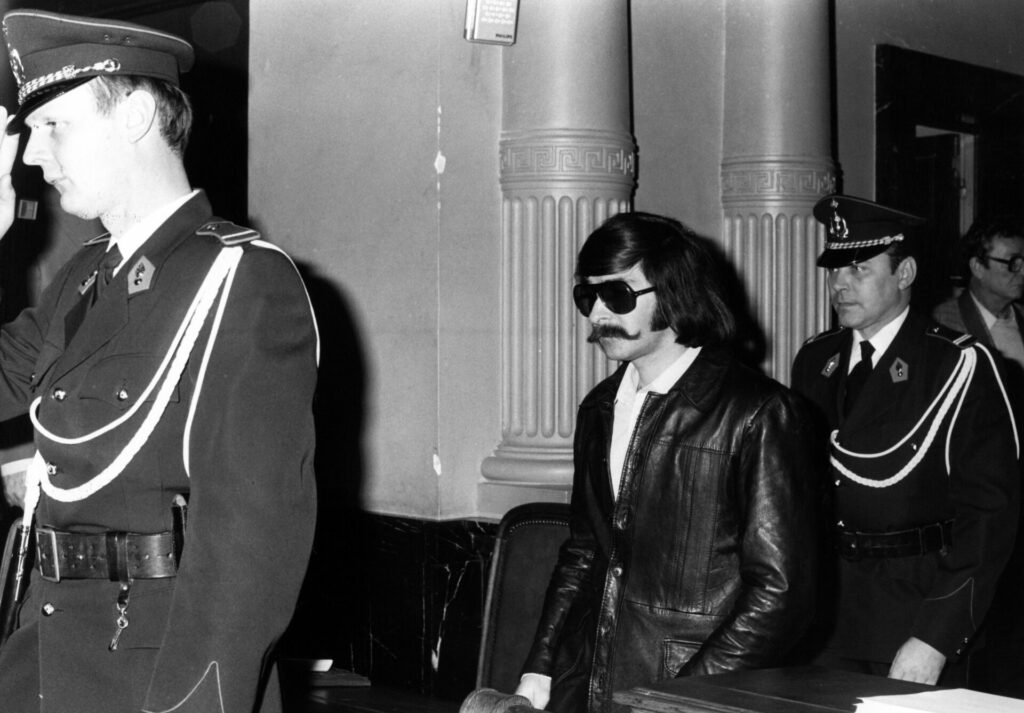
Freddy Horion, 78, who was sentenced to life imprisonment in 1980 for the murder of five members of a car dealer’s family and a shopkeeper, is to be fitted with an ankle monitor and admitted to a forensic care centre, announced the Ghent Sentence Enforcement Court (SURB) on Monday.
On 23 June 1979, Horion and his accomplice, Roland Feneulle, murdered five members of the Steyaert family in Sint-Amandsberg. In 1980, the Ghent Assize Court sentenced him to the death penalty, automatically commuted to life imprisonment, for six counts of murder, after he was also found guilty of the murder of a Polish shopkeeper in 1979.
Over the past 20 years, Horion had submitted several applications for release, but these were rejected each time. On 5 January 2018, a panel of experts ruled that continued imprisonment was no longer appropriate, but that an unprepared return to society would be too drastic.
The panel envisaged an interim solution as a transition to society in the form of a stay in a forensic psychiatric unit, but in practice, this proposal could not be implemented because forensic psychiatric institutions admit only inmates.
Horion’s lawyer initiated proceedings before the Court of Appeal in Antwerp and the European Court of Human Rights. In a judgment of 13 November 2023, the Court of Appeal ordered the Belgian State to admit Horion to an institution outside prison, but the Belgian State lodged an appeal in cassation against that judgment.
The Court of Cassation dismissed the appeal, which in theory meant that he had to be admitted to a facility outside the prison within a period of six months. The Court of Appeal attached a penalty payment of €1,000 per day of delay to this order.
According to his defence, that amount would now amount to around €750,000, but Horion has not yet claimed that sum.
'Residential setting necessary'
On 23 June 2025, the Ghent Sentence Enforcement Court granted Horion his first day-release permits, but only "with a view to arranging residential admission to a specialised centre".
In August, the Sentence Enforcement Court did note that steps had been taken to seek residential placement, but in October, electronic monitoring was rejected. Among other reasons, this was due to "the lack of a concrete, detailed rehabilitation plan and the associated risk of new serious criminal offences", with the SURB also referring to an "immature level of development" in Horion.
"In accordance with the advice of the panel of experts, the court consistently held that admission to a residential setting was necessary," the SURB stated in a press release regarding the judgments of June and August last year.
"In such an institution, work is carried out on the convicted person’s personality issues, and he is taught to deal with interpersonal relationships that are not as structured in the outside world as they are in the prison environment. This is essential to limit the commission of new serious offences," the press release said.

The funeral of the Steyaert family members who were killed by Horion. Credit: Belga Archives
At Beveren prison, the SURB considered a new application for electronic monitoring at the end of April. Johan Steyaert, the brother of Horion's victim Roland Steyaert, who opposes conditional release with or without an ankle monitor, was heard at the hearing. Horion himself was not present.
A new element was the fact that a former girlfriend of Horion had recorded 59 conversations with him, which allegedly revealed his ongoing frustrations with the justice system and society.
The West Flanders Public Prosecutor’s Office launched a criminal investigation but closed the case without further action. The Sentence Enforcement Court decided to request new information, and the case was heard again on 19 May and taken under advisement.
On Monday, the SURB decided to grant electronic monitoring after all, stressing that it is "subject to various strict conditions."
"For instance, he will have to strictly follow the treatment programme and adhere to the institution’s rules. A switch to an outpatient plan is only possible with the approval of the Sentence Enforcement Court," the SURB said. "A restraining order prohibiting contact with the victims and a regional restriction have also been imposed."
