
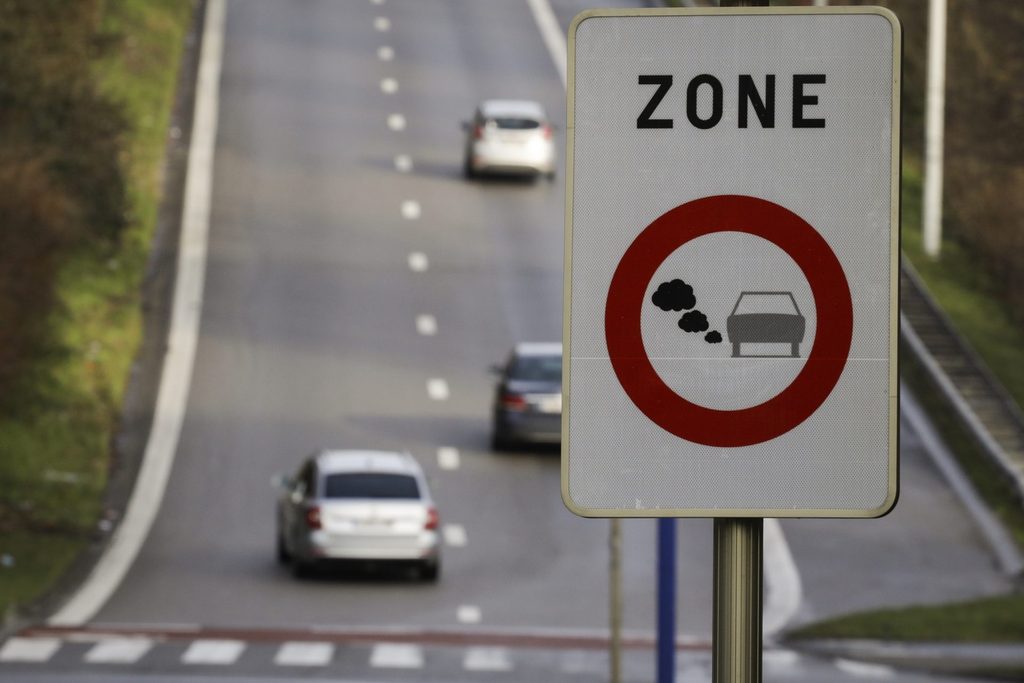
The debate over exemptions to Brussels' Low Emission Zone (LEZ) is becoming increasingly contentious as the deadline for new restrictions approaches.
Fines for drivers of Euro 5 diesel and Euro 2 petrol vehicles are due to take effect on 1 July, yet the Brussels government has still not reached an agreement on who should benefit from exemptions, according to L’Echo.
The issue follows a ruling by Belgium's Constitutional Court, which annulled a one-year postponement of the ban that had been adopted during the government's caretaker period.
Disagreement over exemptions
Regional Finance Minister Dirk De Smedt (Anders) recently confirmed that fines for non-compliant vehicles will begin on 1 July.
A temporary arrangement foresees a €350 fine that would automatically be converted into a one year access pass. Meanwhile, Environment Minister Ans Persoons (Vooruit) is expected to present a more permanent system by mid-June, including monthly fines of €80 and an annual pass costing €350, potentially reduced to €200 for vulnerable groups.
The main disagreement concerns the future exemption scheme. The Socialist Party proposes a full exemption for households containing at least one beneficiary of Belgium's increased healthcare reimbursement scheme, known as "BIM status".
These beneficiaries account for around 30% of the population of the Brussels-Capital Region. Under the PS proposal, one vehicle per eligible household would be exempt from LEZ restrictions.
Groen, however, considers this group too broad and fears that such a measure would undermine the environmental goals of the LEZ. Mobility Minister Elke Van den Brandt (Groen) wants a more targeted approach. One alternative being discussed would limit exemptions to BIM households with at least two or three dependants.
What about professionals?
Exemptions for professional users, a key demand of the MR party, are expected to be considered in 2027 but remain highly uncertain. Policymakers are still struggling to determine which professions should qualify, a debate that is likely to generate further political tensions.
According to figures provided by L’Echo, around 627,700 vehicles registered in Belgium fall under the 2025 LEZ restrictions.
Of these, 23,300 are registered in Brussels, including approximately 15,000 private cars. Authorities have already sent 13,219 warning notices this year. From 1 July onwards, drivers who continue to use non-compliant vehicles risk receiving fines.
What are LEZs and how effective are they?
LEZs are marked-out areas where certain vehicle categories are not allowed to enter – or only under certain conditions – because they are too polluting. Drivers entering an LEZ with a vehicle that is not permitted, or who do so without the necessary authorisation, will be fined.
The start and the end of the zone are also always demarcated with specific traffic signs. The LEZ is valid 24 hours a day, seven days a week.
Brussels introduced its LEZ in 2018 to tackle air pollution. It covers all 19 municipalities (see map), excluding the Ring Road (R0) and certain roads providing access to Park and Ride transit car parks (P+R). Vehicles that do not meet the LEZ access criteria can be parked here, and people can reach the city centre by public transport.
Among the main pollutants from road traffic emissions are nitrogen oxides. Between 2018 and 2024, the traffic emissions of these pollutants dropped by 55%, with nitrogen dioxide (NO2) concentrations falling by around 45%.
In the same period, the emissions of black carbon and fine particulate matter (PM2.5), which also pose health risks, dropped by 62% and 33%. The changes are calculated based on a constant volume of traffic.
The next stage of the LEZ restrictions in Brussels will begin in 2028, prohibiting Euro 6 diesel vehicles and Euro 3 petrol vehicles.
