

Europeans want greater digital sovereignty and a regulated, values-based approach to AI, with Belgian attitudes largely reflecting this attitude, a new poll has found.
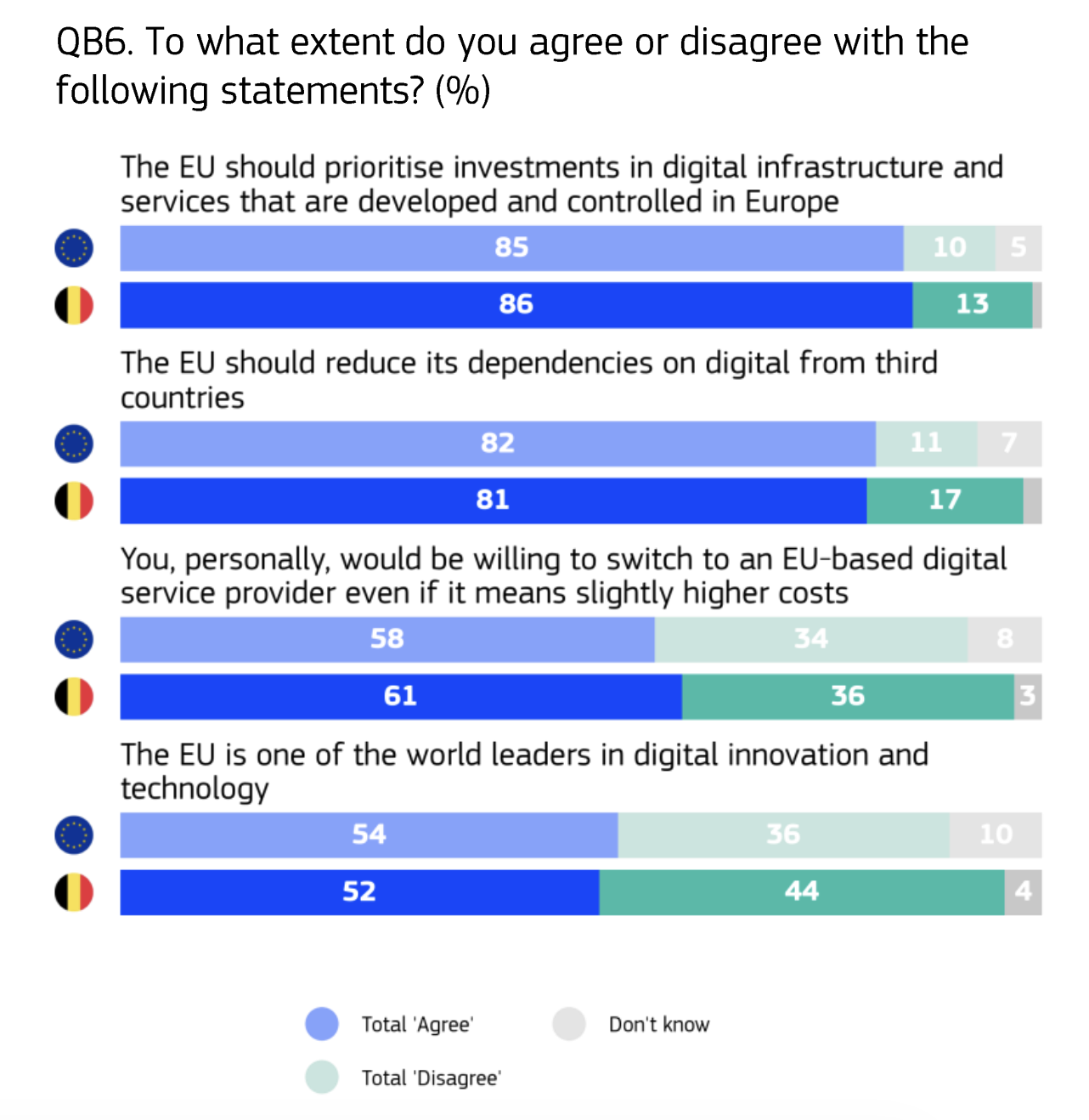
An overwhelming majority of EU citizens want European-controlled digital infrastructure (85%), while at the same time wanting to see a reduction in dependence on non-EU technologies (82%) from countries such as the United States and China, according to the EU’s new Digital Decade survey, released last week.
Pollsters asked citizens about their use of generative AI. It found that Belgians use AI slightly more than the EU average, with 25% of people using it every day in their personal life. Around 26% use it for work every day, compared to a 20% EU average.
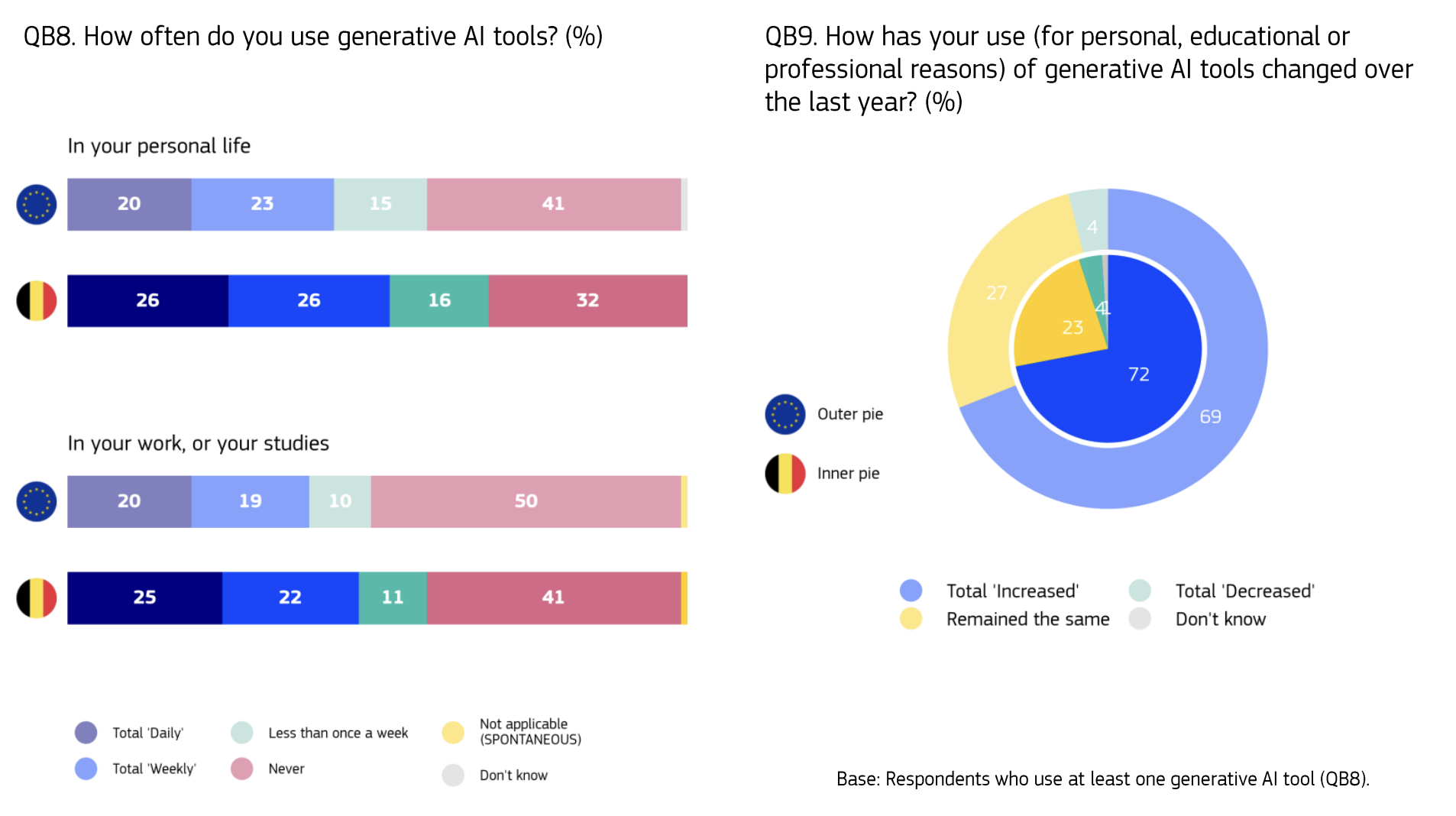
However, 41% of Belgians say they "never" use AI at work, compared to 50% in the EU. In their personal lives, 32% of Belgians responded negatively when asked about using AI.
Generative AI
Overall, generative AI use in the EU is growing, but adoption remains uneven, with Malta, Cyprus, Croatia, and Luxembourg among the most frequent users, while Portugal, Greece, France, and Romania tend to report lower use or higher non-use.
Indeed, a majority of Belgians, as with other Europeans, appear to be aware and willing to use AI as a tool, but are more critical when comes to regulation and its development.
When asked whether they agree with the statement,"The development of AI should be carefully regulated to ensure safety, even if this means that AI developers face some constraints," 80% of Belgians agreed, equalling the average across all EU Member States.
Only 18% of Belgians believe that the "development of AI should be allowed with as few restrictions as possible, even if this means some safety risks" – higher than the average among Europeans (15%).
Digital Decade 2026: Special Eurobarometer
On the most significant obstacle to using more generative AI, Belgians are most concerned about accuracy and incorrect information (40%). For Europeans on average, the biggest concern is over privacy or data protection (37%), a concern also shared by Belgian citizens (37%).
Belgians are considerably more worried (26%) about the environmental impact of these generative AI tools than other Europeans (20%).
Other concerns, which are roughly shared on average with other EU citizens, relate to ethical issues or misuse of AI tools; potential job losses; and "not seeing a need". There are also fears over how the tools are designed and their inherent biases.
Overwhelmingly, both Belgians and Europeans want the development of AI to be environmentally sustainable, but also geared towards improving public services, including healthcare, transport and education.
Citizens in the old continent also want AI to be developed, supporting EU companies to develop European-owned and controlled AI tools (74% for both Belgians and EU citizens) while also using it as a means to reinforce the EU’s competitiveness in the world.
However, Belgians (66%) were slightly less enthusiastic about greater AI control than Europeans (69%).

Illustration picture shows the ChatGPT artificial intelligence software, which generates human-like conversation, Friday 03 February 2023 in Lierde. Credit: Belga / Nicolas Maeterlinck
AI as a threat to democracy
The survey also confirmed a widespread European belief that online manipulation poses a huge threat to democracy. This includes the spread of disinformation, foreign interference, AI-generated content and deepfakes.
Among respondents, 90% of Belgians agreed that AI represents a threat to democracy, compared with an EU average of 87%.
The protection of children and young people online also remains a key concern, with 92% agreeing this must be prioritised.
Digital sovereignty
With up to 35% of AI companies based in the United States, there are also important conversations about digital sovereignty, with 82% of Europeans wanting to reduce dependence on non-EU technologies (82%).
This has become more urgent since Trump's return to office, which has seen US tech companies support his hostile approach towards the EU and its regulations.
Indeed, the survey found that more than half of Europeans (58%) would be willing to switch to an EU-based digital provider at a slightly higher cost. Reasons for this include greater security and reliability (50%) and better protection of personal data (49%), while consumer protection and reducing foreign dependencies were also deemed important.
Among Belgians, "security and reliability" was found to be the most important (46%) reason. Broader economic (i.e. competitiveness) or geopolitical reasons are less influential. Only 20% of Belgians said they would not consider switching at all.
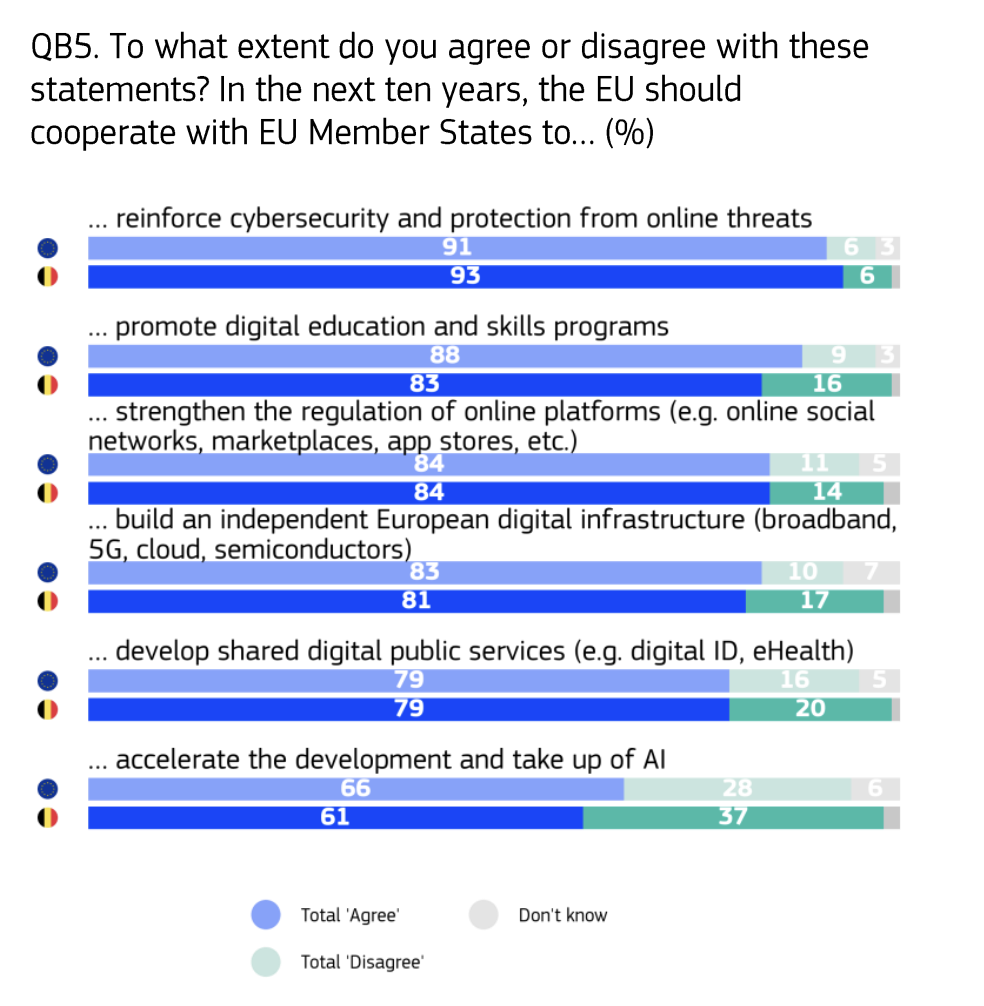
This was also reflected in Belgians believing the EU should work with its member states in reinforcing cybersecurity and protection from online threats (93%), compared to accelerating the development and take-up of AI (66%).
Digital Decade 2026: Special Eurobarometer
Commission omnibus
The survey comes just a day after the European Parliament approved changes to the landmark AI Act, which has angered campaigners who believe it will favour large US big tech companies that already dominate the market.
The changes include bringing in a postponement of some obligations for technology companies producing "high-risk" AI systems, which the EU says is to prevent legal uncertainty.
They also removed overlapping AI requirements for machinery products by clarifying that they only need to comply with the machinery sector's own safety laws, while "ensuring an equivalent level of health and safety".
A clearer definition of what qualifies as a "safety component" was also amended, meaning that products with AI functions that only assist users or optimise performance will not automatically face high-risk obligations.

“Fight for Us, Not for Trump's Billionaires!” projection on the Europa Building in the European Quarter, Brussels, Belgium, 17 June 2026. Credit: People vs Big Tech.
However, campaigners welcomed the EU ban on 'nudifying' tools and on AI-assisted creation of child sexual abuse material, effective from December 2026.
What does the EU think?
On Friday, a Commission spokesperson insisted that EU citizen concerns were being heard, as "the AI Omnibus brings simpler, innovation-friendly rules for AI."
"It sets a clear implementation timeline for the rules on high-risk AI systems, while also strengthening protection for citizens by prohibiting AI systems that generate non-consensual sexually explicit and intimate content or child sexual abuse material, such as AI ‘nudification’ apps," they told The Brussels Times.
The European Commission spokesperson also pointed to EU tech laws (DSA and DMA), which strengthen transparency, user protection online, tackle illegal and harmful content in the EU digital space, as well as ensuring fairer competition in digital markets.
However, not everyone is convinced by these efforts. A protest action was organised last Wednesday outside the European Commission by an NGO coalition– including Greenpeace International, People vs Big Tech, European Digital Rights (EDRi), and WeMove Europe – who sounded the alarm over Big Tech’s influence ahead of the EU summit.
"You cannot declare digital sovereignty with one hand and tear up its legal foundations with the other," said Ava Lee, Executive Director of People vs. Big Tech.
"The GDPR, the AI Act, and the ePrivacy framework are the rulebooks that protect citizens and give Europe control over its own digital future. Weaken them and the EU’s tech sovereignty package isn’t worth the paper it’s printed on".
