
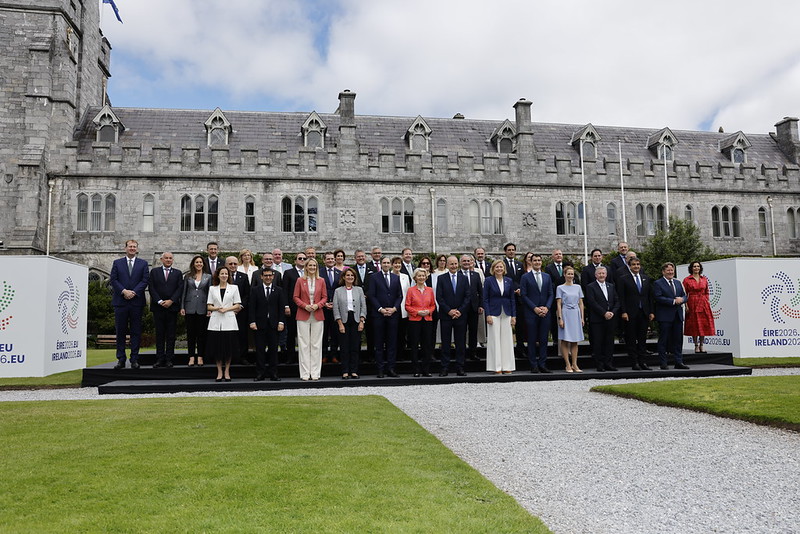
Ireland took over the rotating EU Presidency from Cyprus on 1 July and will chair it until 31 December 2026 under the motto ‘Strength with unity’, an old Irish proverb reflecting its history.
The official opening ceremony of the EU Presidency took place on 2- 3 July in Cork, the second-largest city in Ireland, and included a joint meeting of the Irish government and the European Commission’s College of Commissioners.
This is Irelands eighth EU Presidency, following the first one in 1975 after it joined the EU in 1973. It is also the first of a trio of Presidencies chaired by Ireland, Lithuania and Greece. The pre-established group of three member states collaborates over an 18-month period to maintain institutional continuity and drive a shared agenda across the Council of the European Union.
The 2026 Presidency will be the first Irish Presidency since Irish became a fully-operational working language of the EU in January 2022. The Irish Presidency intends to demonstrate the Union’s commitment to linguistic diversity by integrating Irish into Council business, official communications and cultural events.
Technically Irish gained official working status back in 2007 but a limit to its use was in place due to a shortage of translation staff and technical tools. In Ireland, where Irish is the national language and the first official language, with English as second official language, only an estimated 40% of the population can speak some Irish and it has not been revived to become a daily spoken language of all.
As previously reported, ever since 1952, a member of what is now the European Union has chaired meetings of Council of the European Union. Ever since 1958, these presidency holders have served for a full six months, setting the agenda of legislative work in the institution and playing the role as an honest broker in negotiations with other bodies of the EU.
But it also gives the country who is in charge the chance to set the tone of the meetings and to focus on priorities that are important to its national interests. Ministers from the Presidency holder will chair meetings of certain council summits and get-togethers, and represent the council during behind-closed-door talks. Journalists will have to make an effort to get access to council documents.
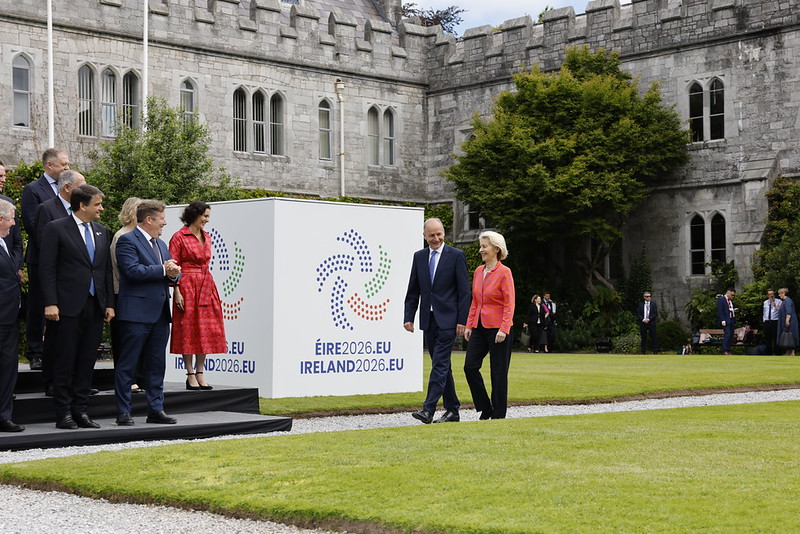
At the meeting in Cork, the Taoiseach (Prime-Minister) Micheál Martin, the Tánaiste (Deputy Prime-Minster) Simon Harris, and the Minister for Foreign Affairs and Trade, Helen McEntee, along with government colleagues, welcomed the President of the European Commission, Ursula von der Leyen, and the College of Commissioners.
“We have a clear set of priorities and are ambitious for what we can achieve,” the Taoiseach said in his welcome speech. “The European Commission is a key partner and I look forward to working with President von der Leyen and the College of Commissioners to deliver our Presidency programme over the next six months.”
“We do so at a critical time for the EU, with greater uncertainty and unpredictability in the world. We commit to doing a good job for the EU and its citizens, and we will work throughout our term to make the Union more prosperous and more secure, and to uphold our shared fundamental values.”
At the joint press conference with von der Leyen, the Taoiseach described the meeting with the Commission as “businesslike” covering the broad range of Presidency objectives in terms of competitiveness, enlargement, budget, security and defense.
A Commission source told The Brussels Times that the Irish came across as professional, prepared and pragmatic. “The 6-month agenda was mapped out with clear and ambitious milestones, and all Minsters presented their briefs confidently and in detail. Expectations are high that Ireland will deliver a strong set of results.”
Programme on three pillars
The Irish programme is built on three pillars, Competitiveness, Values and Security, with a breakdown according to Council configurations (policy areas). Referring to 2026 as the ‘European year of competitiveness’, the Taoiseach pledged that Ireland will work to deliver the ‘One Europe, One Market’ Roadmap. “This will be a real priority for the Irish Presidency.”
The competition agenda includes the following actions: Simplifying regulation for businesses and citizens, deepening the single market, championing fair and open trade, reducing energy prices, decarbonising the economy, and driving the AI and digital transformation.
As regards values, the programmes states that central among the fundamental rights and values of the EU is the protection and well-being of children. It will be a key priority of the Irish Presidency to strengthen in particular the safety of children online, by “robust, privacy-preserving age verification measures”.
In fact, an expert working group is already working on this and the results are expected later this month, to be followed by a Commission legislative proposal. Other value issues, such as the Commission’s proposal for EU-wide recognition of European Parenthood, which previous Presidencies did not manage to pass through, was not mentioned.
Another issue which is hardly mentioned in the programme concerns animal welfare where the revision of EU’s outdated legislation for farmed animals has been stalled until now.
The programme states that, “Animal welfare in livestock systems will remain central to the discussions, reflecting societal expectations and the need to maintain a high standard across the Union. The Irish Presidency will emphasise that animal welfare rules must be firmly based on scientific and technical knowledge, as well as drawing on the experiences and good practices of Member States.”
On foreign affairs, the programmed stressed that, “We live in a time of increased threat and conflict. The EU needs to work harder to protect our citizens, our democracies and our European way of life. We will continue to offer unwavering support to Ukraine, whose people have shown such courage and determination in defending their country. They deserve a just and lasting peace.”
The Irish Presidency also writes that it will work to ensure that the EU makes a meaningful contribution to global peace and security, including in the Middle East. Ireland regards itself as a country with experience of peacebuilding following what it describes as the successful peace process in Northern Ireland. Admittedly, this process reflected the unique circumstances in Ireland.
Credit: Irish EU Presidency
The Irish loophole
An embarrassing question was raised during the joint press conference. It concerned the export of raw material (alumina) from the Aughinish Alumina plant in Limerick, Europe’s largest alumina refinery, to Russia for the production of aluminum. The metal is used in its weapons industry.
An investigation carried out by the Organized Crime and Corruption Reporting Project (OCCRP) and its partners, including Irish Times, found that the Irish facility has sent more than half of its alumina exports to Russian smelters owned by its parent company, the Russian aluminum giant Rusal, since 2023.
Rusal’s founder and former top shareholder is an oligarch who has been sanctioned by the EU for his alleged involvement in companies working with the Russian defense sector. However, a loophole in EU’s sanctions packages only banned the import of Russian aluminum but did not restrict the export of alumina to Russia.
During his visit to Dublin before the start of the Irish EU Presidencey, Ukrainian President Volodymyr Zelenskyy met with the Irish leadership and publicly urged Ireland to shut down the trade loophole, stating that "every tonne of raw material that ends up in Russia is used against us."
When the investigation was first published on 24 March, the European Commission did not respond to requests to comment. At the press conference, the Irish Prime Minister said the Irish Enterprise, Trade and Employment ministry is currently carrying out an investigation. It is expected to be concluded within weeks when the findings will be shared with the Commission.
Commission President von der Leyen commented that it is up to Ireland to lead the investigation and did not address the loophole in the sanctions against Russia.
